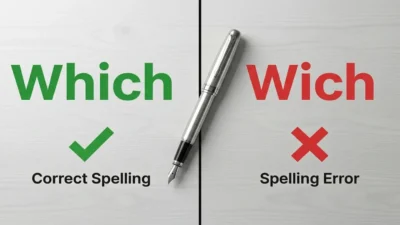
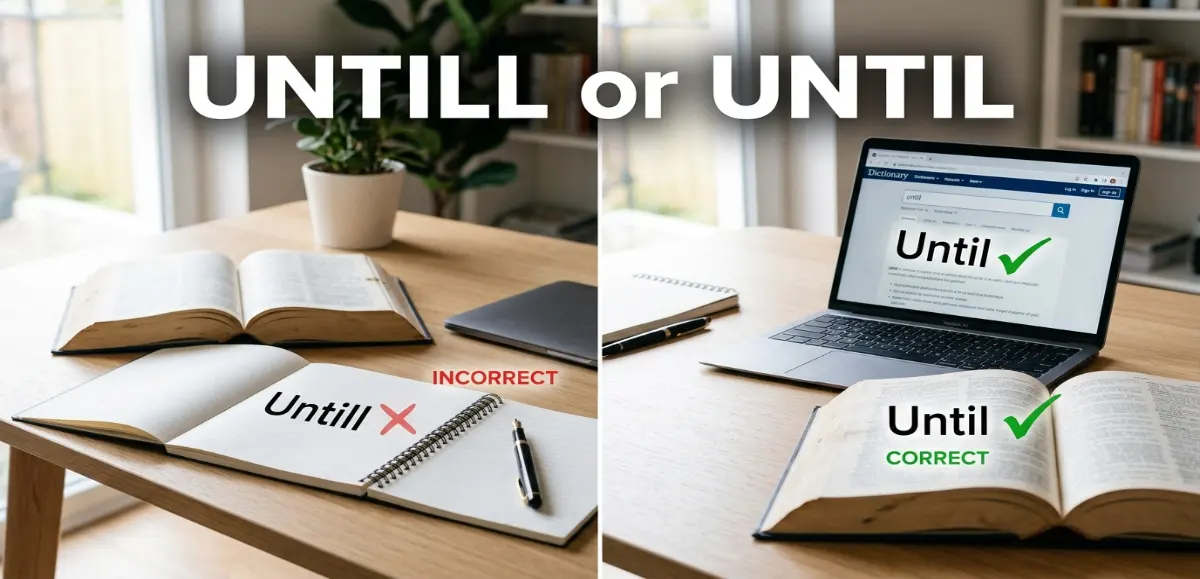
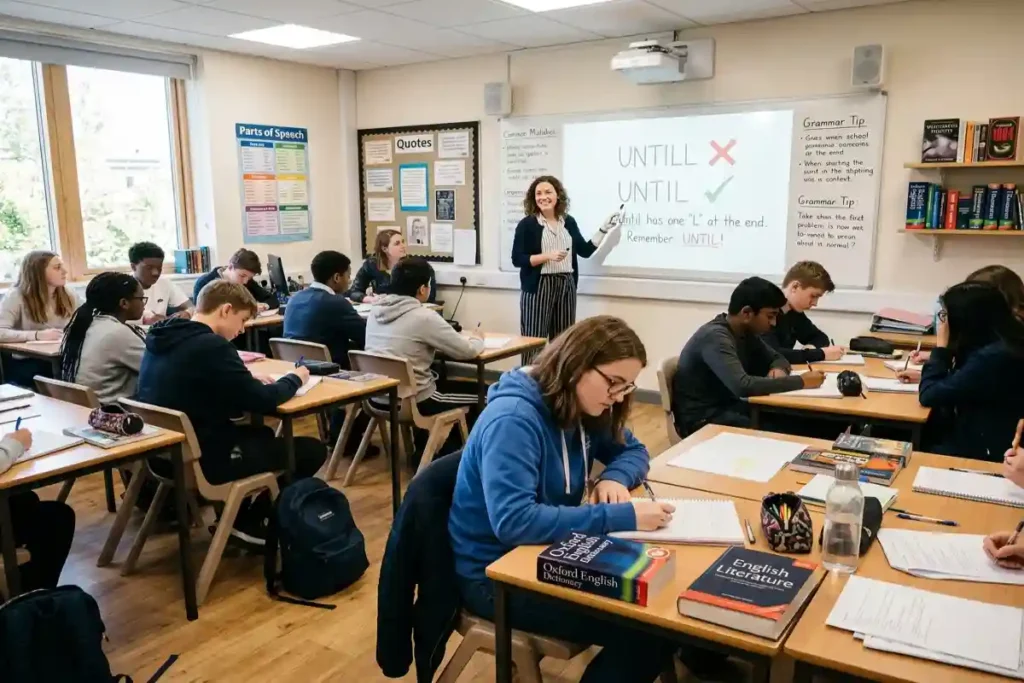
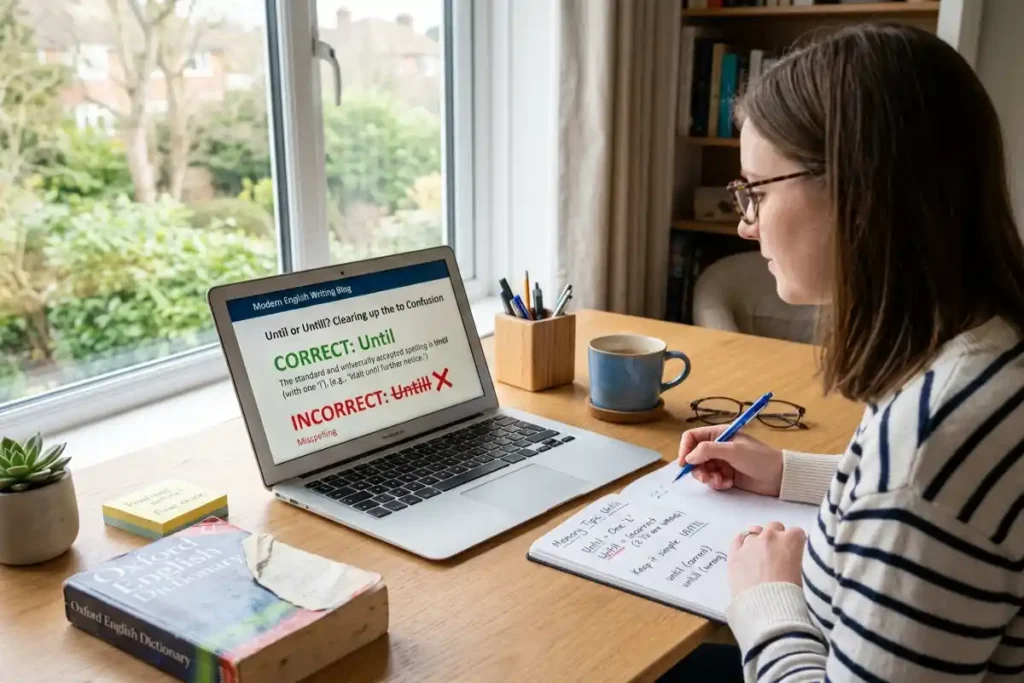
If you’re wondering about untill or until, the correct spelling is until. The word has only one l at the end. Untill is a common spelling mistake, but it isn’t the standard spelling in modern English.
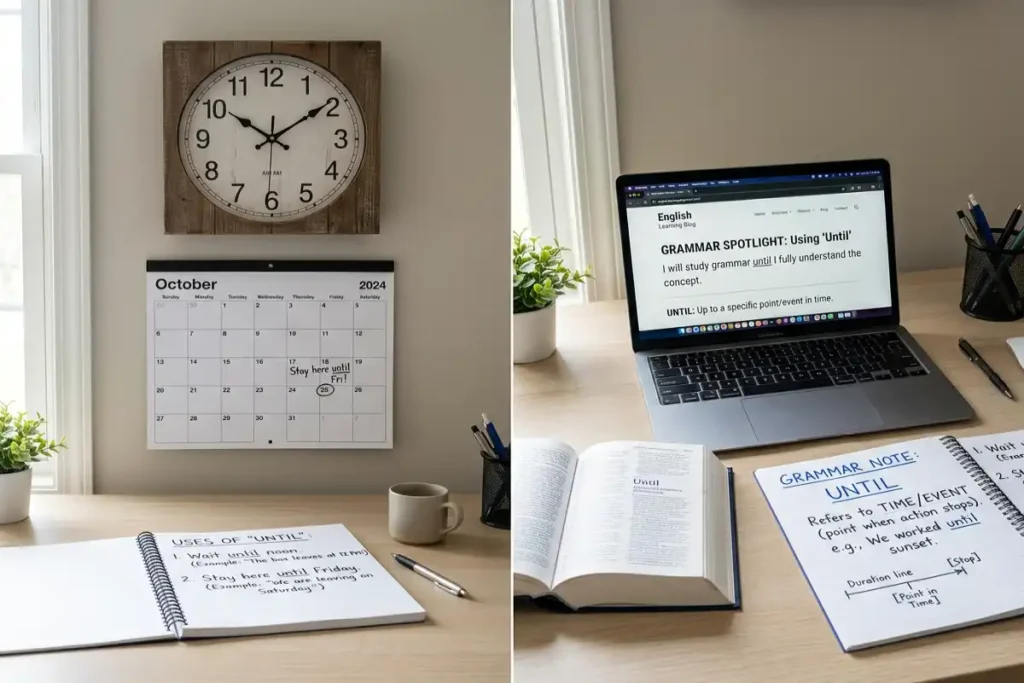
You use until when you want to show that something continues up to a certain time or event. For example, I will wait until Friday means the waiting continues up to Friday. You can also say Wait until I get home when the endpoint is an event instead of a specific time.
The extra l is easy to add because English has many familiar words that end in ll, including still, will, full, and till. The word till can cause extra confusion because it has two l letters, even though until has only one.
This guide explains the correct spelling, the meaning of the word, how to use it in real sentences, and the difference between until, till, by, before, since, and other time words. You’ll also find common mistakes, memory tricks, and examples that make the spelling easier to remember.
Quick Definition
Until means up to a particular time or event. It can be used before a time expression, noun, or complete clause, as in until noon, until Friday, or until she arrives.
Untill is a misspelling. In standard modern English, use until with one l.
Direct Answer
Until is the correct spelling. Untill is incorrect in standard modern English because the word ends with only one l.
Until And Untill Compared
| Word | Meaning | Example Sentence | When to Use It |
|---|---|---|---|
| Until | Up to a particular time or event | I will wait until noon. | Use this spelling in standard English |
| Untill | No standard modern use as this time word | I will wait untill noon. | Do not use it |
The spelling difference comes down to one letter. The correct form is until, not untill.
A useful sentence to remember is:
I will wait until you arrive.
If you can remember that sentence, you can remember the spelling.
Why The Spelling Is So Easy To Get Wrong
The mistake doesn’t happen because the word is difficult to pronounce. It happens because the spelling looks as if it could follow several familiar patterns.
English has many common words ending in two l letters:
still
will
full
fall
call
spill
skill
When you’re typing quickly, your brain may expect until to follow the same pattern. That can lead to untill.
There is another source of confusion. The word till is also used to mean up to a particular time. Since till ends in two l letters, it can make the spelling of until feel less obvious.
For example:
Wait until Friday.
Wait till Friday.
Both sentences are possible, but the words are spelled differently.
The correct spellings are easy to separate once you stop treating them as parts of the same spelling pattern.
Until = one l.
Till = two l letters.
That small difference is worth memorizing because both words appear frequently in everyday English.
The Correct Spelling Rule
There isn’t a complicated spelling rule you need to apply every time you write this word.
Simply remember that until ends in one l.
The letters are:
U N T I L
There is no second l after the final letter.
Incorrect:
U N T I L L
Correct:
U N T I L
If you often make this mistake, write the word several times:
until
until
until
until
until
After seeing the correct form repeatedly, the unusual single l ending starts to look natural.
You can also use a short memory phrase:
Until needs one l.
That’s enough.
What Does Until Mean
Until describes something that continues up to a particular point.
That point can be a time:
I worked until midnight.
It can be a day:
She stayed until Monday.
It can be a date:
The application is open until June 15.
It can be an event:
Wait until I call you.
It can also be the end of another action:
We stayed until the movie ended.
In every case, the word points to an endpoint.
Think of a timeline:
Start → continuing action → until → endpoint
For example:
9 a.m. → work → until → 5 p.m.
The work continues from the starting point up to 5 p.m.
That is the basic idea behind the word.
How To Use Until With Time
One of the most common uses is to show the time when something stops.
For example:
The store is open until 9 p.m.
This tells the reader that the store remains open up to the stated time.
More examples include:
I will stay until six.
She worked until midnight.
We waited until noon.
The library is open until Friday.
He stayed awake until two in the morning.
The word doesn’t need a complicated sentence around it. It simply identifies the endpoint.
You can use exact times or general periods:
until 5 p.m.
until noon
until midnight
until tomorrow
until next week
until the morning
The meaning remains the same. Something continues up to that point.
Until With Days And Dates
You can use until before a day or date when you want to show how long something continues.
For example:
I will be here until Friday.
The sale continues until Sunday.
You have until Monday to submit the form.
The office will remain closed until June 10.
She plans to stay until Christmas.
These sentences are common in everyday speech, business writing, announcements, and website content.
If a deadline is important, giving an exact date is often clearer than using a general expression.
For example:
The application is open until September 30.
That gives the reader a clear endpoint.
Until With Events
Until doesn’t always come before a clock time or date.
You can also use it before an event.
For example:
Wait until I arrive.
Don’t leave until she calls.
Stay here until the rain stops.
We talked until the restaurant closed.
He didn’t leave until his friend arrived.
In these sentences, the event provides the endpoint.
The basic structure is:
action + until + event
For example:
Wait until I arrive.
The waiting continues, and the arrival provides the point at which the situation changes.
This structure is extremely common in spoken and written English.
Until As A Preposition
Until can function as a preposition when it comes before a noun or a time expression.
For example:
We waited until noon.
She worked until midnight.
The office is closed until Monday.
He lived there until 2020.
In these examples, noon, midnight, Monday, and 2020 identify the endpoint.
You don’t need to memorize the grammar label to use the word correctly. The useful point is that until can come directly before a time, date, or similar noun phrase.
Until As A Conjunction
Until can also connect one part of a sentence to another clause.
For example:
Wait until I arrive.
Don’t start until everyone is ready.
We stayed inside until the rain stopped.
She didn’t understand until her teacher explained it.
Here, the word connects the main part of the sentence to a clause containing a subject and verb.
Some common patterns are:
until I arrive
until she calls
until he finishes
until they leave
until the store opens
until the rain stops
This is another reason the word appears so often in everyday English.
Until In Negative Sentences
Until often appears with negative verbs.
For example:
I didn’t know until yesterday.
She didn’t call until noon.
He didn’t arrive until Friday.
We didn’t understand the problem until later.
These sentences often emphasize that something happened later than expected.
Consider:
She arrived at noon.
Now compare:
She didn’t arrive until noon.
The second sentence gives more information. It tells us that she had not arrived before noon.
This is why not until is such a useful structure.
How Not Until Works
Not until means not before a particular time or event.
For example:
I didn’t leave until noon.
This means I stayed until noon and left at that point.
Another example:
She didn’t call until Friday.
This tells us that the call did not happen before Friday.
You can also use the structure with events:
He didn’t understand the problem until his teacher explained it.
The understanding happened after the explanation.
More examples:
We didn’t find the missing book until the next morning.
She didn’t realize the mistake until she checked the report.
They didn’t announce the result until the meeting ended.
I didn’t hear about the change until yesterday.
This pattern is common in both casual and formal writing.
Until And By
One of the most useful distinctions to learn is the difference between until and by.
Until describes a period that continues up to a point.
By usually describes a deadline.
Compare these sentences:
I will work until 6 p.m.
I will finish the report by 6 p.m.
The first sentence says the work continues up to 6 p.m.
The second says the report will be finished no later than 6 p.m.
Another example makes the difference clearer:
She stayed until Friday.
This tells us how long she stayed.
She left by Friday.
This tells us the latest point at which she left.
You can also write:
You have until Friday to apply.
And:
You must apply by Friday.
These sentences can describe the same deadline, but they focus on different parts of the situation.
Until focuses on the time available.
By focuses on the deadline.
Until And Till
Until and till can have the same basic meaning.
For example:
I will wait until noon.
I will wait till noon.
Both mean that the waiting continues up to noon.
Till is a standard English word. It isn’t simply a mistake.
You might hear:
Wait till I get there.
I won’t be home till six.
She stayed till the end.
These are natural sentences.
Still, until is often the safer choice for formal writing. It works naturally in academic papers, professional emails, reports, articles, and other polished content.
The key point for spelling is this:
Until has one l.
Till has two l letters.
Don’t transfer the spelling of one word to the other.
Is Till Less Formal
Till is common in everyday English and isn’t automatically incorrect or poor English.
For example:
Wait till tomorrow.
That sounds completely natural in conversation.
However, many writers prefer until in formal or professional writing because it has a more neutral tone.
For example:
The office will remain closed until Monday.
This fits naturally in a business announcement.
You don’t need to avoid till in all situations. Just know that until is the more broadly useful choice when you want a formal, standard tone.
Until And Before
Until and before are related to time, but they don’t mean exactly the same thing.
Compare:
Wait until noon.
Wait before noon.
The first sentence tells someone to continue waiting up to noon.
The second suggests a time earlier than noon and can sound incomplete or less natural depending on the context.
Another pair shows the difference:
Don’t leave until I arrive.
Don’t leave before I arrive.
These sentences are close in meaning, but until emphasizes the point when leaving becomes possible.
Before simply says that leaving shouldn’t happen earlier than the event.
When you want to describe an action continuing up to an endpoint, until is usually the clearer choice.
Until And Since
Until and since point in opposite directions on a timeline.
Until points toward an ending point.
Since points back to a starting point.
Compare:
I lived there until 2020.
I have lived here since 2020.
The first sentence describes something that ended in 2020.
The second describes something that started in 2020 and continues into the present.
This difference is useful when talking about past and present time.
You can think of it this way:
Until = ending point.
Since = starting point.
Until And For
For describes duration.
Until describes an endpoint.
Compare:
I waited for two hours.
I waited until noon.
The first sentence tells us the length of the waiting period.
The second tells us when the waiting ended.
You can use both in one sentence when you need both pieces of information:
I waited for two hours until noon.
The sentence says the waiting lasted two hours and ended at noon.
This distinction can help you choose the right time word instead of treating all time expressions as interchangeable.
Until And During
During places an action inside a period.
Until gives an endpoint.
Compare:
I worked during the afternoon.
I worked until 5 p.m.
The first sentence says when the work happened.
The second says when the work stopped.
You might also write:
She studied during the evening.
She studied until midnight.
Again, the first focuses on the period. The second focuses on the ending point.
Until And Through
Until and through can sometimes describe similar time periods, especially when talking about schedules.
For example:
The sale continues until Friday.
The sale continues through Friday.
The second sentence usually makes it clearer that Friday is included in the period.
This can matter for business hours, promotions, deadlines, and events.
For example:
The office will be closed through Friday.
This normally means Friday is included in the closure.
The office will be closed until Friday.
This can suggest that the closure ends when Friday arrives.
If the exact timing matters, give the specific day and time.
Clear dates are often better than leaving the reader to guess.
Common Phrases With Until
You probably see until in many fixed phrases without thinking about the spelling.
Some common examples include:
until then
until now
until today
until tomorrow
until later
until Monday
until recently
until further notice
until the end
until the last minute
not until
wait until
stay until
work until
continue until
Learning these phrases can make the correct spelling easier to remember because you begin to recognize the word as a whole.
Until Then
Until then means up to the time that has already been mentioned.
For example:
The meeting is next Monday. Until then, please review the documents.
The phrase refers back to next Monday.
You can also say:
I’ll see you next week. Until then, take care.
Here, until then refers to the next meeting or visit.
It is a natural phrase in both conversation and writing.
Until Now
Until now means up to the present time.
For example:
I didn’t know that until now.
Until now, everything had gone smoothly.
She had never seen snow until now.
The phrase often suggests that something has changed or that new information has just become available.
For example:
Until now, the company had only served local customers.
This tells the reader that the situation is different at present.
Until Today
Until today means up to the day being discussed.
For example:
I had never heard that story until today.
Until today, the store had been closed on Sundays.
She had never used the software until today.
The phrase works best when the current day represents a change or a new experience.
Until Tomorrow
Until tomorrow means up to tomorrow.
For example:
The office is closed until tomorrow.
I will stay here until tomorrow.
We don’t need to decide until tomorrow.
The word still has the same basic function. It marks the point when the current situation ends or changes.
Until Further Notice
Until further notice is a common phrase in formal announcements.
It means something will continue until a new instruction or announcement is provided.
For example:
The road is closed until further notice.
The service is suspended until further notice.
The office will remain closed until further notice.
This phrase appears often in public notices, business communications, transportation updates, and official statements.
Until Recently
Until recently means up to a fairly short time ago.
For example:
Until recently, I lived in Boston.
The store was open until recently.
Until recently, the company had no online store.
It tells the reader that the situation changed not long ago.
Until The End
Until the end means that something continues through the ending point.
For example:
She stayed until the end of the movie.
He worked until the end of the day.
They remained together until the end.
This is another common phrase worth remembering.
Notice the spelling:
until
not:
untill
Until The Last Minute
The phrase until the last minute describes something that continues almost to the final possible moment.
For example:
We waited until the last minute to book the tickets.
She kept working until the last minute.
He didn’t make a decision until the last minute.
This phrase is common in everyday English and often describes delays or late decisions.
Until I Arrive
The pattern until + subject + verb is especially common.
For example:
Wait until I arrive.
You can change the subject:
Wait until she arrives.
Wait until he calls.
Wait until they finish.
Wait until the teacher arrives.
Wait until the store opens.
The word itself never changes.
The spelling remains until no matter what comes after it.
Until It Ends
Until can introduce an event that marks the endpoint.
For example:
Stay here until it ends.
Keep waiting until it stops.
We watched until the movie ended.
Don’t leave until the meeting is over.
These sentences all follow the same basic idea.
Something continues until another event happens or reaches completion.
Until It Is Finished
This pattern is common when talking about tasks and projects.
For example:
Keep working until it is finished.
Don’t stop until the job is finished.
We stayed until the project was finished.
She waited until the work was finished.
The endpoint isn’t a clock time. It is the completion of an action.
This is one reason until is so useful. It can connect an action to many kinds of endpoints.
Common Spelling Mistakes With Until
The most common error is simply adding one extra l.
Incorrect:
I will wait untill Friday.
Correct:
I will wait until Friday.
Another example:
Incorrect:
The store is open untill nine.
Correct:
The store is open until nine.
And:
Incorrect:
Don’t leave untill I call.
Correct:
Don’t leave until I call.
The mistake doesn’t change the meaning of the sentence, but it makes the spelling incorrect.
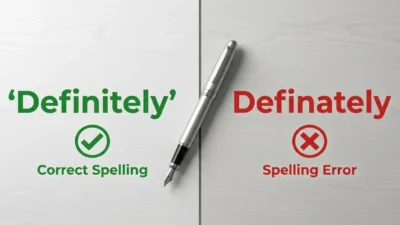
For more help with spelling words that look or sound confusing, you can also read How to Spell Definately. The same basic lesson applies: a word can look logical and still have a spelling that needs to be memorized.
Why Spellcheck Isn’t The Whole Solution
A spelling checker will often flag untill, which is helpful.
But spellcheck isn’t enough to make writing accurate.
A sentence can contain correctly spelled words and still have a grammar or word choice problem.
For example:
I will finish the report until Friday.
The spelling of until is correct, but the sentence may not express the intended meaning. If the writer means the report will be completed no later than Friday, by Friday may be better.
This is why proofreading should check more than individual letters.
Look at:
Spelling.
Meaning.
Grammar.
Word choice.
Sentence structure.
Punctuation.
A good writer doesn’t just ask, Is this word spelled correctly?
The writer also asks, Does this word express what I mean?
Until In Formal Writing
Until is completely acceptable in formal English.
You can use it in:
Academic papers.
Business reports.
Professional emails.
News writing.
Research articles.
Website content.
School assignments.
Official notices.
For example:
The application period remains open until September 30.
The results will not be available until next week.
The committee will meet until all issues have been reviewed.
The project cannot begin until approval is received.
There is no need to replace until with a more complicated word.
It is short, clear, and widely understood.
Until In Business Writing
Businesses frequently use until when discussing deadlines, schedules, offers, and opening hours.
Examples include:
Customer support is available until 8 p.m.
The offer is available until Friday.
Orders can be placed until midnight.
The promotion runs until the end of the month.
The office will remain closed until Monday.
In this type of writing, a spelling mistake can stand out because readers expect business information to be clear and polished.
If a page contains untill several times, readers may question the quality of the rest of the content.
Until In Academic Writing
Students use until when writing about time, research periods, historical events, and study results.
For example:
The researchers continued the study until June.
The participants were observed until the end of the experiment.
The students did not receive the results until the following week.
The project remained incomplete until additional funding was provided.
The spelling is the same in every academic context.
If you’re proofreading an essay, search for untill and replace it with until.
Until In Website Content
Website writers use until in many practical situations.
It appears in:
Opening hours.
Sales.
Promotions.
Event dates.
Registration periods.
Application deadlines.
Service announcements.
Availability notices.
Shipping information.
For example:
Register until Friday.
The offer remains available until midnight.
The store is open until 10 p.m.
The event runs until Sunday.
Because website visitors often scan rather than read every word, clear language matters. A simple spelling mistake can make a page feel less trustworthy.
Related American And British Spelling Differences
Until itself does not have a standard American versus British spelling difference. American English and British English both use until.
That makes it different from words such as armor and armour, where American English normally uses armor and British English normally uses armour. If you’re studying regional spelling differences, Armor or Armour is a useful comparison.
Another example is Analyzing or Analysing. American English normally uses analyzing, while British English commonly uses analysing.
These examples show why you shouldn’t assume that every spelling difference follows the same pattern.
Until is spelled the same way in both varieties.
Until And Other Spelling Questions
English has many words where one extra letter creates an incorrect spelling.
For example, Smoothe or Smooth deals with an extra e that people sometimes add to the end of smooth.
The same type of mistake appears in until. The writer knows the word but adds a letter that doesn’t belong there.
Another example is Focussed or Focused, which is more complex because both forms have usage in English varieties, unlike the incorrect untill.
The important lesson is that spelling questions need to be handled word by word. A spelling pattern that works for one word may not work for another.
Until And Fulfillment
Time words aren’t the only spelling area where American and British English can differ.
For example, Fulfilment or Fulfillment covers a regional spelling difference involving one or two l letters.
British English commonly uses fulfilment, while American English commonly uses fulfillment.
This is very different from until.
For until, adding the second l does not create an accepted American or British variant. Untill remains incorrect in standard modern English.
That distinction matters. Not every difference involving l letters is a British versus American spelling issue.
Until And Publicly
Another useful comparison is Publically or Publicly.
The spelling publicly is the standard modern form most writers should use. The form publically is sometimes seen, but it is generally less preferred.
This is different from until because the extra letter in untill creates a clear spelling error.
The broader lesson is simple: don’t assume that adding letters makes a word more complete or more correct.
English spelling often works against that instinct.
Until And Afterward
Until can appear alongside other time words.
For example:
We waited until afterward.
She didn’t discuss the issue until afterward.
He explained what happened until afterward.
The word afterward can also raise a spelling question, especially for writers comparing American and British usage.
You can read Afterward or Afterwards for a closer look at those forms.
This is useful because time expressions often appear together, and knowing how each word works can make your writing more precise.
Until And Common Verb Forms
Until is often followed by a verb clause.
For example:
Wait until she arrives.
Don’t leave until he calls.
We stayed until they finished.
When the sentence describes an action that happened before another action, verb form can become important too.
For example:
I began working at nine and continued until noon.
If you’re also unsure about began and begun, see Begun or Began. That distinction is about verb grammar, while until is about the time relationship between actions.
Keeping these ideas separate makes grammar much easier.
A Simple Way To Remember The Spelling
You don’t need a complicated mnemonic.
Just remember:
Until has one l.
If you want another visual trick, compare these two words:
until
till
The shorter word has two l letters.
The longer word has one.
That contrast may feel strange at first, but it makes the spelling memorable.
You can also think:
One l in until.
That’s enough to stop the most common error.
A Quick Spelling Test
Try completing these sentences:
I will wait _____ Friday.
The store is open _____ nine.
Don’t leave _____ I call.
She worked _____ midnight.
The office is closed _____ Monday.
The answer is:
until
Every time.
Now try the incorrect spelling:
I will wait untill Friday.
It may look familiar, but it isn’t the standard spelling.
When you see two l letters, train yourself to remove one.
Examples You Can Copy
Here are natural examples using the correct form:
I will wait until tomorrow.
She stayed until midnight.
We worked until Friday.
Don’t leave until I call you.
He didn’t arrive until noon.
The store is open until nine.
The sale continues until Sunday.
You have until Monday to apply.
We waited until the rain stopped.
She didn’t understand until later.
The office is closed until further notice.
I hadn’t heard the news until today.
They stayed until the end of the movie.
We don’t need to decide until next week.
Keep working until the project is finished.
Notice how the word stays exactly the same in every sentence.
There is never a second l.
When Until Sounds Better Than Till
You can often choose between until and till without changing the basic meaning.
For example:
I will wait until you arrive.
I will wait till you arrive.
Both are understandable and standard.
But until often sounds more natural in formal writing:
The application remains open until Friday.
This would fit well in an official announcement.
Till would be more conversational:
Wait till you hear this.
Neither choice changes the spelling of until.
When By Sounds Better Than Until
Choose by when you mean no later than a deadline.
For example:
Please send the form by Friday.
This means Friday is the latest expected time for sending it.
Choose until when you want to describe the period that continues up to a time:
You can use the service until Friday.
The first sentence focuses on the deadline.
The second focuses on how long the service remains available.
This difference is small but useful.
When Before Sounds Better Than Until
Use before when you mean earlier than a time or event.
For example:
Please arrive before noon.
Use until when something continues up to that point:
Please wait until noon.
These aren’t interchangeable.
If you tell someone to arrive before noon, the arrival should happen earlier.
If you tell someone to wait until noon, the waiting continues up to noon.
When Since Sounds Better Than Until
Use since when you are describing a starting point that continues forward.
For example:
I have lived here since 2020.
Use until when you are describing an ending point.
For example:
I lived there until 2020.
The difference can be summarized simply:
Since = start.
Until = end.
This is especially helpful when writing about periods that connect past events to the present.
Is Untill Ever Correct
In modern standard English, no. Untill is not the standard spelling of the time word.
You might encounter unusual or historical spellings in old texts, but that doesn’t make untill appropriate for modern writing.
If you’re writing an article, email, essay, report, or business page, use until.
There is no reason to add the second l.
Does Until Have One L Or Two
Until has one l.
The correct spelling is:
until
Not:
untill
The final part of the word is:
il
not:
ill
This is the single most useful spelling fact to remember.
Is Until A Preposition Or Conjunction
Until can function as both a preposition and a conjunction.
It is used as a preposition in:
until noon
until Friday
until midnight
It is used as a conjunction in:
until I arrive
until she calls
until the rain stops
You don’t need to identify the grammar category every time you write the word. Just recognize that until can introduce both time expressions and clauses.
Can Until Start A Sentence
Yes.
Until can appear at the beginning of a sentence when the writer wants to establish the time relationship first.
For example:
Until recently, the store was closed on Sundays.
Until now, I had never considered that option.
Until she arrived, nobody knew what had happened.
When until begins a sentence, a comma often follows the introductory phrase or clause.
The spelling remains the same.
Can You Say Until Tomorrow
Yes.
Until tomorrow is a normal English phrase.
For example:
The office is closed until tomorrow.
I will stay here until tomorrow.
We can wait until tomorrow.
The phrase means the current situation continues up to tomorrow.
Can You Say Until Later
Yes.
Until later is also possible.
For example:
I can’t discuss it until later.
We’ll deal with that until later.
The exact meaning depends on the sentence, but the spelling never changes.
Can You Say Until Next Year
Yes.
For example:
The project won’t be completed until next year.
She plans to stay there until next year.
The phrase gives a broad future endpoint.
If you need greater precision, give the exact date.
Can Until Refer To A Person
Until can appear before a clause involving a person.
For example:
Wait until Sarah arrives.
Don’t leave until John calls.
We stayed until the manager came back.
The person isn’t the endpoint by themselves. The event involving that person provides the endpoint.
For example:
until Sarah arrives
not simply:
until Sarah
This distinction helps keep the sentence grammatically complete.
Can Until Be Used With The Past
Yes.
Until works with past events just as naturally as it works with future events.
For example:
She stayed until midnight.
We waited until the rain stopped.
He lived there until 2018.
I didn’t understand until later.
The word simply describes the endpoint. The tense comes from the verb in the sentence.
Can Until Be Used With The Future
Yes.
For example:
I will stay until Friday.
She won’t arrive until tomorrow.
We’ll wait until the meeting ends.
The store will remain closed until Monday.
Again, until marks the endpoint.
A Final Proofreading Check
If you’re proofreading a page and want to catch this error quickly, use your browser’s or editor’s search function.
Search for:
untill
If you find it, change it to:
until
Then read the full sentence.
Make sure the word also makes sense in context.
For example:
I will finish the report until Friday.
The spelling is correct, but the sentence may not express the intended meaning.
If you mean the report will be completed no later than Friday, write:
I will finish the report by Friday.
If you mean you will continue working on the report through Friday, write:
I will work on the report until Friday.
This second check is important because correct spelling and correct word choice are two different things.
FAQs
Is untill or until correct?
Until is correct. Untill is a spelling mistake in standard modern English. The correct form ends with one l.
Why do people spell until with two l letters?
The mistake often comes from familiar words such as still, will, and full, which end in two l letters. The word till can also cause confusion because it has two l letters. However, until has only one l.
Does until have one l or two?
Until has one l. The correct spelling is until, not untill.
Is untill a real word?
Untill is not the standard modern spelling of the time word. You may see unusual historical forms in old texts, but modern standard writing uses until.
Is until the same as till?
Until and till can have the same meaning when they describe an endpoint in time. For example, I will wait until noon and I will wait till noon mean essentially the same thing. Until is often preferred in formal writing.
What is the difference between until and by?
Until describes something that continues up to a particular time. By usually gives a deadline and means no later than that time. I will work until five and I will finish by five don’t have exactly the same meaning.
What does not until mean?
Not until means that something does not happen before a particular time or event. In She didn’t arrive until noon, the sentence tells us that she arrived at noon and not earlier.
Can until be used at the beginning of a sentence?
Yes. For example, Until recently, the store was closed on Sundays is completely correct. Until can introduce a time phrase or clause at the beginning of a sentence.
Conclusion
If you’re choosing between untill or until, always choose until in standard modern English. The correct spelling has one l at the end, while untill is an incorrect spelling.
The word until shows that something continues up to a particular time or event. You can use it with times, dates, days, and complete clauses, such as until noon, until Friday, and until she arrives.
Remember that till can have the same basic meaning, but it is spelled differently. Also keep until separate from by, which usually gives a deadline, and since, which points to a starting point.
The easiest rule to keep in your head is this: until has one l. The next time you type the word, take one quick look at the ending. If you see untill, remove the extra l before you publish.