
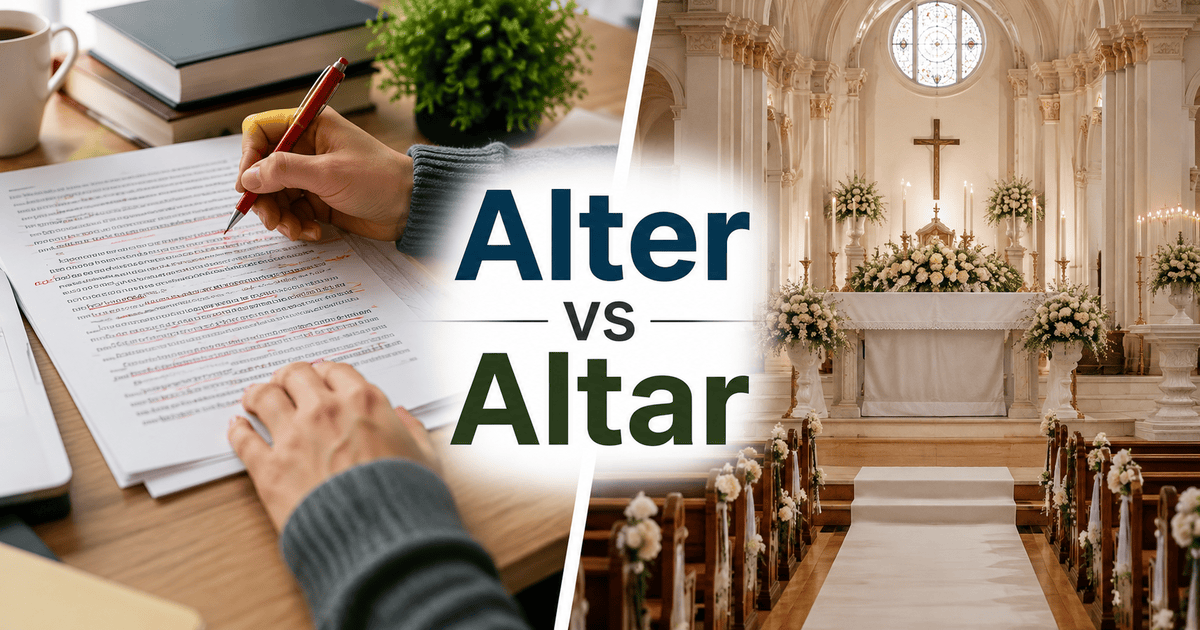
If you searched for alter vs altar, you are probably looking at two words that sound exactly alike but have completely different meanings. It is an easy mistake to make because they are homophones. That means they are pronounced the same but spelled differently and used in different situations.
The good news is that the difference is easy to remember once you know what each word means. Alter is usually a verb that means to change something. Altar is a noun that refers to a table or structure used for religious ceremonies, prayers, or weddings.
Mixing these words up can completely change the meaning of a sentence. Imagine writing that someone decided to altar their plans. That sounds strange because plans can be changed, but they cannot become a place used for worship. Small spelling mistakes like this can make your writing confusing, especially in school assignments, professional emails, or published content.
This guide explains the difference in plain English. You will learn what each word means, see real examples, understand why people confuse them, discover memory tricks that actually work, and avoid the most common mistakes. By the end, choosing the correct spelling will feel natural.
Quick Definition
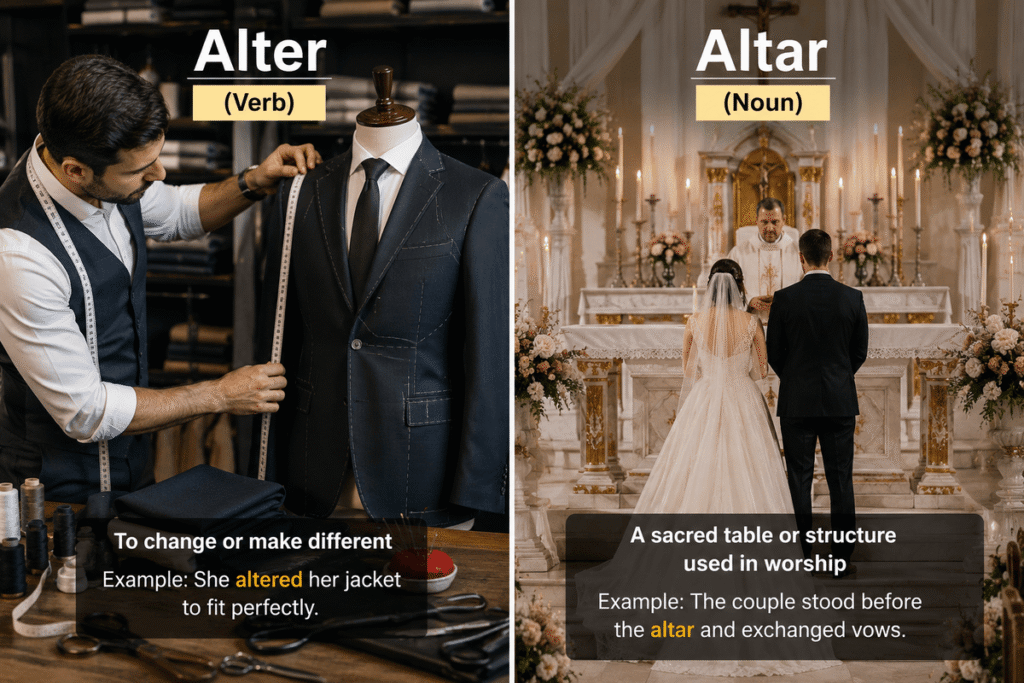
Alter means to change, modify, or make something different. It is usually used as a verb.
Altar is a noun. It refers to a table or raised structure used for religious ceremonies, worship, sacrifices, or weddings in many faiths.
Direct Answer
Use alter when you mean to change something.
Use altar when you are talking about a religious structure or the place where a wedding ceremony takes place.
Comparison Table
| Word | Meaning | Example Sentence | When To Use It |
|---|---|---|---|
| Alter | To change or modify something. | We need to alter the schedule before the meeting. | Changes, adjustments, or modifications. |
| Altar | A religious table or sacred structure. | The couple stood at the altar during the ceremony. | Churches, temples, weddings, and religious services. |
Why People Confuse These Words
It is easy to understand why these words cause trouble. They sound exactly the same when spoken, but their spellings and meanings have nothing in common.
English has many pairs like this. Words such as their, there, and they’re or your and you’re create the same kind of confusion. Your ears hear one sound, but your brain has to choose the correct spelling based on the meaning.
Another reason people mix them up is that altar does not appear in everyday conversations as often as alter. Most people use the word alter regularly when talking about changing plans, editing documents, adjusting clothing, or improving ideas. Altar, on the other hand, usually appears in religious settings, history books, or discussions about weddings.
Because alter is much more common, people sometimes type it automatically even when they actually mean altar. The opposite mistake also happens, although it is less common.
The best way to avoid confusion is to stop thinking about how the word sounds and focus on what it means. Once you connect each spelling to its meaning, choosing the right one becomes much easier.
What Does Alter Mean
The word alter means to change something. The change can be big or small, but the original thing still exists after the change.
You might alter a plan, a document, a recipe, a dress, or your daily routine. In every case, you are making changes instead of replacing something completely.
Here are some everyday examples.
- We decided to alter our travel plans after checking the weather.
- The tailor will alter the jacket so it fits better.
- The company had to alter its schedule because of the storm.
- You should not alter the original document without permission.
Notice that every sentence involves making a change. That simple idea connects every use of the word.

Common Situations Where Alter Appears
You will see alter in many different situations because changing things is part of everyday life.
For example, people alter clothing to improve the fit. Writers alter sentences to make them clearer. Businesses alter prices during sales. Athletes alter their training plans before an important competition.
The word also appears in scientific, legal, and medical writing. Researchers may alter an experiment to test a new idea. A contract might be altered before both sides sign it. A doctor may alter a treatment plan after reviewing new test results.
Although these situations are very different, they all share the same core meaning. Something is being changed.
Alter As A Verb
One helpful fact to remember is that alter is almost always a verb. It describes an action.
Look at these examples.
- Please alter the report before sending it.
- They altered the design after receiving customer feedback.
- The chef altered the recipe by adding fresh herbs.
Each sentence describes someone doing something. That makes it much easier to recognize the correct spelling.
What Does Altar Mean
Unlike alter, the word altar is a noun. It names a place instead of describing an action.
An altar is a table or raised structure used during religious ceremonies. Many churches, temples, and other places of worship have an altar at the front where important rituals take place.
People also use the word when talking about weddings. During many traditional ceremonies, the couple stands at the altar while exchanging vows and rings.
Here are a few examples.
- The bride walked slowly toward the altar.
- Fresh flowers decorated the altar before the ceremony began.
- The family gathered around the altar for prayer.
Each sentence refers to a physical place, not a change. That is the biggest difference between the two words.
Altar In Different Religions
Although many people first think of a church wedding, altars exist in many religions around the world.
Christian churches often have an altar near the front of the sanctuary. In Hindu temples, altars may hold statues, candles, flowers, and offerings. Many Buddhist temples also include altars used for prayer and reflection.
The appearance of an altar changes from one tradition to another, but the purpose remains similar. It is a place connected with worship, respect, and important ceremonies.
Understanding this broader meaning makes it easier to recognize the correct spelling whenever the word appears.
Alter Vs Altar In Everyday Writing
One of the easiest ways to choose the correct word is to think about the message you want to send. Ask yourself a simple question. Are you talking about making a change, or are you talking about a place used for worship or a wedding?
If the sentence is about changing something, the correct word is alter. If it is about a religious structure or the place where a couple exchanges vows, the correct word is altar.
Here are a few examples.
- We need to alter the budget before the meeting starts.
- The tailor can alter your pants by Friday.
- They stood together at the altar during the wedding ceremony.
- The candles on the altar created a peaceful atmosphere.
Thinking about the meaning instead of the pronunciation will help you choose the right spelling almost every time.
Common Mistakes People Make
Since these words sound exactly alike, spelling mistakes happen more often than you might think. The good news is that most errors follow the same patterns.
Using Altar When You Mean Change
This is one of the most common mistakes.
❌ We need to altar the report before sending it.
✔ We need to alter the report before sending it.
A report can be changed, but it cannot become a religious structure.
Here are more examples.
❌ The company decided to altar its policy.
✔ The company decided to alter its policy.
❌ Please altar the settings on your phone.
✔ Please alter the settings on your phone.
Every corrected sentence involves making a change, so alter is the right choice.
Using Alter Instead Of Altar
This mistake is less common, but it still appears in writing.
❌ The bride walked toward the alter.
✔ The bride walked toward the altar.
❌ The flowers looked beautiful on the alter.
✔ The flowers looked beautiful on the altar.
In these examples, the sentence talks about a place used during a ceremony. That makes altar the correct spelling.
Simple Memory Tricks
You do not need to memorize long grammar rules to remember these words. A few simple tricks can make the difference stick.
Remember The Letter E In Alter
The word alter has the letter E, just like edit and change. Both words involve making something different.
When you see alter, think about editing, adjusting, improving, or changing something.
Remember The Letter A In Altar
The word altar begins and ends with the letter A. Think of aisle and altar, two words that often appear together during a wedding.
Many people remember the phrase.
- Walk down the aisle to the altar.
That simple picture is enough to bring the correct spelling to mind.
Think About Action And Place
Another easy trick is to remember that alter is an action, while altar is a place.
If someone is doing something, you probably need alter.
If someone is standing somewhere during a ceremony, you probably need altar.
Real Life Examples
Looking at complete sentences makes the difference much easier to understand.
Sentences With Alter
- We had to alter our vacation plans because of the weather.
- The designer altered the logo before the final presentation.
- She wants to alter the dress before the party.
- Nothing can alter the facts of the case.
- Regular exercise can alter your daily routine in a positive way.
Sentences With Altar
- The couple exchanged vows at the altar.
- White flowers covered the altar before the ceremony began.
- Visitors admired the beautiful altar inside the old church.
- The family gathered around the altar for a special prayer.
- The minister stood beside the altar during the service.
Notice how each group shares the same meaning. The first group is about changing something. The second group is about a physical place.
Similar Confused Word Pairs
If you struggle with alter and altar, you are not alone. English has many homophones that cause similar problems.
Here are a few common examples.
| Word Pair | Difference |
|---|---|
| Accept and Except | Accept means to receive. Except means leaving something out. |
| Affect and Effect | Affect is usually a verb. Effect is usually a noun. |
| Principal and Principle | Principal can mean the head of a school or the main thing. Principle means a rule or belief. |
| Compliment and Complement | Compliment is praise. Complement means something that completes another thing. |
| Stationary and Stationery | Stationary means not moving. Stationery means writing paper and office supplies. |
Learning these pairs together helps you build stronger spelling habits because they all depend on choosing the correct meaning instead of relying on pronunciation.
Why Context Matters
English has thousands of words that sound alike. Native speakers usually understand the correct meaning because of the surrounding words.
Look at these sentences.
- The tailor will alter the jacket before Friday.
- The bride smiled as she approached the altar.
Even though alter and altar sound the same, the surrounding words make the meaning obvious. Words like tailor, jacket, and before Friday suggest a change. Words like bride, ceremony, and church point to a wedding or religious setting.
Getting into the habit of reading the entire sentence before choosing the spelling is one of the easiest ways to avoid mistakes. Instead of focusing on the sound of the word, focus on the idea the sentence is trying to express.
Does Spell Check Always Catch The Mistake
Not always.
Spell check looks for words that are spelled correctly. Since both alter and altar are real English words, many spelling tools will not flag the mistake.
For example, if you write The bride walked to the alter, your computer may not show an error because alter is spelled correctly. The problem is that it is the wrong word for the sentence.
That is why proofreading matters. Reading your work slowly and thinking about the meaning is much more reliable than depending on spell check alone.

FAQs
Is alter or altar correct?
Both words are correct, but they have different meanings. This is the key to understanding alter vs altar. Use alter when you mean to change something. Use altar when you are talking about a religious structure or the place where a wedding ceremony takes place.
Why do people confuse alter and altar?
These words are homophones, which means they sound the same but have different spellings and meanings. Since people often write words based on how they sound, it is easy to mix them up. Paying attention to the meaning of the sentence helps you choose the correct spelling.
Is alter a noun or a verb?
Alter is most commonly used as a verb. It means to change, modify, or adjust something. Although there are rare noun uses in specialized fields, almost every everyday use is the verb.
What is an altar used for?
An altar is used for religious ceremonies, worship, prayer, and other sacred activities. In many Christian weddings, it is the place where the couple exchanges vows. Altars also appear in many other religions around the world.
How can I remember the difference between alter and altar?
A simple trick is to connect alter with edit because both involve making a change. Then connect altar with aisle, since people often walk down the aisle to the altar during a wedding ceremony. These memory tricks are easy to remember and work well in everyday writing.
Can spell check catch this mistake?
Not always. Since both words are spelled correctly, many spelling tools will not recognize the error if you use the wrong one. That is why it is important to proofread your writing and think about the meaning of the sentence.
Are alter and altar pronounced the same?
Yes. They are pronounced the same in standard American English, which is why they are called homophones. Even though they sound alike, their meanings are completely different.
Final Thoughts
Understanding alter vs altar becomes much easier once you connect each spelling with its meaning instead of its pronunciation. Alter means to change or modify something, while altar is a religious structure or the place where many wedding ceremonies take place.
The two words may sound identical, but they belong in completely different situations. One describes an action. The other names a place. Keeping that simple distinction in mind will help you avoid one of the most common spelling mistakes in English.
A quick mental check can save you from choosing the wrong word. Ask yourself if the sentence is talking about making a change or referring to a religious setting. If it is about changing something, use alter. If it is about worship, prayer, or a wedding ceremony, use altar.
The next time you come across these words, pause for a second and think about the meaning instead of the sound. That small habit will improve your writing, reduce spelling mistakes, and help you choose the correct word with confidence every time.