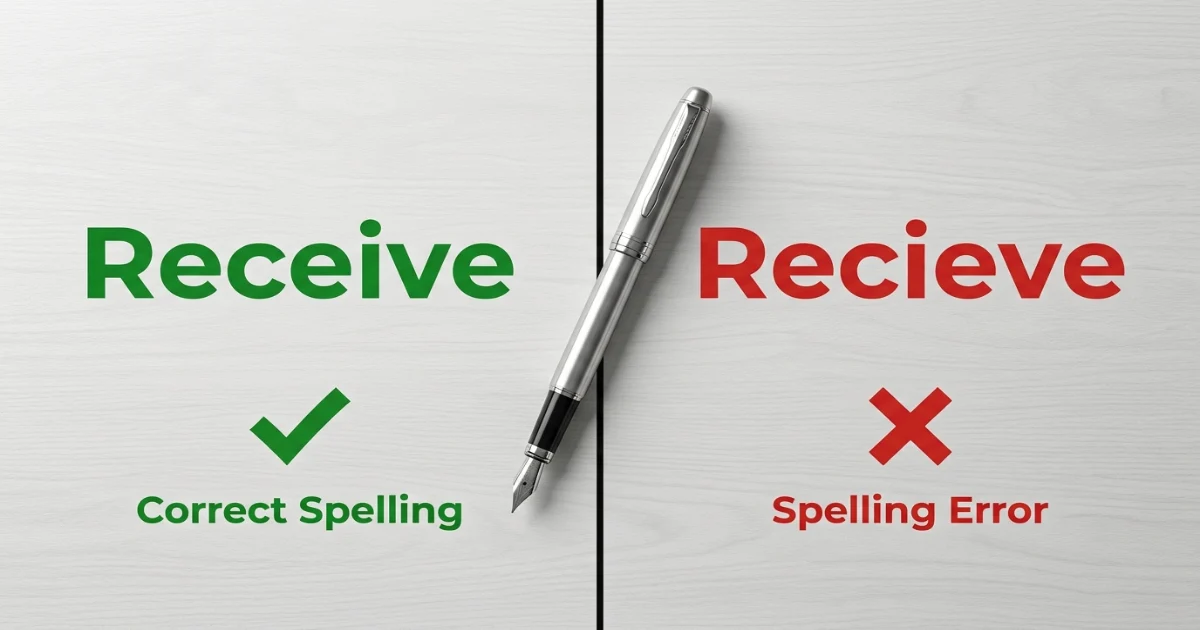
When deciding between recieve or receive, the correct spelling is always receive.
The form recieve is a very common spelling mistake in written English. You will see it constantly in quick emails, personal messages, and unedited drafts. However, modern English dictionaries and style guides mark it strictly as an error. If you write recieve in a job application, a cover letter, or an official document, automated proofreading software will flag it immediately.
Understanding why people swap these two vowels and learning the classic rule governing this word will help you write receive correctly every time.
Quick Definition and Direct Answer
Receive is a transitive verb that means to get, accept, or take something given, sent, or paid. It can also mean to greet guests or experience a particular reaction.
- Receive (with EI) is the only correct standard spelling.
- Recieve (with IE) is a misspelling and should never be used.
If you ever feel unsure about how to spell the word, remember the famous rhyme: I before E except after C. Because the vowels follow the letter C, the order must be E-I.
Quick Comparison Table
| Word or Phrase | Meaning | Example Sentence | When To Use It |
| Receive | To get, accept, or take something offered or sent | Did you receive my email yesterday? | Use as the standard base verb form. |
| Recieve | None (Spelling error) | Incorrect: Please confirm when you recieve this. | Never. Do not use this form in standard English. |
| Receipt | A written acknowledgment that something was received | Keep your receipt for any returns or exchanges. | Use as a noun referring to proof of purchase or payment. |
| Receiver | A person or device that receives something | He picked up the telephone receiver. | Use as a noun for a person or device taking something in. |

The Grammar and Etymology Behind Receive
To understand why receive is spelled with EI rather than IE, it helps to examine its historical roots and grammatical pattern in English.
Origin from Old French and Latin
The word receive entered Middle English from the Anglo-Norman and Old French word recevoir, which itself derived from the Latin verb recipere (composed of re- meaning back and capere meaning to take).
When French words with cei entered English during the Norman period, they brought along the specific E-I vowel order following the consonant C.
The Classic “I Before E Except After C” Rule
English speakers have long used a helpful spelling rule to manage pairs of vowels:
The word receive is one of the textbook examples of this rule in action:
- Look at the letter before the vowels: it is C (re-c-).
- Because the consonant is C, swap the typical I-E order to E-I.
- Result: Receive.
This same rule applies to other related words derived from similar Latin and French roots, such as deceive, perceive, and conceive.
Why People Misspell Receive as Recieve
Even experienced writers occasionally make this mistake when typing fast. Knowing why people accidentally reverse these two vowels makes it much easier to avoid doing it yourself.
Misapplying the Base Rule
The primary rule taught in primary school is “I before E”. Words like believe, relieve, achieve, and field reinforce the habit of placing I before E.
When people type quickly, their brain defaults to the main rule (I before E) and forgets to apply the critical second part of the rule: except after C. This leads directly to recieve.
Fast Touch Typing
On standard keyboards, E and I are both typed using the middle fingers of opposite hands on the top letter row. When typing at high speeds, your finger on the I key often strikes a split second before your finger on the E key, producing recieve as a mechanical typo.
Similar Pronunciation with “Believe”
Words like receive and believe rhyme perfectly in modern English pronunciation: /rɪˈsiːv/ and /bɪˈliːv/. Because they sound identical at the end, writers naturally assume they share the same vowel spelling pattern. However:
- Be-l-i-e-ve (Preceded by L, so use IE)
- Re-c-e-i-ve (Preceded by C, so use EI)
Simple Memory Tricks for Correct Spelling
Memory tricks make it simple to keep your vowels in the correct order when drafting emails or reports.
The “After C” Check
Whenever you type receive, stop and look at the consonant directly before the vowels:
- Re – C – E – I – ve
Grouping the “CEIVE” Family
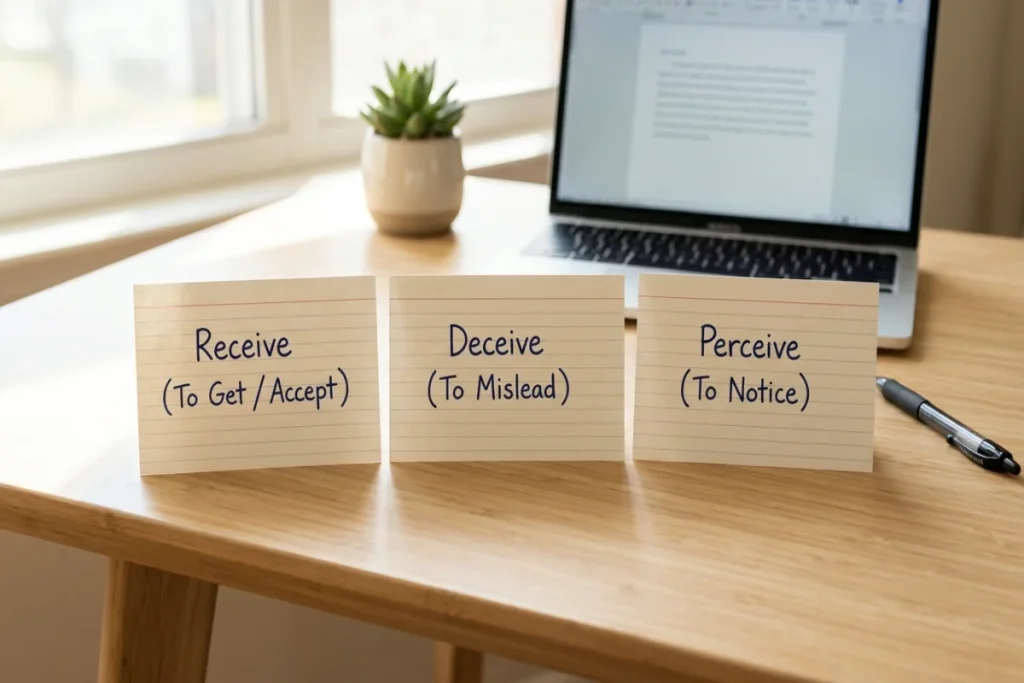
Link receive to its sister words in the English language. Every verb ending in -ceive uses the exact same letter order:
- Receive
- Deceive
- Perceive
- Conceive
If you memorize the four-letter block C-E-I-V, you will spell all four of these common verbs correctly every single time.
Real World Examples of Correct Usage
Here are practical sentences showing how to use receive naturally across different daily writing scenarios.
Daily Conversations
- Did you receive the package I sent you last week?
- We always receive a warm welcome whenever we visit my grandparents.
- She was thrilled to receive first place in the art competition.
- How many notifications do you receive on your phone each day?
Workplace and Business Emails
- Please reply to confirm that you receive these attached documents.
- Our accounting department will receive the payment by the end of the week.
- Clients who sign up early will receive a ten percent discount.
- We receive hundreds of inquiries through our website every month.

Academic and Formal Writing
- Patients who receive early treatment show significantly higher recovery rates.
- The university president will receive the international delegation tomorrow morning.
- The historical paper did not receive widespread recognition until decades later.
Related Common Spelling Errors
Spelling slip-ups often happen when silent vowels, double letters, or tricky rules create confusion. Reviewing related words helps strengthen your overall writing accuracy.
1. Vowel Inversions in Common Words
Just as people swap the E and I in receive, writers frequently reverse adjacent vowels or letters in other everyday terms. For instance, people often struggle with vowel patterns when deciding between thier or their or when choosing between definately or definitely.
2. Spacing and Double Consonant Errors
Merging words or dropping double letters creates another category of widespread typos. Writers frequently face double letter choices when deciding between alot or a lot or when choosing between occured or occurred.
3. Dropping Silent Letters
Dropping internal letters leads to common mistakes in daily vocabulary. Writers frequently miss silent letters when deciding between wich or which or when choosing between suprise or surprise.
4. Regional Spelling Preferences
While some English words change spellings depending on regional standards, others remain fixed worldwide. Navigating choices like analyzing or analysing or comparisons such as armor or armour requires knowing regional preferences.
American English vs. British English Usage
Some English words change their spelling based on whether you are writing for an American or a British audience. For example, American English uses color, center, and check, while British English uses colour, centre, and cheque.
However, when it comes to receive, there is no regional variation whatsoever.
- American English: Receive (spelled E-I)
- British English: Receive (spelled E-I)
- Canadian English: Receive (spelled E-I)
- Australian English: Receive (spelled E-I)
In every major dialect of standard English across the world, receive is the only accepted spelling, and recieve is always marked as an error.
Clear Summary and Final Guidelines
Mastering the spelling of receive comes down to remembering a few clear principles:
- Receive (spelled E-I) is the only correct standard spelling in modern English.
- Recieve (spelled I-E) is a misspelling caused by misapplying the “I before E” rule or typing too fast.
- Apply the rule: I before E except after C. Because the letter C precedes the vowels in receive, E must come before I.
- All words in the -ceive family (receive, deceive, perceive, conceive) share the exact same E-I vowel order.
By keeping the “after C” rule in mind, you can eliminate this common spelling error from your writing permanently.
Frequently Asked Questions
Is recieve ever an acceptable alternative spelling?
No. Recieve is not recognized as a valid word or variant spelling in any standard English dictionary. It is strictly classified as a spelling error in all formal, academic, and casual writing.
What are the four main words in the -ceive family?
The four primary English verbs that end in -ceive are receive, deceive, perceive, and conceive. Every single one of them follows the “except after C” rule and uses the E-I vowel pattern.
How is the noun form receipt spelled?
Like receive, the noun receipt follows the “except after C” rule and is spelled with E-I (r-e-c-e-i-p-t). It also contains a silent letter P.
What are some good synonyms for receive?
Common synonyms for receive include get, accept, collect, obtain, acquire, welcome, and experience.
How can I train myself to stop typing recieve?
The easiest way to train yourself is to memorize the letter combination C-E-I. Whenever you write a word with a C sound followed by an “ee” vowel sound, remind yourself that E must come directly after C.