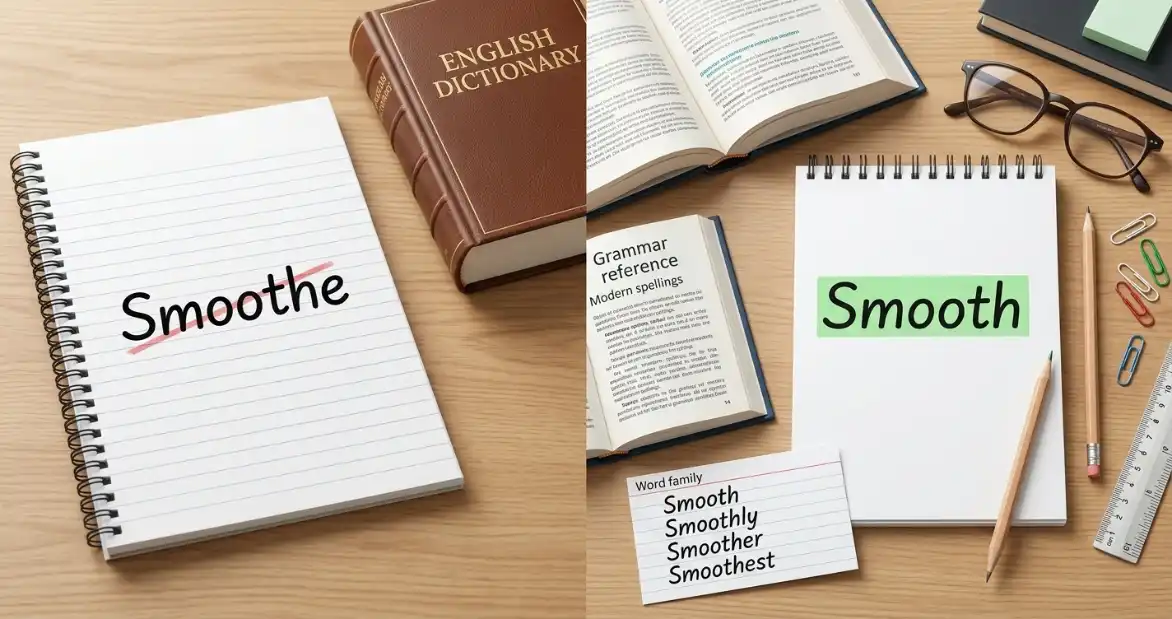
If you’re wondering about smoothe or smooth, the answer is simple: smooth is the standard spelling you should use in modern English. Use smooth when you mean something that isn’t rough, something that happens without problems, or someone or something that appears calm and polished.
The extra e in smoothe can look reasonable. English has many words that end in silent e, and forms such as smoothes can make the spelling even more confusing. But the standard base word is smooth, not smoothe.
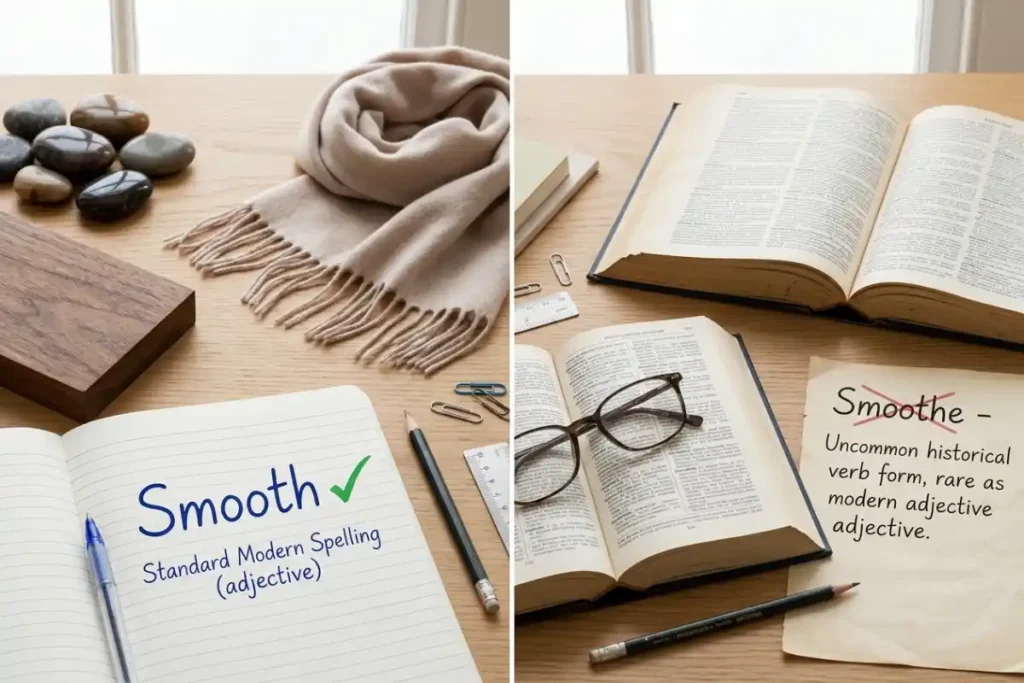
There is one small detail worth knowing. Smoothe isn’t completely made up. It has been used as an alternative form of the verb smooth, and dictionaries and historical sources record it. However, that use is now uncommon, and the adjective has long been written smooth.
So if you’re writing a school assignment, article, email, report, website, or professional document, choose smooth. This guide explains why, shows the different forms of the word, and gives you plenty of examples so you won’t have to stop and think about the spelling again.
Quick Definition
Smooth is the standard modern spelling. It can be an adjective meaning even, not rough, easy, calm, or polished, and it can also be a verb meaning to make something even or to make a situation easier.
Smoothe is an uncommon or archaic alternative form of the verb smooth. It isn’t the normal spelling of the adjective in modern English.
Direct Answer
The correct standard spelling is smooth. Use smooth in normal modern writing, including when describing a surface, process, movement, voice, or personality.
Smooth And Smoothe Compared
| Word | Meaning | Example Sentence | When to Use It |
|---|---|---|---|
| Smooth | Even, not rough, easy, calm, or polished | The table has a smooth surface. | Use this as the standard modern spelling |
| Smoothe | An uncommon or archaic alternative verb form | The old text uses smoothe. | Usually avoid it in modern writing |
The safest rule is easy: smooth has no extra e.
Why Is This Spelling Confusing
The question seems simple until you look at the way English builds related words.
You may already know words such as breathe, clothe, bathe, and wreathe. These words have a final e that changes or helps preserve their pronunciation. Because smooth ends with the th sound, it can feel as if it should follow the same pattern.
That assumption isn’t completely random. Historical English has used spellings such as smothe, smoothe, and smooth. Wiktionary records smoothe as an archaic adjective form and as a now less common alternative form of the verb smooth.
Modern standard English, however, settled on smooth as the normal spelling.
This is similar to other spelling questions where the wrong form looks believable. For example, if you often wonder about another common spelling mistake, the same basic problem appears: the incorrect form looks close enough to the correct one that your eyes may accept it.
With smooth, the extra e isn’t needed.
The Correct Spelling Is Smooth
Smooth is the spelling you should use in modern English.
It can describe a physical surface:
The stone is smooth.
The table has a smooth finish.
The glass feels smooth.
It can describe movement:
The car has a smooth ride.
The dancer made a smooth movement.
The boat made a smooth turn.
It can describe a process:
We had a smooth trip.
The project got off to a smooth start.
The transition was smooth.
It can also describe speech or behavior:
She has a smooth voice.
He gave a smooth presentation.
The speaker had a smooth style.
The spelling stays the same in all of these examples.

What Does Smooth Mean
Smooth has several related meanings. The central idea is something that is free from roughness, sudden changes, or difficulty.
Smooth Means Not Rough
The most basic meaning refers to a surface.
A smooth surface doesn’t have noticeable bumps, ridges, or rough patches.
For example:
The stone feels smooth.
The baby’s skin is smooth.
The polished wood is smooth.
The glass has a smooth surface.
The road is smooth after the repairs.
In this meaning, smooth is the opposite of rough, uneven, or bumpy.
Smooth Means Easy
Smooth can also describe something that happens without problems.
For example:
The meeting was smooth.
The move went smoothly.
We had a smooth journey.
The application process was smooth.
The launch went smoothly.
Here, smooth doesn’t describe a physical surface. It describes an experience or process that has few problems or interruptions.
Smooth Means Even
Smooth can describe movement, sound, flow, or change.
For example:
She made a smooth turn.
The machine has a smooth motion.
The singer has a smooth voice.
The transition between the two sections was smooth.
The river has a smooth flow.
The idea is that something happens evenly instead of suddenly or roughly.
Smooth Can Describe A Person
Smooth can also describe someone who is confident, polished, charming, or persuasive.
For example:
He is a smooth speaker.
She gave a smooth sales pitch.
The actor played a smooth character.
That meaning can be positive or slightly negative depending on the context. A smooth person may seem confident and charming, but the word can sometimes suggest that the person is very practiced at persuading others.
Smooth Is An Adjective
When smooth describes a noun, it works as an adjective.
For example:
The surface is smooth.
The road is smooth.
She has smooth skin.
His voice is smooth.
The process was smooth.
The transition was smooth.
The adjective tells the reader what something is like.
That’s why you should write smooth surface, not smoothe surface.
You may also notice that the word stays the same when it appears before different nouns:
smooth skin
smooth fabric
smooth glass
smooth road
smooth movement
smooth voice
smooth process
There is no reason to add an e.
Smooth Is Also A Verb
Smooth can also function as a verb.
As a verb, it means to make something even, flat, calm, or easier.
For example:
Smooth the paper before folding it.
She smoothed the fabric with her hand.
He smoothed his hair.
The worker smoothed the wall before painting it.
The manager tried to smooth the disagreement.
The company worked to smooth the transition.
This verb is one reason the spelling smoothe can cause confusion.
Historically, smoothe has been used as an alternative spelling of this verb. Modern writing generally prefers smooth. Wiktionary describes smoothe as now less common and sometimes proscribed.
So if you want the safest modern form, write:
Smooth the surface.
Not:
Smoothe the surface.
Smooth Versus Smoothes
One of the biggest reasons people add an e to smooth is the form smoothes.
Smoothes is a real verb form.
For example:
She smoothes the fabric.
He smoothes his hair.
The machine smoothes the rough edges.
The worker smoothes the surface before painting.
This can make someone think the basic word must be smoothe.
But that isn’t the case.
The standard base verb is smooth.
The third person singular form can be smooths or smoothes.
So you can write:
She smooths the fabric.
She smoothes the fabric.
Both forms are found in English.
The important point is that neither one changes the standard adjective.
You still write:
The fabric is smooth.
Not:
The fabric is smoothe.
This is a useful example of why you shouldn’t always work backward from an inflected form to guess the spelling of the base word.
Smooth Versus Smoothed
The past tense is smoothed.
Examples:
She smoothed the paper.
He smoothed his jacket.
The worker smoothed the wall.
She smoothed her hair.
They smoothed out the problem.
The word starts with smooth and adds ed.
Smooth + ed = smoothed.
There is no e between smooth and ed.
This gives you a simple pattern:
smooth
smoothed
smoothing
smooths
smoothes
The base word remains smooth.
Smooth Versus Smoothing
The form smoothing is used for an action that is happening now or as a noun describing the process.
Examples:
She is smoothing the fabric.
He is smoothing his hair.
The worker is smoothing the surface.
The machine is smoothing the rough edges.
The spelling is smoothing, not smootheing.
This is another reason to remember the base word clearly.
Start with smooth.
Then add ing:
smooth + ing = smoothing.
You don’t need to create a new base word by adding e first.
Smooth Versus Smoothly
Smoothly is the adverb form of smooth.
Use smoothly when you are explaining how an action happens.
For example:
The meeting went smoothly.
The machine runs smoothly.
The car moved smoothly.
The presentation went smoothly.
The transition happened smoothly.
Compare these two sentences:
The process was smooth.
The process went smoothly.
Smooth describes the process.
Smoothly describes how the process happened.
This difference matters in formal writing.
You may hear people say, The meeting went smooth, in casual conversation. But smoothly is the standard adverb when you’re writing carefully.
Smooth Versus Smoother
Smoother is the comparative form of smooth.
Use it when comparing two things.
For example:
This fabric is smoother than the other one.
The new road is smoother than the old road.
Her voice sounds smoother now.
This surface feels smoother.
The new system creates a smoother process.
The spelling is:
smooth → smoother
You don’t write smoothe + r.
The base word remains smooth.
Smooth Versus Smoothest
Smoothest is the superlative form.
Use it when comparing three or more things or when describing something as having the highest degree of smoothness.
Examples:
This is the smoothest road in the area.
That was the smoothest ride of the day.
She has the smoothest voice in the group.
This is the smoothest fabric in the store.
The new system provides the smoothest experience.
Again, the spelling starts with smooth.
smooth → smoother → smoothest
No extra e is needed.
Smooth Versus Smoothness
Smoothness is the noun form.
It describes the quality of being smooth.
Examples:
The smoothness of the surface was impressive.
The fabric has a pleasant smoothness.
The smoothness of the ride surprised me.
The cream gives the skin a soft smoothness.
This word family is useful because it shows how stable the spelling is.
Smooth becomes:
smoothness
not
smoothe + ness.
The same base spelling appears throughout the word family.
The Smooth Word Family
Once you learn the base word, many related forms become easy.
| Word | Function | Example |
|---|---|---|
| Smooth | Adjective or verb | The surface is smooth. |
| Smoothly | Adverb | The machine runs smoothly. |
| Smoother | Comparative adjective | This fabric is smoother. |
| Smoothest | Superlative adjective | This is the smoothest road. |
| Smoothness | Noun | I like the smoothness of the fabric. |
| Smoothed | Past tense | She smoothed the paper. |
| Smoothing | Present participle | He is smoothing the wall. |
| Smooths | Verb | She smooths her hair. |
| Smoothes | Verb | She smoothes the fabric. |
Notice something important.
The adjective is smooth.
The base verb is smooth.
The related forms are built around smooth.
You don’t need smoothe as your normal base word.
Is Smoothe A Real Word
This question deserves a more careful answer than simply saying yes or no.
Smoothe has appeared in English and is recorded as an alternative form of smooth. Wiktionary lists it as a verb and says it is now less common and sometimes proscribed. It also lists smoothe as an archaic adjective form.
Historical sources show that the spelling has been used for a long time.
That doesn’t mean you should use it in everyday modern writing.
English has many historical spellings that you may still find in old books, literary works, or historical documents. A spelling can have a real history without being the best choice for modern standard English.
That’s exactly what happens with smoothe.
If you encounter it in an old text, don’t assume the writer simply made a typo. The spelling has historical support.
But if you’re writing a new article today, use smooth.
Is Smoothe Ever Correct
In modern standard writing, smoothe is generally not the form you want.
Its main modern relevance is as an uncommon alternative form of the verb smooth. Wiktionary specifically describes the verb use as now less common and sometimes proscribed.
The adjective use is even less useful for modern writers because smooth is the established standard form.
So if your sentence says:
The surface is ___.
Choose smooth.
If your sentence says:
Please ___ the surface.
Choose smooth.
If your sentence says:
She ___ the fabric.
Use the appropriate modern verb form, such as smooths, smoothes, or smoothed.
For normal writing, there is very little reason to choose smoothe.
Why The Extra E Looks Natural
The spelling smoothe looks convincing for a few reasons.
First, English has many words ending in silent e.
Think about:
breathe
clothe
bathe
wreathe
Second, smooth ends in th.
Writers may naturally connect it with other th words that have an e form.
Third, smoothes is a real verb form.
When someone sees smoothes, they may think:
If the word is smoothes, then perhaps the base word is smoothe.
That reasoning feels logical, but English doesn’t always follow that pattern.
The base word is smooth.
The verb can take an ending that produces smoothes.
So don’t use the spelling of one verb form to guess the spelling of the adjective.
Common Mistakes With Smooth
The most common mistake is adding an unnecessary e.
Incorrect:
The surface is smoothe.
Correct:
The surface is smooth.
Incorrect:
She has a smoothe voice.
Correct:
She has a smooth voice.
Incorrect:
We had a smoothe trip.
Correct:
We had a smooth trip.
Another common problem is using smooth when smoothly is needed.
Informal:
The meeting went smooth.
Standard formal English:
The meeting went smoothly.
The difference is grammatical rather than just spelling related.
Smooth normally works as an adjective.
Smoothly works as an adverb.
Smooth And Smoothly In Real Sentences
Compare these examples:
The flight was smooth.
The plane flew smoothly.
The transition was smooth.
The transition happened smoothly.
The machine is smooth.
The machine runs smoothly.
The first sentence in each pair describes something.
The second explains how an action happens.
This distinction is especially useful in professional writing.
For example:
The software update was smooth.
The software updated smoothly.
Both can be correct, but they focus on different parts of the idea.
Smooth In Everyday Expressions
Smooth appears in many familiar phrases.
Smooth Ride
A smooth ride is comfortable and free from sudden bumps.
The new car has a smooth ride.
The bus gave us a surprisingly smooth ride.
Smooth Sailing
Smooth sailing is an idiom for a situation that goes well without major problems.
After the first few weeks, it was smooth sailing.
The phrase is common in both conversation and writing.
Smooth Transition
A smooth transition happens without major disruption.
The company planned a smooth transition.
The teacher helped make the transition smooth.
Smooth Process
A smooth process has few problems or delays.
We want to create a smooth application process.
The new system made the process smoother.
Smooth Finish
A smooth finish is even and free from rough areas.
The painter gave the wall a smooth finish.
The wood needs a smooth finish before painting.
These phrases are useful because they reinforce the standard spelling in different contexts.
Smooth And Rough
One of the easiest ways to understand smooth is to compare it with rough.
A smooth surface feels even.
A rough surface feels uneven.
For example:
The stone is smooth.
The sandpaper is rough.
The glass is smooth.
The unfinished wood is rough.
The road is smooth.
The old road is rough.
These opposites make the meaning easy to remember.
When you mean the opposite of rough, write smooth.
Smooth And Flat
Smooth and flat are related but don’t mean exactly the same thing.
Flat describes shape or position.
Smooth describes surface texture or a lack of roughness.
A surface can be flat but rough.
For example, a flat piece of unfinished wood may still feel rough.
A curved stone can be smooth even though it isn’t flat.
So if you’re talking about texture, smooth is often the better word.
Smooth And Even
Smooth and even can overlap.
For example:
The surface is smooth.
The surface is even.
Both may describe a surface without major irregularities.
But smooth often focuses on texture, while even can focus on consistency, level, or regularity.
You can also describe movement as smooth:
She made a smooth movement.
You wouldn’t normally use flat in that same way.
Smooth And Easy
Smooth can also mean easy, but the two words aren’t exact synonyms.
A smooth process is one with few problems or interruptions.
An easy process is one that doesn’t require much effort.
For example:
The application process was smooth.
The application was easy.
The first sentence focuses on how well the process worked.
The second focuses on how difficult it was.
Smooth In Professional Writing
Smooth is common in workplace English.
You may see phrases such as:
smooth transition
smooth process
smooth operation
smooth workflow
smooth communication
smooth implementation
smooth performance
Examples:
The team worked to ensure a smooth launch.
The manager helped create a smooth transition.
The new software supports a smooth workflow.
The company wants a smooth implementation.
The system provides smooth performance.
All of these use the standard spelling smooth.
Smooth In Technology
Technology writers use smooth all the time.
For example:
The animation looks smooth.
The app runs smoothly.
The video plays smoothly.
The website has smooth scrolling.
The device provides smooth performance.
The software runs smoothly on older computers.
Again, the adjective and adverb forms are different.
The animation is smooth.
The animation runs smoothly.
That small distinction can make your writing sound more polished.
Smooth In Descriptions Of Speech
Smooth can describe a person’s voice or way of speaking.
For example:
She has a smooth voice.
His voice sounds smooth and calm.
The singer has a smooth tone.
He gave a smooth presentation.
She made a smooth transition between topics.
In these sentences, smooth suggests that something sounds even, pleasant, controlled, or polished.
Smooth In Descriptions Of Movement
Smooth is also useful when describing physical movement.
For example:
The dancer made a smooth turn.
The car has smooth acceleration.
The machine makes a smooth motion.
The swimmer has a smooth stroke.
The horse has a smooth gait.
The transition from one movement to another was smooth.
The word suggests controlled movement without sudden jerks.
American And British English
There is no standard American versus British spelling difference for smooth.
American English uses smooth.
British English also uses smooth.
So you don’t need to choose between two regional forms.
This is different from spelling pairs such as Armor or Armour, where American and British English use different spellings.
That distinction is useful if you’re building a collection of spelling articles. Some of your pages can explain genuine regional differences, while others, such as smooth, deal with a standard spelling versus a less common variant.
Smooth And Other Spelling Questions
The same kind of uncertainty appears throughout English.
A word can look almost right while still using the wrong letter.
For example, your guide to Missle or Missile deals with a word where the letters can easily be misplaced.
Your guide to Vallies or Valleys deals with another spelling that can look natural because of pronunciation.
And Elfs or Elves shows how English plural spelling can sometimes surprise learners.
These examples share one useful lesson: don’t assume that a spelling is correct just because it looks logical.
How To Spell Smooth
If you need the spelling quickly, remember these six letters:
S M O O T H.
Smooth contains two o’s.
It ends with th.
It does not end with e.
Correct:
smooth
Incorrect for the standard adjective:
smoothe
You can use this memory trick:
Smooth has no extra e.
That’s all you need most of the time.
A Simple Memory Trick
Think of a common phrase:
smooth surface
A smooth surface has no rough bumps.
The phrase is so common that it can help you remember the spelling.
You can also remember:
smooth ride
smooth voice
smooth process
smooth transition
smooth finish
In each phrase, the word is smooth.
Never add an e.
How To Choose The Right Form
When you see a blank in a sentence, first ask what job the word is doing.
If you’re describing something, use smooth.
The table is smooth.
If you’re describing how something happens, use smoothly.
The machine runs smoothly.
If you’re telling someone to make something even, use smooth as the verb.
Smooth the paper.
If you’re talking about a completed action, use smoothed.
She smoothed the paper.
If the action is happening now, use smoothing.
She is smoothing the paper.
If the subject is he, she, or it, you may use smooths or smoothes.
She smooths the fabric.
She smoothes the fabric.
This simple check helps you choose the right form without guessing.
Examples You Can Use
Here are natural examples using the standard word family:
The stone has a smooth surface.
The table feels smooth.
The glass is smooth.
The fabric feels smooth.
The road is smooth after the repairs.
We had a smooth trip.
The meeting went smoothly.
The project had a smooth start.
The transition was smooth.
The software runs smoothly.
She has a smooth voice.
He gave a smooth presentation.
This road is smoother than the old one.
That was the smoothest ride I’ve had all year.
She smoothed the paper with her hand.
He smoothed his jacket before the interview.
The worker is smoothing the wall.
The machine smooths the rough surface.
She smoothes the fabric before sewing it.
Each example uses the standard modern spelling.
A Quick Grammar Check
Before you publish your sentence, look at the word around smooth.
If you have a noun after it, smooth may be the adjective:
a smooth surface
a smooth road
a smooth process
a smooth voice
If you’re explaining how an action happens, smoothly may be better:
The car moved smoothly.
The meeting went smoothly.
The machine runs smoothly.
If you’re telling someone to make something even, smooth works as a verb:
Smooth the paper.
Smooth the fabric.
Smooth the surface.
If you’re talking about something that happened in the past:
She smoothed the paper.
If it is happening now:
She is smoothing the paper.
This approach is much more useful than simply memorizing one spelling.
What About Smoothes
Smoothes deserves a quick explanation because it is often responsible for the confusion.
Smoothes can be used as a third person singular form of the verb smooth.
For example:
She smoothes the fabric.
He smoothes his hair.
The machine smoothes the edges.
You may also see smooths:
She smooths the fabric.
Both forms are used.
The important point is that neither form makes the adjective smoothe.
Write:
The fabric is smooth.
The surface is smooth.
The road is smooth.
The voice is smooth.
That is the standard modern pattern.
What About Smoothe In Older Writing
If you’re reading an older book and see smoothe, don’t immediately assume it is a typographical error.
The spelling has historical use. Wiktionary records examples of the verb form in older texts and describes it as an alternative form of smooth. It also records smoothe as an archaic adjective form.
Historical English often contains spellings that aren’t preferred today.
That happens with many words.
So there are two separate questions:
Was smoothe ever used?
Yes.
Should you normally use smoothe in modern English?
No.
For present day standard writing, smooth is the better choice.
When You Should Definitely Use Smooth
Use smooth when you’re writing:
School assignments.
College papers.
Blog posts.
Business emails.
Website copy.
Reports.
Instructions.
Product descriptions.
Professional documents.
Social media posts.
News or informational content.
In all of these settings, smooth is clear and standard.
There is almost never a practical reason to choose the less common smoothe.
Common Questions
Is smoothe or smooth correct
Smooth is the standard spelling for modern English. Smoothe has historical and alternative verb usage, but smooth is the form you should normally use today.
Is smoothe a real word
Yes, but it is uncommon. It has been used as an alternative form of the verb smooth and also appears as an archaic adjective form.
Why do people spell smooth as smoothe
The extra e can look natural because many English words have a final silent e. The verb form smoothes can also make writers think the base word should be smoothe, but the standard base spelling is smooth.
Is smooth an adjective or a verb
Smooth can be both. As an adjective, it can describe a surface, process, movement, voice, or person. As a verb, it means to make something even or to make a situation easier.
What is the adverb of smooth
The standard adverb is smoothly. For example, you can say, The machine runs smoothly. Use smoothly when you are describing how an action happens.
Is smoothes a correct word
Yes. Smoothes is a verb form of smooth. For example, She smoothes the fabric before sewing it.
What is the past tense of smooth
The past tense is smoothed. For example, She smoothed the paper before folding it.
What is the difference between smooth and smoothly
Smooth is normally an adjective, while smoothly is an adverb. You can say, The process was smooth, or, The process went smoothly.
Is smooth spelled differently in British English
No. Smooth has the same standard spelling in American and British English. It isn’t like spelling pairs that change between the two varieties.
Conclusion
If you’re deciding between smoothe or smooth, choose smooth for modern standard English. It is the normal spelling for the adjective and the standard base form of the verb.
The extra e can seem logical, especially because English contains many words with silent e endings and because smoothes is a real verb form. But those patterns don’t change the standard spelling of the base word.
Smoothe has a real history in English and can still be found as an uncommon alternative verb form. That makes it different from a completely invented spelling, but it doesn’t make it the best choice for everyday modern writing.
The easiest rule to remember is this: smooth has no extra e. Write smooth surface, smooth ride, smooth process, smooth voice, and smooth transition. When you’re describing how something happens, use smoothly. Once you remember that pattern, this spelling question becomes easy to handle.