When deciding between loose or lose, the correct choice depends entirely on what you want to communicate in your sentence. Unlike simple typos or spelling mistakes where one form is completely invalid, both loose and lose are legitimate, standard English words. However, they function as different parts of speech, carry distinct definitions, and use different pronunciations.
Mixing up loose and lose is one of the most frequent vocabulary errors in written communication. You will see people write loose when they mean misplacing an item or failing a game, or write lose when describing clothing that does not fit tightly. Using the wrong word in an essay, business proposal, cover letter, or formal email can make your writing look unpolished.
Understanding the grammatical roles, historical backgrounds, pronunciation markers, and usage rules for both words will ensure you choose the right form every time.
Quick Definition and Direct Answer
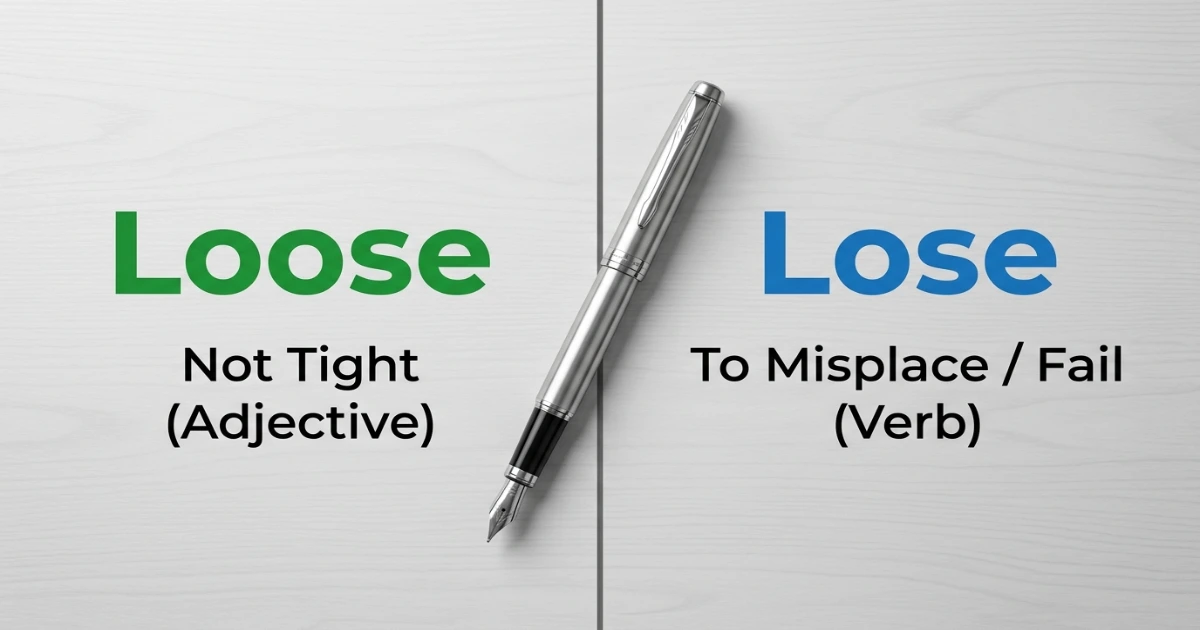
Loose and lose have entirely separate jobs in the English language and should never be used interchangeably.
- Loose (pronounced looss with a soft S sound) is primarily an adjective that means not tight, unbound, free from restraint, or not securely attached.
- Lose (pronounced looz with a Z sound) is strictly a verb that means to misplace something, to fail to win, to be deprived of something, or to shed weight.
If you ever feel confused while drafting, use this quick check: if you are describing a physical state or fit, use loose (with double O). If you are describing an action involving misplacing or failing, use lose (with a single O). A simple visual trick is to remember that when you lose something, the word itself has lost an O.
Quick Comparison Table
| Word or Phrase | Part of Speech | Primary Meaning | Natural Example Sentence | When To Use It |
| Loose | Adjective | Not firmly fixed; baggy; free from restraint | She wore a loose sweater on the cool evening. | Use to describe a noun that is not tight or fixed. |
| Lose | Verb | To misplace; to fail to win; to suffer deprivation | Try not to lose your house keys again. | Use to show the action of misplacing or failing. |
| Loosen | Verb | To make or become less tight or firm | Please loosen the strap on the backpack. | Use as the primary verb for unfastening or relaxing tightness. |
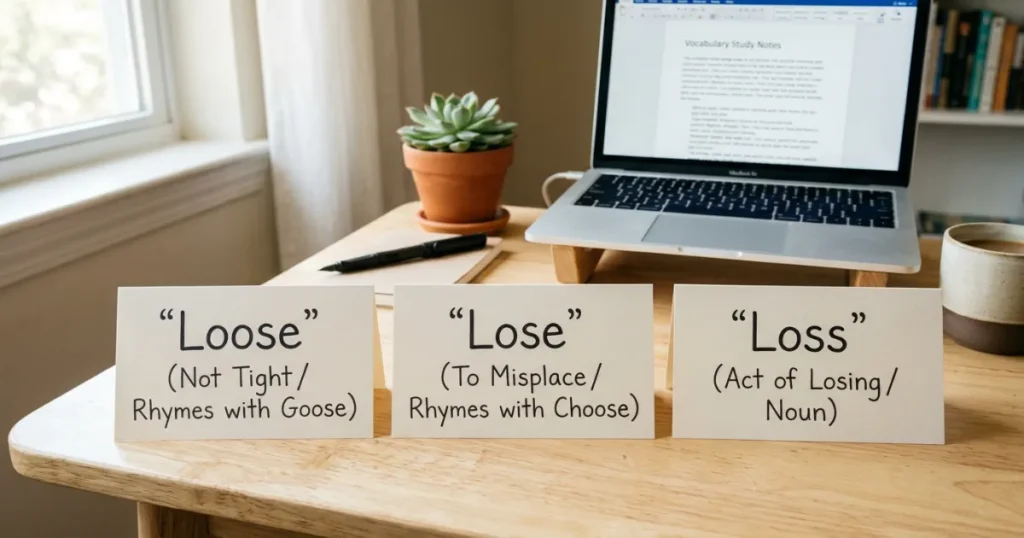
| Loss | Noun | The process or instance of losing something | The business suffered a heavy financial loss. | Use when referring to the event or state of losing. |
| Loser | Noun | A person or team that suffers defeat | Neither team wanted to be the loser in the final. | Use as a noun for one who loses a game or competition. |
The Grammar Behind Loose and Lose
To master these terms in your writing, it helps to examine how each word functions grammatically inside sentences.
Understanding Loose as an Adjective
In the majority of everyday sentences, loose functions as an adjective modifying a noun or pronoun. It describes physical attributes, states of attachment, or degrees of restriction.
1. Describing Fit and Tightness
When referring to clothing, footwear, or equipment, loose describes items that leave extra space or are not tightly compressed.
- The belt was too loose, so his pants kept sliding down.
- Make sure the shoes are not too loose before you start running.
- The mechanic noticed a loose wire near the car battery.
2. Describing Restraint or Confinement
Loose also describes animals, people, or objects that are unchained, unbound, or set free from physical boundaries.
- The farmer checked the fence to ensure no cattle got loose.
- Several loose papers blew off the desk when the window opened.
- Dogs are not allowed to run loose in the city park.
3. Describing Broad or Imprecise Ideas
In abstract contexts, loose describes connections, groupings, or translations that lack strict precision or tight organization.
- The movie is a loose adaptation of a famous nineteenth century novel.
- They formed a loose coalition to address local environmental concerns.
- The translator gave a loose explanation of the complex document.
Rare Verb Usage of Loose
It is worth noting that loose can occasionally function as a formal verb meaning to release, unleash, or set free. For example, a writer might state that a hunter loosed an arrow from the bow or that a storm loosed its fury on the coast. However, in modern English, people generally use the verb loosen when talking about making something less tight, or release when talking about setting something free.
Understanding Lose as an Irregular Verb
Unlike loose, the word lose functions exclusively as an irregular verb. Its past tense and past participle forms are both lost, and its present participle form is losing. Because it is a verb, it expresses an action performed by a subject.
1. Action of Misplacing or Forgetting
Use lose when someone cannot find an object, an idea, or a location due to carelessness, distraction, or accident.
- I always lose my reading glasses when I leave them on the counter.
- Do not lose your boarding pass before reaching the gate.
- He tends to lose his train of thought when interrupted.
2. Suffering Defeat in Competition
Use lose when a person, team, or organization fails to win a game, match, contest, or election.
- The basketball team will lose the match if they keep making errors.
- Nobody likes to lose a fair competition after working hard.
- The candidate began to lose ground in the late opinion polls.
3. Experiencing Deprivation or Reduction
Use lose when someone experiences a reduction in quantity, value, control, or physical weight.
- Many people hope to lose weight by walking every day.
- The company will lose valuable customers if service quality drops.
- Try not to lose your temper during the business negotiation.

Why People Misspell Lose as Loose
Even experienced writers occasionally swap these two words when typing quickly. Understanding the psychological and phonetic triggers behind this mistake makes it much easier to avoid.
Vowel Pronunciation Confusion
In English spelling, a double OO letter combination frequently creates a long “oo” sound, as seen in everyday words like boot, cool, food, moon, room, and tool.
Because the word lose is pronounced with that exact same long “oo” sound (/luːz/), writers naturally assume that it should contain a double OO. Their visual brain expects the spelling to match the spoken sound, leading them to type loose.
However, lose is pronounced with a voiced Z sound at the end (/luːz/), while loose is pronounced with a voiceless S sound (/luːs/).
- Loose ends with an S sound like goose, moose, noose, and hoose.
- Lose ends with a Z sound like choose, snooze, shoes, and news.
Confusion with Other Double-O Verbs
English contains several common verbs that end in a voiced “ooz” sound and use a double OO spelling pattern. The most notable example is choose.
Because choose and lose rhyme perfectly in modern English, writers assume they follow the exact same spelling structure. They reason that if choose uses double OO, then lose should also use double OO.
This logical trap leads directly to the misspelling loose. Remembering that choose uses two O’s while lose uses only one O breaks this misleading pattern.
Simple Memory Tricks for Correct Usage
Retaining the correct spelling becomes effortless when you use reliable visual and phonetic tricks.
Method 1: The “Lost an O” Rule
The most effective trick for keeping these words straight is focusing on the number of letters in each word:
- Lose has lost an O (it only has one O).
- Loose has an extra O (it is loose and baggy).
Method 2: The Sound Association Test
Pay attention to how the words sound when spoken out loud and connect them to rhyming words:
- Loose rhymes with goose and moose.
- Lose rhymes with choose and snooze.
Ask yourself a simple check question: Am I talking about a loose goose, or did I snooze and lose?
If you are describing a loose goose, use double OO. If you are talking about what happens when you snooze and lose, use a single O.
Real World Examples of Correct Usage
Here are natural example sentences demonstrating how to use loose and lose accurately across various everyday writing contexts.
Daily Conversations and Personal Writing
- My favorite pair of jeans is feeling a little loose after all the hiking I did this month.
- Please make sure the dog’s leash does not come loose during the walk.
- I always seem to lose my car keys right when I am running late.
- We cannot afford to lose another game if we want to make the playoffs.
- He gave a loose estimate of how long the home repairs would take.
- You will lose your balance if you stand on that wobbly chair.
Workplace, Business, and Professional Communication
- We must address the client’s concerns quickly so we do not lose their account.
- The safety inspector found a loose handrail on the staircase leading to the office basement.
- The company expects to lose revenue during the scheduled factory maintenance.
- Employees should secure any loose files on their desks before leaving for the weekend.
- If we do not adjust our pricing strategy, we will lose market share to newer competitors.
- The manager gave a loose outline of the new project goals during the morning meeting.
Academic, Scientific, and Literary Contexts
- Environmental researchers warned that loose soil along the riverbank could cause a major landslide.
- Patients who fail to complete the full course of treatment may lose the progress they made.
- The paper provided a loose interpretation of the historical evidence gathered from the site.
- Early astronomers risked their reputations when theories began to lose support among peers.
- The fabric of the ancient garment was so loose that museum curators handled it with special gloves.
Related Common Spelling Errors
Spelling slip-ups often cluster around silent vowels, double letters, or tricky letter transpositions. Reviewing related words helps strengthen your overall vocabulary accuracy.
1. Letter Transpositions in Common Words
Just as people reverse letters or add extra vowels in loose and lose, writers frequently swap adjacent vowels in other everyday terms. For instance, people often struggle with vowel placement when deciding between recieve or receive or when choosing between thier or their.
2. Double Letter Confusion and Spacing Errors
Adding unnecessary letters or dropping required double consonants creates another category of widespread typos. Writers frequently face double letter choices when deciding between occured or occurred or when deciding between single and double letters in alot or a lot.
3. Dropping Silent Vowels and Consonants
Dropping internal letters leads to common mistakes in daily vocabulary. Writers frequently miss silent letters when deciding between definately or definitely or when choosing between suprise or surprise.
4. Regional Spelling Differences
While some English words change spellings depending on regional standards, others remain fixed globally. Navigating choices like analyzing or analysing or comparisons such as armor or armour requires knowing regional preferences.
American English vs. British English Usage
Some English words undergo spelling alterations when moving between American English and British English standards. For example, Americans write color, center, and organize, while British writers prefer colour, centre, and organise.
However, when it comes to loose and lose, there is no regional variation whatsoever.
- American English: Loose (adjective) / Lose (verb)
- British English: Loose (adjective) / Lose (verb)
- Canadian English: Loose (adjective) / Lose (verb)
- Australian English: Loose (adjective) / Lose (verb)
- New Zealand English: Loose (adjective) / Lose (verb)
In every major dialect of standard English across the world, loose and lose maintain the exact same definitions, grammatical roles, and spellings.
Clear Summary and Final Guidelines
Mastering the difference between loose and lose comes down to keeping a few clear principles in mind:
- Loose (spelled with double OO) is an adjective that means not tight, untied, baggy, or free from restraint.
- Lose (spelled with a single O) is a verb that means to misplace an item, to suffer defeat, or to be deprived of something.
- Remember that when you lose something, the word itself has lost an O.
- Test the sound: loose rhymes with goose (soft S sound), while lose rhymes with choose (Z sound).
- All global varieties of English use the exact same spellings for both terms.
By running the sound test or relying on the “lost an O” memory trick, you can choose the correct word with complete confidence every single time you write.

Frequently Asked Questions
What is the past tense of lose?
The past tense and past participle of the verb lose is lost (for example, I lost my keys yesterday). The word loosed is the past tense of the verb form of loose, which means released or set free (for example, He loosed the dog from its leash).
What is the difference between lose and loss?
Lose is an irregular verb that describes the physical action of misplacing something or suffering defeat (for example, We do not want to lose the match). Loss is a noun that refers to the instance, event, or amount of losing something (for example, The company reported a severe financial loss).
Can loose ever be used as a verb in modern writing?
Yes, but it is uncommon in everyday speech. Loose can act as a verb meaning to release, untie, or set free (for example, The archer loosed an arrow toward the target). However, if you are describing making something less tight, use the verb loosen instead.
Is loose weight or lose weight the correct phrase?
The correct phrase is always to lose weight. Writing loose weight is a spelling error. You are taking the action of losing pounds, so you need the verb form lose.
How can I train myself to stop typing loose instead of lose?
The easiest way to train yourself is to pause whenever you write about misplacing an item, failing a test, or losing a sporting event. Remind yourself that when you lose something, the word itself has lost an O.