When comparing wack vs whack, picking the right word comes down to whether you are describing something bad or strange versus a hitting action. While both terms sound identical when spoken out loud, they serve entirely different roles in the English language and belong to different levels of formal grammar.
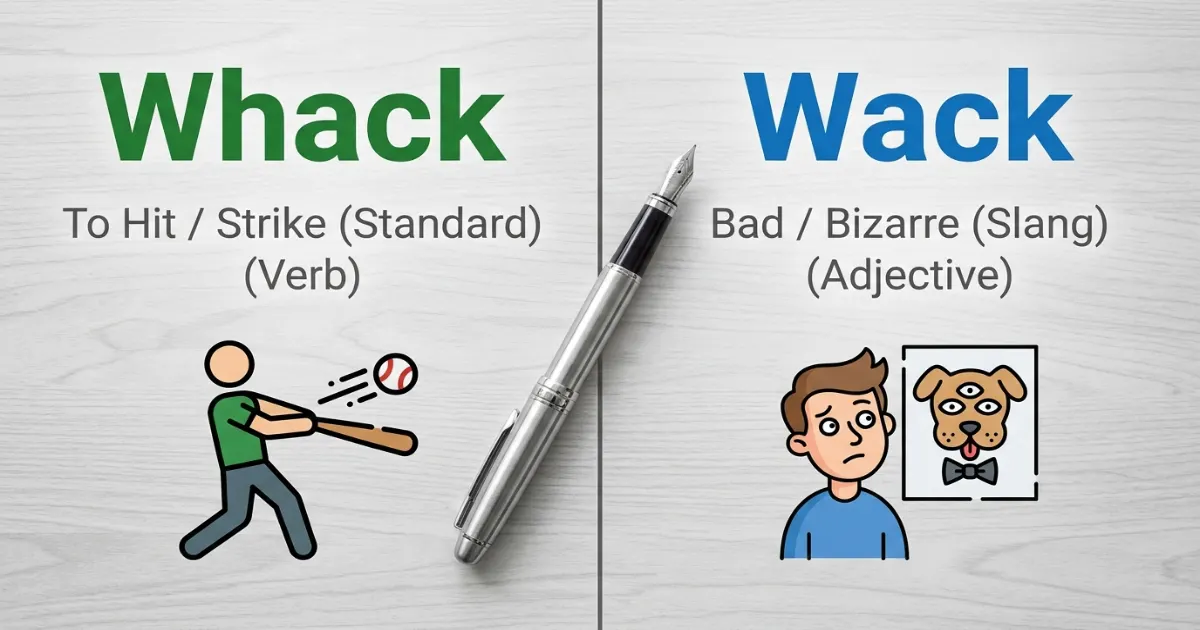
The word whack (spelled with an h) is a long-standing standard English verb and noun that refers to striking or hitting something with a sharp blow, or taking a turn at an activity. The word wack (spelled without an h) is modern informal slang used to describe something that is bad, weird, crazy, annoying, or inferior.
Using wack when you mean whack is a very common spelling mistake in written English. Understanding how these two terms function grammatically, where they came from historically, and how they operate in common idioms will keep your writing clear, professional, and context-appropriate.
Quick Definition and Direct Answer
Wack and whack are homophones with completely distinct definitions, grammatical rules, and linguistic origins.
- Whack (with an h) is the standard English word meaning to hit, strike, chop, or attempt something.
- Wack (without an h) is informal slang meaning bad, bizarre, annoying, or low quality.
If you ever feel unsure while drafting an essay, email, or article, remember a simple check: if there is physical contact, a sharp impact, or an attempt involved, use whack. If you are describing something disappointing or weird in casual conversation, use wack.
Quick Comparison Table
| Word or Phrase | Part of Speech | Primary Meaning | Natural Example Sentence | When To Use It |
| Whack | Verb / Noun | To hit sharply; a hard blow; a trial or attempt | He gave the ball a strong whack with the bat. | Use when referring to striking something or taking a turn. |
| Wack | Adjective / Noun | Bad; strange; unfair; an eccentric person | That rule is totally wack and makes no sense. | Use in casual contexts to mean weird, bad, or inferior. |
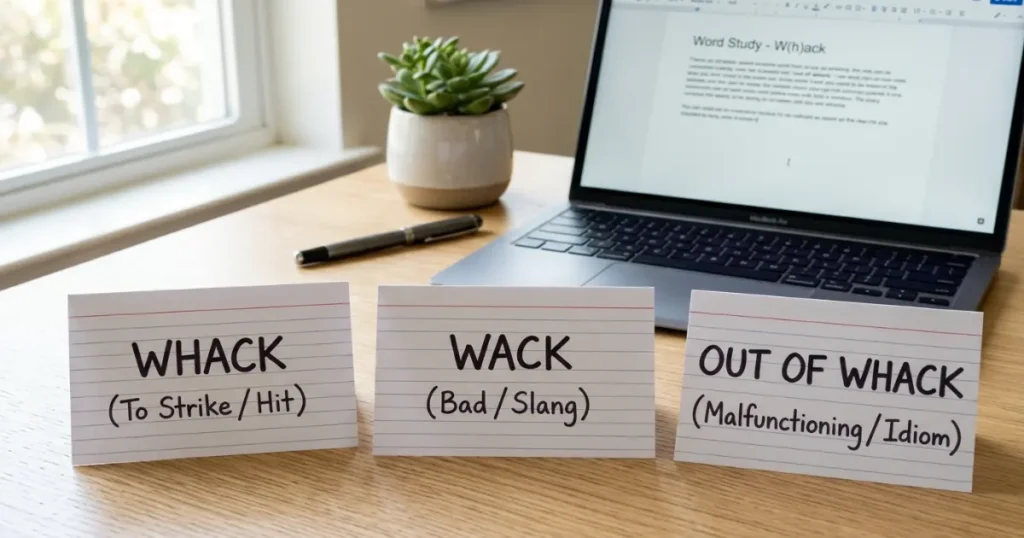
| Out of whack | Idiom | Out of alignment; not working properly | My sleep schedule is completely out of whack. | Use to describe something disorganized or malfunctioning. |
| Wacko | Noun / Adjective | Eccentric; crazy; wild | He had some wacko theory about alien landings. | Use informally to describe erratic behavior. |
| Bushwhack | Verb | To ambush; to cut through dense woods | We had to bushwhack our way through the brush. | Use when clearing a path or launching a surprise attack. |
The Grammar and Origin Behind Whack and Wack
To use wack vs whack accurately in your writing, it helps to examine how each word developed over time and how it functions inside sentences.
Understanding Whack (Standard English)
The word whack has been an authentic part of the English language since the early eighteenth century. Linguists believe it originated as an onomatopoeia, which is a word that mimics the actual sound it describes, echoing the sharp noise made by a sudden impact, slap, or blow.
1. Whack as a Verb
As a verb, whack describes the physical action of striking something forcefully with a hand, stick, tool, or weapon.
- She had to whack the side of the television to clear the static.
- The lumberjack continued to whack away at the fallen tree log.
- Watch out or you will whack your head on the low basement beam.
- He attempted to whack the tennis ball over the net.
2. Whack as a Noun
As a noun, whack refers to the physical blow itself, or informally to a turn, chance, or attempt at completing an activity.
- The baseball player hit the ball with a powerful whack.
- Let me take a whack at solving this complex math puzzle.
- Everyone on the team deserves a fair whack at the opportunity.
- He received a painful whack on the shin during the soccer match.
Understanding Wack (Slang and Informal Use)
The word wack is a much newer addition to the English vocabulary. It emerged in American urban slang during the late twentieth century, rising to widespread popular culture prominence through hip-hop music and youth culture during the 1980s and 1990s.
It originally derived as a shortened variant of wacky (which means eccentric, crazy, or erratic). Over time, its meaning shifted away from harmless eccentricity to describing anything disappointing, ugly, unfair, poorly made, or frustrating.
1. Wack as an Adjective
In informal speech, wack describes things, ideas, or situations that are bad, boring, strange, or completely unacceptable.
- The food at that new neighborhood diner was completely wack.
- Calling off the championship game at the last minute was a wack decision.
- His new album sounds really wack compared to his early records.
- It feels wack that we have to work on a national holiday.
2. Wack as a Noun
In casual conversation, wack can also refer to a person who behaves erratically, foolishly, or untrustworthy.
- Do not listen to his advice; he is acting like a total wack.
Because wack is strictly informal slang, standard style guides recommend avoiding it in formal academic essays, professional business correspondence, legal documents, and news reporting unless you are quoting spoken dialogue directly.
Understanding Common Idioms and Phrases
Several popular English idioms feature these words. Knowing which spelling belongs in each expression prevents embarrassing writing mistakes.
1. Out of Whack
The phrase out of whack is a standard English idiom meaning out of order, misaligned, malfunctioning, or unequal. It always uses the spelling whack with an h.
- Correct: My back went out of whack after lifting those heavy moving boxes.
- Incorrect: My back went out of wack after lifting those heavy moving boxes.
- Example: After staying up late all weekend, my internal sleep clock felt completely out of whack.
2. Take a Whack At
The idiom take a whack at means to attempt, try, or make an effort at accomplishing a task. It always uses whack.
- Correct: I will take a whack at repairing the lawnmower engine tomorrow.
- Incorrect: I will take a wack at repairing the lawnmower engine tomorrow.
- Example: Even though she had never painted before, she decided to take a whack at canvas landscape painting.
3. Whack-a-Mole
The classic arcade game where players hit plastic moles with a rubber mallet as they pop up is spelled Whack-a-Mole. It uses whack because the entire game centers around physical striking.
- Example: Managing constant server crashes feels like playing an endless game of Whack-a-Mole.
4. Have a Whack
In British, Canadian, and Australian English, have a whack means to take a turn or have a share in something.
- Example: Give your brother a chance to have a whack at the video game.
Why People Confuse Wack and Whack
Even experienced writers accidentally mix up these two words when drafting quickly. Understanding why this mistake happens makes it much easier to avoid.
The Silent H Sound in Spoken English
In modern American, British, and Australian speech, the wh consonant blend at the start of words like whack, which, where, and what sounds identical to a plain w sound for almost all speakers. Linguists refer to this as the wine-whine merger.
Because your ear hears a plain w sound (/wæk/), your brain naturally wants to spell the word without the letter h.
Popularity of Informal Slang in Digital Media
Because the slang term wack appears frequently across social media platforms, music lyrics, and online video content, readers see it written down constantly.
This frequent visual exposure causes people to assume wack is the primary or original spelling for physical striking as well, leading them to drop the h when writing about hitting something or using idioms like out of whack.
Simple Memory Tricks for Correct Usage
Retaining the correct spelling becomes effortless when you use reliable visual and letter associations.
The Hitting Check
Look at the third letter of whack: W – H – A – C – K.
Remember that WHACK has an H for Hitting, Hard blow, or Hammer!
If your sentence involves striking, hitting, physical impact, or trying your hand at an activity, make sure you include the letter H.
The Wild and Bizarre Check
Look at the shorter word wack: W – A – C – K.
Remember that WACK is short for WACKY!
If you can replace the word with wacky, bad, weird, or lame, then wack without the h is the casual slang term you need.

Real World Examples of Correct Usage
Here are practical example sentences demonstrating how to use wack and whack accurately across various writing contexts.
Daily Conversations and Informal Writing
- He gave the golf ball a solid whack and sent it flying straight down the fairway.
- That scary movie had a really wack ending that ruined the entire storyline for everyone.
- I accidentally whacked my knee against the coffee table in the dark.
- It was a wack situation at the airport, but we tried to stay patient.
- She took a quick whack at learning how to surf during her beach trip.
- His excuse for missing the party sounded totally wack.
Workplace, Business, and Professional Communication
- Our financial budget projections got thrown out of whack by the sudden price increase.
- The carpenter used a wooden mallet to whack the timber frame into proper alignment.
- We need to take a fresh whack at resolving these recurring client complaints.
- Equipment that is out of whack must be recalibrated before the factory shift begins.
- The marketing team took a whack at designing a brand new logo for the launch.
Academic, Scientific, and Historical Contexts
- The biological rhythms of nocturnal animals can go out of whack when exposed to constant artificial lighting.
- Historical documents describe how early settlers would whack away dense underbrush to build wilderness trails.
- Scholars noted that urban slang terms like wack gained widespread cultural traction through television broadcasts during the late twentieth century.
- The sudden mechanical shock delivered a sharp whack to the structural beam during testing.
Related Common Confused Words
Vocabulary slip-ups often cluster around homophones, informal terms, and letter variations. Reviewing related words helps strengthen your overall writing accuracy.
1. Homophone Confusion and Word Choices
Just as people confuse wack vs whack, writers frequently mix up other words that sound identical but serve different grammatical roles. For instance, writers often review rules when deciding between loose or lose or when choosing between thier or their.
2. Spelling Inversions and Silent Letters
Vowel placement and silent consonants create frequent confusion across everyday vocabulary. Writers frequently review rules for silent letters when deciding between recieve or receive or when choosing between definately or definitely.
3. Spacing and Double Letters
Adding extra consonants or merging separate words creates another category of common typos. Writers frequently double-check letter patterns when deciding between occured or occurred or when deciding on spacing in alot or a lot.
4. Regional Spelling Preferences
While some English words change spellings depending on regional standards, others remain fixed globally. Navigating choices like analyzing or analysing or comparisons such as armor or armour requires knowing regional rules.
American English vs. British English Usage
Some English words change spellings or definitions when moving between American English and British English standards. For example, Americans write color, center, and organize, while British writers prefer colour, centre, and organise.
However, when it comes to wack vs whack, core meanings and primary spellings remain consistent across all major global dialects.
- American English: Whack (hit/strike) / Wack (slang for bad)
- British English: Whack (hit/strike) / Wack (slang for bad)
- Canadian English: Whack (hit/strike) / Wack (slang for bad)
- Australian English: Whack (hit/strike) / Wack (slang for bad)
- New Zealand English: Whack (hit/strike) / Wack (slang for bad)
In British and Australian informal speech, whack also appears in regional phrases like to pay a fair whack (meaning paying a full or heavy share of money). In all international regions, whack remains the standard spelling for striking, while wack is recognized as informal slang.
Clear Summary and Final Guidelines
Mastering the choice between wack vs whack comes down to keeping a few clear principles in mind:
- Whack (spelled with an h) is a standard noun and verb meaning to hit, strike sharply, or take a turn at an activity.
- Wack (spelled without an h) is informal slang meaning bad, weird, disappointing, or inferior.
- The common idiom out of whack always uses the spelling whack.
- Remember that whack has an H for Hitting, Hard blow, or Hammer.
- Use whack in formal writing, school essays, and business documents; keep wack reserved for casual speech and informal dialogue.
By checking whether physical impact or an attempt is involved, you can pick the right word with complete confidence every single time you write.

Frequently Asked Questions
Is wack a real dictionary word?
Yes, wack is recognized in major modern English dictionaries, including Merriam-Webster, Oxford, and Cambridge. However, it is explicitly classified as informal slang, meaning it should generally be avoided in professional, formal, and academic writing.
What is the correct spelling of out of whack?
The correct spelling is out of whack with an h. Writing out of wack is considered a spelling mistake in standard English.
Where did the slang word wack come from?
The slang word wack originated in late twentieth-century American hip-hop culture and urban youth slang. It developed as a shortened variant of wacky, shifting in meaning from crazy or wild to describing something low quality, bad, or unfair.
Can whack mean something other than hitting?
Yes. In informal speech, whack can mean a trial, turn, or attempt (for example, let me take a whack at it). In crime fiction and mob slang, whack is also used as a slang verb meaning to murder someone.
How can I stop confusing wack and whack in my writing?
Train yourself to look for physical action or attempts. If your sentence involves hitting, swinging, striking, or getting something out of alignment, remind yourself that you need the H in whack.