
You are typing an email, writing an essay, or texting a colleague, and you pause at a tricky word. You wonder if you should write seperate or separate to get your point across correctly. Your fingers hover over the keyboard because both options look somewhat familiar.
This hesitation happens to almost everyone who writes in English. The letter “e” and the letter “a” sound identical in the middle of this word, which creates confusion for even the most experienced writers.
In this guide, you will learn the exact spelling, why your brain gets tricked, and easy tricks to never make this typo again. We will cover word forms, pronunciation tips, common mistakes, and practical sentence examples.
By the end of this article, you will feel completely confident choosing between these spellings every single time you sit down to write.
Quick Definition
Separate (with an “a” in the middle) is the only correct spelling in standard English, whether you use it as a verb, an adjective, or a noun. The spelling with an “e” in the middle is an extremely common misspelling that does not exist as an official word in any English dictionary.
Direct Answer
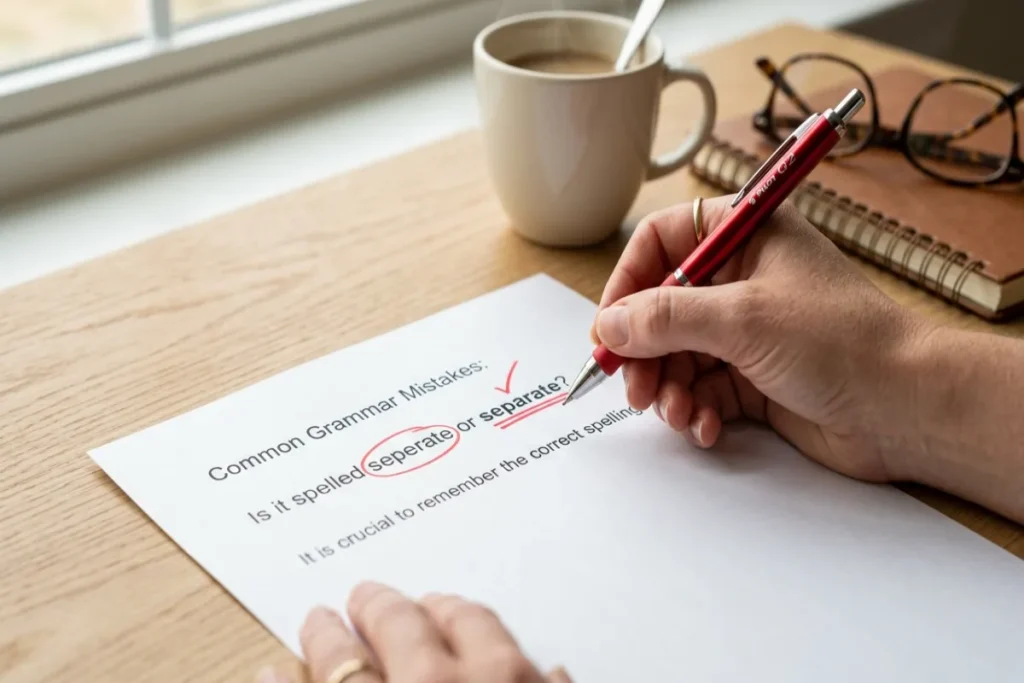
The correct spelling is separate. The form spelled with two middle “e”s is always incorrect.
Comparison Table
| Word / Phrase | Status | Meaning | Example Sentence | When to Use It |
| Separate | Correct | To divide, keep apart, or distinct | Please keep the red clothes separate from the white clothes. | Always use this form for verbs, adjectives, and nouns. |
| Seperate | Incorrect | None (Misspelling) | Please keep the red clothes seperate from the white clothes. | Never use this spelling in formal or informal writing. |
Why “Separate” Tricks Your Brain
Spelling mistakes rarely happen by pure chance. They occur because English spelling rules do not always match the way words sound out loud.
Phonetics and the Schwa Sound
When you speak naturally, you do not pronounce every vowel clearly. In normal speech, the middle vowel in this word turns into a neutral, unstressed vowel sound. Linguists call this neutral sound a schwa.
Because the middle vowel sounds like “uh” or “eh,” your brain tries to guess which letter belongs there. Many people guess the letter “e” because the word begins with an “e” in the first syllable. That simple mental shortcut leads directly to the mistake.
Visual Confusion and Syllables
Look at how the word is built visually:
- First syllable: sep- (uses an e)
- Middle syllable: -ar- (uses an a)
- Final syllable: -ate (uses an a)
Notice that the letter “e” only appears once in the entire correct word, right at the very beginning. However, because the first syllable has an “e,” your eyes want to repeat that letter in the middle section.
Visual symmetry feels natural to the human mind. Breaking that visual symmetry requires conscious attention until muscle memory takes over.

How to Remember the Correct Spelling
Remembering tricky words becomes simple when you rely on targeted memory hooks. Here are three reliable memory tricks that will help you select the right letters every time.
The “A Rat” Memory Trick
The most famous memory trick for this word is hidden directly inside its center. Look closely at the middle four letters of the correct spelling:
Notice the phrase “a rat” right in the middle:
Just tell yourself, “There is a rat in separate.”
If you try to spell it incorrectly, you get “a ret,” which makes no sense. Remembering the rodent keeps the letter “a” firmly in the middle where it belongs.
The “Part” Connection
Another easy way to fix your spelling is to think of a related word that shares the same root origin. The word comes from Latin roots that mean to set apart.
Think of the simple word part. Both words mean dividing things into pieces.
Notice that the word part contains the letter a. If you can spell “part,” you can remember that this word must have an a after the letter “p.”
Syllable Breakdown Method
You can also train yourself to pronounce the word clearly in your head as you type. Split the word into three distinct chunks:
- Sep
- Ar
- Ate
Say “sep – AR – ate” silently to yourself, exaggerating the middle “ar” sound like a pirate saying “arr.” This vocal emphasis instantly removes the confusion.
Understanding the Different Parts of Speech
One reason this word is so common in English is that it performs three distinct jobs in grammar. It can act as a verb, an adjective, or a noun.
Using it as a Verb
As a verb, the word means to divide, disconnect, or cause things to move apart. When used as a verb, it is pronounced with a long “a” sound at the end (sep-uh-rayt).
Here are clear examples of the verb form in action:
- The fence will divide the two yards so the dogs do not fight.
- Teachers often have to disconnect noisy students during study hour.
- You should keep raw meat apart from fresh vegetables while cooking.
- A thin glass wall breaks the kitchen away from the main living room.
When modifying verb tenses, remember these correct forms:
- Separates (present tense)
- Separated (past tense)
- Separating (present participle)
Notice that all these forms keep the letter “a” in the middle.
Using it as an Adjective
As an adjective, the word describes things that are distinct, not attached, or kept in different places. In this form, the ending is pronounced with a short vowel sound (sep-er-it).
Here are examples of the adjective form:
- They decided to ride in two distinct cars to the party.
- The apartment has an attached entrance for extra privacy.
- Please write your feedback on a distinct sheet of paper.
- Each child sleeps in a different bedroom.
Even though the pronunciation changes slightly between the verb and adjective forms, the spelling remains completely identical.
Using it as a Noun
Less frequently, the word serves as a noun, usually in the plural form (separates). In the clothing industry, it refers to individual pieces of clothing—like skirts, pants, and shirts—that are sold individually rather than as a set suit.
Examples of the noun form:
- She prefers buying individual pieces so she can mix and match her outfits.
- The store expanded its display of summer tops and bottoms.
Real-World Sentence Examples
Seeing words used in everyday contexts helps solidify proper usage. Here are several practical examples broken down by context.
Business and Professional Writing
- Please send the invoice in a different email thread so accounting can track it.
- Our company policy requires us to divide confidential files from general office storage.
- The manager held individual meetings with every team member to discuss goals.
If you are drafting professional reports, maintaining proper spelling is vital for credibility. It pays to double-check tricky terms, much like verifying whether to write publically or publicly
in a corporate document.
Everyday Life and Household Contexts
- You must sort the dark laundry from the light laundry before starting the machine.
- The twins decided to get different birthday cakes this year.
- A small curtain divides the sleeping area from the rest of the room.
Academic and Formal Contexts
- Scientists must isolate variables during an experiment to get accurate results.
- The court ruling created two distinct legal guidelines for small businesses.
- Geography plays a major role in keeping populations isolated over time.
When editing academic papers, pay close attention to commonly confused words. Standard spelling rules apply across all formal disciplines, similar to deciding between indexes or indices in technical research.
Common Related Misspellings and Variations
When people make mistakes with this keyword, the error often spreads into related word forms. Understanding how suffixes attach to the root word will protect you from making related errors.
Separation (Not Seperation)
The noun form that describes the state of being divided is separation.
- Correct: The physical distance between the two friends was difficult.
- Incorrect:The physical seperation between the two friends was difficult.
Just like the root word, the noun form maintains the letter “a” in the second syllable: s-e-p-a-r-a-t-i-o-n.
Separately (Not Seperately)
The adverb form describes an action performed individually or apart from others.
- Correct: Each package will ship individually to your home address.
- Incorrect:Each package will ship seperately to your home address.
Keep the core word intact before adding the -ly suffix: separate + ly = separately.
Separator (Not Seperator)
A device or tool used to divide things is a separator.
- Correct: An egg tool helps you divide the yolk from the white easily.
- Incorrect:An egg seperator helps you divide the yolk from the white easily.
Notice how every single word in this family preserves that crucial middle “a”.
Why Auto-Correct Does Not Always Save You
Many writers rely heavily on spell-check tools and smartphone auto-correct. While these technologies are helpful, they are not foolproof.
Typing Speeds and Muscle Memory
If you type quickly, your fingers might default to incorrect patterns. If your keyboard dictionary accidentally learns your mistakes, auto-correct might stop flagging errors.
Similar Confusions in English
English is filled with words where vowels shift unexpectedly. Consider these common spelling hurdles:
- Writing untill or until correctly.
- Choosing between afterward or afterwards in formal essays.
- Knowing when to write focussed or focused in modern text.
Learning the fundamental rules behind your errors makes you independent of automated digital proofreading tools.
Etymology: Where Did the Word Come From?
Understanding a word’s historical origin helps explain its spelling structure.
Latin Roots
The word enters English through Latin roots. It traces back to the Latin word separatus, which is the past participle of separare.
Let us break down the Latin parts:
- se-: a Latin prefix meaning “apart,” “away,” or “aside.”
- parare: a Latin verb meaning “to prepare,” “to yield,” or “to set.”
Because the root verb in Latin is parare (spelled with an a), the Latin derivative kept that vowel. That historical “a” has survived through centuries of language evolution directly into modern English.
Historical Evolution
The word entered Middle English through Old French around the 14th century. Throughout centuries of shifting accents and vowel changes, the written form remained remarkably stable, holding onto its classical Latin root structure.
Knowing that the middle part comes from parare gives you another solid anchor. If you know that words like preparation and repair come from similar ideas of setting things right, remembering the letter “a” becomes much easier.

How to Practice and Eliminate the Typo
Overcoming a deeply ingrained spelling habit requires active practice. Here are four practical strategies to eliminate this spelling mistake forever.
1. The Highlight Strategy
Whenever you write a draft, run a quick search using Ctrl + F (or Cmd + F on Mac) for the string “sep”. Look closely at every matching word in your document. Highlight the middle vowel to confirm it is an “a”.
2. Physical Writing Practice
Muscle memory develops through physical movement. Grab a piece of paper and write out the correct spelling ten times by hand.
As you write each letter, say out loud: “S-E-P – A – R-A-T-E.” Emphasize the middle letter verbally. Writing by hand engages motor pathways in your brain that simple typing does not activate.
3. Visual Sticky Notes
If you make this error often in work emails, write “sep-A-rate” on a small sticky note and place it near your monitor. Seeing the correct letter emphasized visually throughout the workday trains your brain to recognize the pattern instantly.
4. Grouping with Similar Vowel Patterns
Pair this word with other words that cause similar spelling issues. For example, compare how you approach seperate or separate with how you manage other tricky word pairs:
- Knowing whether to write counselor vs councilor based on context.
- Understanding when to use capital or capitol in government documents.
- Distinguishing between alter vs altar depending on meaning.
Building a broader awareness of homophones and spelling traps sharpens your overall editing eyes.
Writing Rules Across Different English Dialects
A common question among English learners is whether spelling rules change depending on region.
American English vs. British English
Many words change spellings across Atlantic boundaries. For instance, Americans write color, center, and check, while British writers prefer colour, centre, and cheque. You might also see variations like armor or armour
or differences such as analyzing or analysing
.
However, this specific word is an exception to regional variation.
There is zero regional difference for this word.
Whether you are writing in American English, British English, Canadian English, or Australian English:
- Separate is always correct.
- Seperate is always incorrect.
No major English-speaking region accepts the double-“e” spelling as valid.
Proofreading Tips for Writers
Before submitting an important document, check your text carefully to ensure your spelling is accurate.
Make sure you always keep “sep-A-rate” spelled with an “a” in the middle, and apply the same rule to related words like separation, separately, and separator. Avoiding double “e” spellings in the root word will immediately keep your writing accurate and professional.
Taking thirty seconds to run through your draft prevents embarrassing typos from reaching your readers, clients, or instructors.
Grammar Exercises to Test Your Knowledge
Test your understanding right now. Read the following sentences and select the correct option for each sentence.
Quiz Questions
- Please place the files in (seperate / separate) folders on your desktop.
- The chef recommended (seperating / separating) the eggs before beating the whites.
- They decided to live (seperately / separately) after working in different cities.
- The storm caused a total (seperation / separation) of the two search teams.
- Is it better to keep business and personal expenses (seperate / separate)?
Answer Key
- separate (Adjective form describing distinct folders)
- separating (Verb form showing an action)
- separately (Adverb modifying how they decided to live)
- separation (Noun form describing the state of division)
- separate (Adjective describing distinct categories)
If you answered all five correctly, your brain has successfully processed the rule!
Summary of Key Rules
To keep your writing clean and accurate, keep these core guidelines in mind:
- Always use an “a” in the middle: The middle vowel must be an “a”.
- Remember “A RAT”: Use the built-in trick sep-A-RAT-e to fix your spelling.
- Keep suffixes consistent: Derivatives like separately and separation also keep the letter “a”.
- Universal rule: This rule applies equally to US, UK, and international English formats.
Common Questions
Why is “seperate” considered wrong if everyone understands what it means?
Standardized spelling ensures consistency across formal communication, publishing, and automated text indexing. While readers might understand a misspelled word, errors distract from your message and can reduce your professional authority.
Is there any context where “seperate” is acceptable?
No. Standard dictionaries categorize it strictly as a common misspelling. It should be corrected in all writing contexts, including casual texts, business emails, and creative writing.
How do you pronounce “separate” correctly?
When used as a verb, it is pronounced SEP-a-rayt (rhyming with “gate”). When used as an adjective or noun, it is pronounced SEP-er-it (rhyming with “fit”).
What is the easiest way to remember how to spell “separately”?
Spell the base word separate first using the “a rat” trick (sep-A-RAT-e), then simply add the suffix -ly to the end.
Does the spelling change when adding “-ed” or “-ing”?
No. Simply drop the final “e” before adding “-ing” (separating) or add a “d” for past tense (separated). The middle letter “a” never changes.
Are there other words with similar middle-vowel traps?
Yes. Words like definitely, category, and maintenance frequently trick writers due to unaccented middle vowels. Applying targeted visual tricks helps master those words as well.
Is “separate” used as a noun in everyday conversation?
It is less common in general speech, but widely used in fashion and retail to describe individual clothing pieces (tops, skirts, trousers) sold individually rather than as matching sets.
Does the word “separate” ever use three “e” letters?
No. The correct word contains two “e” letters total: one at the very start and one at the very end. The middle two vowels are both the letter “a”.
Final Takeaway
Deciding between seperate or separate comes down to remembering one simple letter in the middle of the word.
Never let unaccented vowel sounds confuse your spelling choices again. Keep the phrase “there is a rat in separate” in mind whenever you write, and you will get this word right every single time.
Clean, accurate spelling builds reader trust and makes your writing stand out for all the right reasons. Keep practicing these visual habits, use your memory tricks, and write with complete confidence.