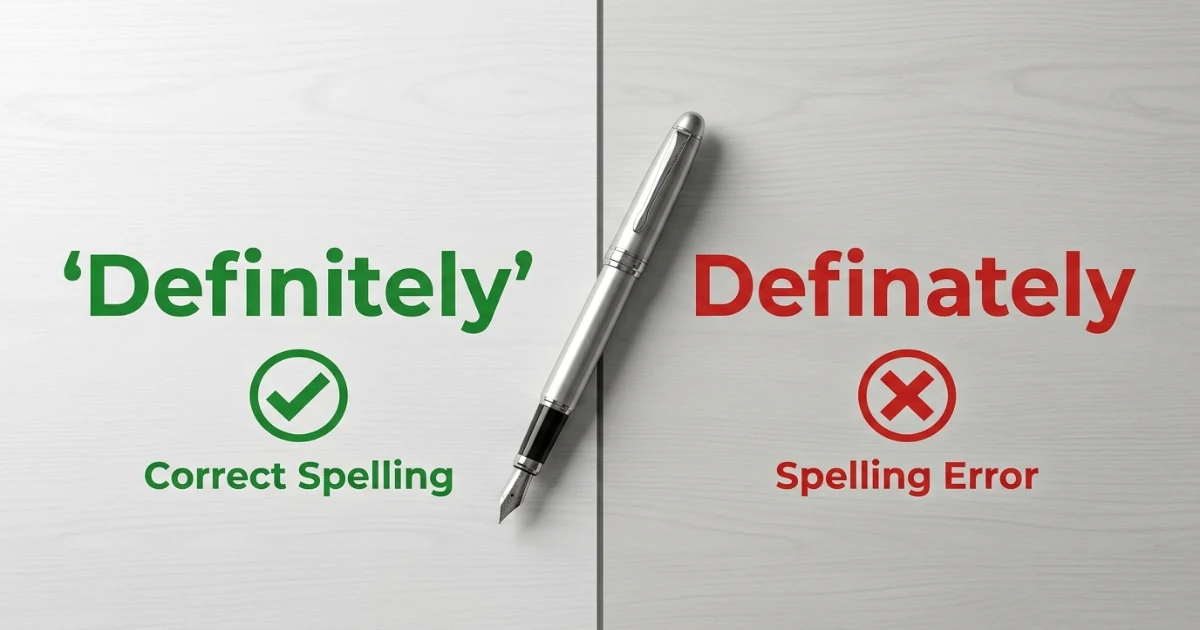
When deciding between definately or definitely, the correct spelling is always definitely.
The form definately is a very common spelling error in written English. You will see it constantly in casual text messages, social media posts, internet forums, and quick informal drafts. However, modern English dictionaries, academic style guides, and professional editing standards classify it strictly as an error. If you write definately in an essay, a cover letter, a business proposal, or a work email, automated spellcheck software will highlight it immediately.
Understanding why this mistake happens so frequently and learning how to spot the root word hidden inside it will help you spell definitely correctly in every context.
Quick Definition and Direct Answer
Definitely is an adverb that means without a doubt, clearly, unmistakably, or unquestionably. It is used to express total certainty about a statement, action, or decision.
- Definitely (with an I in the third syllable) is the only correct standard spelling in standard English.
- Definately (with an A in the third syllable) is a misspelling and should never be used in formal or informal writing.
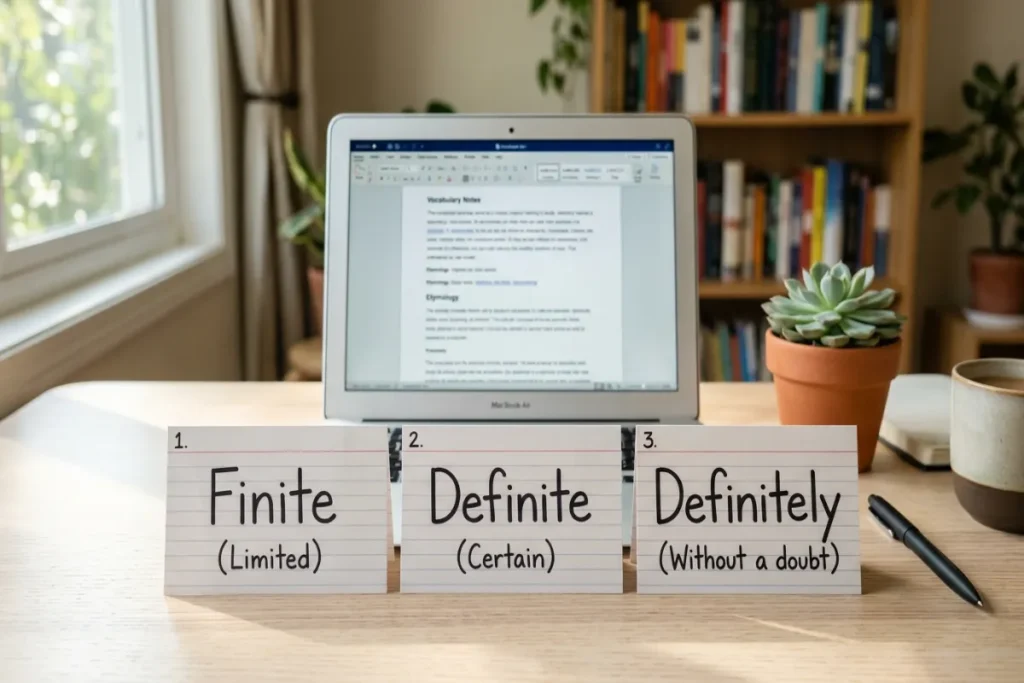
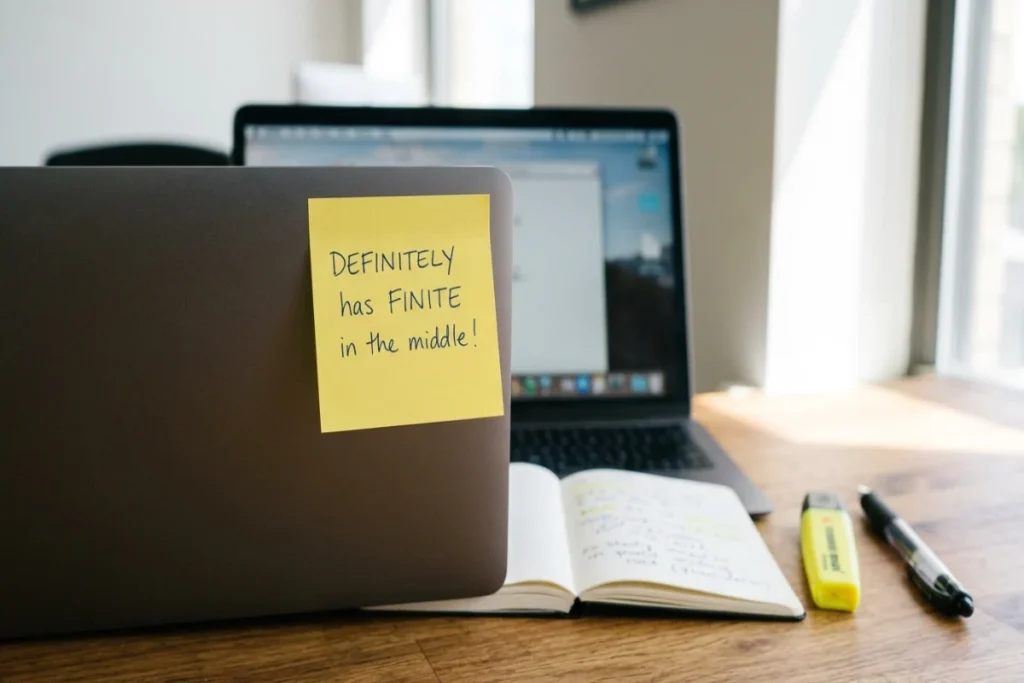
If you ever feel unsure about how to spell this word, remember that it contains the smaller, familiar word finite right in the middle.
Quick Comparison Table
| Word or Phrase | Meaning | Example Sentence | When To Use It |
| Definitely | Without a doubt; certainly; clearly | I will definitely attend the conference next week. | Use whenever you want to express complete certainty. |
| Definately | None (Spelling error) | Incorrect: This is definately the best option. | Never. Do not use this form in standard English. |
| Definite | Certain; clear; fixed in meaning | We need a definite answer by tomorrow morning. | Use as an adjective to describe a noun that is clear or fixed. |
| Indefinitely | For an unlimited or unspecified time | The store closed its doors indefinitely. | Use when an action has no fixed end date. |
| Definition | A statement of the exact meaning of a word | Consult the dictionary for a clear definition. | Use as a noun when referring to the exact meaning of terms. |

The Grammar and Etymology Behind Definitely
To understand why definitely is spelled with an I rather than an A, it helps to examine its historical roots and grammatical construction. English spelling often seems arbitrary on the surface, but looking at word families reveals a consistent underlying logic.
The Origin: Latin Root Finitus
The word definitely traces its lineage back to the Latin verb definire, which means to limit, determine, or set bounds to. That Latin verb is composed of two parts:
- The prefix de-, which functions here as an intensifying element meaning completely or fully.
- The root finire, meaning to limit, bound, or end.
From finire, Latin derived the participle finitus, meaning bounded or limited. This root traveled into Middle French as definit and eventually entered Middle English as definite.
This historical lineage explains why the root word contains the letter I in its third syllable. The root word is identical to the modern English word finite, which refers to something that has fixed limits or boundaries.
Word Family Breakdown
Every step in building this word family preserves the letter I:
- Fine (adjective/noun): Relates to boundaries or precision.
- Finite (adjective): Possessing fixed limits or boundaries.
- Definite (adjective): Fixed, precise, explicit, or certain.
- Definitely (adverb): In a definite manner; with complete certainty.
Notice how the letter A does not exist anywhere in this word family. Adding the adverbial suffix -ly to the base adjective definite simply attaches to the final silent e:
- Definite + ly = Definitely
Because the adjective definite ends in -ite, the adverb definitely must retain that exact spelling.
How Definitely Functions in Sentences
As an adverb, definitely fulfills several structural roles depending on the sentence layout:
Modifying Main Verbs
When modifying a main verb, definitely typically sits directly before the verb or between an auxiliary verb and the main verb.
- She definitely wants to move to New York.
- We have definitely decided to launch the product in September.
- The committee will definitely approve the funding request.
Modifying Adjectives
When modifying an adjective, definitely intensifies the quality described by that adjective.
- The second candidate was definitely more qualified than the first.
- This solution is definitely safer than the old method.
- The room felt definitely colder after the sun went down.
Modifying Other Adverbs
Adverbs can modify other adverbs to add emphasis regarding degree or certainty.
- He spoke definitely more clearly during his second presentation.
- The car drove definitely faster on the open track.
Operating as an Independent Exclamation
In spoken English and informal text exchanges, definitely often stands alone as a one-word answer expressing enthusiastic agreement.
- Are you coming to the concert tonight? Definitely!
- Do you think we should update the website? Definitely.
Why People Misspell Definitely as Definately
Despite being one of the most frequently used adverbs in English, definitely consistently ranks among the most misspelled words in the language. Understanding the psychological and phonetic triggers behind this error can protect your own writing.
1. Phonetic Ambiguity and the Schwa Sound
In spoken English, vowels in unstressed syllables often reduce to a neutral, blurred sound known in linguistics as a schwa (represented in the International Phonetic Alphabet as /ə/).
When speakers pronounce definitely at a normal conversational speed, they do not clearly enunciate each syllable as def-i-nite-ly. Instead, the third syllable loses its sharp I sound:
- Spoken pronunciation: /ˈdɛf.ə.nət.li/ or /ˈdɛf.nət.li/
Because the vowel in that third syllable sounds like a weak “uh” sound, the ear provides almost no guidance on which vowel letter belongs on the page. Writers who spell words purely by sound often guess the letter A, producing definately.
2. Muscle Memory from Adverbs Ending in -ately
English contains dozens of common adverbs that end in the suffix combination -ately. These words are derived from adjectives ending in -ate:
- Fortunately (from fortunate)
- Immediately (from immediate)
- Accurately (from accurate)
- Passionately (from passionate)
- Deliberately (from deliberate)
- Separately (from separate)
- Legitimately (from legitimate)
- Compassionately (from compassionate)
Because writers encounter and type the -ately letter string thousands of times, their fingers build visual and tactile habits around it. When typing definitely, the subconscious mind visualizes an adverb and automatically applies the familiar -ately pattern, resulting in definately.
3. Autocorrect Reliance and Typing Fatigue
On touchscreen keyboards, the letters A and I are frequent targets for mis-taps. When typing rapidly on a mobile phone, hitting an A instead of an I is a minor mechanical error.
However, if a writer relies heavily on autocorrect without actively checking their spelling, they may not notice when an incorrect form slips past or when a draft saves the misspelling into a custom dictionary. Over time, seeing the wrong spelling uncorrected weakens visual recognition of the true form.
Simple Memory Rules to Lock in the Correct Spelling
Retaining correct spelling becomes effortless when you use reliable mental associations. Here are three practical tricks to ensure you never write definately again.
Method 1: The “Finite” Search Rule
The single most effective trick for spelling definitely is finding the word finite right in the middle of it.
If you can spell finite, you already know how to spell definitely:
- De + FINITE + ly = DEFINITELY
Ask yourself a simple check question whenever you draft: Is there a finite inside my definitely?
If the answer is yes, your spelling contains the letter I and is correct.
Method 2: The “Absolute Zero A’s” Rule
Another foolproof strategy is remembering that the word definitely contains zero instances of the letter A.
Count the vowels in definitely:
- E (first syllable)
- I (second syllable)
- I (third syllable)
- E (fourth syllable)
- Y (ending vowel sound)
Notice that the letter A does not appear anywhere in the word. If you spot an A anywhere in your spelling of definitely, it is automatically incorrect.
Method 3: Connect with Definite and Definition
Link definitely to its close relatives in your mind:
- Definite (adjective)
- Definition (noun)
- Definitive (adjective)
None of these related words use the letter A in their third syllable. You would never write defanation or defanitive; connecting definitely to definition keeps the letter I firmly in place.
Detailed Example Sentences in Different Styles
To illustrate natural usage, here are expanded real-world examples categorized by writing context.
Daily Conversations and Personal Communication
- We are definitely planning to take a road trip up the coast this summer.
- I am definitely feeling more confident about the exam after reviewing the study guide.
- That was definitely one of the best books I have read all year.
- If you need help moving this weekend, I can definitely lend a hand.
- My dog definitely knows when it is time for his evening walk.
Workplace, Business, and Formal Communication
- Our engineering team will definitely deliver the software update before the quarterly deadline.
- The chief financial officer definitely supports the proposed expansion into international markets.
- Please let us know by Thursday if your team can definitely attend the project kickoff meeting.
- The new automation process is definitely reducing operational costs across all departments.
- We should definitely review the legal compliance terms before signing the vendor agreement.
Academic, Scientific, and Literary Writing
- The empirical data definitely demonstrate a strong correlation between sleep duration and cognitive performance.
- Archeological evidence gathered from the site definitely points to an advanced settlement during the Bronze Age.
- While earlier studies were inconclusive, recent genetic testing definitely confirms the classification of the species.
- The author’s use of recurring motifs definitely reinforces the central themes of isolation and memory throughout the novel.
- Environmental changes of this magnitude will definitely alter migratory patterns across the continent over the coming decades.
Related Common Spelling Errors to Watch For
Spelling mistakes rarely occur in isolation. Writers who struggle with definitely often run into similar issues with other words involving silent letters, tricky vowel shifts, or confusing suffix rules.
1. Separate vs. Seperate
Much like definitely, the word separate is frequently misspelled as seperate. People put an E in the middle syllable instead of an A because of the unstressed pronunciation.
- Correct: Separate
- Incorrect: Seperate
- Memory Trick: There is a rat in separate.
2. Dropping or Swapping Silent Letters
Writers who drop the I in definitely often miss silent or soft consonants in other everyday terms. For example, people frequently drop internal consonants when deciding between suprise or surprise or when choosing between wich or which in fast-paced daily writing.
3. Suffix Misconceptions and Double Letters
Tricky suffix rules cause frequent errors across formal vocabulary. Writers polishing professional correspondence often double-check rules for single versus double letters in words like publically or publicly or phrase choices like make do or make due.
4. Regional Spelling Shifts
While some English words change spellings depending on regional standards, others remain fixed worldwide. Understanding how words shift between dialects makes it easier to navigate choices like analyzing or analysing or comparisons such as armor or armour.
American English vs. British English Usage
Many English words undergo spelling alterations when moving between American English and British English. Common examples include:
- Color (American) vs. Colour (British)
- Center (American) vs. Centre (British)
- Defense (American) vs. Defence (British)
- Organize (American) vs. Organise (British)
However, definitely is entirely uniform across all global varieties of English.
- American English: Definitely (spelled with an I)
- British English: Definitely (spelled with an I)
- Canadian English: Definitely (spelled with an I)
- Australian English: Definitely (spelled with an I)
- New Zealand English: Definitely (spelled with an I)
No matter where your audience is located, definitely is the only correct spelling, and definately is universally recognized as a mistake.
Synonyms and Alternatives to Definitely
While definitely is a clear word, overusing it can make writing feel repetitive. Varying your choice of adverbs strengthens your prose and maintains reader engagement.
High-Certainty Synonyms
- Certainly: Expresses complete confidence without qualification.
- Example: We will certainly consider your application for the position.
- Unquestionably: Emphasizes that something is beyond dispute or doubt.
- Example: She is unquestionably the most talented designer on the team.
- Undoubtedly: Indicates that no doubt exists regarding the statement.
- Example: The project was undoubtedly a major success for the agency.
- Absolutely: Expresses total agreement or unreserved certainty.
- Example: I am absolutely sure that the figures in the report are correct.
- Indisputably: Stresses that a facts cannot be argued against or challenged.
- Example: The findings are indisputably accurate based on the laboratory tests.
- Decidedly: Suggests a clear, noticeable, and resolute quality.
- Example: The atmosphere in the office was decidedly more positive after the announcement.
Contextual Usage Table
| Context | Recommended Alternative | Example Sentence |
| Formal Research | Indisputably / Demonstrably | The evidence demonstrably supports the conclusion. |
| Workplace Emails | Certainly / Without a doubt | I will certainly send those files over today. |
| Casual Speech | Absolutely / For sure | That was for sure the best movie of the year. |
| Academic Essays | Unquestionably / Undoubtedly | This policy was unquestionably a turning point in history. |

Clear Summary and Final Guidelines
Mastering the spelling of definitely comes down to recognizing its internal structure and keeping a few clear principles in mind:
- Definitely (spelled with an I in the third syllable) is the only standard, correct spelling in English worldwide.
- Definately (spelled with an A) is an error caused by spoken pronunciation and confusion with words ending in -ately.
- The root word finite lives directly inside definitely (De + FINITE + ly).
- The correct word contains zero A’s. If you see an A, it is wrong.
- Regional dialects (American, British, Canadian, Australian) all use the exact same spelling: definitely.
By remembering the word finite inside definitely, you can write with absolute confidence every single time.
Frequently Asked Questions
Is definately ever an acceptable alternative spelling?
No. Definately is not recognized as a valid word or variant spelling in any standard English dictionary, including the Oxford English Dictionary, Merriam-Webster, Cambridge, or American Heritage. It is strictly classified as a spelling error in all formal, academic, and professional contexts.
Why is definitely so commonly misspelled?
People misspell definitely because the third syllable uses an unstressed vowel sound (schwa) in spoken English, making the exact vowel hard to hear. Additionally, many writers accidentally copy the ending pattern of common adverbs that end in -ately, such as fortunately or immediately.
What is the noun form of definitely?
The primary noun forms associated with definitely are definition (the statement of meaning) and definiteness (the quality of being clear or certain). Like definitely, both related noun forms use the letter I in their middle syllables and contain no letter A.
What is the difference between definite and definitive?
While both are adjectives derived from the same root, definite means clear, explicit, or certain (e.g., a definite answer). Definitive means conclusive, authoritative, or final beyond further change (e.g., the definitive biography of the president).
How can I train myself to stop typing definately?
The easiest way to train your visual memory is to break the word into three distinct parts: De + FINITE + ly. Whenever you prepare to type the word, pause briefly and spell finite in your mind first. Once you link definitely to finite, the incorrect letter A will disappear from your writing naturally.