
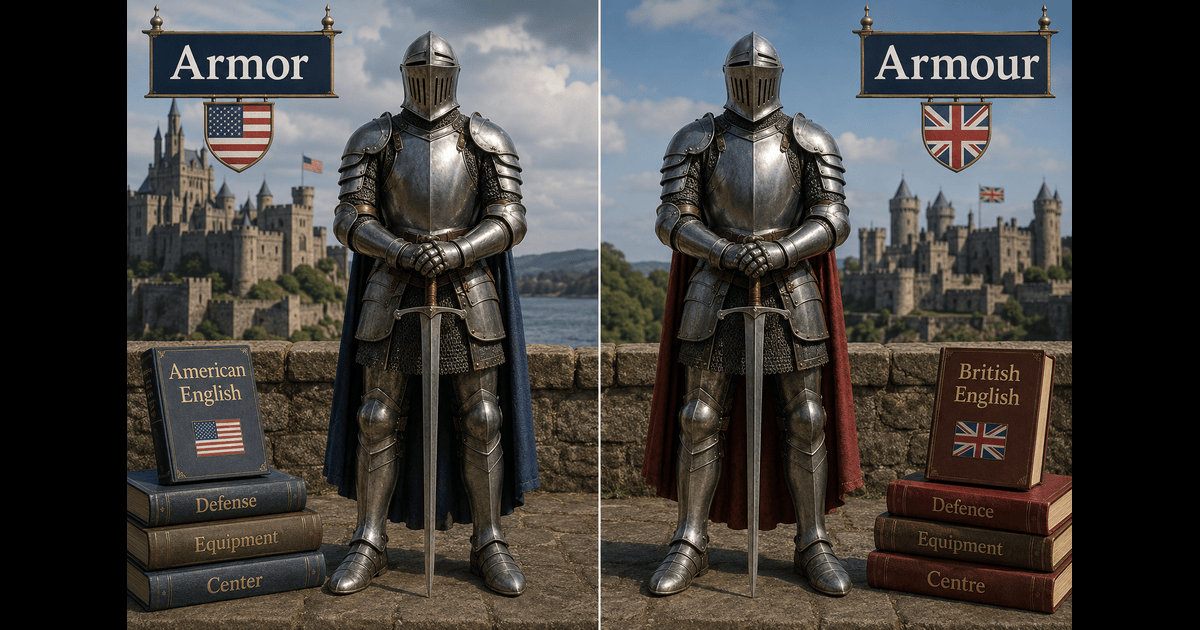
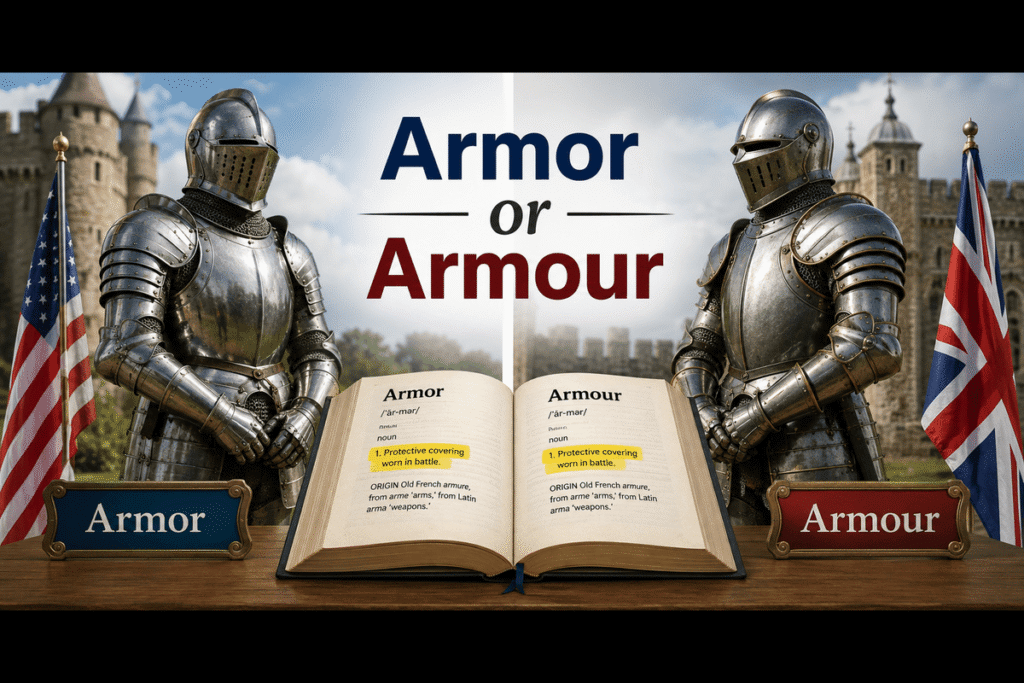
If you have searched armor or armour, you are probably wondering which spelling is correct. The good news is that both words are correct. The only difference is the type of English you are using. Armor is the standard spelling in American English, while armour is the standard spelling in British English and many other English speaking countries.
This spelling difference confuses many people because the meaning never changes. You may read one version in an American novel and another in a British newspaper. Both refer to the same protective covering worn by soldiers, police officers, or anyone who needs protection.
Knowing the correct spelling matters more than you might think. Using the version that matches your audience makes your writing look polished and consistent. It also helps you avoid mixing American and British English in the same document.
This guide explains the difference in plain English. You will learn why two spellings exist, where each one is used, common mistakes to avoid, real examples, and simple memory tricks that make the rule easy to remember.
Quick Definition
Armor and armour are two spellings of the same word. They both describe protective clothing, metal coverings worn in battle, or any material designed to protect a person or object from harm.
The spelling depends on the variety of English you are using, not on the meaning of the word.
Direct Answer
Use armor if you are writing in American English. Use armour if you are writing in British English, Canadian English, Australian English, or most other forms of English that follow British spelling conventions.
Neither spelling is more correct than the other. The right choice depends on your audience.
Comparison Table
| Word | Meaning | Example Sentence | Best Time To Use |
|---|---|---|---|
| Armor | Protective covering or defensive equipment. | The knight polished his armor before the battle. | American English. |
| Armour | Protective covering or defensive equipment. | The knight polished his armour before the battle. | British English and other British based varieties of English. |
Why Do Two Spellings Exist
Many English spelling differences can be traced back hundreds of years. This is one of them.
American English and British English share the same roots, but their spelling systems gradually developed in different directions. Over time, American English simplified the spelling of many words ending in our, while British English kept the older form.
That is why American English uses words like color, favor, and honor. British English keeps the traditional spellings colour, favour, and honour.
The same pattern explains the difference between armor and armour. The meaning never changed. Only the spelling evolved.
Once you recognize this pattern, many other spelling differences become much easier to understand.

Understanding The Rule
The rule is surprisingly simple.
If your writing follows American English, use armor every time. This is the spelling you will find in American schools, newspapers, books, websites, and dictionaries.
If your writing follows British English, use armour instead. This spelling appears in publications across the United Kingdom and in many countries that follow British spelling conventions.
The important point is consistency. Switching between the two spellings in the same article, report, or website can distract readers and make your writing look less professional.
For example, imagine a history article that begins with armor but later changes to armour without any reason. Readers may wonder if the change was intentional or simply a mistake. Choosing one spelling and using it throughout the entire piece creates a smoother reading experience.
What Does Armor Mean
The word has several related meanings, but they all revolve around protection.
The most familiar meaning refers to the metal clothing worn by medieval knights. Helmets, breastplates, shields, and chain mail all formed parts of a knight’s protective equipment.
Today, the word has a much broader meaning. Modern soldiers wear body armor designed to protect against bullets and shrapnel. Police officers wear protective vests. Military vehicles use heavy metal plating to resist attacks. Even some animals have natural armor, including turtles, armadillos, and pangolins.
The word also appears in everyday conversation as a metaphor. Someone might describe confidence as emotional armor or call patience a person’s best armor during difficult times. In these examples, the word no longer refers to physical protection. Instead, it describes something that helps a person stay strong through challenges.
Real Examples In Everyday Writing
Looking at real examples makes the difference much easier to remember.
American English examples.
- Firefighters rely on specialized protective armor in dangerous situations.
- The museum displayed a collection of medieval armor.
- The military tested a lighter form of body armor.
British English examples.
- The museum displayed medieval armour from the fifteenth century.
- Modern soldiers wear advanced body armour during combat.
- The documentary explained how armour changed throughout history.
Notice that the sentences mean exactly the same thing. Only the spelling changes to match the variety of English being used.
That simple difference is the only rule most writers ever need to remember.
Common Words That Follow The Same Pattern
The difference between these two spellings is not unique. It is part of a much larger pattern that appears throughout English. Once you learn that pattern, you will recognize dozens of similar spelling differences.
American English usually drops the extra u from many words ending in our. British English keeps the older spelling. Neither version is better. Each one follows the conventions of its own variety of English.
Here are some common examples.
| American English | British English |
|---|---|
| Color | Colour |
| Honor | Honour |
| Favor | Favour |
| Neighbor | Neighbour |
| Labor | Labour |
| Behavior | Behaviour |
| Rumor | Rumour |
| Armor | Armour |
If you already know words like color and colour, remembering armor and armour becomes much easier. They all follow the same spelling rule.

Which Countries Use Each Spelling
Knowing your audience is the easiest way to choose the correct spelling.
Countries That Use Armor
American English is the standard in the United States. If you are writing for an American audience, armor is the correct spelling.
You will commonly see it in:
- American books.
- US newspapers.
- Government publications.
- School textbooks.
- Business documents.
- Most American websites.
Countries That Use Armour
British English keeps the traditional spelling armour. It is widely used in several countries that follow British spelling conventions.
You will commonly see it in:
- The United Kingdom.
- Australia.
- New Zealand.
- South Africa.
- Ireland.
- Many Canadian publications.
Canada deserves a quick mention because it sometimes blends American and British spelling. Even so, armour remains more common in Canadian dictionaries and many official publications.
Does The Meaning Ever Change
No. The meaning stays exactly the same.
Both spellings describe protective equipment worn by people or attached to vehicles. They can also describe natural protection, decorative historical equipment, or figurative protection in writing and speech.
Here are a few examples.
A museum may display a knight’s protective suit.
A police officer may wear body protection during dangerous situations.
A military vehicle may have heavy steel protection.
A turtle has a hard shell that acts as natural protection.
A writer may describe courage as emotional protection during difficult times.
The spelling changes from one country to another, but the meaning never does.
Common Mistakes People Make
The rule is simple, but writers still make a few common mistakes.
Mixing Both Spellings In One Article
This is probably the most common mistake.
A writer starts with armor, then later switches to armour without noticing.
For example.
❌ The soldier repaired his armor before putting on his armour.
The sentence mixes American and British spelling.
Choose one version and stay consistent.
✔ The soldier repaired his armor before putting it on.
✔ The soldier repaired his armour before putting it on.
Choosing The Wrong Spelling For Your Audience
Imagine writing a blog for American readers while using British spelling throughout the article. The writing is still understandable, but it may feel unusual to your audience.
The opposite is also true. A British publisher usually expects British spelling.
Matching your audience makes your writing feel natural from beginning to end.
Thinking One Spelling Is Wrong
Many people believe one version must be incorrect because the spellings look different.
That is not true.
Both spellings are accepted by major dictionaries. The choice depends entirely on the variety of English you are using.
Easy Ways To Remember The Difference
You do not need to memorize a complicated grammar rule.
A simple memory trick works well.
Think about the word color.
Americans write color.
British writers use colour.
Now apply that same idea.
Americans write armor.
British writers write armour.
If you can remember one pair, you can usually remember the other.
Another helpful trick is to think about your audience before you begin writing. Once you choose American English or British English, keep that spelling style consistent throughout the entire document.
Related Words People Often Confuse
This spelling difference is part of a larger family of words that follow similar patterns.
Armored And Armoured
These words are adjectives. They describe something protected by armor.
American English uses armored vehicle.
British English uses armoured vehicle.
The meaning stays exactly the same.
Body Armor And Body Armour
This phrase refers to protective clothing designed to reduce injuries.
American English writes body armor.
British English writes body armour.
Again, the spelling changes, but the meaning does not.
Armory And Armoury
The same pattern appears here.
An armory or armoury is a place where weapons and protective equipment are stored.
American English prefers armory.
British English prefers armoury.
Learning these related words helps you stay consistent across your writing instead of changing spelling styles from one sentence to the next.
Does It Matter For SEO
It can.
Search engines understand that armor and armour mean the same thing. Modern search algorithms recognize spelling differences between American and British English.
Still, your audience should guide your choice.
If your website mainly targets readers in the United States, American spelling usually creates a better user experience.
If your audience lives in the United Kingdom or another country that follows British English, British spelling will feel more natural.
Many international websites even create separate versions of the same content for different audiences. One version uses American spelling, while the other follows British spelling conventions. That approach improves consistency and helps readers feel at home with the language they expect.
The most important rule is to stay consistent. Mixing spelling styles throughout one article can make even well written content feel less polished.
FAQs
Is armor or armour correct?
Both spellings are correct. The choice depends on the type of English you are using. Armor is the standard spelling in American English, while armour is the standard spelling in British English and many other countries that follow British spelling conventions.
Why does American English spell it armor?
American English simplified the spelling of many words ending in our during the development of its spelling system. That is why Americans write color, honor, and armor, while British English keeps colour, honour, and armour.
Is armour used in Canada?
Yes. Canadian English generally follows British spelling for many words, including armour, although American spellings also appear in some publications. If you are writing for a Canadian audience, checking your style guide or publication preference is always a good idea.
Is body armor different from body armour?
No. Both phrases describe the same protective clothing worn by military personnel, police officers, security professionals, and others who need protection. The only difference is the spelling.
Which spelling should I use in school or at work?
Use the spelling that matches the English style your school, employer, or client expects. If you are writing in American English, choose armor. If you are writing in British English, choose armour. Once you choose one style, use it consistently throughout your writing.
Is armor or armour an American versus British spelling difference?
Yes. This is one of the most common spelling differences between American and British English. It follows the same pattern as color and colour, favor and favour, and honor and honour.
Can I mix armor and armour in the same article?
It is best not to. Mixing American and British spelling in one document makes the writing look inconsistent. Pick the spelling that matches your audience and use it from beginning to end.
Final Thoughts
The question about armor or armour has a simple answer once you know the rule. Both spellings are correct, and both describe the same thing. The only difference is the variety of English you are writing.
If your audience is in the United States, armor is the standard choice. If you are writing for readers in the United Kingdom, Australia, New Zealand, or many other countries that follow British English, armour is the preferred spelling.
The easiest way to remember the rule is to connect it with other familiar spelling pairs. If you already know the difference between color and colour, you already understand the difference between armor and armour. They follow the same pattern.
The next time you write about medieval knights, military equipment, protective clothing, or body protection, think about your audience first. Choose the spelling that matches their version of English, stay consistent throughout your writing, and you will never have to second guess yourself again.