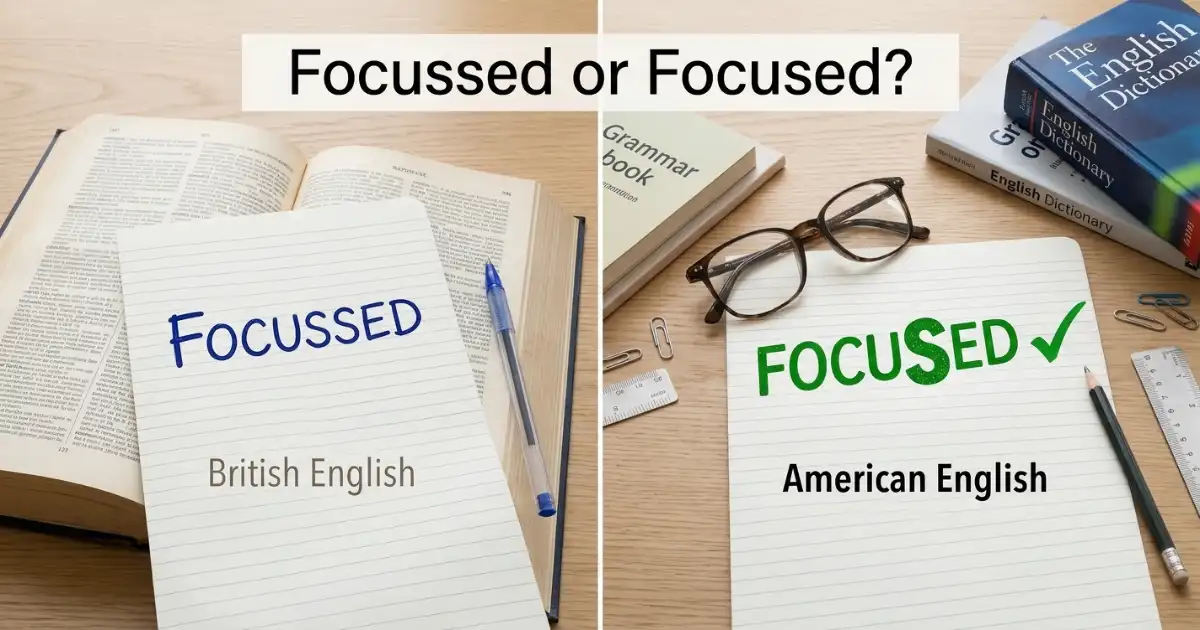
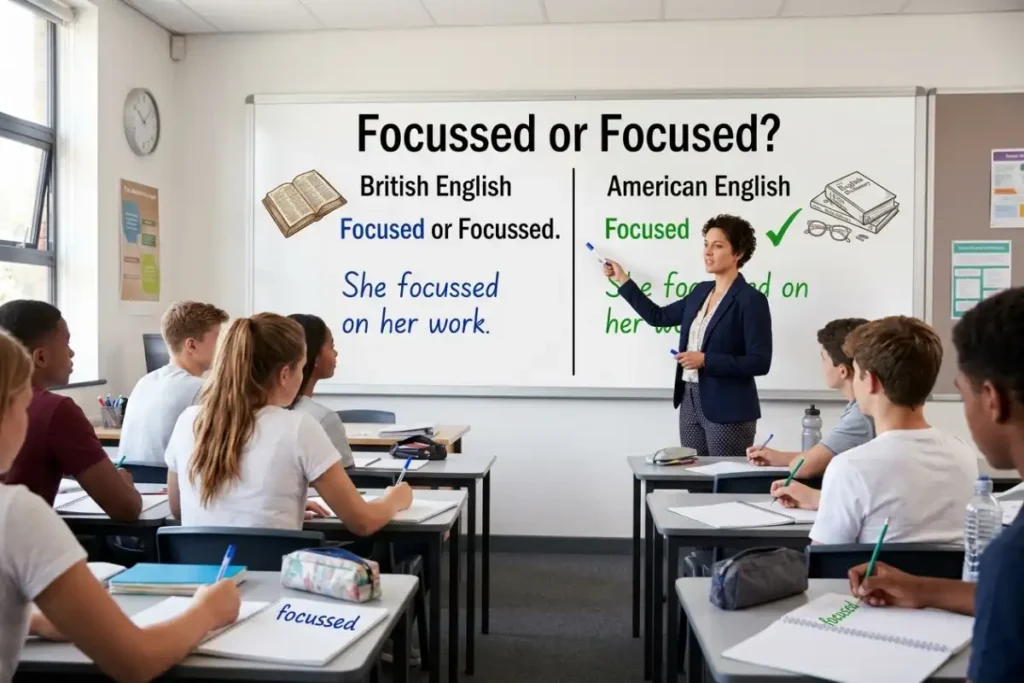
If you’re wondering about focussed or focused, both spellings are correct, but focused is the standard spelling in American English. British English accepts both focused and focussed, although focused is also widely used there. If you’re writing for a US audience, focused is the clear choice.
The confusion comes from the way English handles verbs that end in a single consonant after a vowel. Some words double the final consonant before certain endings, while others don’t. Focus sits in a slightly unusual position because the spelling conventions differ between American and British English.
That means this isn’t quite the same kind of spelling mistake as writing a word with a missing letter. It can be a genuine regional spelling difference. Still, choosing the right form matters if you’re writing for a particular audience or trying to keep your article consistent.
This guide explains the difference between focused and focussed, which form American English prefers, how British English treats the two spellings, and how to use forms such as focusing, focuses, focused, and focussing correctly. We’ll also look at why the extra s appears and how to remember the preferred spelling.
Quick Definition
Focused and focussed are both accepted spellings of the past tense and past participle of focus. Focused is the standard and more common spelling in American English, while British English accepts both forms.
If you’re writing for readers in the United States, use focused.
Direct Answer
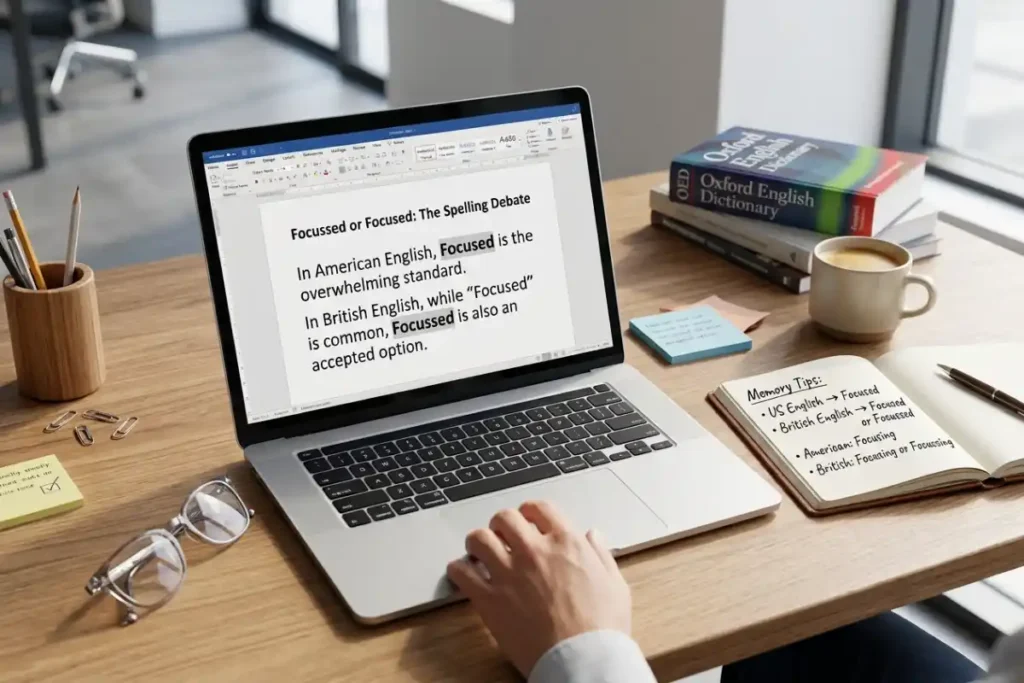
Focused is the preferred spelling in American English. Focussed is also accepted, especially in British English, but focused is the safer choice for US writing.
Focused And Focussed Compared
| Word | Meaning | Example Sentence | When to Use It |
|---|---|---|---|
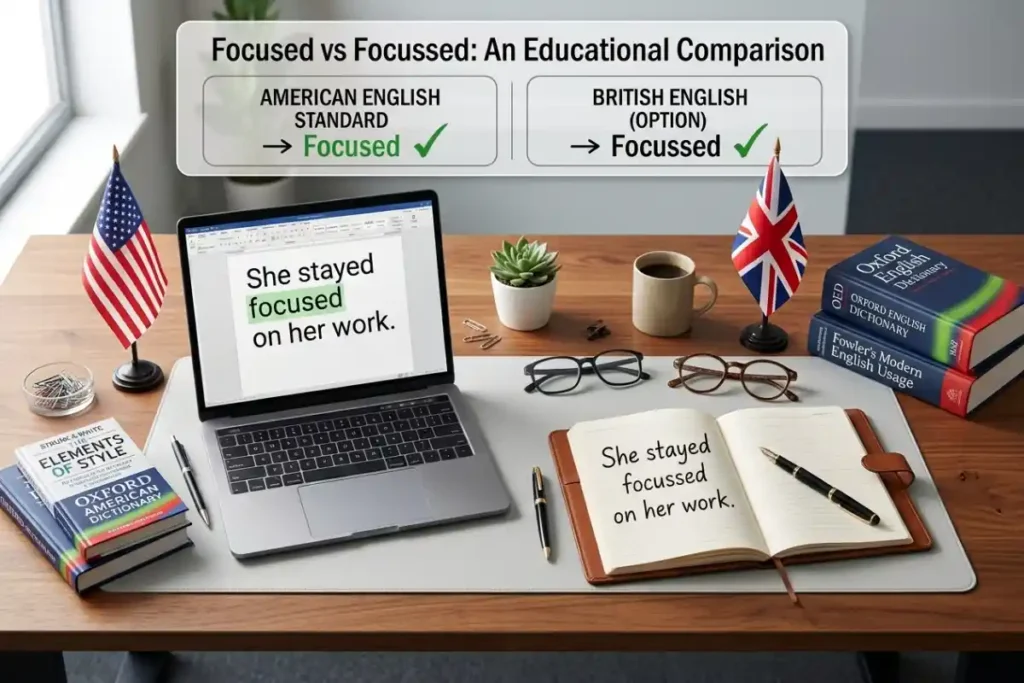
| Focused | Concentrated on something or directed toward something | She stayed focused on her work. | Preferred in American English and widely used internationally |
| Focussed | Same meaning as focused | She stayed focussed on her work. | Accepted in British English and some other varieties |
The important point is that the two spellings don’t have different meanings.
They describe the same idea.
The main difference is spelling preference by region.
Why There Are Two Spellings
The word focus comes from Latin and entered English through other European languages. Modern English uses focus as both a noun and a verb.
As a verb, focus means to direct attention toward something or to make something clear.
For example:
I need to focus on this task.
She focused on the problem.
They focused their attention on the customer.
When the verb changes to its past form, English has two established spellings:
focused
focussed
The difference comes from spelling conventions used in different forms of English.
American English generally favors focused.
British English allows both focused and focussed.
This is similar to other spelling questions where American and British English don’t always use exactly the same form. For example, Analyzing or Analysing explains another common regional spelling difference involving American and British English.
That doesn’t mean one spelling is always wrong.
It means you should know your audience.
Focused Is Preferred In American English
For US English, focused is the spelling you should normally use.
Examples:
She stayed focused during the meeting.
He remained focused on his goal.
The team focused on customer needs.
I need to stay focused on my work.
The lesson focused on basic grammar.
The report focused on spelling errors.
American dictionaries and style guides generally use focused as the preferred spelling.
If you’re writing a US English article, use focused consistently.
This matters because consistency makes your writing look polished. If you use focused in one paragraph and focussed in another, readers may wonder if the two forms have different meanings.
They don’t.
You’re simply mixing spelling conventions.
Focussed Is Common In British English
British English traditionally allows focussed as well as focused.
For example:
She remained focussed on her studies.
The team was focussed on the problem.
He stayed focussed during the presentation.
British writers may also use focused.
So a British reader can encounter both forms.
This makes focussed different from a simple spelling error.
If you see focussed in a British publication, it doesn’t automatically mean the writer made a mistake.
The spelling is accepted in British English.
However, if your website follows US English, focused should be your normal choice.
Is Focused Or Focussed More Common
Focused is generally the more widely used spelling, especially in American English and in many international contexts.
Focussed remains established in British English and some other varieties that follow British spelling traditions.
For a US audience, there is no real reason to choose focussed.
Use focused.
For example:
The article is focused on common spelling errors.
That sentence is natural and standard in American English.
You don’t need to write:
The article is focussed on common spelling errors.
The second version isn’t the preferred American form.
The Meaning Of Focus
Before looking at the spelling forms, it helps to understand the word itself.
Focus can mean the center of attention or interest.
For example:
The main focus of the article is spelling.
Education is the focus of the program.
Customer service is our main focus.
Focus can also mean concentration.
For example:
I need better focus when I study.
The noise made it hard to maintain focus.
She has excellent focus during difficult tasks.
As a verb, focus means to direct attention toward something.
For example:
Focus on the question.
She focused on her studies.
They focused their efforts on the new project.
The past tense is where the spelling question appears.
Focused As A Verb
Focused is the past tense and past participle form of focus.
For example:
She focused on the assignment.
He focused on the road.
The team focused on the problem.
They focused their attention on the customer.
The company focused on improving service.
In each sentence, focused tells us that the action happened in the past or describes a completed state.
The spelling focused is standard in American English.
Focused As An Adjective
Focused can also work as an adjective.
It describes someone or something that is concentrated on a particular goal, task, or subject.
For example:
She is a focused student.
He is focused on his career.
The team is highly focused.
The article has a focused purpose.
The discussion remained focused.
Here, focused doesn’t simply describe an action that happened in the past. It describes a state or quality.
That’s why you may see focused used in many different types of sentences.
Focus On Something
The most common structure is focus on.
For example:
Focus on your work.
She focused on the main issue.
The article focuses on spelling errors.
He focused on improving his writing.
The team focused on customer feedback.
The preposition on is important in this structure.
You don’t normally say focus at something when you mean direct your attention toward it.
Use focus on.
Focused On Something
The past form follows the same pattern.
For example:
She focused on her homework.
He focused on the problem.
They focused on the main issue.
The article focused on spelling mistakes.
The company focused on customer service.
This structure is extremely common, so it’s useful to remember it as one complete phrase:
focused on
Once you know that phrase, the spelling becomes easier to recognize.
Focused On Versus Focused In
Focused on is usually the natural expression when you mean concentrating attention on something.
For example:
The article is focused on spelling.
The team focused on the main problem.
The student focused on the lesson.
Focused in can appear in other structures, especially when in introduces a location or area.
For example:
The camera is focused in the center of the frame.
However, when you’re talking about attention, concentration, or subject matter, focused on is normally what you want.
Focused Versus Focussed In American English
If you’re writing American English, focused is the preferred spelling.
This is especially useful for:
School assignments.
College papers.
Business writing.
Blog posts.
Website content.
News writing.
Marketing copy.
Professional reports.
For example:
The study focused on spelling errors.
The student remained focused during the test.
The meeting focused on customer service.
These sentences look natural in US English.
Using focussed would not normally be necessary.
Focused Versus Focussed In British English
British English is more flexible.
Both focused and focussed are used.
For example:
She focused on the task.
She focussed on the task.
Both can be found in British writing.
The spelling with double s follows a traditional British pattern in which the final consonant is doubled before certain endings.
But British English also accepts the simpler focused spelling.
That means British writers have more than one standard option.
If you’re writing for a mixed international audience, focused is often the simplest choice because it is widely recognized and is standard in American English.
Why Does Focussed Have Two Ss
The double s comes from a spelling pattern used with some verbs.
English sometimes doubles the final consonant before adding an ending.
For example:
stop → stopped
plan → planned
prefer → preferred
The basic idea is that doubling can preserve the short vowel sound or follow established spelling rules.
Focus creates a special case because the final consonant is s and the word ends in an unstressed syllable.
British English traditionally permits focussed, while American English generally uses focused.
The important thing isn’t to memorize a complicated rule.
Just remember the regional preference.
US English: focused.
British English: focused or focussed.
Why Doesn’t American English Double The S
American English generally prefers the simpler focused form.
This reflects a broader tendency toward shorter spellings in some cases, although English spelling has many exceptions and doesn’t follow one simple rule for every word.
You shouldn’t assume that every verb ending in a single consonant follows exactly the same pattern.
For example, Busing or Bussing deals with another spelling question where American and British usage can affect the form you see.
The best approach is to learn the established spelling of each word rather than trying to apply one rule to every verb.
For focus, the practical rule is easy.
Use focused in American English.
Focused Versus Focusing
The present participle of focus creates another spelling question.
American English normally uses:
focusing
For example:
She is focusing on her work.
He is focusing on the main issue.
The camera is focusing on the subject.
The student is focusing on the lesson.
British English commonly allows:
focussing
For example:
She is focussing on her work.
Both forms follow the same regional spelling pattern.
American English usually prefers focusing.
British English may use focusing or focussing.
This means the difference isn’t limited to the past form.
Focusing In American English
For US readers, focusing is the standard spelling.
For example:
I am focusing on the most important task.
She is focusing on her studies.
The camera is focusing on the subject.
The company is focusing on customer service.
The article is focusing on common spelling mistakes.
Notice that American English does not normally double the s.
Focus → focusing.
This is the form you’ll usually want in US English content.
Focussing In British English
British English also uses focussing.
For example:
She is focussing on her studies.
The company is focussing on customer service.
The teacher is focussing on the main topic.
The photographer is focussing the camera.
British writers can also use focusing.
So again, the two forms are linked to spelling preferences rather than different meanings.
Focuses Is Different
Focuses is the present tense form used with he, she, or it.
For example:
She focuses on her work.
He focuses on the details.
The article focuses on spelling.
The camera focuses on the subject.
The company focuses on customer service.
Focuses has one s in the base word and another s as part of the verb ending.
This spelling can sometimes confuse learners because it looks similar to focussed.
But they are different forms.
Focuses is a present tense verb.
Focused and focussed are past tense or past participle forms.
Focused Versus Focuses
Compare these sentences:
She focuses on grammar.
She focused on grammar.
The first sentence uses the present tense.
The second uses the past tense.
Both are correct.
The spelling changes because the verb form changes.
Here are more examples:
The article focuses on spelling errors.
The article focused on spelling errors.
The teacher focuses on pronunciation.
The teacher focused on pronunciation.
The company focuses on quality.
The company focused on quality.
This is a useful grammar distinction to remember.
Focus Versus Focused
Focus is the base form.
Focused is the past form.
For example:
I focus on my work every morning.
I focused on my work yesterday.
She focuses on the problem.
She focused on the problem.
The verb changes according to tense and subject.
The spelling question only becomes complicated because American and British English can treat the past and ongoing forms differently.
Focused And Concentrated
Focused and concentrated are close in meaning.
Both can describe attention directed toward something.
For example:
She stayed focused on her work.
She stayed concentrated on her work.
However, focused is usually more natural in everyday English.
You can also use focused to describe a plan, article, discussion, or goal.
For example:
The article has a focused topic.
The discussion remained focused.
The team has a focused strategy.
Concentrated doesn’t always fit these contexts as naturally.
Focused And Attentive
Focused and attentive also overlap.
An attentive person pays close attention.
A focused person directs attention toward a particular task or goal.
For example:
The students were attentive during the lesson.
The students were focused on completing the assignment.
Both sentences describe attention, but the emphasis is slightly different.
Focused often suggests a specific target.
Focused And Dedicated
Focused can also overlap with dedicated.
A focused person keeps attention on a task.
A dedicated person is committed to achieving something.
For example:
She is focused on finishing the project.
She is dedicated to finishing the project.
The first sentence emphasizes attention.
The second emphasizes commitment.
Knowing these small differences can help you choose the best word instead of simply searching for a synonym.
Focused In Everyday English
Focused is very common in everyday conversation.
You might hear:
I can’t focus today.
I need to stay focused.
Try to focus on the task.
She is really focused.
He stayed focused during the exam.
The meeting wasn’t very focused.
These expressions are natural and widely understood.
The spelling doesn’t change based on the meaning.
If you’re using American English, use focused.
Focused In School Writing
Students often use focused when describing study habits, essays, research, and attention.
Examples:
I stayed focused during the exam.
The essay focused on climate change.
The research focused on student performance.
The lesson focused on grammar.
She remained focused throughout the class.
If you’re writing a school paper in American English, focused is the standard choice.
It’s also useful to remember that How to Spell Definately covers another common spelling issue that often appears in student writing.
The two topics are different, but both show why checking a word before submitting an assignment can prevent simple spelling mistakes.
Focused In Business Writing
Focused is also common in professional English.
Examples include:
focused strategy
focused approach
focused discussion
focused effort
focused team
focused plan
focused campaign
For example:
The company developed a focused strategy.
The meeting needs a more focused agenda.
The team made a focused effort to solve the problem.
The report provides a focused analysis.
These expressions work naturally in US English.
Focused In Academic Writing
Academic writers often use focused when describing research.
For example:
The study focused on language development.
The research focused on spelling patterns.
The paper focused on regional differences.
The experiment focused on memory and attention.
The analysis focused on common errors.
Academic writing usually benefits from consistency. If you’re following American English, focused should be used throughout the paper.
Focused In Digital And Online Writing
Blog writers and website owners use focused in phrases such as:
focused content
focused topic
focused article
focused keyword
focused audience
focused approach
For example:
The article is focused on common spelling errors.
The page has a focused topic.
The writer created content for a focused audience.
If your website follows US English, focused should be your default form.
Consistency across your site matters too. Mixing American and British spellings can make a website feel less consistent, especially when you publish many articles in the same category.
How To Remember The American Spelling
The easiest memory trick is:
US English uses one s in focused.
Think:
focus + ed = focused.
Then remember:
focus + ing = focusing.
The American forms are simple:
focused
focusing
The British forms may also appear as:
focussed
focussing
You don’t need to memorize every historical spelling rule.
Just connect the single s forms with American English.
A Second Memory Trick
Think about the word focus itself.
It ends with one s.
For American English, keep that single s when you add ed or ing:
focus → focused
focus → focusing
This is a simple visual reminder.
If you see two s letters:
focussed
focussing
think British English.
That won’t cover every style guide or every regional preference, but it gives you a useful quick check.
Common Mistakes With Focused
One common mistake is assuming that focussed must be wrong.
That’s not quite true.
Focussed is accepted in British English.
The better way to think about it is:
US English → focused.
British English → focused or focussed.
Another mistake is using focussing in US English.
For American writing, focusing is the standard choice.
A third mistake is mixing forms in the same article.
For example:
The team focused on the problem.
Later:
The team remained focussed on the solution.
If your article is written in American English, that mixture looks inconsistent.
Choose one regional style and stick with it.
Should You Use Focused Or Focussed
If your audience is American, use focused.
If your audience is British, either focused or focussed can work.
If you’re unsure about your audience and want the most broadly accepted modern form, focused is usually the safer choice.
This is especially true for websites that use American English throughout their content.
The goal isn’t to label focussed as a spelling error in every context.
The goal is to choose the form that matches your style.
What About Focussing Or Focusing
The same regional difference appears in the ing form.
American English:
focusing
British English:
focusing or focussing
Examples:
She is focusing on the problem.
She is focussing on the problem.
Both can be correct depending on the English variety.
For US content, use focusing.
Focused And Focussed In Dictionaries
Major dictionaries recognize the word focus and its related forms. The spelling preference can vary by dictionary and regional edition.
This is why dictionary searches may sometimes show both forms.
Finding focussed in a dictionary doesn’t mean American English has suddenly adopted it as the preferred spelling.
It simply reflects the fact that English has more than one established spelling tradition.
When checking a spelling question, always consider the variety of English you’re writing.
That matters for many words.
Your guide to Armor or Armour is a good example. American English prefers armor, while British English uses armour.
The situation with focused is slightly different because American English prefers focused, while British English accepts both focused and focussed.
Focused And Other Regional Spelling Differences
English has many words where American and British spelling differ.
Examples include:
color and colour
center and centre
favorite and favourite
analyze and analyse
armor and armour
Some differences are very clear.
Others are more subtle.
Focused belongs to the second group because British English can use the American style focused as well as focussed.
Our Analyzing or Analysing article is especially relevant here because it explains the same larger issue of choosing a spelling based on the English variety you’re using.
The lesson is simple: don’t treat every difference between American and British spelling as a mistake.
Sometimes it’s a style choice.
How To Keep Your Website Consistent
If your website targets US readers, choose American spelling throughout your articles.
That means using forms such as:
focused
focusing
analyze
analyzing
color
favorite
armor
You can still discuss British alternatives when they are relevant.
For example:
American English uses focused.
British English also accepts focussed.
This gives readers the information they need without making your own writing inconsistent.
Consistency is especially useful for a spelling website because readers expect you to be precise about language.
Focused In Different Sentences
Here are several natural examples:
She stayed focused during the test.
He focused on his homework.
The article focused on spelling errors.
The team focused on customer service.
I need to stay focused today.
The discussion remained focused.
The report is focused on the main issue.
The teacher focused on pronunciation.
The study focused on language development.
The company focused its efforts on improving service.
The camera focused on the subject.
The student remained focused throughout the lesson.
These examples show how flexible the word can be.
Examples With Focussed
If you’re reading British English, you may encounter examples such as:
She stayed focussed during the test.
He focussed on his homework.
The article focussed on spelling errors.
The team focussed on customer service.
I need to stay focussed today.
The discussion remained focussed.
These sentences have the same meanings as the versions with focused.
The difference is spelling convention.
Examples With Focusing And Focussing
American English:
She is focusing on her work.
The camera is focusing on the subject.
The company is focusing on customer service.
British English can also use:
She is focussing on her work.
The camera is focussing on the subject.
The company is focussing on customer service.
Again, the meaning stays the same.
A Simple Word Family
Learning the whole word family can make the spelling easier.
| Form | Example |
|---|---|
| Focus | Focus on your work. |
| Focuses | She focuses on grammar. |
| Focused | She focused on grammar. |
| Focusing | She is focusing on grammar. |
| Focussed | British alternative of focused |
| Focussing | British alternative of focusing |
| Focus | The main focus is grammar. |
For American English, the forms you will most often need are:
focus
focuses
focused
focusing
These are the forms worth memorizing.
Does Focused Mean The Same As Focussed
Yes.
Focused and focussed have the same meaning when they are used as the past tense, past participle, or adjective.
For example:
She focused on her work.
She focussed on her work.
Both sentences mean that she directed her attention toward her work.
The difference is spelling preference, not meaning.
Is Focussed Wrong In American English
Focussed is not the preferred spelling in American English.
That doesn’t mean an American reader won’t understand it.
They will.
However, if you’re following standard US English, focused is the better choice.
Use focused in American school, business, academic, and online writing unless you are intentionally preserving another variety of English.
Is Focused Wrong In British English
No.
Focused is accepted in British English.
British writers may use either focused or focussed.
So if you see focused in a British article, there is no reason to assume it is an Americanism that must be corrected.
Both spellings are used.
Does Focussed Have A Different Pronunciation
No.
Focused and focussed are pronounced the same when they have the same meaning and grammatical function.
The extra s changes the spelling, not the basic pronunciation.
That is another reason the two forms can be easy to confuse.
When you hear the word, you cannot normally tell which spelling the writer will choose.
You need to know the regional style.
Is The Double S Version Older
The double s spelling is associated with British and related spelling traditions and has been used for a long time.
The single s form is also well established.
English spelling often preserves multiple forms because different regions develop different conventions.
This is why spelling questions can sometimes have answers that are more nuanced than simply right and wrong.
For this word, the practical distinction is regional.
Focused Or Focussed For SEO Writing
If you’re writing for a US audience, use focused.
Search engines can understand both spellings, but your readers matter more than trying to force every possible spelling into the page.
You can naturally mention focussed once or twice when explaining the British form.
There is no need to repeat it throughout the article.
For your main content, stick with the spelling that matches your site’s chosen English variety.
This approach also helps avoid awkward keyword repetition.
Focused Or Focussed For A School Assignment
If your teacher expects American English, use focused.
For example:
The essay focused on the effects of technology.
If your school follows British English, focussed may also be acceptable.
The safest approach is to follow the spelling style used by your teacher, textbook, or school.
The same principle applies to other regional spelling differences.
Focused Or Focussed For A Resume
For a US resume, use focused.
Examples:
Focused on customer service and client support.
Focused on improving team performance.
Focused on meeting project deadlines.
Focused on quality and accuracy.
These are standard American English uses.
If you’re applying for a job in a country that follows British English, focussed may also appear in local writing, but focused remains widely recognized.
Focused Or Focussed For A Website
For a US website, use focused.
For example:
This guide is focused on common spelling errors.
The page is focused on helping readers choose the correct word.
The article focuses on American English spelling.
If your website follows British English, you can choose focussed, but keep your spelling style consistent across the site.
Your existing spelling articles can help reinforce that consistency. For example, Afterward or Afterwards discusses another spelling variation that can depend on regional preference and writing style.
A Quick Test
If you need to choose the spelling quickly, ask:
Am I writing American English?
If the answer is yes, choose:
focused
If you’re writing British English, you can use:
focused
or
focussed
The same check works for the ongoing form:
American English:
focusing
British English:
focusing or focussing
This is much easier than trying to memorize a long list of rules.
Related Spelling Errors
The difference between focused and focussed belongs to a larger group of English spelling questions.
Some involve regional spelling.
Some involve doubled letters.
Some involve missing letters.
Some involve words that sound alike.
For example, Publically or Publicly deals with a word where one spelling is much more common and preferred in modern standard usage.
Similarly, Vallies or Valleys explains why a spelling can seem logical based on pronunciation but still be incorrect.
And Elfs or Elves looks at an irregular plural spelling that often causes confusion.
These pages cover different spelling problems, but they share one useful lesson: the form that feels natural isn’t always the form accepted by the standard rules.
When To Use Focused
Use focused when:
You are writing American English.
You need the past tense of focus.
You need the past participle of focus.
You are using focused as an adjective.
You are describing concentration.
You are describing a specific purpose or target.
Examples:
She focused on the assignment.
He has focused attention.
The article is focused on spelling.
The team remained focused.
The research focused on language.
When Focussed Can Be Used
Use focussed if you’re intentionally following a British English style that uses the double s spelling.
For example:
The article is focussed on spelling.
She remained focussed during the meeting.
The team focussed on the main issue.
This spelling isn’t necessary for American English.
If you’re writing for US readers, focused is the better choice.
The Most Useful Rule To Remember
You don’t need to memorize every detail of English spelling.
Remember this:
American English prefers focused and focusing.
British English accepts focused and focussed, and also focusing and focussing.
That’s the main rule.
If your writing follows US English, use the single s forms.
This keeps your spelling clear and consistent.
Final Examples
Here are some examples to reinforce the difference.
American English:
The student stayed focused.
She focused on the lesson.
The team focused on the problem.
The company is focusing on quality.
The article is focused on spelling errors.
British English may use:
The student stayed focussed.
She focussed on the lesson.
The team focussed on the problem.
The company is focussing on quality.
The article is focussed on spelling errors.
The meanings are the same.
Only the spelling convention changes.
FAQs
Is focussed or focused correct
Both spellings are accepted, but focused is the standard choice in American English. British English accepts both focused and focussed. For a US audience, focused is the better choice.
Is focussed British or American spelling
Focussed is more closely associated with British English and other varieties that follow British spelling conventions. American English generally prefers focused. British English also accepts focused, so the double s form isn’t required.
Is focused correct in British English
Yes. British English accepts focused as well as focussed. You may see either spelling in British publications, although individual style guides may favor one form.
Why does focussed have two s letters
The double s reflects a spelling convention used with some verbs in British English. Focus is one of the words where British usage allows the doubled consonant in forms such as focussed and focussing.
Is focusing or focussing correct
Both forms are used. American English normally uses focusing, while British English accepts both focusing and focussing. The two forms have the same meaning.
Is focused an adjective or a verb
Focused can be both. It is the past tense and past participle of focus, and it can also work as an adjective meaning concentrated or directed toward a particular goal or subject.
What is the past tense of focus
The past tense is focused in American English. British English also accepts focussed. For example, you can write, She focused on the problem, or, in British usage, She focussed on the problem.
What is the difference between focus and focused
Focus is the base form of the verb and can also be a noun. Focused is the past form and can also be an adjective. For example, I focus on my work uses the base verb, while I focused on my work uses the past form.
Conclusion
If you’re choosing between focussed or focused, the answer depends on the variety of English you’re using. Focused is the preferred spelling in American English, while British English accepts both focused and focussed.
The two forms have the same meaning. The difference is mainly a matter of spelling convention. American English also normally uses focusing, while British English can use either focusing or focussing.
For US readers, the practical rule is simple: use focused and focusing. If you’re writing in British English, check your preferred style guide and stay consistent throughout the article.
When you see the double s form, don’t automatically call it a spelling mistake. It can be perfectly acceptable British English. But if your goal is clear, consistent American English, choose focused every time.