

If you searched for busing or bussing, you are probably wondering which spelling is correct. The short answer is that both spellings are correct, but they are not always used in the same way. Busing is the preferred spelling in most modern dictionaries when talking about transporting people by bus. Bussing is commonly used for clearing tables in restaurants, although some dictionaries also accept it as a spelling related to buses.
This spelling question catches many writers off guard because the words look almost identical. The extra s seems small, yet it can change the meaning or make your writing look inconsistent. If you are writing an article, an email, or a school paper, choosing the right spelling helps your message stay clear.
Another reason people get confused is that different dictionaries and style guides do not always give the same advice. Some accept both spellings for transportation, while others clearly recommend one over the other. That leaves many people asking which version they should actually use.
This guide explains the difference in plain English. You will learn where each spelling comes from, how dictionaries treat them, when each one is appropriate, and the simple rule that makes the choice easy. By the end, you will know which spelling fits your sentence and why.
Quick Definition
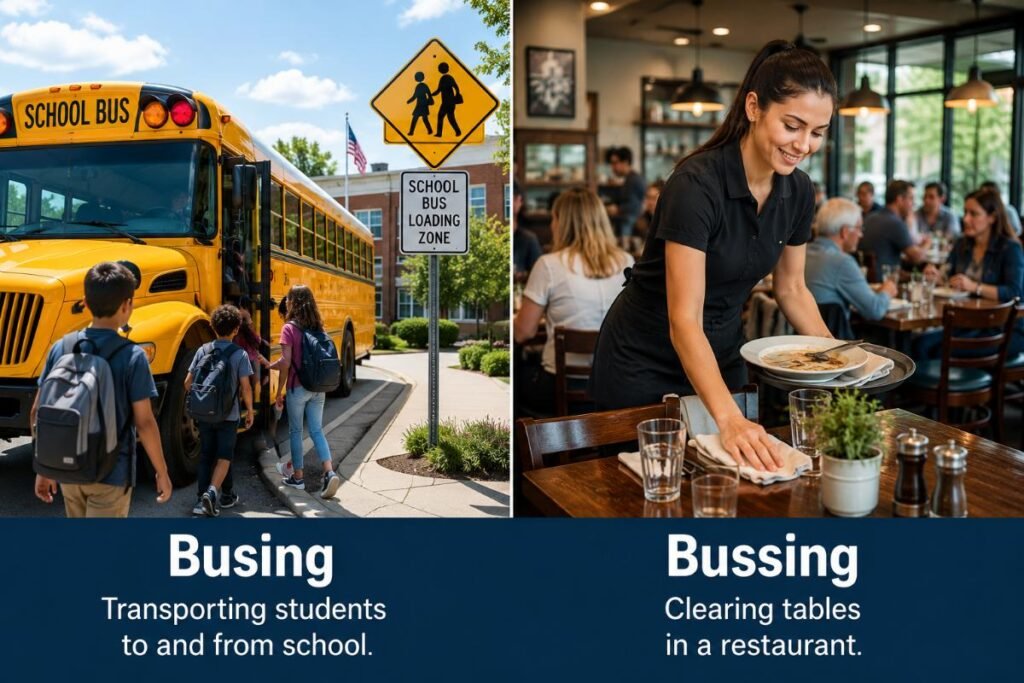
Busing usually means transporting people by bus. It is the preferred spelling in modern American English for school transportation, public transit, and similar topics.
Bussing most often means clearing dishes from restaurant tables. Some dictionaries also list it as a variant spelling of the transportation verb, but that use is less common.
Direct Answer
If you are writing about transportation, schools, or public transit, busing is the safest and most widely accepted spelling.
If you are writing about restaurant staff clearing tables, use bussing. That spelling clearly matches the restaurant meaning and avoids confusion.
Comparison Table
| Word Or Phrase | Meaning | Example Sentence | Best Time To Use |
|---|---|---|---|
| Busing | Transporting people by bus. | The district is busing students to a nearby school. | School transportation, public transit, and general writing. |
| Bussing | Clearing dishes and cleaning tables in a restaurant. | She spent the afternoon bussing tables at the café. | Restaurant and hospitality settings. |
| Bussing | A less common spelling of transporting by bus. | The city is bussing passengers during the rail closure. | Only if following a style guide or dictionary that accepts this spelling. |
Why This Spelling Question Causes Confusion
Many spelling questions have one clear answer. This one is different because both words appear in dictionaries. That makes it easy to assume they can always be used interchangeably.
The confusion starts with the word bus itself. Most English words ending in a single consonant double that consonant before adding ing. For example, run becomes running, and sit becomes sitting. Based on that pattern, many people naturally expect bus to become bussing.
English does not always follow the most obvious pattern. Over time, the spelling busing became the preferred choice for transportation. Writers, publishers, and style guides adopted it because it clearly separates the transportation meaning from the restaurant term bussing.
That distinction is helpful because the English language already has another verb spelled buss. It means to kiss, although that meaning is now uncommon. The restaurant term bussing tables developed from a different history, and its spelling stayed with the double s. As a result, modern English uses two similar spellings that often point to different meanings.
Understanding The Basic Rule
The easiest way to remember the difference is to think about the subject of your sentence.
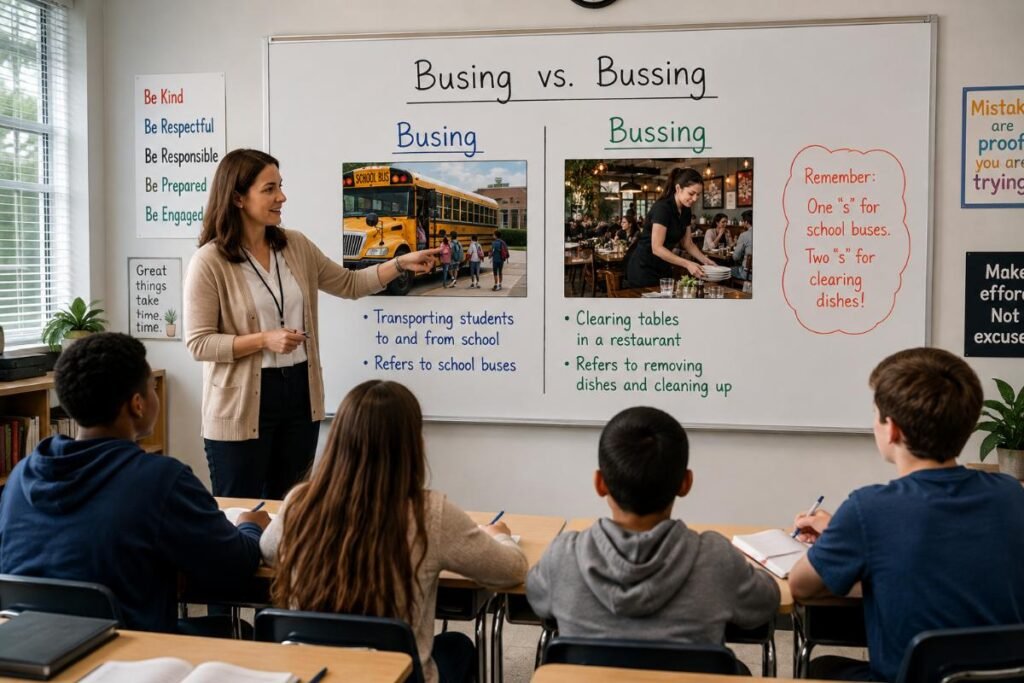
If your sentence is about buses, schools, public transportation, or moving passengers, choose busing.
If your sentence is about restaurants, servers, dishes, or clearing tables, choose bussing.
Here are a few examples.
- The school is busing students to another campus during the renovation.
- The city began busing commuters after the train service stopped.
- He spent the summer bussing tables at a local diner.
- The restaurant hired two employees for bussing and cleaning duties.
Once you connect each spelling with its meaning, the choice becomes much easier.
Why Busing Became The Preferred Transportation Spelling
The spelling busing did not become popular by accident. Editors and publishers wanted a simple way to distinguish transportation from the restaurant term. Using one s for buses and two s letters for restaurant work reduced confusion for readers.
Today, major American dictionaries recognize busing as the standard spelling for transportation. News organizations, government agencies, schools, and educational publishers also tend to prefer it. If you are writing for a broad audience, this is the spelling that readers expect to see.
Why Bussing Still Appears In Dictionaries
Seeing bussing in a dictionary does not mean it is the best choice in every situation. Dictionaries often record words as people actually use them, including less common spellings and regional variations.
That is why some dictionaries list bussing as an accepted variant for transportation while also showing busing as the preferred form. At the same time, they continue using bussing for restaurant work because that spelling has become firmly established in the hospitality industry.
The safest approach is simple. Use busing for transportation and bussing for restaurant duties. That choice matches modern usage, follows most style guides, and makes your writing easier for readers to understand.
What Major Dictionaries Say
One reason this spelling question refuses to disappear is that dictionaries do not all present the information in exactly the same way. They agree on the main idea, but some include extra details that can make the issue look more complicated than it really is.
Most modern American dictionaries list busing as the preferred spelling when the verb means transporting people by bus. You will see this form in educational materials, newspapers, government publications, and professional writing.
Many dictionaries also recognize bussing as a variant spelling for transportation. That does not mean it is the recommended choice. It simply means enough people have used it for dictionaries to record it.
For restaurant work, dictionaries consistently use bussing when talking about clearing tables. That spelling has become the accepted standard in the hospitality industry.
The simplest takeaway is easy to remember. If your sentence is about buses, use busing. If it is about restaurants, use bussing.
How Style Guides Treat The Two Spellings
Style guides exist to keep writing consistent. They help publishers, schools, businesses, and news organizations make the same spelling choice throughout their work.
Most American style guides favor busing for transportation because it avoids confusion with the restaurant term. If every article used different spellings, readers might stop and wonder if the writer meant something else.
Imagine reading these two sentences.
- The school district is busing students across town.
- The restaurant is bussing tables after the lunch rush.
The different spellings immediately tell you that the sentences describe two different activities. That small spelling difference makes reading smoother and more natural.
If you write for a company, magazine, or website, it is also worth checking its style guide. Some organizations have their own preferred spellings, and consistency matters just as much as correctness.
Real Life Examples
Looking at complete sentences makes the difference much easier to understand.
Examples Using Busing
These examples all relate to transportation.
- The school began busing students to a larger campus last fall.
- The city is busing passengers while the subway station is under repair.
- The district continued busing children during the road construction project.
- Several buses were added to support the busing program.
In every sentence, the subject involves transportation by bus.
Examples Using Bussing
These examples all relate to restaurants.
- She started her first job bussing tables at a neighborhood café.
- The manager thanked the team for bussing tables so quickly.
- He spent the evening bussing dishes during the dinner rush.
- Bussing tables helped her learn how a restaurant operates.
The meaning changes completely because the topic is restaurant work instead of transportation.
Common Mistakes People Make
Most spelling mistakes happen because people apply one rule to every situation. A closer look at the sentence usually reveals the correct answer.
Using Bussing For School Transportation
This mistake appears quite often.
❌ The district is bussing students to another school.
Although some dictionaries list this spelling as a variant, busing is the preferred form in modern American English.
✔ The district is busing students to another school.
Using Busing For Restaurant Work
The opposite mistake is also common.
❌ She spent the afternoon busing tables.
Restaurant work normally uses the double s spelling.
✔ She spent the afternoon bussing tables.
Assuming Both Spellings Always Mean The Same Thing
Some writers think the two spellings can replace each other in every sentence. That approach often creates unnecessary confusion.
Choosing the spelling that matches the meaning makes your writing clearer. Readers understand your message immediately because the spelling supports the context.
Why English Has Two Different Spellings
English is full of words that have changed over hundreds of years. Some spellings become simpler, while others stay the same because they help distinguish one meaning from another.
The verb bus became common as public transportation expanded during the twentieth century. As people started writing about transporting students and passengers more often, many publishers preferred the shorter spelling busing.
The restaurant term followed a different path. Hospitality workers had already been using bussing tables for years, and the double s spelling became familiar within that industry.
Instead of forcing both meanings into one spelling, modern English gradually settled on two forms that help readers tell the difference at a glance. That small change makes writing more precise without adding extra words.
Easy Memory Tricks
You do not have to memorize dictionary entries to remember the correct spelling. A couple of simple tricks usually do the job.
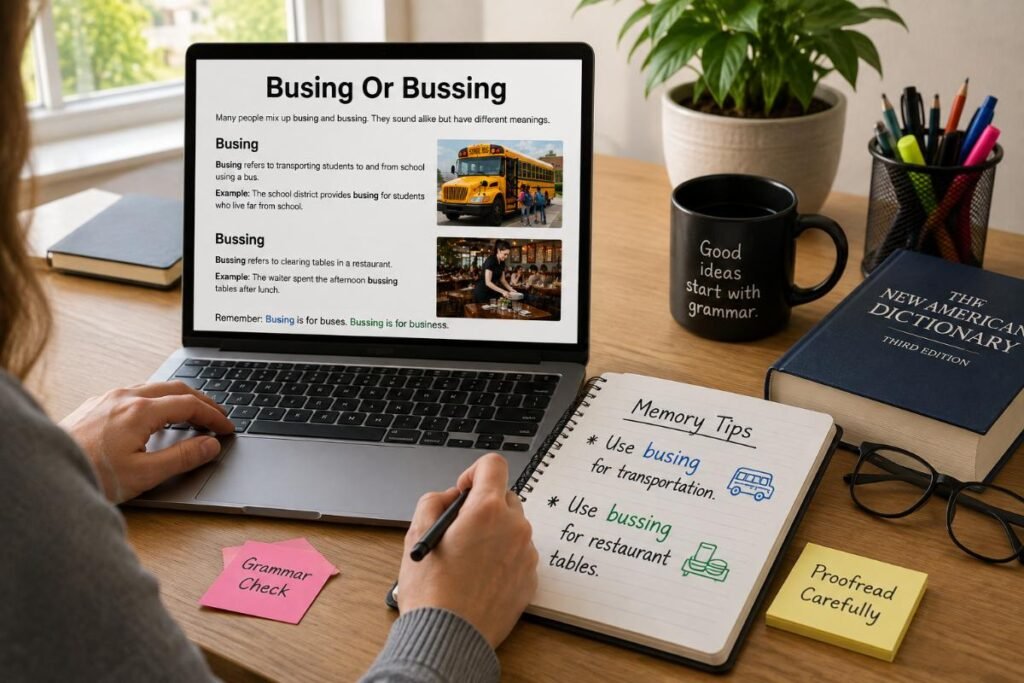
The first trick is to think about the destination.
If people are getting on a bus, use busing.
If someone is carrying plates, use bussing.
Another trick is to picture the extra s as standing for serving or server. Restaurant workers often bus tables, so the extra letter becomes a reminder of the restaurant setting.
You can also ask yourself one quick question before writing.
Is this sentence about transportation or restaurant work?
If the answer is transportation, choose busing.
If the answer is restaurant work, choose bussing.
That question takes only a second, but it prevents the mistake most writers make.
Related Spelling Questions
People who search for this topic often wonder about similar spelling patterns.
Bused Or Bussed
The same rule applies.
- Bused usually refers to transportation.
- Bussed usually refers to restaurant work or, in older English, the verb meaning to kiss.
Busing Or Bussing Students
When writing about schools, busing students is the preferred spelling in modern American English. It is the form used by educational organizations, newspapers, and government agencies.
Busboy And Busser
These words often appear in restaurant discussions.
A busboy or busser clears dishes, cleans tables, and helps servers keep the dining area organized. Because these words belong to the restaurant industry, they naturally connect with bussing tables rather than busing students.
Understanding these related words makes the spelling rule easier to remember because each one fits naturally within its own setting.
FAQs
Is busing or bussing correct?
The answer depends on what you mean. This is exactly why busing or bussing confuses so many writers. Busing is the preferred spelling when talking about transporting people by bus. Bussing is the standard spelling when referring to clearing tables in a restaurant.
Why is busing spelled with one s?
Most modern dictionaries and style guides prefer busing for transportation because it clearly separates that meaning from bussing, which is strongly associated with restaurant work. Using one s also keeps the writing clear and avoids unnecessary confusion.
Can I use bussing for school transportation?
Some dictionaries list bussing as a variant spelling for transportation, so it is not always considered incorrect. Still, busing is the preferred spelling in modern American English and is the better choice for school, business, and professional writing.
What does bussing mean in a restaurant?
Bussing means clearing dirty dishes, wiping tables, and preparing them for the next customers. A person who does this work is often called a busser. The term is common in restaurants, cafés, and other dining establishments.
Is bussing tables correct?
Yes. Bussing tables is the accepted and widely used spelling in the restaurant industry. If your sentence is about clearing dishes or cleaning tables, the double s spelling is the correct choice.
Is busing used in British English?
Both American and British English recognize the verb bus, but style preferences can differ depending on the publisher or dictionary. If you are writing for an American audience, busing is the safest choice for transportation because it matches modern usage in schools, news articles, and official publications.
How can I remember the correct spelling?
Think about the subject of the sentence. If people are riding a bus, use busing. If someone is clearing tables, use bussing. That simple connection makes the correct spelling much easier to remember.
Final Thoughts
The question of busing or bussing is easier than it first appears. Both spellings exist, but they usually serve different purposes. Busing is the preferred spelling for transporting people by bus, while bussing is the standard choice for clearing tables in restaurants.
The confusion comes from the fact that some dictionaries recognize bussing as a variant spelling for transportation. Even so, most American style guides, publishers, and educational resources recommend busing because it clearly separates transportation from restaurant work.
If you are ever unsure, think about the context before you write. Ask yourself one simple question. Is the sentence about buses or about restaurant tables? That answer will almost always point you to the correct spelling.
Once you remember that one s travels with buses and two s letters stay in the restaurant, the choice becomes easy. You will write with more confidence, avoid a common spelling mistake, and make your meaning clear from the very first sentence.