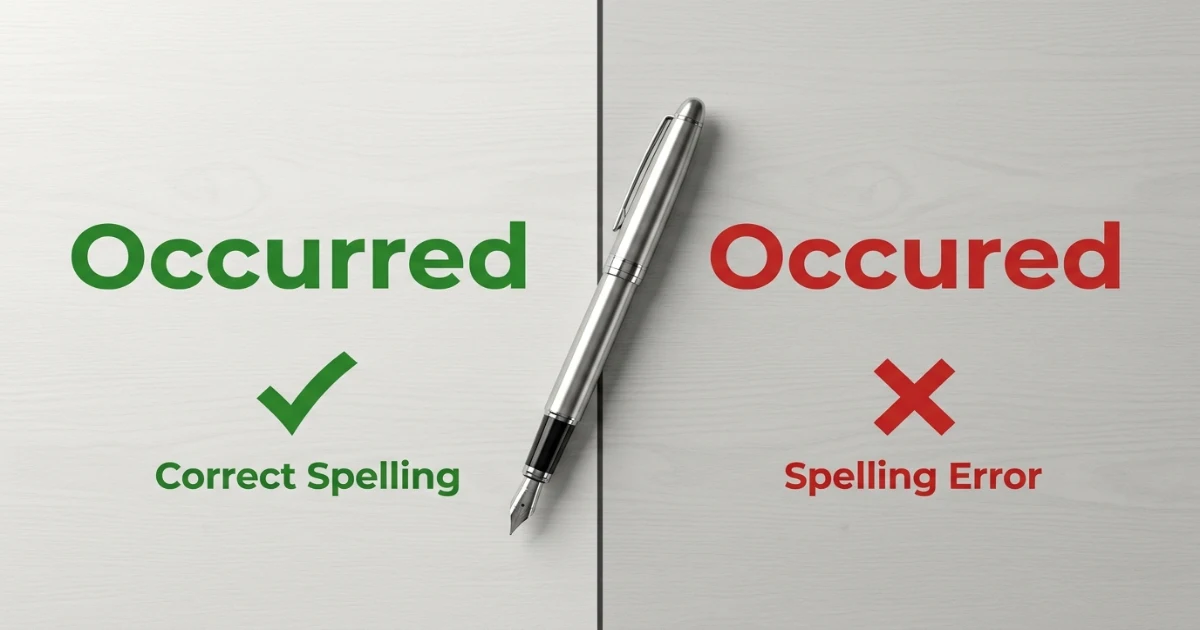
When deciding between occured or occurred, the correct spelling is always occurred.
The form occured is a very common spelling mistake. You will often see it in casual text messages, quick emails, and unedited drafts. However, modern English dictionaries and style guides mark it as wrong. If you write occured in an essay, a legal report, or a business document, spellcheck will highlight it immediately.
Understanding why this mistake happens and learning the simple doubling rule for consonants will help you spell occurred correctly every time.
Quick Definition and Direct Answer
Occurred is the past tense and past participle form of the verb occur. It means happened, took place, or came to mind.
- Occurred (with double C and double R) is the only correct standard spelling.
- Occured (with a single R) is a misspelling and should never be used.
If you ever feel unsure about how to spell the word, remember that when adding -ed to occur, you must double the final R.
Quick Comparison Table
| Word or Phrase | Meaning | Example Sentence | When To Use It |
| Occurred | Happened; took place; came to mind | The accident occurred late last night. | Use as the standard past tense form of occur. |
| Occured | None (Spelling error) | Incorrect: An error occured during loading. | Never. Do not use this form in standard English. |
| Occur | To happen or take place | Problems may occur if instructions are ignored. | Use as the base present tense verb. |
| Occurring | Happening right now; taking place | We are analyzing events occurring this week. | Use as the present participle form (doubles the R). |
| Occurrence | An event or incident that happens | Power outages are a rare occurrence here. | Use as the noun form (doubles both C and R). |

The Grammar Behind Occurred
To use occurred accurately in your writing, it helps to understand the spelling rule that governs doubled consonants in English verbs.
The 1-1-1 Doubling Rule for Verbs
English has a clear rule for when to double a final consonant before adding suffixes like -ed or -ing.
You double the final consonant when a verb meets three specific criteria:
- It ends in a single consonant (except x, w, or y).
- That final consonant is preceded by a single vowel.
- The stress falls on the final syllable of the verb.
Let us look at the base verb occur:
- It ends in a single consonant: r.
- The consonant is preceded by a single vowel: u.
- The stress falls on the final syllable: oc-CUR.
Because all three conditions are met, you must double the final r before adding -ed, creating occurred.
Contrast with Unstressed Syllables
To see why doubling happens in occurred, compare it with a verb where the stress falls on the first syllable, such as open or happen:
- Happen: Stress is on the first syllable (HAP-pen). Past tense: happened (single N).
- Occur: Stress is on the final syllable (oc-CUR). Past tense: occurred (double R).
Why People Misspell Occurred as Occured
Even experienced writers occasionally make this mistake. Knowing why people accidentally drop the second r makes it much easier to avoid doing it yourself.
Single vs. Double Consonants
The base word occur already contains a double consonant near the beginning (cc) and a single consonant at the end (r). When adding -ed, many writers visually assume that one set of double consonants is enough for one word.
Because your brain sees the double c, it naturally resists adding a second double letter right after it, leading to occured.
Misapplying Rules from Other Words
Some verbs ending in -r do not double the final letter because their stress is on the first syllable or they end in two vowels. For example:
- Offer becomes offered (single R).
- Enter becomes entered (single R).
- Appear becomes appeared (single R, because two vowels precede the R).
Writers who confuse these patterns often mistakenly apply the single-R pattern to occurred.
Fast Typing and Autocorrect
Typing quickly on keyboards leads to missed keystrokes. Skipping the second r is one of the most widespread typing typos in modern writing.
Simple Memory Tricks for Correct Spelling
Memory tricks make it simple to keep your double letters straight when drafting essays or emails.
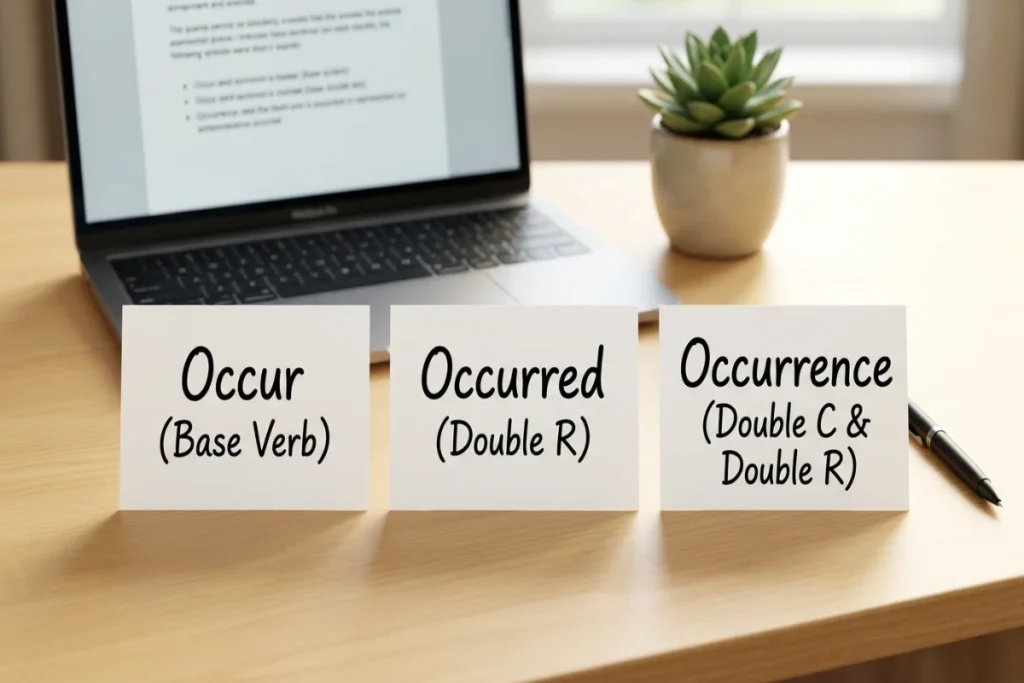
The “Double C, Double R” Rule
The easiest way to remember how to spell occurred is to remember the balance of double letters:
- C C in the middle
- R R near the end
If your word only has one r, it is missing its matching pair.
Connect with Occurrence
Link occurred to its noun relative:
- Occurrence (double C, double R)
Both words require double c and double r. Remembering that both forms double their internal consonants keeps your spelling consistent.

Real World Examples of Correct Usage
Here are practical sentences showing how to use occurred naturally across different daily writing scenarios.
Daily Conversations
- A sudden power outage occurred while we were watching television.
- It never occurred to me that the store would be closed today.
- The best ideas often occurred to him while taking a walk.
- A funny misunderstanding occurred during lunch.
Workplace and Business Communication
- System maintenance occurred over the weekend without any service downtime.
- A significant delay occurred due to severe weather conditions.
- We reviewed the safety incident that occurred on the factory floor last Tuesday.
- Please document every client interaction that occurred during the trial period.
Academic, Legal, and Formal Writing
- The chemical reaction occurred at a much faster rate under high pressure.
- Several key historical shifts occurred during the late nineteenth century.
- The witness described the events exactly as they occurred.
Related Common Spelling Errors
Spelling slip-ups often happen when double letters or silent vowels create confusion. Reviewing related words helps strengthen your overall writing accuracy.
1. Double Consonant Errors
Just as people forget to double the R in occurred, writers frequently struggle with double letters in other common terms. For instance, people often misplace letters when deciding between thier or their or when choosing between publically or publicly in formal writing.
2. Dropping Silent Letters
Dropping internal silent letters creates another category of common typos. Writers frequently miss letters when deciding between definately or definitely or when choosing between suprise or surprise.
3. Regional Spelling Differences
While some English words change spellings depending on regional standards, others remain fixed worldwide. Navigating choices like analyzing or analysing or comparisons such as armor or armour requires knowing regional preferences.
American English vs. British English Usage
Some English words change their spelling based on whether you are writing for an American or a British audience. For example, American English uses color, center, and traveled, while British English uses colour, centre, and travelled.
However, when it comes to occurred, there is no regional variation whatsoever.
- American English: Occurred (double C, double R)
- British English: Occurred (double C, double R)
- Canadian English: Occurred (double C, double R)
- Australian English: Occurred (double C, double R)
In every major dialect of standard English across the world, occurred is the only accepted spelling, and occured is always marked as an error.
Clear Summary and Final Guidelines
Mastering the spelling of occurred comes down to recognizing the consonant doubling rule and keeping a few clear principles in mind:
- Occurred (with double C and double R) is the only standard spelling in modern English.
- Occured (with a single R) is a spelling error caused by fast typing or confusion over doubling rules.
- Because the stress in occur falls on the second syllable (oc-CUR), the final R must be doubled before adding -ed.
- All major global varieties of English use the exact same spelling: occurred.
By remembering that occurred needs two C’s and two R’s, you can write this word confidently every single time.
Frequently Asked Questions
Is occured ever acceptable as an alternative spelling?
No. Occured is not recognized as a valid word or alternative spelling in any standard English dictionary. It is considered a straightforward spelling mistake in all formal, academic, and professional writing.
Why does occur double its R in occurred, but offer does not in offered?
The difference depends on where the syllable stress falls. In occur, the stress is on the second syllable (oc-CUR), which forces the R to double. In offer, the stress is on the first syllable (OF-fer), so the final R remains single when adding -ed.
What is the difference between occurred and happened?
Both words mean that an event took place, but occurred carries a slightly more formal tone than happened. Occurred is often preferred in scientific, legal, academic, and formal business contexts.
How is occurrence spelled?
Like occurred, the noun occurrence requires both a double C and a double R (o-c-c-u-r-r-e-n-c-e). It also ends with -ence rather than -ance.
How can I train myself to stop typing occured?
The easiest way to train yourself is to check for balanced double letters. Remind yourself that occurred has two C’s and two R’s. If your word only has one R, add the second one immediately.