
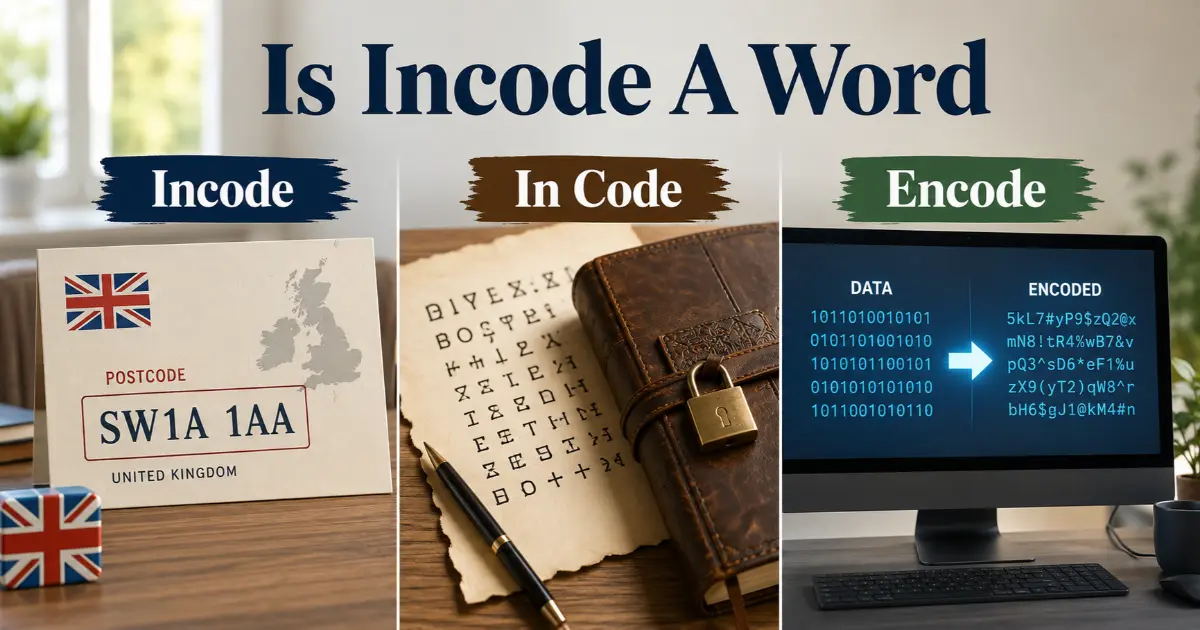
If you’re asking is incode a word, the answer depends on what you mean by incode. In standard American English, incode isn’t the usual word for talking about coding or putting information into a code. The forms you normally need are in code and encode.
There is one detail that can make this question confusing. Incode does exist as a rare English noun with a specialized British postal meaning. It refers to the second part of a UK postcode. You probably won’t need this word in everyday American English, but its existence explains why you may find it listed in some dictionaries.
For most people, the real question is about the difference between incode, in code, and encode. These forms look similar, but they have different meanings and grammatical jobs. Once you understand that difference, the spelling becomes much easier to remember.
This guide covers the common uses of all three forms. You’ll learn when to use in code, when to use encode, why incode appears in some word references, and which form works best in American English. You’ll also see examples from everyday writing, technology, programming, and British postal language.
Quick Definition
Incode is a rare noun used in a specialized British postal context. It refers to the second part of a UK postcode.
In code is a two word phrase that means something is written, expressed, or communicated using a code. Encode is a standard verb that means to convert information into a coded form.
Direct Answer
If you’re writing standard American English, incode usually isn’t the word you want. Use in code when you mean something is written or expressed using a code. Use encode when you mean to convert information into a coded form.
The rare noun incode has a specific British postal meaning, but it isn’t a general replacement for in code or encode.
The Three Forms At A Glance
The easiest way to understand the difference is to look at the three forms together. They may look almost identical, but each one has a different role.
| Word or Phrase | Meaning | Example Sentence | When To Use It |
|---|---|---|---|
| Incode | A rare noun for the second part of a UK postcode. | The incode identifies part of the delivery area. | Specialized British postal writing. |
| In code | Using a code or coded system. | The message was written in code. | Everyday English and general writing. |
| Encode | To convert information into a coded form. | The software will encode the file. | Technology, computing, data, and general English. |
The important difference is grammatical. In code is a phrase. Encode is a verb. Incode is a rare noun with a very specific use.
So don’t choose the spelling just because the letters look similar. Think about what you want the sentence to mean first.
Why People Write Incode
The spelling incode can look reasonable at first. English has many words that were created by joining smaller words together. That can make it tempting to join in and code into one word.
English doesn’t work that way in every case. Two words appearing next to each other don’t automatically become one word.
The phrase in code has an established form. The two words work together as a phrase, but they remain separate.
For example, you might say:
The message was written in code.
This tells the reader how the message was written. The message uses a code as its method of communication.
Writing the sentence this way isn’t standard:
The message was written incode.
The meaning is still easy to understand, but the spelling doesn’t match the normal form of the phrase.
This is a common type of English spelling mistake. People sometimes remove a space because the combined form looks natural. English has many expressions that need to remain as separate words even though they work closely together.
In Code Means Using A Code
The phrase in code describes something that is written, spoken, stored, or communicated through a code.
A code can be a secret system of symbols. It can also be a system used to represent information. The exact meaning depends on the context.
For example:
The soldiers sent the message in code.
She couldn’t understand the note because it was written in code.
The instructions were written in code so only the team could understand them.
The old document contains several sections written in code.
In each example, in code describes the form or method used to communicate the information. It doesn’t describe an action that changes the information.
That distinction becomes useful when you compare in code with encode.
In Code In Everyday English
The phrase isn’t limited to secret messages. You can use it in several everyday situations.
Imagine that two students create a simple system of symbols that only they understand. One student writes a note using that system. You could say that the note was written in code.
The same phrase can describe information represented through a computer language. A developer might say that a feature is written in code. Here, the phrase refers to programming code rather than a secret message.
You might also see the phrase in discussions about documents, instructions, signs, or data.
The meaning changes according to the subject, but the spelling stays the same. It remains in code as two separate words.
Encode Is A Different Word
Encode is a standard English verb. It means to convert information into a particular coded form.
You’ll often see this word in technology and computing. It can describe what software, hardware, or another system does to information.
For example:
The program will encode the file before sending it.
The camera encodes the video automatically.
The system encodes the data before storing it.
The software can encode the audio into a different format.
In each sentence, encode describes an action. Something is being changed from one form into another.
Compare these two ideas.
The message was written in code.
The program encoded the message.
The first sentence describes the form of the message. The second describes an action performed by the program.
That small difference is one of the best ways to remember the correct spelling.
Encode And Decode Are Opposites
A simple memory trick is to connect encode with decode.
To encode information means to change it into a coded form. To decode information means to turn coded information back into a form that can be understood.
For example:
The system encoded the message before sending it.
The receiving system decoded the message before displaying it.
These two verbs often appear together in technology, communication, and data processing.
The connection can make the spelling easier to remember. If you’re talking about putting information into a coded representation, think encode. If you’re talking about taking coded information back out, think decode.
You don’t need incode for either action.
When Incode Is Actually A Word
This is the part that makes the answer less simple than a basic yes or no.
Although incode isn’t the standard spelling for in code or encode, it does exist as a specialized noun. The word is associated with British postal terminology.
In this context, incode refers to the second part of a UK postcode.
A UK postcode can look like this:
SW1A 1AA
The postcode has two main sections separated by a space. The first section is known as the outcode. The second section can be called the incode in specialized postal terminology.
This meaning is uncommon in everyday American English. Most American readers will probably never need the word.
That means you shouldn’t assume that finding incode in a dictionary makes it suitable for every sentence involving the word code. Dictionaries include rare words, technical terms, regional words, and specialized vocabulary. A word can be real and still be the wrong choice for your sentence.
Why The Rare Meaning Matters
English contains many words that are legitimate but rarely used. Some belong to a particular profession, region, or technical field.
Incode is a good example.
Someone writing about British postal systems may use the word correctly. Someone writing about a secret message would normally use in code. Someone writing about software converting information would normally use encode.
The context determines the correct form.
This is why the question isn’t simply about spelling. It’s also about meaning and grammar. Once you identify the meaning you need, the correct form becomes much easier to choose.
Incode In British Postal Terms
The specialized postal meaning becomes clearer when you look at how UK postcodes are structured.
A UK postcode contains an outward section and an inward section. The first part identifies a broader postal area. The second part identifies a more specific delivery area.
In specialized postal language, these parts can be called the outcode and incode.
Consider this postcode:
SW1A 1AA
The section before the space is the outcode. The section after the space is the incode in this specialized terminology.
This use has little connection to programming or secret messages. It is simply a postal term.
That distinction matters because someone may see the word incode online and assume it is another spelling of in code. It isn’t. The postal noun has its own specific meaning.
Why Incode Isn’t The Usual Word For Coding
The biggest mistake is treating incode as another spelling of encode.
The two words don’t have the same grammatical role.
Encode is a verb. It describes the action of converting information into a coded form.
In code is a phrase. It describes information that is expressed or represented through a code.
Incode is a rare noun used mainly in a specialized British postal context.
Look at how the three forms work.
The message is in code.
The computer will encode the message.
The incode appears after the space in the postcode.
Each sentence uses the word or phrase for a different reason.
Once you understand these roles, the spelling becomes much easier to control.

A Simple Rule To Remember
If you’re unsure which form to use, ask yourself what you’re describing.
If you’re describing something that uses a code, use in code.
The note was written in code.
If you’re describing an action that changes information into a coded form, use encode.
The program will encode the data.
If you’re talking about the second part of a UK postcode in specialized postal terminology, incode may be appropriate.
For almost every everyday American English sentence, though, you can focus on in code and encode. Those are the forms you’re most likely to need.
The key is simple. Don’t join in and code just because they appear together. Use in code when the phrase means using a code. Use encode when you need a verb for converting information into coded form.
How To Choose The Right Form
The easiest way to choose among incode, in code, and encode is to look at the job the word performs in your sentence. If you’re describing something that uses a code, you usually need in code. If you’re describing the action of changing information into a coded form, you need encode. The rare noun incode has a much narrower meaning and usually belongs in a postal context.
This simple test works in most situations. Ask yourself what you’re trying to describe before you worry about the spelling. Once the meaning is clear, the correct form usually becomes obvious.
Use In Code For A Coded Form
Use in code when you mean that something is expressed, written, stored, or communicated using a code. The phrase describes the form or method of communication rather than an action.
For example, you might write:
The message was written in code.
The instructions were sent in code.
She kept her notes in code so other people couldn’t understand them.
The old letter was written in code.
In each sentence, the phrase explains how the information was presented. The word code names the system being used, while in connects that system to the information.
This is why the two words stay separate. They work together as a phrase, but they don’t form the ordinary word incode.
Use Encode For An Action
Use encode when you need a verb that means to convert information into a coded form. The subject of the sentence performs the action.
For example:
The software will encode the file.
The camera encodes the video automatically.
The system encodes the data before storing it.
The program can encode the information into a different format.
Here, encode tells us what the software, camera, system, or program does. That’s different from saying that something is in code.
Compare these two sentences.
The message is written in code.
The program encodes the message.
The first sentence describes the form of the message. The second describes an action performed on the message.
That distinction is more useful than trying to memorize a spelling rule without understanding the meaning.
A Simple Test That Prevents Mistakes
When you’re unsure which form to use, try replacing the phrase with using a code. If the sentence still makes sense, in code is probably what you need.
For example:
The message was written using a code.
That sentence makes sense. So you can also say:
The message was written in code.
Now try the same idea with an action.
The program will convert the message into a coded form.
That idea can be expressed more naturally with:
The program will encode the message.
This gives you a useful mental test. In code describes a condition or form. Encode describes a process or action.
The test won’t solve every technical sentence, but it works well for most everyday examples.
Common Mistakes With Incode
The most common mistake is writing incode when the sentence needs in code. This usually happens because the writer sees the two words together and assumes they should be joined.
For example, this isn’t the standard form:
The message was written incode.
The normal form is:
The message was written in code.
The meaning of the original sentence is still clear, but the spelling isn’t standard for this general phrase.
Another common mistake happens when someone uses incode instead of encode.
For example:
The software will incode the file.
The correct sentence is:
The software will encode the file.
The difference is easy to explain. The first sentence needs a verb because the software is doing something. Encode is the verb that expresses that action.
Mistake One
A writer may think in code should always become one word because the phrase appears often.
That isn’t how English spelling works. Common phrases don’t automatically become single words just because speakers use them frequently.
For example:
The students wrote their answers in code.
The words remain separate because in code is functioning as a phrase.
Mistake Two
A writer may see encode and assume it means exactly the same thing as in code.
The two forms are related, but they don’t perform the same job.
The information is in code.
The computer encodes the information.
The first sentence describes the information’s form. The second describes what the computer does.
Mistake Three
Another mistake is using the base form encode after a past tense verb.
For example:
The computer has encode the file.
That sentence needs the past participle:
The computer has encoded the file.
The same pattern appears with other common verbs.
The program encoded the image yesterday.
The program is encoding the image now.
The program will encode the image later.
The forms change according to the sentence, but they all come from the same verb.
Common Forms Of Encode
Once you understand encode, the related forms are easy to recognize. You may see several versions of the verb in everyday technology writing.
The base form is encode.
The software can encode the file.
The third person form is encodes.
The application encodes the data automatically.
The past form is encoded.
The system encoded the information before sending it.
The present form is encoding.
The device is encoding the video right now.
The noun form is encoding.
Video encoding can take several minutes.
These forms all belong to the same word family. They have nothing to do with the rare postal noun incode.
Encode And Decode
One of the easiest ways to remember encode is to pair it with decode. The two words describe opposite processes.
To encode something means to convert information into a particular coded form. To decode something means to interpret that coded information and recover its meaning or original form.
For example:
The system encoded the message before sending it.
The receiving computer decoded the message before displaying it.
You may see this pair in discussions about software, communication systems, data, files, and digital information. The exact process can vary, but the basic idea stays the same.
This also gives you a useful memory trick. Encode means putting information into a coded form. Decode means taking meaning from coded information.
If you’re describing one of those actions, incode isn’t the word you need.
Encode And Encrypt Are Not The Same
Another source of confusion comes from the words encode and encrypt. They are related to information and security, but they have different meanings.
Encoding changes information into another form. The goal can be storage, transmission, compatibility, or processing. Encoding doesn’t automatically mean that the information is secret.
Encryption is different. It changes information in a way designed to prevent unauthorized people from reading it. A key or another authorized method is normally needed to recover the protected information.
For example, an image may be encoded into a format that a computer can process. A private message may be encrypted so that only authorized people can read it.
You might therefore write:
The software encodes the image.
But if the purpose is to protect private information, you may write:
The software encrypts the message.
Using the correct term matters, especially in technical writing. Encode is about representation. Encrypt is about protection.
In Code Can Refer To Programming
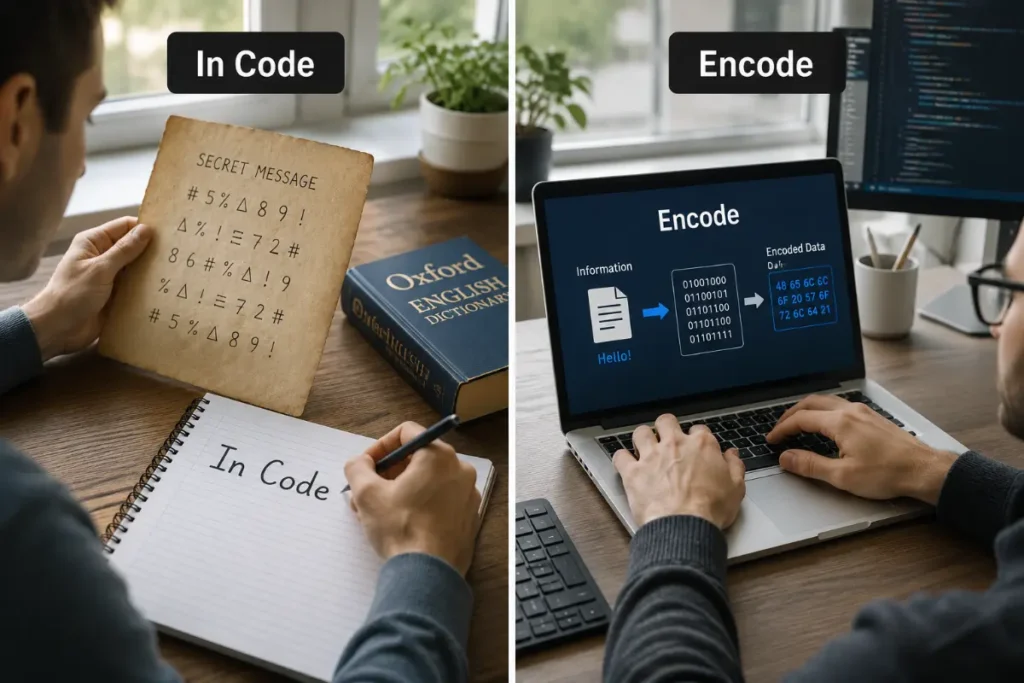
The phrase in code isn’t limited to secret messages. It can also appear when people talk about programming.
A developer might say:
The feature is written in code.
That means the feature has been created using a programming language.
You could also say:
The instructions are written in code.
The website contains code for the form.
The behavior is controlled by code.
In these examples, code refers to instructions written for a computer. The phrase still uses two words when it follows in.
This is an important point for people who work with websites or software. Seeing the word code in a technology sentence doesn’t automatically mean you should use encode.
The surrounding grammar still determines the right form.
In Code And Coding
The words in code and coding can sometimes appear in the same conversation, but they aren’t interchangeable.
Coding usually refers to the process of writing instructions for a computer. A person who writes software is coding.
For example:
She is coding a new website.
He spends his evenings coding.
They learned coding at school.
In code describes something represented through code.
For example:
The instructions are written in code.
The answer appears in code.
The feature is hidden in the code.
The difference is small but useful. Coding describes an activity. In code describes a form or location within a coded system.
Incode And UK Postcodes
The rare noun incode becomes much easier to understand when you look at British postal terminology.
A UK postcode normally contains two main parts separated by a space. The first part identifies a broader postal area. The second part identifies a more specific delivery area.
In specialized postal language, the first part can be called the outcode. The second part can be called the incode.
For example:
SW1A 1AA
The section before the space is the outcode. The section after the space is the incode in this specialized terminology.
This use has very little connection with programming or secret messages. It’s a postal term.
That’s why context matters so much. If you see incode in a discussion about British postcodes, it may be intentional and correct. If you see it in a sentence about computer software, the writer may have intended encode. If you see it after the word written, the writer may have intended in code.
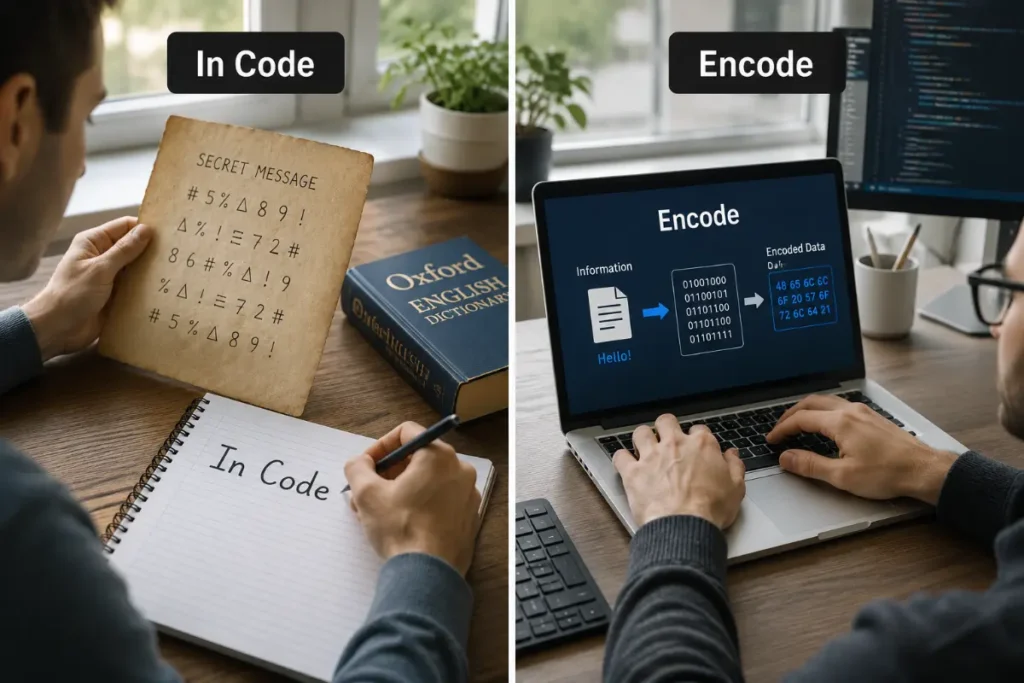
Why The Postal Meaning Causes Confusion
People often expect a dictionary to give them one simple answer. English vocabulary isn’t always that neat.
A word can have a rare meaning in one field while being uncommon everywhere else. Incode is a good example of this kind of specialized vocabulary.
Someone working with UK postal data might know the term well. An American reader who has never dealt with the British postcode system may have no reason to know it.
That doesn’t mean the word is useful in general writing. It simply means the word has a specific place in the language.
This is an important lesson when checking unfamiliar words. Finding a word in a dictionary tells you that the word has an established use. It doesn’t automatically tell you that it’s the best choice for your sentence.
How Context Changes The Answer
Imagine that you see the word in three different sentences.
The message was written in code.
The program will encode the message.
The incode is shown after the space in the postcode.
All three sentences can be correct because they are using different forms for different meanings.
The first sentence describes a coded form of communication. The second describes an action performed by software. The third uses a specialized postal noun.
This is why spelling questions often need more than a yes or no answer. You need to know what the writer is trying to say.
Once you identify the meaning, the correct form usually becomes clear.
A Quick Memory Trick
You can remember the difference with three simple ideas.
In code means using a code.
Encode means to put information into a coded form.
Incode refers to a specialized postal term in British English.
Think of in code as describing where or how information exists. Think of encode as describing something being done to information.
For example:
The note is in code.
The computer will encode the note.
The incode is part of a UK postcode.
That small three part pattern covers most situations you’ll encounter.
Which Form Should American Writers Use
For most American writers, the answer is straightforward. Use in code when the phrase means using a code. Use encode when you need a verb that means converting information into a coded form.
You won’t normally need incode unless you’re discussing the specialized British postal meaning.
This is especially useful for students, bloggers, editors, and business writers. If you’re writing a general article and you’re unsure about the form, in code or encode will almost certainly be the choice you need.
The safest approach is to focus on meaning instead of appearance. Don’t join two words simply because they sound like they could form one word. English has many phrases that remain separate even when they are used together very often.
FAQs
Is incode a word in English
Incode is a real word in a very limited context. It can refer to the second part of a UK postcode in specialized British postal language. In ordinary American English, however, it’s not the form you should use when you mean in code or encode.
Should I write in code as two words
Yes. Use in code as two words when you mean that something is written, expressed, or communicated using a code. For example, you can say that a secret message was written in code or that programming instructions appear in code.
Is encode the same as in code
No. The two forms have related meanings, but they serve different purposes in a sentence. In code describes something that uses a code, while encode is a verb that means to convert information into a coded form.
Is incode correct in American English
You generally shouldn’t use incode in ordinary American English. If you’re talking about a message written using a code, use in code. If you’re talking about converting information into a coded form, use encode.
What does incode mean in British English
In specialized British postal language, incode refers to the second part of a UK postcode. This is a narrow technical meaning, so most people won’t encounter it in normal conversation or general writing.
Is incode a word in Scrabble
A word’s appearance on a particular word list doesn’t always tell you how useful or common it is in everyday English. Some word games include rare, technical, regional, or specialized terms. If you’re asking about normal writing rather than a game, the more useful question is which form fits your sentence.
Should I use incode or encode in programming
Use encode when you’re talking about converting data or information into a particular coded format. For example, you can say that a program encodes a file or that software encodes data before sending it.
Why does incode look like a normal English word
The spelling looks natural because English has many words formed by joining smaller words. That doesn’t mean every combination becomes a standard word. In this case, in code developed as a separate phrase, while encode became the standard verb for the action of converting information into coded form.
Examples You Can Use
Seeing the forms in real sentences is often more useful than memorizing definitions. The following examples show how the meaning changes depending on the form.
Examples With In Code
The students wrote their secret notes in code.
The detective found a message written in code.
The instructions were hidden in code.
The old letter contained several lines written in code.
The children created their own code and wrote the answers in code.
The developer found the problem in the code.
The last example is especially useful because in code can also appear in programming contexts. Here, it doesn’t mean that information has been encoded. It means that something exists within the computer code.
Examples With Encode
The software will encode the video before uploading it.
The application encodes the data automatically.
The camera encodes each video file before saving it.
The system encoded the information into a digital format.
The program is encoding the file now.
These examples all describe an action. Something is being converted or represented in a particular format.
Examples With Incode
The incode appears after the space in the UK postcode.
The postal system uses an outcode and an incode.
The database stores the postcode in separate outcode and incode fields.
These examples use incode in its specialized postal sense. That meaning is much narrower than the everyday meanings of in code and encode.
How The Meaning Changes With One Space
A single space can make a major difference in English. That may seem surprising, but word spacing often affects both meaning and grammar.
Compare these two forms.
In code works as a phrase. It can describe something written or expressed using a code.
Encode works as a verb. It describes an action that changes information into a coded form.
The difference isn’t just visual. The two forms have different jobs.
Consider this sentence:
The message is in code.
The phrase tells us something about the message. It explains the form in which the message appears.
Now consider:
The computer will encode the message.
The verb tells us what the computer will do.
If you understand this difference, you won’t need to rely on spelling alone. You’ll be able to choose the correct form based on the meaning of the sentence.
Related Words You May See
Understanding related words can make this whole group easier to remember. Several terms appear alongside encode in technology and general English.
Encoded
Encoded is the past form of encode. It describes information that has already been converted into a particular coded form.
For example:
The file was encoded before it was sent.
The system stored the encoded information.
The message had already been encoded.
The word encoded describes the result of an encoding process.
Encoding
Encoding can refer to the process of converting information into a coded form. It can also refer to the way information is represented.
For example:
The video is still encoding.
The encoding process took several minutes.
The software supports several types of encoding.
This word is common in computing, media, and data processing.
Decoder
A decoder is something that interprets or converts coded information back into a usable form.
For example:
The receiver uses a decoder to process the signal.
The device includes a built in decoder.
The decoder converts the information into a format the system can read.
This connects naturally with the word decode.
Decoding
Decoding is the process of interpreting coded information.
For example:
The software handles the decoding automatically.
The device performs decoding before displaying the video.
These terms form a useful word family.
Encode describes putting information into a coded form.
Encoded describes information that has gone through that process.
Encoding describes the process.
Decode describes reversing or interpreting the coded information.
Decoding describes that process.
Learning the family makes it easier to recognize the correct form when you encounter it in technical writing.
A Practical Editing Test
If you’re proofreading an article, email, essay, or website and you find incode, don’t automatically delete it. First, read the entire sentence and identify what the writer means.
If the sentence describes something written or expressed using a code, change the form to in code.
For example:
The message was written incode.
Change it to:
The message was written in code.
If the sentence describes a computer or another system converting information, use encode or one of its related forms.
For example:
The program will incode the file.
Change it to:
The program will encode the file.
If the sentence discusses the second section of a UK postcode, check the surrounding context before changing anything. The specialized noun incode may be intentional.
This approach is much safer than treating every occurrence as a simple spelling error.
Why Context Matters More Than The Spelling
Word form questions often seem like spelling questions, but they are really meaning questions.
Suppose someone writes:
The program will incode the image.
The problem isn’t simply that a letter or space is missing. The writer is using the wrong word for the intended action. Encode is the verb they need.
Now suppose someone writes:
The note was written incode.
Here, the problem is different. The writer needs the phrase in code.
Finally, imagine this sentence:
The incode was stored separately from the outcode.
Now the unusual spelling may be correct because the sentence is using specialized British postal terminology.
The same group of letters can therefore create very different problems depending on the context.
That is why good editing looks at meaning, grammar, and usage together.
A Quick Guide For Everyday Writing
For most writers, you only need to remember two common choices.
Use in code when you mean using a code.
Use encode when you mean converting information into code.
You can keep incode in the back of your mind as a specialized British postal term. You don’t need to use it in ordinary American English.
If you’re writing for an American audience, this rule will cover almost every situation you’re likely to face.
A few examples make the pattern easy to see.
The message was written in code.
The software will encode the message.
The file contains encoded information.
The system is encoding the data.
The developer found an error in the code.
Each sentence uses the form that matches its meaning and grammatical role.
Final Takeaway
The answer to is incode a word isn’t simply yes or no. Incode does exist, but its use is limited. In everyday American English, it isn’t the normal spelling for the phrase in code, and it isn’t the standard verb encode.
Use in code when you’re describing something that is written, expressed, or communicated through a code. Use encode when you’re describing the action of converting information into a coded form. These two forms will handle almost all ordinary situations.
The rare word incode belongs mainly to specialized British postal language. If you’re discussing UK postcodes, you may come across it as the name for the second part of a postcode. Outside that narrow context, using it can make your writing look like a spelling mistake even when your reader can guess what you mean.
The simplest rule is worth keeping close. In code means using a code. Encode means to put information into a coded form. Incode has a specialized postal meaning. Remember those three ideas and you’ll have no trouble choosing the right form the next time this word causes confusion.