
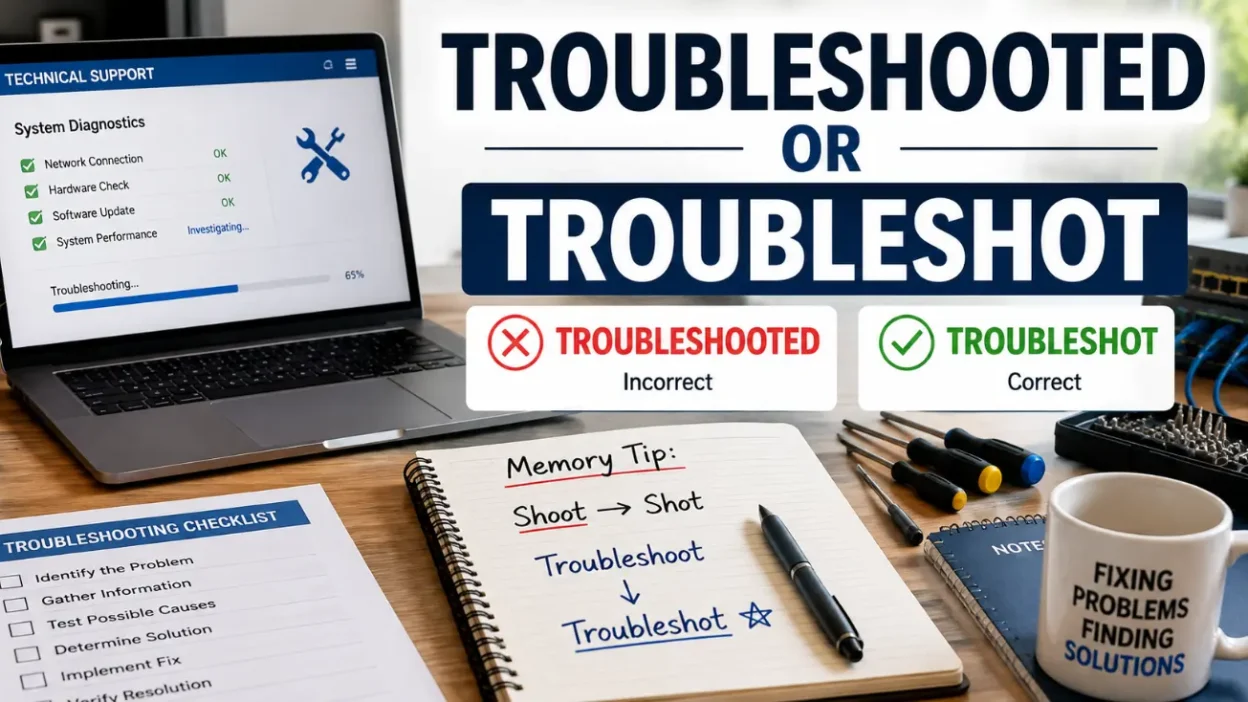
If you’re wondering about troubleshooted or troubleshot, the correct past tense and past participle of troubleshoot is troubleshot. The verb is irregular, so you don’t normally add ed to form its past tense. You can say I troubleshot the problem yesterday or We have troubleshot several network issues this week.
The confusion makes sense because many English verbs form their past tense by adding ed. For example, we have fixed, tested, checked, and repaired. Since troubleshoot sounds like a regular action verb, it can be tempting to write troubleshooted. However, English treats this verb differently.
The word troubleshoot comes from the idea of finding and solving the source of a problem. Today, people use it in many settings. You might troubleshoot a computer, a phone, a printer, a network, a machine, a software program, or even a process that isn’t working properly.
This guide explains why troubleshot is the standard form, how to use it in real sentences, and why troubleshooted sometimes appears online. You’ll also learn the other forms of the verb, how to use it with different tenses, and how to avoid similar mistakes.
Quick Definition
Troubleshot is the standard past tense and past participle of troubleshoot. It means that someone investigated a problem and worked to find or fix its cause.
Troubleshooted is sometimes used by speakers and writers, but it is not the standard past form in edited English. For formal writing and professional communication, use troubleshot.
Direct Answer
The correct form is troubleshot. Say I troubleshot the computer yesterday rather than I troubleshooted the computer yesterday.
Comparison Table
| Word Or Phrase | Meaning | Example Sentence | When To Use It |
|---|---|---|---|
| Troubleshoot | Present form meaning to find and fix a problem | I need to troubleshoot the printer. | Present tense and after helping verbs such as will and can. |
| Troubleshot | Past tense and past participle | She troubleshot the network issue. | Past actions and perfect tenses. |
| Troubleshoots | Present form for he she or it | He troubleshoots software problems. | Present tense with a singular third person subject. |
| Troubleshooting | Present participle and gerund | They are troubleshooting the server. | Continuous tenses and as a noun. |
| Troubleshooted | Nonstandard past form | He troubleshooted the issue. | Avoid in standard edited English. |
Why Troubleshot Is The Correct Form
The key is that troubleshoot is an irregular verb. Regular verbs usually form the past tense by adding ed. Irregular verbs follow their own patterns instead.
For example, the past tense of walk is walked. The past tense of repair is repaired. The past tense of test is tested. These verbs follow the regular pattern.
Other verbs do something different. Go becomes went. Take becomes took. Find becomes found. Teach becomes taught. You cannot predict their past forms simply by adding ed.
Troubleshoot follows the same kind of pattern as shoot. The word troubleshoot is built from trouble and shoot, but its verb forms follow the irregular pattern associated with shoot.
The present form is troubleshoot. The past form is troubleshot. The past participle is also troubleshot.
Here is the pattern.
- I troubleshoot computer problems.
- I troubleshot a computer problem yesterday.
- I have troubleshot many computer problems.
- I am troubleshooting a computer problem now.
Notice that only the first form uses troubleshoot by itself. The past form changes to troubleshot.
Understanding The Verb Troubleshoot
Before looking at more examples, it helps to understand exactly what troubleshoot means.
To troubleshoot something means to investigate a problem so you can identify its cause and find a solution. The word is especially common in technology and technical work, but its meaning is much broader.
If your laptop will not connect to Wi Fi, you might troubleshoot the connection. If a printer refuses to print, you might troubleshoot the printer. If a production process keeps producing errors, a team might troubleshoot the process to find the source of the problem.
Troubleshooting usually involves a series of checks. You identify the problem, look for possible causes, test solutions, and then try to confirm that the problem has been fixed.
For example, imagine that your internet connection suddenly stops working. You might first check the modem. Then you might check the cables, restart the equipment, test another device, and examine the network settings. That whole process can be described as troubleshooting the connection.
The past form simply tells the reader that this process happened in the past.
- I troubleshot the connection this morning.
- The technician troubleshot the router yesterday.
- We troubleshot the network after the outage.
- She troubleshot the software before the meeting.
How Troubleshoot Became A Common Word
The word has a strong connection with technical problem solving. It became especially common as machines and complex systems became part of everyday work.
The basic idea is simple. A trouble shooter was originally someone who dealt with problems and tried to find their source. Over time, the expression developed into the verb troubleshoot.
Today, you do not have to work in a technical field to use it. The word appears in instructions, customer support articles, workplace communication, software documentation, and ordinary conversations.
You might hear someone say, I need to troubleshoot my phone. A support agent might tell you, Let’s troubleshoot the connection. A manager could say, We need to troubleshoot the new process before launch.
The meaning stays the same. Someone is looking into a problem and trying to solve it.
Examples Of Troubleshot In Real Sentences
Seeing the correct form in different situations makes the pattern easier to remember.
Technology Examples
I troubleshot my laptop after it stopped connecting to the internet.
The action happened in the past, so troubleshot is the correct form.
The technician troubleshot the network before replacing the router.
Here, the technician investigated the network problem first and then decided what action to take.
We troubleshot the software issue for two hours before finding the cause.
The word clearly refers to a completed activity in the past.
Workplace Examples
The word is not limited to computers and technical equipment.
Our team troubleshot the reporting process after several errors appeared.
Here, the team investigated a process rather than a physical machine.
She troubleshot the customer service problem and found that the new system was causing delays.
The sentence shows the usual meaning of the verb. She investigated the problem and identified its cause.
The manager troubleshot the scheduling issue before the next shift began.
Again, troubleshot describes an action that was completed in the past.
Everyday Examples
You can also use the verb in ordinary situations.
I troubleshot the washing machine before calling a repair company.
Dad troubleshot the television and got it working again.
We troubleshot the car problem before taking it to the shop.
These examples show why the verb is useful. It does not simply mean fix. It usually suggests that you investigated the problem first.
That distinction matters. If you repaired something without investigating the cause, fixed or repaired may be a better word. If you spent time figuring out what was wrong and then worked toward a solution, troubleshot is a strong choice.
Troubleshot Does Not Always Mean Fixed
This is an important difference that often gets overlooked.
To troubleshoot a problem means to investigate it and work toward a solution. It does not always mean that you successfully fixed the problem.
For example, you could say:
I troubleshot the printer but could not find the cause of the error.
The sentence is perfectly natural. You investigated the printer, but the investigation did not lead to a solution.
You could also say:
The technician troubleshot the system and discovered that the hard drive had failed.
The troubleshooting process identified the problem. Another step might still be needed to fix it.
This distinction makes troubleshoot more precise than simply saying fix. A person can troubleshoot a problem without successfully repairing it.

Why Troubleshooted Sounds Reasonable
If troubleshot is correct, why does troubleshooted sound so natural to some people?
The answer comes back to the way English normally forms past tense verbs. Most English verbs are regular. Speakers learn early that adding ed often creates the past form.
- Clean becomes cleaned.
- Start becomes started.
- Check becomes checked.
- Test becomes tested.
- Troubleshoot sounds like it should become troubleshooted.
That last step is where the mistake happens.
The brain often applies a familiar grammar pattern automatically. When a verb does not follow that pattern, people may create a form that seems logical even though standard English uses something else.
English has many irregular verbs that work this way. A person might say runned instead of ran or buyed instead of bought when learning the language. Those forms make sense based on the regular pattern, but they are not standard English.
Troubleshooted follows the same kind of logic. It is understandable, but troubleshot is the established standard form.
The Connection Between Shoot And Troubleshoot
A useful way to remember the correct past form is to look at the word shoot.
The verb shoot has these forms.
- Shoot.
- Shot.
- Shot.
Since troubleshoot contains shoot as its second part, it follows the same pattern.
- Troubleshoot.
- Troubleshot.
- Troubleshot.
This makes the spelling much easier to remember.
Think of the word as a team.
Shoot becomes shot.
Troubleshoot becomes troubleshot.
You do not need to memorize an entirely new irregular verb. You can connect it to a word you probably already know.
A Simple Memory Trick
When you are unsure about the past tense, remove trouble from the word in your mind.
You are left with shoot.
Shoot becomes shot.
So troubleshoot becomes troubleshot.
That gives you a quick way to check yourself.
- Today I troubleshoot the problem.
- Yesterday I troubleshot the problem.
- I have troubleshot similar problems before.
If you remember that small connection, you are much less likely to write troubleshooted by mistake.
How The Different Forms Work
Knowing that troubleshot is the correct past form is only part of the picture. You also need to know when to use each form of the verb. The form changes based on the tense and the role the word plays in the sentence.
The four main forms are troubleshoot, troubleshoots, troubleshooting, and troubleshot. Once you see them together, the pattern becomes much easier to remember.
Troubleshoot In The Present Tense
Use troubleshoot when the action happens now or happens regularly. It can also follow helping verbs such as can, will, should, may, and must.
For example, you might say, I troubleshoot computer problems for my team when this is part of your regular job. You could also say, We need to troubleshoot the printer before the meeting because the action has not happened yet.
Here are a few more examples.
- I troubleshoot network problems at work.
- We need to troubleshoot the software.
- You can troubleshoot the connection from the settings menu.
- They will troubleshoot the system tomorrow.
- We should troubleshoot the issue before changing the equipment.
Notice that the base form stays the same after a helping verb. You would not say will troubleshot or can troubleshot. The correct forms are will troubleshoot and can troubleshoot.
Troubleshoots In The Present Tense
Use troubleshoots with he, she, it, or another singular subject in the simple present tense.
For example, She troubleshoots software problems for the company describes something she regularly does. The s is added because the subject is singular.
Compare these sentences.
- I troubleshoot the system.
- We troubleshoot the system.
- They troubleshoot the system.
- She troubleshoots the system.
- The technician troubleshoots the system.
The change is small, but it matters. Many English learners remember the past tense correctly but forget this simple present form.
Troubleshooting As An Ongoing Action
Troubleshooting is the form you use when the action is happening now or when you use the word as a noun.
For example, I am troubleshooting the printer means the investigation is happening now. You could also say, Troubleshooting the network took most of the afternoon when the activity itself is the subject of the sentence.
Here are some natural examples.
- The technician is troubleshooting the server.
- We are troubleshooting a connection problem.
- She spent an hour troubleshooting the software.
- Troubleshooting can take time when the cause is unclear.
- The guide includes basic troubleshooting steps.
This form is especially common in technical writing. You will often see phrases such as troubleshooting guide, troubleshooting steps, and troubleshooting tips.
Troubleshot For Completed Actions
Use troubleshot when the action happened in the past.
- I troubleshot the printer yesterday.
- She troubleshot the network before lunch.
- We troubleshot the problem last night.
- The technician troubleshot the system before replacing the part.
The same form works as a past participle after have, has, or had.
- I have troubleshot this problem before.
- She has troubleshot similar issues.
- We had troubleshot the system before the engineer arrived.
That is one reason troubleshot is so useful. The same form works for the simple past and the past participle.
Troubleshoot Vs Troubleshot
A quick way to tell the difference is to look at when the action happens.
If the action is happening now, happens regularly, or has not happened yet, use troubleshoot.
I need to troubleshoot the printer.
If the action already happened, use troubleshot.
I troubleshot the printer yesterday.
If you are using have, has, or had, use troubleshot again.
I have troubleshot this printer before.
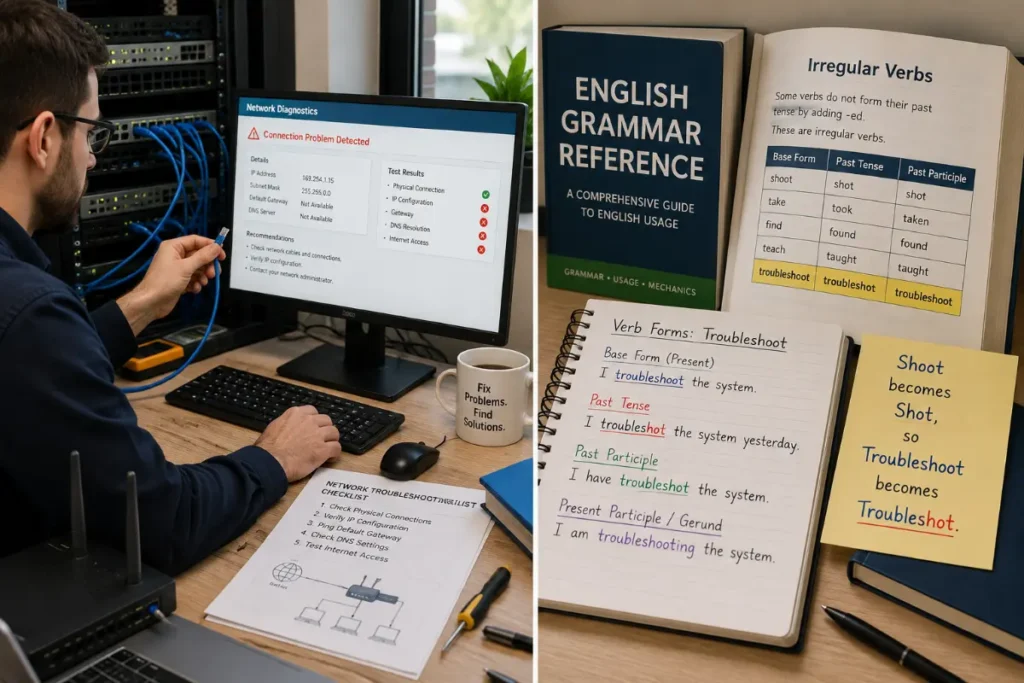
This pattern is similar to other irregular verbs.
- Shoot → shot → shot.
- Teach → taught → taught.
- Buy → bought → bought.
- Troubleshoot → troubleshot → troubleshot.
Seeing these forms together makes the rule much easier to remember.
Common Mistakes With Troubleshoot
The biggest mistake is adding ed to the end of the verb. However, there are several other errors worth knowing because they can make an otherwise clear sentence sound awkward.
Using Troubleshooted As The Past Tense
The most common mistake looks like this.
❌ I troubleshooted the computer yesterday.
The standard form is:
✔ I troubleshot the computer yesterday.
The same rule applies after have, has, and had.
❌ We have troubleshooted the network several times.
✔ We have troubleshot the network several times.
The second sentence follows the established irregular pattern.
Using Troubleshot For A Future Action
Another mistake is using the past form after a future helping verb.
❌ We will troubleshot the server tomorrow.
✔ We will troubleshoot the server tomorrow.
The word will already tells the reader that the action is in the future. The verb that follows it stays in the base form.
The same thing happens with other helping verbs.
❌ You can troubleshot the issue yourself.
✔ You can troubleshoot the issue yourself.
❌ We should troubleshot the system first.
✔ We should troubleshoot the system first.
Using Troubleshoot With A Past Time Marker
Sometimes writers know that troubleshoot is the main verb but forget to change it when talking about the past.
❌ She troubleshoot the printer yesterday.
✔ She troubleshot the printer yesterday.
Words such as yesterday, last week, earlier, and two hours ago often signal a completed past action. When you see one of these time markers, check the verb carefully.
Troubleshot Or Troubleshooted In Professional Writing
If you work in technology, customer support, engineering, manufacturing, or another technical field, you may come across both forms. The standard choice for edited professional English is troubleshot.
This matters because technical writing often needs to be clear and consistent. A support report might say, The technician troubleshot the connection and identified a faulty cable. A project update could say, We troubleshot the software issue and restored normal operation.
Using the established form keeps the writing clean and avoids distracting readers who expect standard English. You do not need a complicated word when a short and correct one already exists.
Why Technical Teams Sometimes Use Troubleshooted
You may still see troubleshooted in technical forums, internal notes, support chats, and user generated content. That does not make it the preferred form.
Technical communities often create new language quickly. People type messages while solving problems, and informal communication does not always receive careful editing. When enough people use a form, it can begin to look normal even when it is outside the standard pattern.
That is why you should separate common usage from standard usage. Seeing a form online does not automatically mean it is the best choice for a professional document.
If you are writing a manual, report, article, email, resume, or customer support message, troubleshot is the better choice.
Troubleshoot Does Not Mean Diagnose
Another useful distinction involves the meaning of the verb itself.
To diagnose a problem means to identify what is causing it. To troubleshoot a problem usually means to investigate the issue through a series of checks or tests so you can find the cause and work toward a solution.
The two words often appear together because they describe related steps.
For example, a technician might troubleshoot a computer by checking the power supply, cables, software settings, and network connection. After those checks, the technician may diagnose the problem as a failed network card.
You could write:
The technician troubleshot the computer and diagnosed a faulty network card.
That sentence gives each verb a clear job. Troubleshot describes the investigation. Diagnosed describes identifying the specific cause.
This distinction can make your writing more precise, especially in technical or workplace situations.
Troubleshoot Does Not Mean Repair
The same point applies to repair.
A repair means fixing something that is damaged or not working. Troubleshooting is the process of investigating what is wrong.
For example, you might troubleshoot a washing machine and discover that the motor has failed. You have not necessarily repaired the machine yet. You have found the problem and can now decide what repair is needed.
Compare these sentences.
I troubleshot the printer but could not fix it.
I repaired the printer after finding the problem.
Both sentences are correct, but they describe different actions.
This distinction is useful because it prevents you from using troubleshot as a simple replacement for fixed. If your point is that you successfully repaired something, fixed or repaired may be the clearer word.

Examples In Different Tenses
Seeing the verb across several tenses can make the pattern stick.
Simple Present
I troubleshoot customer issues every morning.
This describes a regular activity.
Simple Past
I troubleshot a customer issue yesterday.
The action happened in the past.
Present Perfect
I have troubleshot this type of issue before.
The action happened at some point before now and is relevant to the present.
Past Perfect
I had troubleshot the system before the specialist arrived.
The troubleshooting happened before another past event.
Future
I will troubleshoot the issue after lunch.
The action has not happened yet.
Present Continuous
I am troubleshooting the connection right now.
The action is happening at the moment.
These examples show why learning the full verb pattern is better than memorizing only one word. Once you understand the tense, the correct form becomes much easier to choose.
A Few Tricky Sentences
Some sentences can feel confusing because they contain several verbs. Look at the time and the helping verb before choosing the form.
We need to troubleshoot the server before restarting it.
The action has not happened yet, so the base form is correct.
We troubleshot the server before restarting it.
Both actions happened in the past, so troubleshot works.
We have troubleshot the server several times.
The word have requires the past participle, which is also troubleshot.
We will troubleshoot the server again tomorrow.
The word will is followed by the base form.
We are troubleshooting the server now.
The ing form shows an action in progress.
Once you learn to look at the words around the verb, these choices become much easier.
A Reliable Rule To Remember
If you only remember one grammar rule from this article, remember this pattern:
Troubleshoot → troubleshot → troubleshot.
The first form is the base verb. The second is the simple past. The third is the past participle.
Think of shoot as your memory anchor.
Shoot → shot → shot.
Then add trouble back to the beginning.
Troubleshoot → troubleshot → troubleshot.
That small connection gives you a reliable shortcut. You do not have to wonder if the verb needs ed. You already know that shoot changes to shot, so the compound verb follows the same pattern.
FAQs
Is troubleshooted a real word?
You may find troubleshooted in online writing and informal communication, but it isn’t the standard past tense of troubleshoot. Standard English uses troubleshot for both the simple past and the past participle. If you’re writing for work, school, publication, or a professional audience, choose troubleshot.
What is the past tense of troubleshoot?
The past tense is troubleshot. For example, you can say, The technician troubleshot the network yesterday. You should not normally write The technician troubleshooted the network yesterday in standard edited English.
What is the past participle of troubleshoot?
The past participle is also troubleshot. You use it after have, has, or had, as in We have troubleshot several network problems this month. The form doesn’t change to troubleshooted.
Is troubleshot the same as fixed?
Not exactly. Troubleshot means someone investigated a problem and worked to identify its cause or find a solution. The person may or may not have successfully fixed the problem.
For example, I troubleshot the printer but couldn’t repair it is perfectly natural. The sentence shows that the investigation happened even though the repair wasn’t successful.
Why does troubleshooted sound correct?
It sounds reasonable because most English verbs form their past tense by adding ed. Words such as tested, checked, and repaired follow that pattern. Troubleshoot is different because it is an irregular verb that follows the pattern of shoot, which becomes shot.
Can I say I have troubleshot a problem?
Yes. I have troubleshot the problem is grammatically correct. In this structure, troubleshot works as the past participle after have.
Is troubleshoot an irregular verb?
Yes. Troubleshoot follows the irregular pattern of shoot. Its three main forms are troubleshoot, troubleshot, and troubleshot.
Final Thoughts
The choice between troubleshooted or troubleshot becomes much easier once you recognize the pattern behind the verb. Troubleshot is the standard past tense and past participle of troubleshoot. The form troubleshooted may appear in informal writing, but it isn’t the standard form you should choose in polished English.
The reason is simple. Troubleshoot follows the same irregular pattern as shoot. Just as you say shoot, shot, shot, you say troubleshoot, troubleshot, troubleshot. That connection is the easiest way to keep the correct form in your memory.
Remember that the base form still appears after helping verbs such as can, will, should, and must. You say I will troubleshoot the problem, but I troubleshot the problem yesterday. When you use have, has, or had, the form is again troubleshot, as in We have troubleshot similar issues before.
So when you’re writing a report, support message, technical article, email, or other professional text, use troubleshot. If you ever hesitate, think of shoot becoming shot, add trouble back to the front, and the answer is right there: troubleshoot becomes troubleshot.