You may have searched is funner a word after hearing someone say it in a conversation. Maybe a friend said, This game is funner than the last one, and it sounded perfectly natural. Then someone else insisted that more fun is the only correct choice. So who is right?
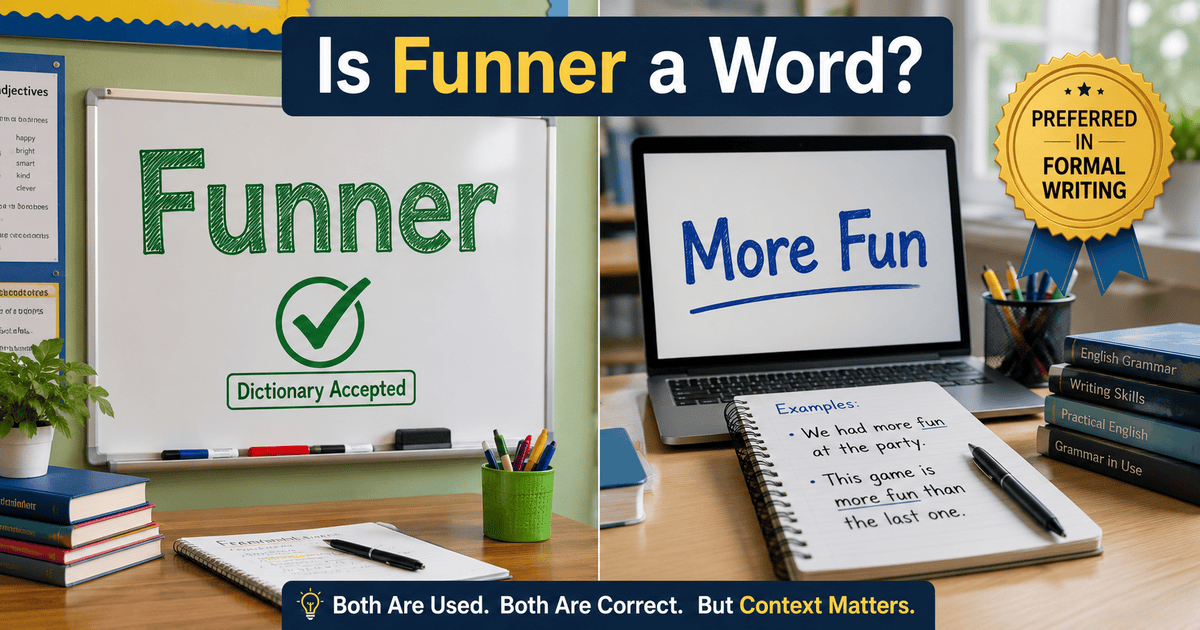
The answer is more interesting than a simple yes or no. Funner is a real word. It appears in major dictionaries and has been used for many years. At the same time, many teachers, editors, and style guides still prefer more fun, especially in formal writing.
That difference leaves many English learners and native speakers scratching their heads. One source says the word is correct, while another tells you to avoid it. The good news is that both forms have their place once you understand how English uses them.
This guide explains what funner means, why people disagree about it, when you can use it with confidence, and when more fun is the better choice. You will also learn the grammar behind both forms, see plenty of natural examples, and avoid the mistakes that confuse many writers.
Quick Definition
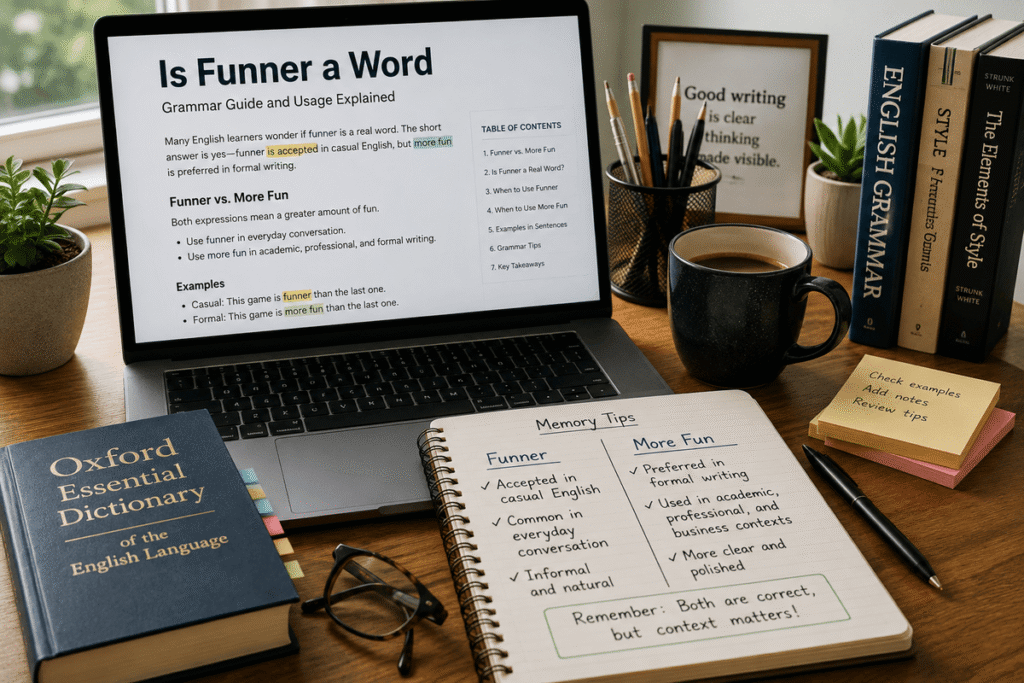
Funner is the comparative form of fun. It means something is more enjoyable, more entertaining, or more pleasant than something else.
Although funner is recognized as a real word, more fun remains the more common and widely accepted choice, especially in formal English.
Direct Answer
Yes. Funner is a real word and appears in modern dictionaries. Still, more fun is generally preferred in formal writing because it sounds more natural to many readers and editors.
Comparison Table
| Word Or Phrase | Meaning | Example Sentence | Best Time To Use |
|---|---|---|---|
| Fun | Enjoyable or entertaining. | The party was fun. | General use. |
| Funner | More enjoyable than something else. | This game is funner than the last one. | Casual conversations and informal writing. |
| More fun | Comparative form of fun. | This game is more fun than the last one. | Formal writing and everyday English. |
| Funnest | Most enjoyable. | That was the funnest trip of the year. | Casual conversations. |
| Most fun | Superlative form of fun. | That was the most fun trip of the year. | Formal writing and everyday English. |
Why This Question Causes So Much Confusion
Few English words create as much debate as fun. The confusion comes from the fact that English has more than one way to compare things.
Some adjectives become comparative by adding er. For example, small becomes smaller, and fast becomes faster.
Other adjectives use more instead. For example, we say more beautiful instead of beautifuler because that sounds awkward.
The word fun sits somewhere in the middle. Many people naturally form funner because it follows the same pattern as short adjectives like fast or kind. Others feel that more fun sounds smoother and closer to traditional English.
Both forms have been around for years. The debate continues because language changes over time, and not everyone accepts those changes at the same pace.
What Makes A Word Real
Before deciding if funner is correct, it helps to answer another question.
What makes any word a real word?
Many people assume a word becomes real only after grammar teachers approve it. That is not how English works. Dictionaries do not create words. They record words that people actually use.
When a word appears regularly in books, newspapers, conversations, television shows, and other reliable sources, dictionary editors study that evidence. If the word has a clear meaning and enough real world use, they may include it in the dictionary.
That is exactly what happened with funner. It is not a brand new invention. People have been using it for generations, and today it appears in respected dictionaries alongside more fun.
This does not mean every editor prefers it. Dictionaries describe language as it is used. Style guides recommend the form that best fits formal writing. Those are two different jobs, and understanding that difference explains much of the disagreement.
How Fun Became An Adjective
The history of fun also helps explain why this topic creates so many questions.
Hundreds of years ago, fun was mainly used as a noun. People talked about having fun or making fun of someone. It was not commonly used as an adjective.
Over time, English speakers began saying things like The trip was fun or That movie was fun. As this new use became more popular, people naturally started looking for comparative forms.
Some speakers chose more fun, while others began saying funner. Both forms spread through everyday conversation, although more fun remained the favorite in formal English.
This pattern is not unusual. English has changed many times through its history because speakers naturally simplify words, shorten expressions, and create new forms that feel comfortable in conversation.
Why Many People Prefer More Fun
Even though funner is recognized as a word, more fun remains the choice most teachers and editors recommend.
One reason is familiarity. People have been reading and hearing more fun for decades, so it sounds natural to their ears. When they hear funner, it may sound unusual simply because they encounter it less often.
Another reason is style. Professional writing usually aims for language that most readers immediately accept without distraction. Since more fun is widely accepted, editors often choose it to keep the focus on the message instead of the wording.
You can see the difference in these examples.
- This board game is more fun than the old one.
- This board game is funner than the old one.
Both sentences communicate the same idea. The first one simply sounds more familiar in formal English.
That is why many newspapers, magazines, schools, and businesses continue to recommend more fun. It is not because funner is wrong. It is because more fun remains the more widely accepted choice in careful writing.
When Funner Sounds Natural
Even though many style guides recommend more fun, you should not assume funner is always wrong. In everyday conversations, plenty of native English speakers use it without giving it a second thought.
Imagine a group of friends comparing two amusement parks. One person says the new park is funner because it has bigger rides and shorter lines. Nobody stops the conversation to point out the grammar. The meaning is clear, and the sentence sounds natural to everyone involved.
The same thing happens with children, families, classmates, and coworkers. Casual speech often follows the patterns people hear around them instead of the rules found in grammar books. That is one reason funner continues to appear in everyday English.
If your goal is to sound relaxed and conversational, using funner will rarely confuse anyone. Most native speakers immediately understand what you mean.
Formal English Vs Casual English
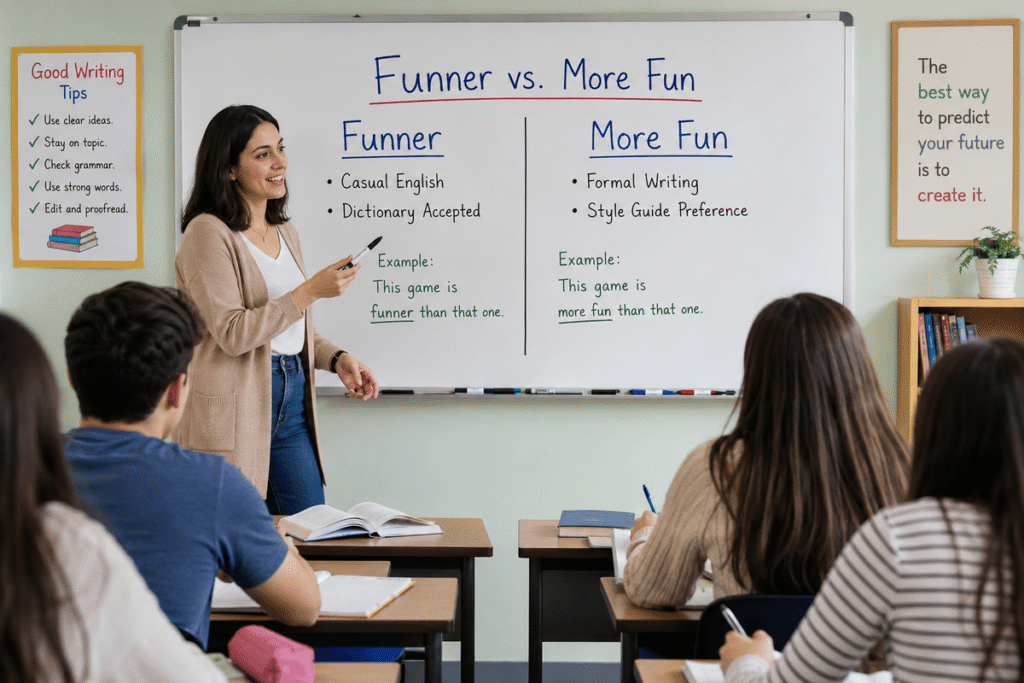
The easiest way to decide between the two forms is to think about your audience.
If you are writing a school paper, a business email, an article, or any professional document, more fun is usually the better choice. It is accepted everywhere and is unlikely to distract readers.
Casual conversations give you much more freedom. Friends and family are not grading your grammar. They simply want to understand what you are saying, and both forms communicate the same idea.
A simple guide can help.
| Situation | Best Choice |
|---|---|
| School assignment | More fun. |
| Business email | More fun. |
| Job interview | More fun. |
| Casual conversation | More fun or funner. |
| Text messages | Both are common. |
| Social media posts | Both are common. |
If you are ever unsure, choosing more fun is the safest option because it works well in every setting.
What Major Dictionaries Say
One reason people continue asking this question is that dictionaries and style guides have different purposes.
A dictionary records words that people actually use. If enough speakers use a word consistently with a clear meaning, dictionary editors may include it. That does not automatically mean the word is the preferred choice in every situation.
Today, several respected dictionaries recognize funner and funnest as valid words. They also note that many speakers still prefer more fun and most fun, especially in formal writing.
Style guides focus on consistency and readability. That is why many editors continue choosing more fun when writing for schools, newspapers, businesses, and professional publications.
The important point is that these sources are not contradicting each other. They simply answer different questions. One describes how English is used. The other recommends the style that best fits formal writing.
Why English Allows Both Forms
English is full of words that have more than one accepted form. Language is flexible, and speakers naturally shape it over time.
Think about words like dreamed and dreamt or learned and learnt. Both versions exist, although one may be more common depending on the country or the writing style.
The same idea applies here. Some people naturally say more fun, while others say funner. Neither choice changes the meaning of the sentence.
This flexibility is one reason English can feel challenging. There is not always a single correct answer. Sometimes the best choice depends on the audience, the setting, and the tone you want to create.
Common Mistakes People Make
Most mistakes happen because people misunderstand why the two forms exist.
Thinking Funner Is Not A Real Word
This is probably the biggest misconception.
Many people confidently say that funner is not a word at all. That is no longer true. Modern dictionaries recognize it, and native speakers have used it for many years.
The better question is not Is it a word? The better question is Is it the best choice for this situation?

Assuming More Fun Is The Only Correct Form
This mistake is just as common.
While more fun is still preferred in formal writing, calling funner incorrect ignores how English is actually spoken today. Casual American English includes many expressions that are accepted because people use them naturally.
Understanding that difference helps you make better choices instead of relying on outdated myths.
Mixing Comparative And Superlative Forms
Another common mistake is mixing the two forms.
❌ This is the more funnest game.
The sentence combines two different comparison patterns.
The correct versions are:
✔ This is the funnest game.
✔ This is the most fun game.
Choose one form and use it consistently.
Using Funner In Highly Formal Writing
Even though the word is accepted, many readers still expect more fun in professional writing.
If you are writing an academic paper, a report, or business content, using more fun helps avoid distracting readers who prefer the traditional style.
Easy Ways To Remember The Rule
You do not need to memorize a long grammar lesson to make the right choice.
The easiest trick is to think about where your writing will appear. If it is formal, choose more fun. If you are chatting with friends or writing informally, both forms work.
Another helpful tip is to remember that more fun never sounds out of place. It fits casual conversations and formal writing alike. That makes it the safest choice any time you are unsure.
Finally, do not panic if you hear someone say funner. They are not necessarily making a grammar mistake. They are simply using a form that has become common in everyday English.
Similar Word Pairs That Cause Confusion
The debate around funner is not unique. English has several word pairs that create similar questions.
Farther And Further
Many style guides suggest using farther for physical distance and further for figurative ideas. In everyday conversation, many people use them interchangeably.
Toward And Towards
American English usually prefers toward, while British English often uses towards. Both forms are correct within their own varieties of English.
Gray And Grey
Both spellings are correct. Gray is more common in American English, while grey is preferred in British English.
Burned And Burnt
American English usually favors burned, while burnt appears more often in British English and in certain expressions.
These examples show that English often allows more than one acceptable form. Knowing your audience is just as important as knowing the grammar.
FAQs
Is funner a word in the dictionary?
Yes. This is one of the biggest reasons people search is funner a word. Several major dictionaries recognize funner as a real word. At the same time, many dictionaries note that more fun is still the preferred choice in formal English.
Is funner grammatically correct?
Yes. Funner is grammatically correct and has become an accepted comparative form of fun. Even so, many teachers, editors, and style guides recommend using more fun in formal writing because it is more widely accepted.
Which sounds better funner or more fun?
That depends on the situation. More fun sounds more natural in formal writing and professional communication. Funner sounds perfectly normal in many casual conversations, especially in American English.
Is funnest a real word too?
Yes. Like funner, funnest appears in modern dictionaries and is used in everyday English. Still, most fun remains the preferred choice in formal writing.
Why do some teachers say funner is wrong?
Many teachers follow traditional grammar rules and style guides that recommend more fun. Their goal is to teach the form that will be accepted in school, professional writing, and standardized tests. That does not mean funner is not a real word.
Should I use funner in school essays?
It is usually better to choose more fun. Most teachers and editors expect that form, and it helps your writing sound polished. If you save funner for casual conversations, you are unlikely to run into any problems.
Do native English speakers use funner?
Yes. Many native speakers use funner naturally in everyday conversations. It is especially common in relaxed speech among friends and family. Even people who prefer more fun generally understand the word without any confusion.
Final Thoughts
The answer to is funner a word is much simpler than many people expect. Yes, it is a real word. It appears in respected dictionaries, and millions of native English speakers use it in everyday conversations.
That does not mean it is always the best choice. More fun continues to be the preferred form in formal writing because it sounds more familiar to many readers and follows the style recommended by most editors and teachers.
If you only remember one rule, make it this one. Use more fun any time you want the safest option. Use funner in casual conversations if it feels natural and fits the situation. Both forms express the same idea, but one is simply more appropriate in formal English.
English is full of words that change over time. The debate around funner is a good reminder that language grows with the people who speak it. Understanding the difference between everyday usage and formal style helps you make confident choices instead of relying on outdated myths.