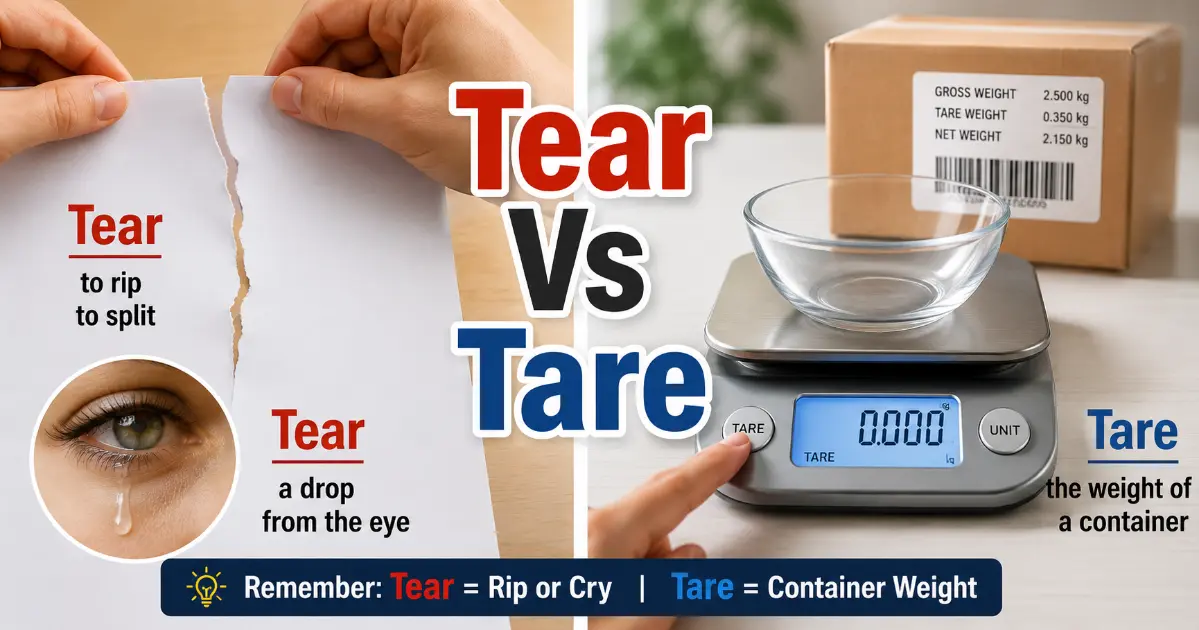
If you’re confused about tear vs tare you’re dealing with two words that sound alike but have completely different meanings. Tear can mean to rip something or a drop that comes from your eye. Tare is mainly used when talking about weight and packaging. It can also refer to a type of plant.
The difference becomes much easier once you connect each spelling with its main meaning. Think of tear as something that can rip or fall from your eye. Think of tare as something connected to a scale or the weight of a container.
These words are easy to mix up because they can sound exactly alike when spoken in some accents. Spelling them correctly depends on understanding the context. This guide explains their meanings, pronunciation, grammar, common uses, and the mistakes people often make.
You’ll also see plenty of natural examples so you can recognize the right word quickly. By the end, you’ll have a simple memory trick that makes the difference much easier to remember.
Quick Definition
Tear has several meanings. As a verb, it means to pull or rip something apart. As a noun, a tear can be a drop of liquid from your eye.
Tare is most often a weight term. It means the weight of an empty container or package that needs to be subtracted from the total weight of the goods inside.
Direct Answer
Use tear when you mean to rip something or a drop from the eye. Use tare when you mean the weight of an empty container or the adjustment made on a scale for that container.
Comparison Table
| Word | Meaning | Example Sentence | When To Use It |
|---|---|---|---|
| Tear | To rip or a drop from the eye | Be careful not to tear the paper. | Use it for ripping or eye moisture. |
| Tare | The weight of an empty container | The tare weight of the box is two pounds. | Use it for scales, packaging, shipping, and measurement. |
| Tare | A plant in the pea family | The farmer grew tare as a crop. | Use it when discussing the plant. |
Why These Words Cause Confusion
The main reason people confuse these words is pronunciation. In many cases, tear and tare sound alike. When two words have the same pronunciation but different spellings and meanings, context becomes especially important.
You may hear someone say, “The box has a tare weight of two pounds.” If you only hear the sentence, you might not know which spelling they mean. The surrounding words give you the answer. A discussion about boxes, scales, shipping, or measurements points to tare. A discussion about paper, clothing, skin, or crying points to tear.
There is another wrinkle with tear. It has two common pronunciations because it has two different meanings. The word for ripping something sounds like tare. The word for liquid from your eye has a different sound and rhymes with words such as near and fear.
That makes this pair more interesting than it first appears. Tare has one common pronunciation, while tear can be pronounced in two different ways depending on its meaning.
What Tear Means
The word tear is much more common than tare. You’ll see it in everyday conversations, books, news reports, instructions, and countless other situations.
It has two main meanings.
The first meaning is connected to ripping or pulling something apart. The second refers to a drop of liquid that comes from your eye.
Tear As A Verb
When tear is a verb, it means to rip, split, or damage something by pulling it apart.
For example, you might tear a sheet of paper in half. You might tear a hole in your shirt by catching it on a sharp edge. A child might accidentally tear the page of a book while turning it.
Here are some natural examples.
- Please don’t tear the wrapping paper.
- I accidentally tore my jacket on the fence.
- She tore the letter into small pieces.
- The strong wind tore the sign from the wall.
- Be careful when you open the package so you don’t tear the label.
The past tense is tore. The past participle is torn.
That pattern is worth remembering because tear is an irregular verb.
- Present: I tear the paper.
- Past: I tore the paper.
- Past participle: I have torn the paper.
For example, you could say, “I tore my jeans yesterday.” You could also say, “I have torn these jeans twice.”
Tear As A Noun
Tear can also mean a drop of liquid produced by your eye. Tears can appear because of sadness, pain, laughter, irritation, or strong emotion.
For example, you might say, “A tear rolled down her cheek.” You could also say, “His eyes filled with tears when he heard the news.”
This meaning has a different pronunciation from the verb that means rip.
Consider these examples.
- A tear rolled down his cheek.
- She wiped a tear from her eye.
- There were tears in her eyes.
- The movie brought tears to my eyes.
- He laughed so hard that tears came to his eyes.
The spelling stays the same even though the pronunciation changes. English has several words like this. Context tells you which meaning and pronunciation the speaker intends.

Tear Can Also Describe A Rip
As a noun, tear can describe a damaged area in fabric, paper, or another material.
For example, you might notice a tear in your jeans. You might find a tear in a page of a book. You could also discover a tear in a curtain after moving furniture.
In these sentences, tear means a rip or split.
- There’s a tear in my shirt.
- The old flag has several tears.
- I found a tear in the corner of the page.
- The repair shop fixed the tear in my coat.
This meaning is different from the liquid produced by your eye. The spelling is the same, but pronunciation and context separate the two meanings.
What Tare Means
Tare is much less common in everyday conversation. You’ll mainly encounter it in shipping, food packaging, manufacturing, retail, laboratories, farming, and other settings where people measure weight.
The most common meaning is the weight of an empty container.
Imagine that you put a cardboard box on a scale. The box weighs two pounds. Then you put five pounds of products inside it. The scale now shows seven pounds.
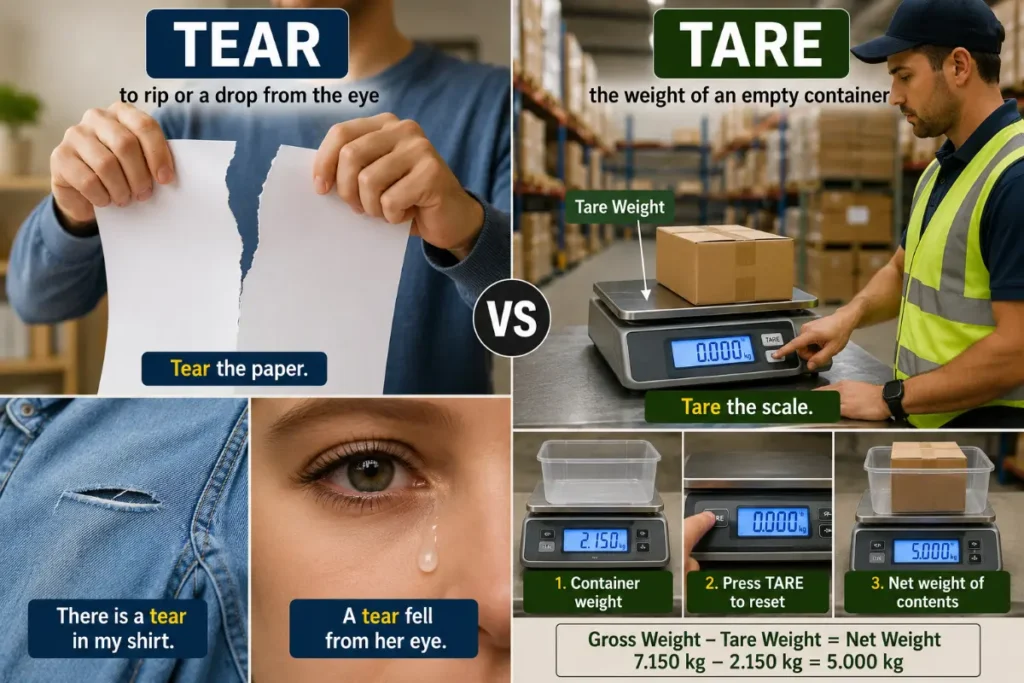
The seven pounds is the total or gross weight. The two pound box is the tare weight. The five pounds of products is the net weight.
That distinction matters in many industries because people need to know the weight of the actual goods rather than the goods plus their packaging.
Tare Weight
The phrase tare weight is the most useful expression to remember.
Tare weight is the weight of the empty container or packaging. It is subtracted from the gross weight to find the net weight of the contents.
The basic relationship is simple.
Gross weight minus tare weight equals net weight.
Suppose a shipping container and its contents weigh 80 pounds. The empty container weighs 12 pounds. The contents therefore weigh 68 pounds.
In everyday language, you could explain it like this.
“The package weighs 80 pounds altogether, but 12 pounds comes from the container. The net weight of the contents is 68 pounds.”
You may see this idea on scales, shipping documents, product labels, warehouse records, and commercial invoices.
The Tare Button On A Scale
You may already use tare without realizing it.
Many kitchen scales have a button labeled Tare. Pressing that button resets the displayed weight to zero while the container remains on the scale.
For example, imagine you want to measure flour in a bowl. You place the empty bowl on the scale. The display shows 12 ounces. You press the Tare button, and the scale returns to zero. You can then add flour and measure only the flour.
The scale has effectively removed the bowl’s weight from the measurement.
That is why the word tare appears so often on digital scales. It tells the user to account for the weight of the container.
Tear And Tare In Real Sentences
Seeing the words in complete sentences is one of the fastest ways to understand the difference. The surrounding words usually make the correct spelling obvious.
Consider these examples.
Tear
“I accidentally tore the receipt while putting it in my wallet.”
The word refers to ripping. The past tense of tear is tore.
Tare
“The tare weight of the empty container is three ounces.”
Here the sentence is about measurement. The correct word is tare.
Now compare these two sentences.
“There is a tear in the plastic bag.”
“The tare weight of the plastic bag is listed on the label.”
The first sentence refers to damage. The second refers to weight. The similar sound does not matter because the meaning makes the spelling clear.
The Pronunciation Difference
Pronunciation causes much of the confusion between these words. However, the pronunciation of tear itself can change depending on its meaning.
When tear means to rip, it is pronounced like tare.
For example.
- Tear the paper.
- Tear the cloth.
- Tear the package open.
In these examples, tear and tare sound alike.
When tear means a drop from the eye, it has a different pronunciation. It sounds like near and fear.
For example.
- A tear fell from her eye.
- He wiped away a tear.
- One tear rolled down her cheek.
This gives you a useful clue. If you hear the word pronounced like tare, you still need the context to know the spelling. If the meaning involves ripping, the spelling is tear. If the meaning involves weight or an empty container, the spelling is tare.
If the word refers to liquid from the eye, it is also spelled tear, but it has a different pronunciation.
A Simple Way To Remember The Difference
The easiest memory trick is to connect tare with a scale.
Picture a kitchen scale with a button marked TARE. The button removes the container’s weight so the scale can measure what you actually want.
If you’re thinking about weight, packaging, or a scale, remember tare.
For everything related to ripping or crying, think tear.
You can also use a short mental picture. Imagine a tear ripping through a piece of paper. Then imagine a tare button on a scale sitting beside a package.
Those two images are very different. That makes the spellings easier to keep apart.
Common Mistakes With These Words
Most mistakes happen when someone knows the meaning but cannot remember the spelling. A few patterns show up again and again.
Using Tare For A Rip
This is incorrect.
- I accidentally tare my shirt.
The correct sentence is:
- I accidentally tore my shirt.
The present tense is tear. The past tense is tore.
Using Tear For Tare Weight
This is also incorrect.
- The tear weight of the box is five pounds.
The correct phrase is:
- The tare weight of the box is five pounds.
When you are talking about the weight of packaging, always use tare.
Confusing Tear With Torn
Another common mistake involves the verb forms.
You can say:
- I tear the paper.
- I tore the paper yesterday.
- I have torn the paper before.
You should not say, “I have tore the paper.” The correct past participle is torn.
This matters because the spelling changes as the verb changes. Learning the full pattern helps prevent mistakes.
Tear Vs Tare In Everyday English
You are far more likely to use tear in everyday English. People talk about tearing paper, tearing clothes, tearing packages, and shedding tears all the time.
Tare appears in more specific situations. You may encounter it when reading about shipping, product weight, food packaging, laboratory measurements, or digital scales.
That does not make tare less useful. It simply belongs to a narrower part of the vocabulary.
Knowing this difference can help you recognize the word faster when reading. If you see tare in a sentence, look for words connected to weight, containers, packages, scales, or measurement. If you see tear, check the context for ripping, damage, crying, or eye moisture.
When Tear Means Rip
The verb tear often describes a physical action.
You can tear paper, cloth, cardboard, plastic, fabric, labels, envelopes, and other materials. You can also tear something apart in a figurative sense.
For example, someone might say, “The argument tore the family apart.” Nobody is physically ripping the family. The phrase means that the conflict caused serious emotional damage or division.
Here are a few more examples.
- The child tore the page out of the notebook.
- I tore the envelope open.
- The dog tore the toy apart.
- The storm tore several branches from the tree.
- The news tore him apart emotionally.
The basic idea remains the same. Something is being split, damaged, or pulled apart.
When Tear Means Cry
The noun tear can describe the liquid that forms in your eyes.
Tears have many causes. You might cry because you are sad. Your eyes might water because of smoke or dust. You might even laugh hard enough to produce tears.
For example.
- She had tears in her eyes during the wedding.
- The smoke made my eyes tear up.
- He wiped the tears from his face.
- That funny story had me laughing until I had tears in my eyes.
The phrase tear up is also common. It can mean that someone begins to cry or becomes emotional.
For example, “I always tear up when I hear that song.”
Here tear is pronounced differently from the verb meaning rip. Context makes the meaning clear.
How Tare Works With Weight
The most useful way to understand tare is to think about a scale. When you place an empty container on a scale and reset the display to zero, the scale is accounting for the container’s weight. That adjustment is called the tare.
For example, imagine you want to measure sugar in a glass bowl. The empty bowl weighs 10 ounces. You place it on the scale and press the tare button. The display goes back to zero. When you add 20 ounces of sugar, the scale shows 20 ounces because the bowl’s weight has already been removed.
This feature is especially useful in kitchens. It saves you from doing the math yourself each time you add an ingredient. You can place a bowl on the scale, zero it, add flour, zero it again, and then add sugar. The scale lets you measure each ingredient without removing the bowl.
Gross Weight And Net Weight
Tare becomes even clearer when you know the difference between gross weight and net weight.
Gross weight is the total weight of the product and its container. Net weight is the weight of the actual product. Tare weight is the weight of the empty container.
Suppose a box of coffee weighs 34 ounces with its packaging. The empty package weighs 4 ounces. The coffee itself weighs 30 ounces. In that example, 34 ounces is the gross weight, 4 ounces is the tare weight, and 30 ounces is the net weight.
This distinction matters in shipping and retail because customers and businesses need to know how much of the listed weight comes from the product itself. It also helps warehouses and carriers calculate loads accurately.
Tare In Shipping
Shipping companies use tare weight when they deal with large containers and cargo. A container has its own weight before anyone puts goods inside it. That empty weight must be separated from the weight of the cargo.
For example, a shipping container might weigh several thousand pounds when empty. Once it is loaded with furniture, machinery, or other goods, the total weight becomes much higher. The tare weight allows workers to determine how much of that total comes from the cargo.
You may see the term on shipping records, cargo documents, scales, and container labels. It is a practical measurement term rather than a word you are likely to use in an ordinary conversation.
Tare As A Verb
Tare can also work as a verb. In this form, it means to determine or remove the weight of a container from a measurement.
For example, a worker might say, “Tare the scale before adding the product.” The instruction means to reset the scale so the container does not count toward the final measurement.
You might also see sentences such as these.
- Tare the scale before weighing the flour.
- The operator tared the container before filling it.
- The machine automatically tares the package.
- Tare the empty tray before adding the ingredients.
This use is common in technical and workplace settings. In ordinary conversation, people are more likely to say, “Zero the scale” or “Reset the scale.”
Tare As A Noun Beyond Weight
There is another meaning of tare that has nothing to do with scales. It can refer to certain plants in the pea family.
This meaning is less common in everyday American English. You are more likely to encounter it in farming, botany, gardening, or older texts.
Some plants called tare are types of vetch. They can be grown as crops or used as forage for animals. The word can therefore appear in agricultural writing even when no weighing is involved.
For most readers, though, the weight related meaning is the one worth remembering first. If you see tare in a sentence about a scale, package, container, or measurement, it almost certainly refers to weight.
Why Tear Has So Many Meanings
The word tear has developed several related uses over time. That is why you can find it in very different sentences without the spelling changing.
As a verb, it can mean to rip something.
- Please tear the paper along the line.
As a noun, it can mean a rip or damaged area.
- There is a tear in the curtain.
As a noun, it can also mean liquid from the eye.
- A tear ran down her cheek.
The context does most of the work. English readers usually identify the intended meaning without much effort because the words around tear provide clues.
For example, “tear the paper” clearly describes an action. “A tear fell from her eye” clearly refers to liquid. “There is a tear in my jacket” clearly describes damage.
The Two Pronunciations Of Tear
This is one of the most useful details to learn because it explains why tear can be especially confusing.
When tear means to rip, it has the same sound as tare.
- Tear the paper.
- Tare the scale.
The two words sound alike in these examples even though they have different meanings and spellings.
When tear means liquid from the eye, it has a different pronunciation.
- She shed a tear.
- A tear fell from his eye.
This pronunciation rhymes with fear and near.
So you can think of tear as having two sounds and two major groups of meanings. One sound is connected to ripping. The other is connected to crying. Tare has the same sound as the ripping sense of tear, but its meaning is different.
How Context Tells You The Right Word
When two words sound alike, context becomes your best clue. You do not need to know the spelling immediately if you can identify the meaning first.
Suppose you hear someone say, “The box has a tare of five pounds.” The subject is a box and the sentence refers to weight. That tells you the spelling is tare.
Now suppose you hear, “Be careful not to tear the box.” The subject is still a box, but this time the action involves ripping. The correct spelling is tear.
The same principle works with writing. Before choosing the spelling, ask yourself what the word means in the sentence.
If the meaning is rip, use tear.
If the meaning is a drop from the eye, use tear.
If the meaning is the weight of a container, use tare.
That simple three part check handles most situations.

Common Phrases With Tear
Learning common phrases can make the word easier to recognize.
Tear Apart
Tear apart means to rip something into pieces or separate it completely.
- The children tore the old cardboard box apart.
- The dog tore the stuffed toy apart.
It can also have a figurative meaning.
- The disagreement tore the team apart.
Tear Up
Tear up can mean to rip something into pieces.
- She tore up the old receipt.
It can also mean to become emotional or begin crying.
- I always tear up during that scene in the movie.
The context tells you which meaning is intended.
Tear Down
Tear down can mean to pull down or destroy a structure.
- The city plans to tear down the abandoned building.
It can also describe harsh criticism.
- The reviewer tore down the new restaurant.
Tear Into
Tear into can mean to attack physically or criticize someone strongly.
- The dog tore into the bag of food.
In another context, someone might say, “The coach tore into the players after the poor performance.” That means the coach criticized them harshly.
These expressions all keep the central idea of force or separation, even when the meaning becomes figurative.
Common Phrases With Tare
Tare appears in fewer everyday phrases because it belongs mainly to measurement language.
The most common combinations include tare weight, tare button, tare value, and tare the scale.
For example, a recipe might tell you to use the tare button before adding ingredients. A shipping document might list the tare weight of a container. A warehouse worker might record the tare value before loading goods.
If you see tare beside words like weight, scale, container, package, gross, or net, the meaning should be easy to identify.
Tear Or Tare In A Sentence
Sometimes the easiest way to test your understanding is to compare similar sentences.
Consider these examples.
- I don’t want to tear the package.
- The package has a tare weight of two ounces.
The first sentence is about ripping. The second is about measurement.
Now look at another pair.
- There is a tear in the envelope.
- The tare weight is printed on the shipping label.
Again, the first sentence describes damage. The second describes the weight of the packaging.
Here is another example.
- She wiped a tear from her cheek.
- The scale needs to be tared before use.
The meanings are completely different, even though the words can sound similar.
How To Avoid Spelling Errors
The best way to avoid confusing these words is to stop thinking about sound alone. Say the meaning in your head first.
If you mean rip, choose tear.
If you mean eye moisture, choose tear.
If you mean container weight, choose tare.
This works because the spelling follows the meaning. You are not trying to remember two random spellings. You are connecting each spelling to a clear idea.
It also helps to learn tare as part of the phrase tare weight. That phrase is so common in measurement contexts that remembering the pair can make the spelling automatic.
Tear And Tare In Business And Professional English
The word tare becomes especially important in fields where weight must be measured accurately. Shipping companies, warehouses, food producers, manufacturers, laboratories, and retailers may use the term regularly.
In these settings, confusing tare with tear can create a real spelling problem because the two words refer to completely different things. A shipping record that refers to tare weight is talking about the container, not damage to the container.
For example, a warehouse worker might record the gross weight of a shipment and then subtract the tare weight of the pallet or container. The result gives the net weight of the goods.
In professional writing, precision matters. Using the correct term makes the record easier to understand and prevents confusion during measurement or shipping.
Tear And Tare In School Writing
Students are more likely to encounter tear than tare unless they are writing about science, math, cooking, farming, or measurement.
If you are writing a story, tear might describe damaged clothing or someone crying. If you are writing a science report about mass and measurement, tare might appear in an explanation of how a digital scale works.
For example, a student might write, “The experiment required the students to tare the container before measuring the liquid.” That sentence uses the technical meaning correctly.
A different student might write, “The paper had a small tear along the edge.” Here tear is the correct spelling because the sentence describes damage.
Knowing the subject of your writing can therefore help you choose the right word.
A Quick Memory Trick
Think of tear as connected to two things: ripping and crying.
Think of tare as connected to scales.
You can remember the rule with three simple questions.
Is something being ripped? Use tear.
Is someone crying? Use tear.
Are you measuring the weight of a container? Use tare.
That is all you need for most situations. If you see the word on a scale or shipping document, tare should immediately come to mind. If you see it in a story about a ripped shirt or someone with wet eyes, tear is the right choice.
FAQs
What is the difference between tear and tare?
The main difference is meaning. Tear can mean to rip something or a drop of liquid from your eye. Tare usually refers to the weight of an empty container or the adjustment made on a scale to remove that container’s weight from the measurement.
Is tare the same as tear?
No. They can sound the same when tear means to rip something, but they have different meanings and spellings. Tear relates to ripping or crying, while tare most often relates to weight and measurement.
How do you remember the spelling of tare?
Connect tare with a scale. Many digital scales have a Tare button that removes the container’s weight before you measure what is inside. If you are thinking about a package, bowl, container, or scale, tare is usually the word you need.
Is tear pronounced like tare?
It depends on the meaning. When tear means to rip, it is pronounced the same way as tare. When tear means liquid from the eye, it has a different pronunciation that rhymes with words such as near and fear.
What is tare weight?
Tare weight is the weight of an empty container or package. It is subtracted from the gross weight to find the net weight of the contents. For example, if a package weighs 10 pounds and the empty container weighs 2 pounds, the net weight of the contents is 8 pounds.
What does the tare button do on a scale?
The tare button resets the scale to zero while the container remains on it. This lets you measure only the contents inside the container. It is useful when weighing ingredients in a bowl or products in a package.
Is tear a noun or a verb?
Tear can be both a noun and a verb. As a verb, it can mean to rip something. As a noun, it can describe a rip in something or a drop of liquid from the eye.
Can tear mean a rip?
Yes. Tear can describe a damaged area in paper, clothing, fabric, or another material. For example, you can say, “There is a tear in my jacket.” In that sentence, the word means a rip or split.
Tear And Tare In Related Words
Understanding a few related words can make this pair even easier. English often uses the same basic word in several forms, so recognizing the pattern can help you avoid spelling mistakes.
The verb tear has several forms that are worth learning together. The present form is tear, the past form is tore, and the past participle is torn.
For example, you can say, “I tear the paper carefully.” If the action happened yesterday, you would say, “I tore the paper yesterday.” If you are describing something that has already happened, you could say, “I have torn the paper.”
These forms can be confusing because the spelling changes quite a bit. Still, the meaning stays connected to ripping or pulling something apart.
Tare is different. Its forms are more regular when it is used as a verb. You may see tared or taring in technical writing. For example, “The technician tared the scale before measuring the sample.”
You do not need to use these forms often in everyday conversation. Still, recognizing them can help when you read instructions, technical documents, or workplace material.
When The Context Makes The Answer Obvious
Sometimes the words around the spelling give you the answer immediately.
Consider this sentence.
“The chef placed the bowl on the scale and pressed the button before adding flour.”
The context points to tare because the sentence involves a scale and a container. You would not use tear in this situation.
Now consider another sentence.
“The child was careful not to damage the paper while opening the package.”
If the sentence were changed to “The child tore the paper while opening the package,” the meaning would clearly involve ripping. That tells you the spelling is tear.
A sentence about emotion gives you another clue.
“She had a tear in her eye when she said goodbye.”
The word refers to liquid from the eye. Again, the surrounding words make the meaning clear.
This is a useful habit for all confusing word pairs. Do not focus only on how a word sounds. Look at what the word is doing in the sentence. Meaning usually gives you the answer.
The Difference Between Tare And Tear Weight
One mistake deserves special attention because tare weight is a fixed term.
The correct phrase is tare weight. It refers to the weight of the empty package or container.
You might see a label that gives the gross weight, tare weight, and net weight. These three numbers describe different parts of the same measurement.
Gross weight includes everything. Tare weight is the empty container. Net weight is the actual contents.
For example, imagine a jar filled with honey. The full jar weighs 36 ounces. The empty jar weighs 8 ounces. The honey therefore weighs 28 ounces.
In this example, 36 ounces is the gross weight. The 8 ounce jar is the tare weight. The 28 ounces of honey is the net weight.
This distinction is useful far beyond grammar. It explains why tare appears on scales, shipping records, food labels, and other documents involving measured weight.
Why Tear Is More Common
Most people use tear much more often than tare. That is simply because ripping and crying are common parts of everyday language.
You might tear open a letter. You might tear a piece of paper. Your child might tear a page from a coloring book. You might notice a tear in your shirt. You might also shed a tear during an emotional movie.
The word appears in many ordinary situations.
Tare has a narrower job. It is mostly connected to measurement. Unless you work with shipping, food preparation, manufacturing, farming, laboratory equipment, or other areas that involve weight, you may rarely need the word.
That difference in frequency can actually help you remember the spelling. When you see a common everyday sentence, tear is much more likely. When you see a sentence about an empty container or a scale, think tare.
A Final Practice Test
Try choosing the correct word in each sentence before looking at the answers.
The wind might ___ the flag if it gets stronger.
The empty box has a ___ weight of three pounds.
A single ___ rolled down her cheek.
Please press the ___ button before adding the flour.
There is a small ___ in the sleeve of my shirt.
The worker recorded the ___ weight before loading the truck.
The correct answers are tear, tare, tear, tare, tear, and tare.
Notice the pattern. The first, third, and fifth sentences involve ripping, crying, or damage. They use tear. The second, fourth, and sixth involve containers, scales, or measurement. They use tare.
If you can spot that pattern, you already understand the main rule.
A Simple Rule To Keep
You do not need a complicated grammar lesson to remember these words. Just connect each spelling with its main idea.
Use tear for ripping something, a rip in something, or liquid from the eye. Remember that the word has two different pronunciations depending on the meaning.
Use tare for the weight of an empty container or the process of removing that weight from a scale reading. If the sentence involves a scale, package, bowl, container, gross weight, or net weight, tare is probably the correct choice.
The sound can be misleading, but the meaning usually isn’t. Once you train yourself to look at the context, this word pair becomes much easier.
Final Thoughts
The confusion behind tear vs tare comes mainly from sound. When tear means to rip, it sounds exactly like tare in standard American pronunciation. The spelling changes because the meanings are different.
Remember the two main ideas. Tear belongs with ripping, damage, and liquid from the eye. Tare belongs mainly with scales, containers, packaging, and weight. The phrase tare weight is especially useful because it gives you a strong clue whenever you see the word in a measurement context.
There is also one pronunciation detail worth keeping in mind. The word tear has a different sound when it means a drop from the eye. That form rhymes with near and fear, while the ripping form sounds like tare.
The next time you hesitate over the spelling, ask yourself one quick question. Am I talking about ripping or crying, or am I talking about the weight of a container? If it is ripping or crying, choose tear. If it is a scale or container weight, choose tare.