
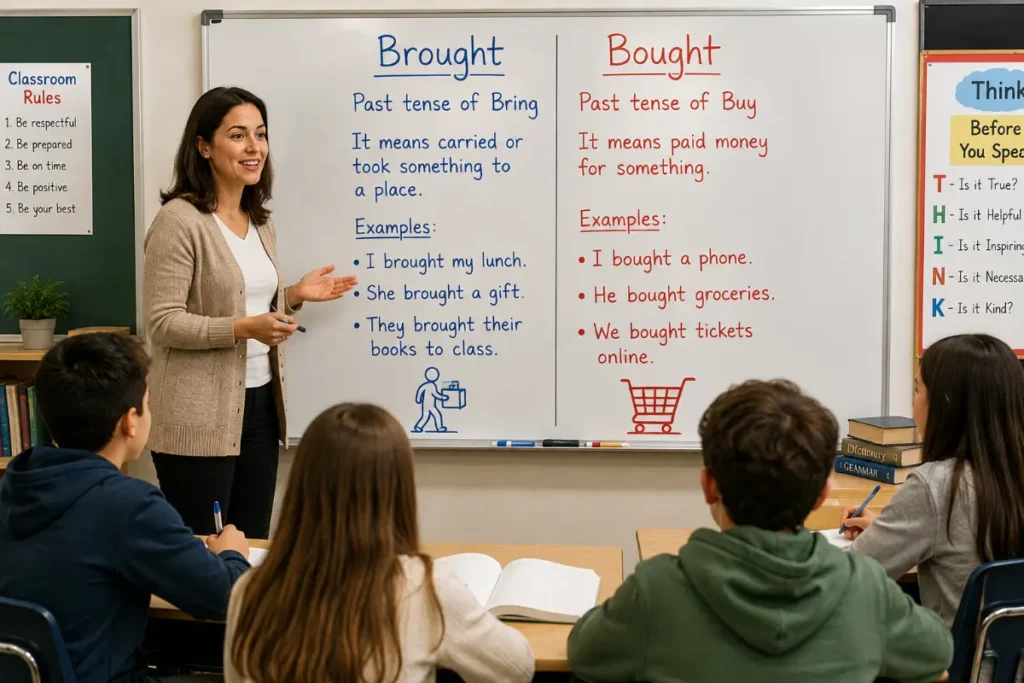
If you confuse brought vs bought, you’re definitely not alone. These two words look and sound similar, but they have completely different meanings. Brought is the past tense of bring, while bought is the past tense of buy.
The easiest way to remember the difference is to connect each word with its base verb. If someone brought something, they carried or took it to a place. If someone bought something, they paid money for it. Once you see that simple connection, the spelling becomes much easier to manage.
The problem usually starts because the words sound very similar when people speak quickly. Their spellings are also close enough to cause mistakes when you’re writing. This guide will show you how each word works, when to use it, common mistakes to avoid, and a few memory tricks that can help the difference stick.
Quick Definition
Brought is the past tense of bring. It means someone carried or took something to a person or place.
Bought is the past tense of buy. It means someone paid money to get something.
Direct Answer
Use brought when you mean carried or took something somewhere. Use bought when you mean purchased something with money.
For example, I brought my lunch to work means I carried my lunch with me. I bought my lunch at the café means I paid for the lunch.
Comparison Table
| Word | Meaning | Example Sentence | When To Use It |
|---|---|---|---|
| Brought | Past tense of bring | She brought her laptop to class. | Use it when someone carried or took something to a place or person. |
| Bought | Past tense of buy | She bought a new laptop. | Use it when someone purchased something. |
Why These Words Cause Confusion
The main reason these words get mixed up is their pronunciation. Brought and bought sound almost identical in most forms of American English. When you hear them in a fast conversation, you may not be able to tell which word someone used.
Spelling creates another problem. Both words contain ou and end with the same ght sound pattern. The first letters are different, but the rest of the words look close enough to make a quick writing mistake.
Their meanings are completely different, though. Brought has a connection with movement. Bought has a connection with money and purchasing.
Compare these two sentences.
- Maria brought a cake to the party.
- Maria bought a cake for the party.
In the first sentence, Maria carried the cake to the party. The sentence tells us what she did with the cake.
In the second sentence, Maria purchased the cake. The sentence tells us how she got it.
She could actually have done both things.
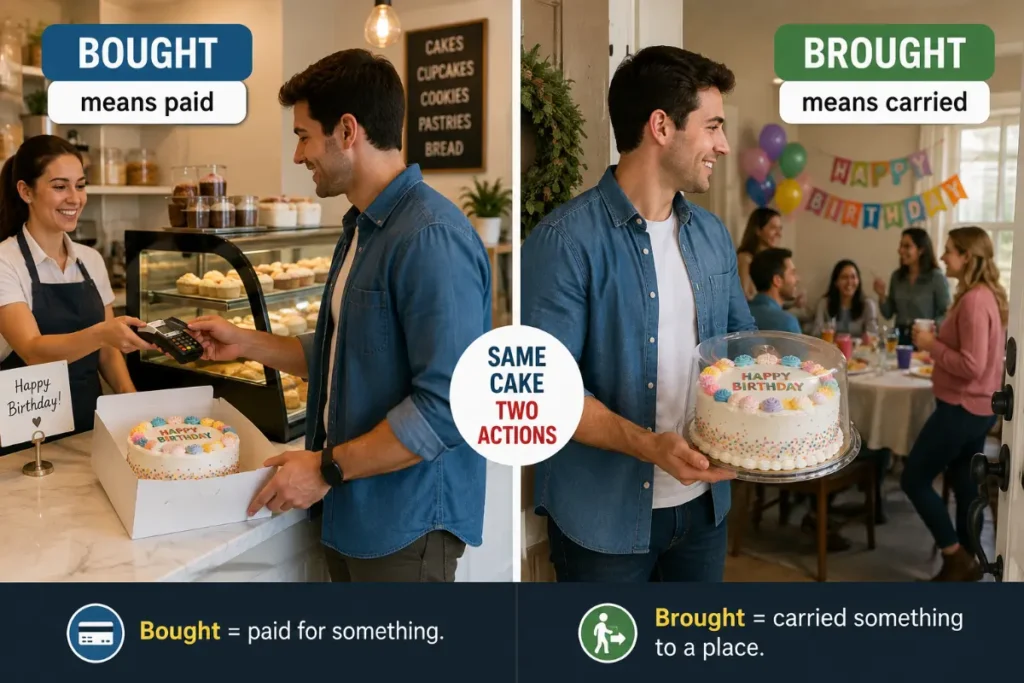
Maria bought a cake from the bakery and brought it to the party.
That sentence is a great way to remember the difference. She bought the cake because she paid for it. She brought the cake because she carried it to the party.
The Meaning Of Brought
Brought is the past tense and past participle of bring. The basic idea behind bring is movement toward a particular person or place.
For example, imagine that you are sitting at home and ask your brother to bring you a glass of water. If he walks into the room with the water, he brought you a glass of water.
The word can describe physical objects, people, food, documents, ideas, and many other things.
Here are some natural examples.
- I brought my jacket because it was cold outside.
- She brought cookies to the office.
- He brought his dog to the park.
- We brought extra chairs for our guests.
- They brought the documents to the meeting.
- Sarah brought her children to the wedding.
In each example, something or someone moved to a particular place.
Brought Describes Movement
A useful way to understand brought is to picture someone carrying something from one place to another.
Imagine your friend is visiting your house. You ask her to bring some snacks. She arrives with a bag of chips and a box of cookies.
You might say:
- Thanks for bringing snacks.
If you talk about the action later, you use the past tense.
- She brought snacks to my house.
The meaning stays connected to movement. Something came along with the person.
This works with many everyday situations.
- I brought my notes to class.
- Dad brought the groceries home.
- We brought blankets to the beach.
- The waiter brought our food.
- She brought her passport to the airport.
The object does not have to be something you can physically carry. The word can also describe bringing information, attention, change, or other less concrete things.
For example:
- The new manager brought fresh ideas to the team.
- The storm brought heavy rain.
- Her speech brought hope to the community.
In all these examples, something is being introduced or carried into a situation.
The Meaning Of Bought
Bought is the past tense and past participle of buy. It means that someone paid money to get something.
The connection with money is the key.
If you go to a store and pay for a shirt, you bought the shirt. If you order a meal and pay for it, you bought the meal. If you pay for a new phone online, you bought the phone.
Here are some natural examples.
- I bought a new pair of shoes yesterday.
- She bought groceries after work.
- We bought tickets for the concert.
- He bought his mother a birthday gift.
- They bought a house last year.
- My brother bought a new computer.
In each sentence, the person made a purchase.
Bought Connects To Money
The easiest mental connection is bought equals paid.
When you see bought, think about a purchase.
You bought a book.
That means you paid for the book.
You bought a car.
That means you paid for the car.
You bought lunch.
That means you paid for the lunch.
This simple connection can prevent a lot of spelling mistakes.
It also helps to remember that bought comes from buy.
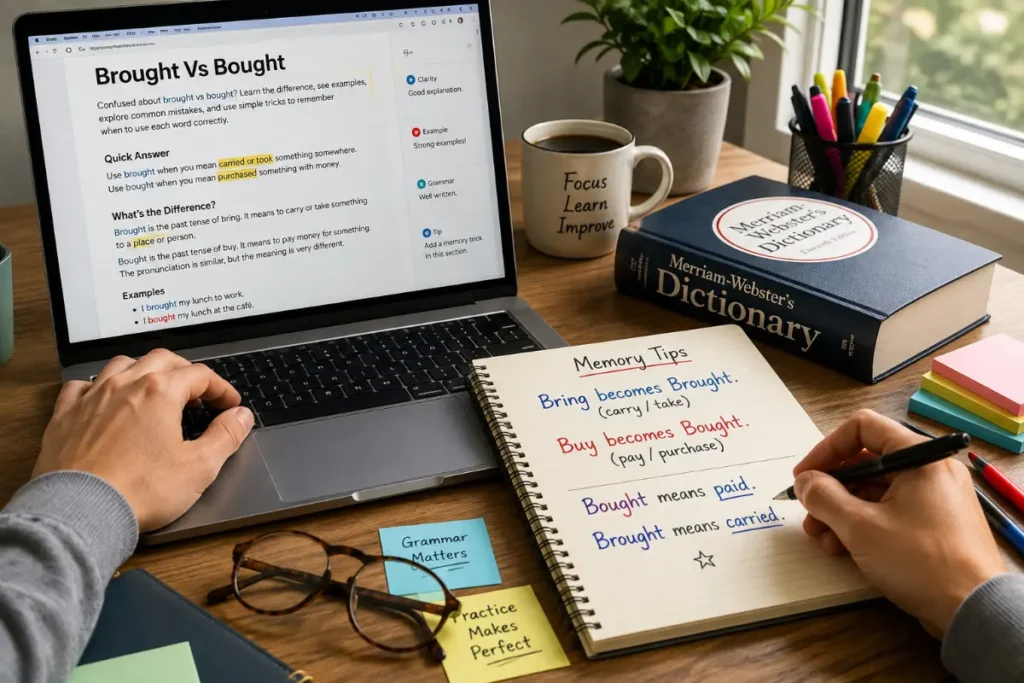
- Buy becomes bought.
- Bring becomes brought.
Those are the two verb pairs you need to keep separate.
The Biggest Difference Between Brought And Bought
The clearest difference is the action behind each word.
Brought describes taking or carrying something to a person or place.
Bought describes paying for something.
Think about a birthday gift. You might buy the gift at a store and then bring it to your friend’s house.
For example:
- I bought a gift for Emma.
- I brought the gift to her party.
The first sentence tells us how you got the gift. You paid for it.
The second sentence tells us what you did with the gift afterward. You carried it to the party.
This distinction works in countless everyday situations.
Food Example
Imagine you stop at a restaurant before visiting a friend.
You pay for two pizzas.
You bought two pizzas.
Then you drive to your friend’s house and carry the pizzas inside.
You brought two pizzas.
You can even put both actions into one sentence.
- I bought two pizzas and brought them to your house.
That sentence shows the difference perfectly.
Gift Example
Now imagine you need a birthday present.
You visit a store and purchase a watch.
You bought a watch.
Later, you take the watch to the birthday party.
You brought a watch.
The words describe two separate actions, even though they can happen to the same object.
School Example
Suppose a teacher asks students to bring their homework to class.
You finish your homework at home and carry it to school.
You brought your homework.
You did not necessarily buy it. The action involves movement, not payment.
Now imagine you need a new notebook for the assignment. You go to a store and pay for one.
You bought a notebook.
Again, the difference comes down to the action.
A Simple Rule To Remember
Here is the rule worth keeping in your head.
Bring becomes brought. Buy becomes bought.
If the original verb is bring, the past form is brought.
If the original verb is buy, the past form is bought.
You can test a sentence by replacing the confusing word with its present tense verb.
For example:
- I brought my camera to the trip.
Ask yourself, “Did I bring my camera?”
Yes. So brought is correct.
Now try:
- I bought a new camera.
Ask yourself, “Did I buy a new camera?”
Yes. So bought is correct.
This little test works because the past tense forms are irregular. They do not follow the simple pattern of adding ed. Instead, bring changes to brought, and buy changes to bought.
How The Verbs Change
Both words come from irregular verbs. That means you cannot form their past tense by simply adding ed.
The verb bring changes like this:
- Present: bring.
- Past: brought.
- Past participle: brought.
The verb buy changes like this:
- Present: buy.
- Past: bought.
- Past participle: bought.
Notice that both verbs use the same past form for the simple past and past participle.
You can see this in sentences such as:
- I brought my lunch yesterday.
- I have brought my lunch every day this week.
And:
- I bought my lunch yesterday.
- I have bought lunch here many times.
The grammar changes around the verb, but brought and bought remain the same.
More Examples In Everyday English
The best way to make the difference stick is to see the words in situations you might actually talk about.
Imagine a coworker asks why you have a large box on your desk.
You could say:
- I bought a new printer yesterday and brought it to work this morning.
The first action involves payment. The second involves movement.
Now imagine you are hosting a family dinner.
- My sister bought the dessert, and I brought the drinks.
Your sister paid for the dessert. You carried the drinks to the dinner.
Here is another example.
- Dad bought some flowers and brought them home.
He paid for the flowers at the store. Then he carried them home.
One more.
- We bought sandwiches and brought them to the park.
You paid for the sandwiches. Then you took them to the park.
These examples show why the two words can appear together so often. Buying and bringing are different actions, but they can happen one after the other.
A Quick Test For Any Sentence
When you are unsure which word to use, ask yourself one question.
Am I talking about paying for something or taking something somewhere?
If you are talking about payment, choose bought.
If you are talking about movement to a person or place, choose brought.
For example:
- She ___ flowers for her mother.
Did she pay for the flowers?
Yes. The answer is bought.
- She ___ flowers to her mother.
Did she take the flowers to her mother?
Yes. The answer is brought.
The surrounding words often give you the answer. Words such as store, price, paid, shop, and purchase often point toward bought. Words such as home, office, school, party, here, and there often point toward brought.
Those clues are not absolute rules, but they can help when you are writing quickly.
Why Pronunciation Makes The Problem Worse
In most American English speech, brought and bought have very similar pronunciations. That means your ears may not help much when someone says one of them.
This is especially true in fast speech. A sentence like I bought it yesterday can sound very close to I brought it yesterday if you are still learning English.
That is why this confusion is often more noticeable in writing. You may know exactly what you mean but still choose the wrong spelling because the two words sound so much alike.
When that happens, do not rely on pronunciation. Go back to the base verb.
Ask yourself:
- Did I bring it?
- Did I buy it?
If the answer is bring, write brought.
If the answer is buy, write bought.
That one habit is much more reliable than trying to hear the difference.
The Difference In One Sentence
If you bought something, you paid for it. If you brought something, you carried or took it to a person or place.
That is the core rule you can use every time.
Common Mistakes With These Words
The most common mistake is using bought when the sentence is about carrying something somewhere. The other common mistake is using brought when the sentence is about purchasing something. Since the words sound so similar, it’s easy to make this error when writing quickly.
Consider this sentence.
- I bought my lunch to work.
If you mean that you purchased your lunch, the sentence is incomplete in meaning because bought does not describe taking the lunch to work. The correct sentence is:
- I brought my lunch to work.
Now consider the opposite.
- I brought a new phone yesterday.
If you mean that you purchased a new phone, the correct word is bought.
- I bought a new phone yesterday.
The best way to catch these mistakes is to focus on the action rather than the sound of the word. Ask yourself what happened. Did money change hands, or did something move from one place to another?
Mistake With Food
Food creates many opportunities for confusion because people often buy food and then bring it somewhere.
For example:
- I bought pizza for the party.
This means you paid for the pizza.
- I brought pizza to the party.
This means you took the pizza to the party.
You can also do both.
- I bought pizza and brought it to the party.
That sentence is completely natural because it describes two different actions.
Mistake With Gifts
Gifts work the same way.
- I bought a birthday present for my sister.
You paid for the present.
- I brought the birthday present to her house.
You carried the present to her house.
If you say I bought the present to her house, the listener may understand what you mean from context, but the verb is wrong. The correct word is brought because the sentence describes movement.
Mistake With Documents
Documents can create the same problem.
- I bought the documents to the meeting.
This would suggest that you purchased the documents, which probably isn’t what you mean.
If you carried the documents to the meeting, say:
- I brought the documents to the meeting.
If you actually paid for the documents, then bought could be correct.
The surrounding details always matter.
Brought Can Describe More Than Physical Objects
One reason the verb bring can be tricky is that it does not always describe carrying a physical object.
You can bring an idea, a feeling, a result, a change, or an opportunity.
For example:
- The new policy brought several changes.
- Her speech brought hope to the community.
- The rain brought cooler temperatures.
- His decision brought peace to the family.
- The new manager brought fresh ideas to the company.
Nobody is physically carrying these things into the room. The verb still works because the idea is that something is introduced or caused to come into a situation.
This broader meaning is important because it helps you understand the verb instead of treating it as a simple synonym for carry.
Bring Can Mean Cause
In some sentences, bring means cause something to happen.
Consider this example:
- The storm brought heavy rain.
The storm did not physically carry the rain like someone carrying a bag. Instead, the storm caused the rain to arrive.
The past tense is still brought.
You might also say:
- The decision brought new problems.
- The changes brought better results.
- Her actions brought attention to the issue.
In each case, something caused a result or introduced a new situation.
Bought Always Connects To Getting Something Through Purchase
The verb buy is more focused. Its basic meaning involves getting something by paying for it.
You can buy physical objects.
- I bought a new desk.
- She bought a jacket.
- They bought a car.
You can also buy services.
- We bought plane tickets.
- He bought a gym membership.
- She bought insurance.
You can buy experiences or access to something.
- They bought tickets to the concert.
- I bought a pass for the museum.
- We bought seats near the stage.
In every case, money or another form of payment is involved. That connection makes bought easier to identify once you know what to look for.
Brought And Bought In The Same Sentence
One of the best ways to understand these words is to put them together. When both appear in one sentence, their different meanings become obvious.
- I bought a new chair and brought it home.
You paid for the chair. Then you took it home.
- She bought flowers and brought them to the hospital.
She purchased the flowers. Then she carried them to the hospital.
- We bought snacks and brought them to the movie night.
We paid for the snacks. Then we took them to the event.
- He bought a gift and brought it to the office.
He purchased the gift. Then he carried it to the office.
These sentences are useful because they show that the same object can be bought and brought. The action changes, not the object.
A laptop can be bought at a store and brought to work. A cake can be bought at a bakery and brought to a party. A book can be bought online and brought into a classroom.
Once you understand this, the difference becomes much less confusing.
The Role Of Direction With Brought
There is another detail that can help you understand brought. The verb bring usually focuses on movement toward a particular person, place, or situation.
Imagine you are at home and your friend is at your door.
You say:
- Did you bring the books?
The books have moved toward you.
Now imagine your friend is talking about leaving your house with the books.
You might hear take instead.
- I’ll take the books to the library.
This gives you a useful comparison.
Bring often describes movement toward the speaker or another known destination.
Take often describes movement away from the speaker or toward another destination.
For example:
- Bring your coat to my house.
- Take your coat to school.
The exact choice can depend on the speaker’s point of view, but the important idea is that bring involves movement. That makes it very different from buy.
Bring And Take Are Related
Learning bring and take alongside buy can make the whole group easier to understand.
Consider this situation.
You go to a store and pay for a cake.
You buy the cake.
Then you carry the cake to your friend’s house.
You bring the cake to your friend.
Later, your friend asks you to carry the leftovers to another house.
You take the leftovers there.
So the three verbs describe different actions.
- Buy means pay for something.
- Bring means move something toward a person or place.
- Take means move something away or to another destination.
These verbs can appear together in the same story because each one describes a different part of the action.
Brought And Bought In Different Tenses
Another useful point is that both brought and bought can work as past participles. That means you will see them after helping verbs such as have, has, and had.
For example:
- I have brought my lunch every day this week.
- She has brought extra chairs.
- They had brought everything before we arrived.
The same pattern works with bought.
- I have bought a new laptop.
- She has bought the tickets.
- They had bought the house before prices increased.
The words do not change when they appear after these helping verbs.
Simple Past
Use brought as the simple past form of bring.
- I brought my umbrella yesterday.
- She brought her notes to class.
- We brought enough food for everyone.
Use bought as the simple past form of buy.
- I bought an umbrella yesterday.
- She bought new notebooks.
- We bought enough food for everyone.
Present Perfect
Both words also work after have or has.
- I have brought my umbrella.
- She has brought her notes.
- We have brought enough food.
And:
- I have bought an umbrella.
- She has bought new notebooks.
- We have bought enough food.
The helping verb does not change the basic meaning. You still need to decide if the action involves bringing or buying.
Past Perfect
You can also use both words after had.
- I had brought the documents before the meeting started.
- She had brought enough chairs for everyone.
Compare that with:
- I had bought the documents before the meeting started.
- She had bought enough chairs for the new office.
Again, the meaning changes completely depending on the verb.
A Useful Spelling Trick
If spelling is the part that gives you trouble, focus on the first letter.
Brought begins with br because it comes from bring.
Bought begins with b because it comes from buy.
You can make a simple mental pair:
Bring → brought.
Buy → bought.
The vowel pattern inside the words may look confusing, so don’t try to memorize the past forms by themselves. Always connect the past tense to its base verb.
That approach works for many irregular verbs in English. Instead of memorizing a random word, memorize the complete verb family.
For example:
- bring → brought → brought.
- buy → bought → bought.
- think → thought → thought.
- catch → caught → caught.
Seeing the pattern can make irregular verbs easier to remember.
A Fast Proofreading Test
When you’re proofreading your writing, stop whenever you see brought or bought. Ask yourself which base verb makes sense.
If you can replace the word with bring, keep brought.
If you can replace it with buy, use bought.
For example:
- She ___ flowers for her mother.
Try the base verbs.
- She bring flowers for her mother.
- She buy flowers for her mother.
The second idea makes sense, so the past form is:
- She bought flowers for her mother.
Now try:
- She ___ flowers to her mother.
Again, test the verbs.
- She bring flowers to her mother.
- She buy flowers to her mother.
The first idea is the one that makes sense. The correct past form is:
- She brought flowers to her mother.
This method is especially useful when you’re editing an email, essay, article, or social media post. You don’t have to rely on pronunciation. You simply identify the action and connect it to the correct base verb.
Memory Tricks That Actually Work
A good memory trick should be short enough to use without thinking too hard.
The first one is buy means money. If money was spent, think bought.
The second one is bring means movement. If something was carried or taken to a person or place, think brought.
You can turn that into a simple phrase:
Bought means paid. Brought means carried.
That is not a full dictionary definition, but it is a useful memory aid.
Another trick is to imagine a shopping bag. If you are standing at a store and paying for something, you bought it. If you are walking through your front door with that shopping bag, you brought it home.
The same object can fit both words, but the action changes.
Practice With Real Examples
Try choosing the correct word before looking at the explanation.
Example One
- I ___ a new jacket yesterday.
The correct answer is bought because you purchased the jacket.
Example Two
- I ___ my new jacket to school today.
The correct answer is brought because you took the jacket with you to school.
Example Three
- She ___ cookies for the office.
This sentence can mean different things depending on the intended meaning. If she purchased the cookies, use bought. If she carried the cookies to the office, use brought.
This is a good example of why context matters. Sometimes both words can fit grammatically, but they create different meanings.
Example Four
- He ___ a gift and ___ it to the party.
The answers are bought and brought.
He purchased the gift and then carried it to the party.
Example Five
- We ___ the tickets online and ___ them to the event.
The first word is bought because you paid for the tickets. The second word is brought only if you physically carried the tickets to the event. If you mean that you showed the tickets on your phone, a different verb such as showed may be more natural.
This example shows why good writing depends on the exact action. Don’t choose a word simply because it sounds familiar. Make sure it expresses what actually happened.
When Both Words Could Be Correct
Sometimes a sentence gives you too little information to know which word the writer intends.
Consider this sentence:
- Sarah ___ lunch for everyone.
Both options can make sense.
- Sarah bought lunch for everyone.
- Sarah brought lunch for everyone.
The first means Sarah paid for the lunch. The second means Sarah carried or took the lunch to the place where everyone was.
The sentence itself does not tell us which action happened. We need more context.
Now add a little information.
- Sarah went to the café and bought lunch for everyone.
The meaning is clear. She purchased the food.
Or:
- Sarah prepared lunch at home and brought it to the office.
Now the movement is clear.
This is an important point for writers. Sometimes a word choice isn’t a simple grammar error. The real issue is that the sentence does not give enough information. Good writing makes the intended action clear.
A Short Story To Remember The Difference
Imagine you’re hosting a small dinner for your friends.
In the afternoon, you go to the grocery store. You pay for vegetables, bread, drinks, and dessert. You bought everything you need.
When you get home, you carry the bags inside. You brought the groceries home.
Later, your friend calls and asks if you need anything else. You tell her to bring some ice.
She stops at the store, pays for the ice, and then arrives at your house with the bag.
She bought the ice at the store and brought it to your house.
That little story contains the entire rule. Buying describes the purchase. Bringing describes the movement.
Once you start seeing the two verbs as separate actions rather than two similar sounding words, the confusion fades quickly.
Common Questions
Is brought the past tense of bring?
Yes. Brought is both the simple past tense and the past participle of bring. For example, you can say I brought my lunch yesterday and I have brought my lunch every day this week.
Is bought the past tense of buy?
Yes. Bought is both the simple past tense and the past participle of buy. For example, She bought a new phone yesterday and She has bought a new phone already.
What is the easiest way to remember brought and bought?
Connect each word to its base verb. Bring becomes brought, while buy becomes bought. You can also remember that bought connects with paying and brought connects with carrying or taking something somewhere.
Can you use brought and bought in the same sentence?
Yes. In fact, using them together is a great way to see the difference. For example, I bought a cake and brought it to the party. You paid for the cake and then carried it to the party.
Why do brought and bought sound so similar?
Both words have very similar pronunciations in American English. Their spelling is also close, so it’s easy to confuse them when you’re writing from memory. Focusing on the base verbs bring and buy is more reliable than trying to hear the difference.
Is brought used only for physical things?
No. Brought can also describe something that causes or introduces an idea, feeling, condition, or result. For example, The storm brought heavy rain and Her speech brought hope to the community.
Can bought refer to services?
Yes. You can use bought for many things that you pay for, including services, tickets, memberships, and access. For example, I bought a gym membership and We bought tickets for the concert.
Is it correct to say I bought it to work?
Usually not if you mean that you carried something to work. The correct sentence is I brought it to work. Use bought only when you mean that you paid for something.
Final Thoughts
The difference in brought vs bought comes down to two simple actions. Brought is the past form of bring, so it describes taking or carrying something to a person or place. Bought is the past form of buy, so it describes paying for something.
The words can describe the same object at different points in time. You might buy a laptop at a store and then bring it home. You might buy a birthday cake from a bakery and bring it to a party. The object stays the same, but the action changes.
When you’re unsure, go back to the base verb. Ask yourself if you mean bring or buy. If you mean bring, write brought. If you mean buy, write bought.
A quick memory trick can help too. Bought means paid. Brought means carried. Keep that pair in mind the next time the two words sound alike in your head, and you’ll have a simple test you can use in seconds.
Key Takeaway
Use brought for movement and bought for a purchase. If you paid money for something, you bought it. If you carried or took it to someone or somewhere, you brought it.
That distinction is small but powerful. Once you connect each past tense to its base verb, bring to brought and buy to bought, the spelling becomes much easier to get right.