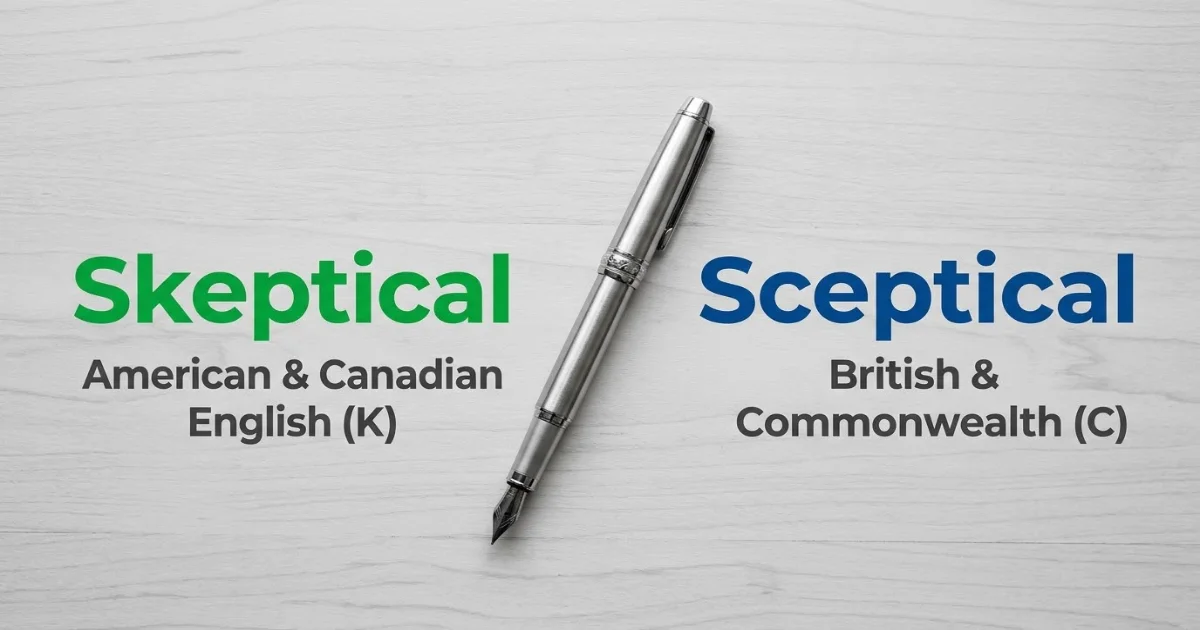
When comparing skeptical vs sceptical, deciding which spelling to use comes down entirely to regional English conventions. Both forms are grammatically correct, share the exact same pronunciation, and mean having doubts or reservations about a statement, claim, or theory.
The form skeptical (spelled with a k) is the standard spelling in American English and Canadian English. The form sceptical (spelled with a c) is the preferred spelling in British English, Australian English, and New Zealand English.
Using sceptical in an American journal or using skeptical in a traditional British publication is a minor regional mismatch rather than a spelling error. Understanding how these regional preferences developed, how both words function in a sentence, and how to pronounce them correctly will ensure your writing fits your target audience.
Quick Definition and Direct Answer
Skeptical and sceptical are spelling variations of the exact same adjective. Neither form is incorrect, but each belongs to a specific geographic region.
- Skeptical (with a K) is standard in American English and Canadian English.
- Sceptical (with a C) is standard in British English, Australian English, and New Zealand English.
Both words are pronounced identically with a hard K sound (/ˈskɛp.tɪ.kəl/). If you are writing for an American audience, use skeptical. If you are writing for a British or Commonwealth audience, use sceptical.
Quick Comparison Table
| Word or Phrase | Part of Speech | Regional Preference | Natural Example Sentence | Primary Usage |
| Skeptical | Adjective | American & Canadian English | Scientists remain skeptical about the preliminary results. | Use when writing for North American audiences. |
| Sceptical | Adjective | British & Commonwealth English | The public remains sceptical about the government’s claims. | Use when writing for British or Commonwealth audiences. |
| Skeptic | Noun | American & Canadian English | He has always been a healthy skeptic when reading news online. | Person who habitually doubts or questions claims (US/CA). |
| Sceptic | Noun | British & Commonwealth English | The lead investigator proved to be a thoughtful sceptic. | Person who habitually doubts or questions claims (UK/AU). |
| Skepticism | Noun | American & Canadian English | Her proposal was met with widespread skepticism. | The attitude of doubting or questioning knowledge (US/CA). |
| Scepticism | Noun | British & Commonwealth English | The new economic policy sparked deep scepticism. | The attitude of doubting or questioning knowledge (UK/AU). |

The Origin and Etymology of Skeptical and Sceptical
To understand why skeptical vs sceptical split into two regional forms, it helps to examine the history of the word and how Greek roots moved through French into English.
Rooted in Ancient Greek Philosophy
Both spelling variations originate from the Ancient Greek word skeptikos, which meant thoughtful, inquiring, or reflective. The word came from the Greek verb skeptesthai, which meant to look closely, examine, or consider.
In Ancient Greece, the Skeptics were a school of philosophers (led by Pyrrho) who held that certainty of knowledge was impossible, advocating instead for continuous inquiry and suspended judgment.
The French Influence and the C Spelling
When the Greek word skeptikos was adapted into Latin, the Greek letter kappa (k) was translated into the Latin letter c, producing scepticus.
This Latin form entered Middle French as sceptique, maintaining the letter c. When English borrowed the word from French during the late sixteenth and early seventeenth centuries, writers initially adopted the French spelling sceptic and sceptical.
Noah Webster and the American K Spelling
During the late eighteenth and early nineteenth centuries, American lexicographer Noah Webster sought to reform American English spelling to make it more logical and closer to its original phonetic roots.
Because the word is pronounced with a hard k sound, Webster advocated for replacing the French c with the original Greek k. He argued that spelling it as sceptical misled readers into pronouncing it with an s sound (similar to words like septic or susceptibility).
American publishers adopted Webster’s k spelling, making skeptical the standard across the United States and Canada. Meanwhile, British publications preserved the traditional French-derived sceptical spelling, which remains the norm across the United Kingdom, Australia, and New Zealand.
Grammar, Meaning, and Sentence Structure
Whether you write skeptical or sceptical, the word functions as a descriptive adjective in sentences.
Core Definitions
- Doubting a Claim: Expressing doubt or hesitation regarding a specific statement, theory, or promise.
- Example: Investors were skeptical about the start-up’s profit forecasts.
- Inclined to Question: Disposed to questioning accepted beliefs or demanding empirical evidence before believing something.
- Example: A good investigative journalist must maintain a sceptical attitude toward press releases.
- Philosophical Doubt: Relating to the philosophical doctrine that absolute knowledge is unattainable.
- Example: The essay examines classical skeptical philosophy from Pyrrho to Descartes.
Preposition Combinations
Both spelling forms pair naturally with specific prepositions in written prose:
- Skeptical / Sceptical OF: Used when directing doubt toward a person, claim, or institution.
- Example: Voters are deeply skeptical of political promises made during election campaigns.
- Skeptical / Sceptical ABOUT: Used when expressing hesitation regarding an event, plan, or outcome.
- Example: She felt sceptical about the manager’s ability to meet the tight deadline.

Pronunciation Rules: Avoiding Common Mistakes
One of the most confusing aspects of sceptical (with a c) for English learners is its pronunciation.
In standard English, the combination sc- followed by an e or i usually produces a soft S sound. Consider these everyday words:
- Scene (/siːn/)
- Scent (/sɛnt/)
- Science (/ˈsaɪ.əns/)
- Septic (/ˈsɛp.tɪk/)
Because of this standard phonetic pattern, people who see sceptical written on paper often mispronounce it as septic-al (/ˈsɛp.tɪ.kəl/).
However, sceptical is a rare exception to this phonetic rule. Regardless of whether it is spelled with a k or a c, the initial consonant blend is always pronounced with a hard K sound:
- Skeptical: /ˈskɛp.tɪ.kəl/ (Sounds like skep-tih-kull)
- Sceptical: /ˈskɛp.tɪ.kəl/ (Sounds like skep-tih-kull)
Never pronounce sceptical with a soft S sound like septic. Mispronouncing sceptical as septic-al changes the meaning from doubtful to infected or contaminated.
Simple Memory Tricks for Regional Selection
Choosing the correct spelling for your context becomes effortless when you use clear letter associations.
The “K for King” Rule
Look at the regional preferences for the letter C:
- C is for Commonwealth, Cambridge, and Crown.
If you are writing for a British, Australian, or Commonwealth audience, use the spelling with a C: sceptical.
The “K for Kansas” Rule
Look at the regional preferences for the letter K:
- K is for Kansas, Kentucky, and North American Keyboards.
If you are writing for an American or Canadian audience, use the spelling with a K: skeptical.
Real World Examples of Correct Usage
Here are natural example sentences demonstrating how to use skeptical and sceptical accurately across various writing contexts.
American English Contexts (Using Skeptical)
- The board of directors remained skeptical until the finance team presented verified sales figures.
- Consumer advocacy groups are skeptical of the airline’s new baggage fee structure.
- Dr. Smith presented a skeptical review of the unverified medical study during the conference.
- I was initially skeptical about the online course, but it proved to be extremely thorough.
- Historical researchers remain skeptical about the authenticity of the newly discovered journal.
British and Commonwealth Contexts (Using Sceptical)
- Members of Parliament expressed a sceptical response to the Chancellor’s economic forecast.
- Environmental activists in London are sceptical of the proposed urban expansion plan.
- The professor encouraged her Edinburgh students to take a sceptical approach to historical documents.
- Local residents in Sydney remain sceptical about the construction timeline for the new railway line.
- The editorial board published a sceptical analysis of the international trade agreement.
Related Common Confused Words
Vocabulary slip-ups often cluster around regional spelling variations, homophones, and letter inversions. Reviewing related words helps strengthen your overall writing accuracy.
1. Regional Spelling Variations
Just as skeptical vs sceptical splits between American and British standards, many other English words undergo similar regional changes. Navigating choices like analyzing or analysing or comparisons such as armor or armour requires knowing your audience.
2. Confused Words and Slang
Distinguishing between formal terms and informal slang prevents stylistic errors in professional writing. Writers frequently review usage rules when deciding between wack vs whack or when choosing between loose or lose.
3. Vowel Transpositions and Silent Letters
Vowel placement and silent consonants create frequent confusion across everyday vocabulary. Writers frequently review rules for silent letters when deciding between recieve or receive or when choosing between definately or definitely.
4. Spacing and Double Letters
Adding extra consonants or merging separate words creates another category of common typos. Writers frequently double-check letter patterns when deciding between occured or occurred or when deciding on spacing in alot or a lot.
Complete Word Family Overview
When adopting a regional spelling convention, ensure you apply it consistently across all members of the word family. Mixing American and British forms in the same document looks careless.
American and Canadian Forms (K Family)
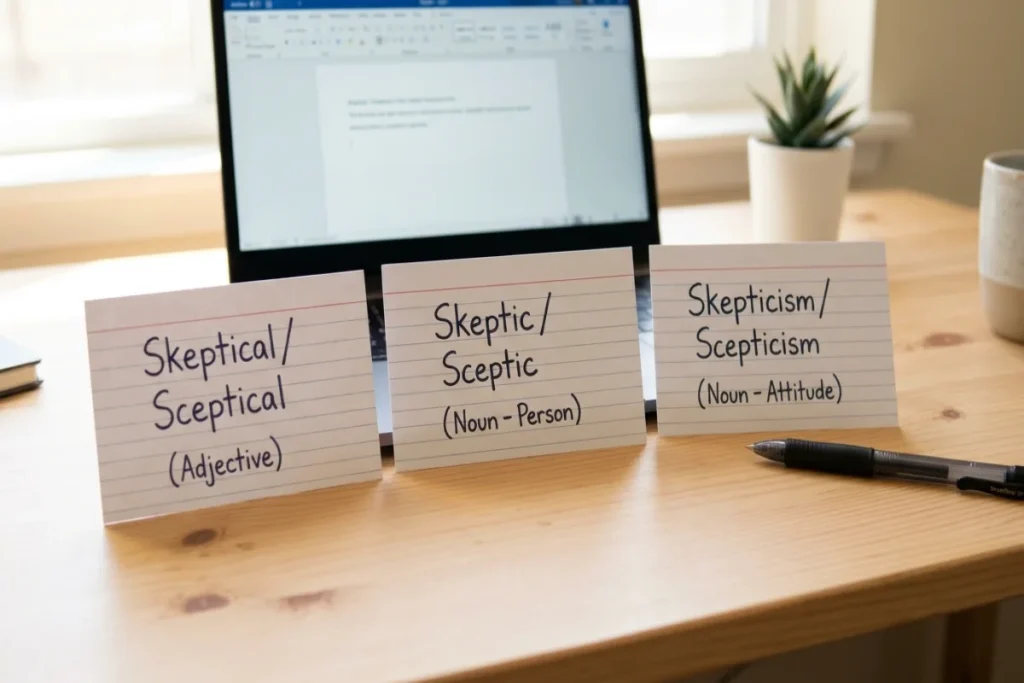
- Adjective: Skeptical (She gave a skeptical look.)
- Adverb: Skeptically (He shook his head skeptically.)
- Noun (Person): Skeptic (He is a lifelong skeptic.)
- Noun (Attitude): Skepticism (The news was greeted with skepticism.)
British and Commonwealth Forms (C Family)
- Adjective: Sceptical (She gave a sceptical look.)
- Adverb: Sceptically (He shook his head sceptically.)
- Noun (Person): Sceptic (He is a lifelong sceptic.)
- Noun (Attitude): Scepticism (The news was greeted with scepticism.)
Clear Summary and Final Guidelines
Mastering the choice between skeptical vs sceptical comes down to keeping a few clear principles in mind:
- Both skeptical and sceptical are valid English spellings that share the exact same definition and pronunciation.
- Skeptical (with a K) is standard in American English and Canadian English.
- Sceptical (with a C) is standard in British English, Australian English, and New Zealand English.
- Both words are pronounced with a hard K sound (/ˈskɛp.tɪ.kəl/); never pronounce sceptical like septic.
- Maintain consistency throughout your document by pairing your chosen form with its matching word family members (such as skepticism or scepticism).
By identifying your target audience and sticking to their regional convention, you can write with complete confidence every single time.
Frequently Asked Questions
Is skeptical or sceptical correct in global business writing?
Both are correct, but you should choose based on your company’s location or main audience. If your headquarters or primary readers are in North America, use skeptical. If they are in the UK, Europe, Australia, or Asia, sceptical or skeptical are both widely understood, though British style guides prefer sceptical.
Why is sceptical pronounced with a K sound if it has a C?
The hard K sound comes directly from the original Ancient Greek root skeptikos. Although Latin and French writers replaced the Greek k with a c during translation, the original Greek pronunciation persisted across centuries of spoken English.
What is the difference between skeptical and cynical?
While often confused, they mean different things. Someone who is skeptical doubts a claim and demands reliable evidence before believing it. Someone who is cynical believes that human actions are purely motivated by self-interest and selfishness, regardless of evidence.
Can I use skeptical in British English?
While British publications prefer sceptical, the American spelling skeptical is increasingly common in British digital media and scientific publishing. However, formal UK style guides (such as Oxford and the BBC) still mandate sceptical.
How can I avoid mixing up the forms in a long essay?
Set your word processor’s document language setting to either English (United States) or English (United Kingdom) before you start typing. Your spellchecker will automatically flag the form that does not match your chosen regional standard.