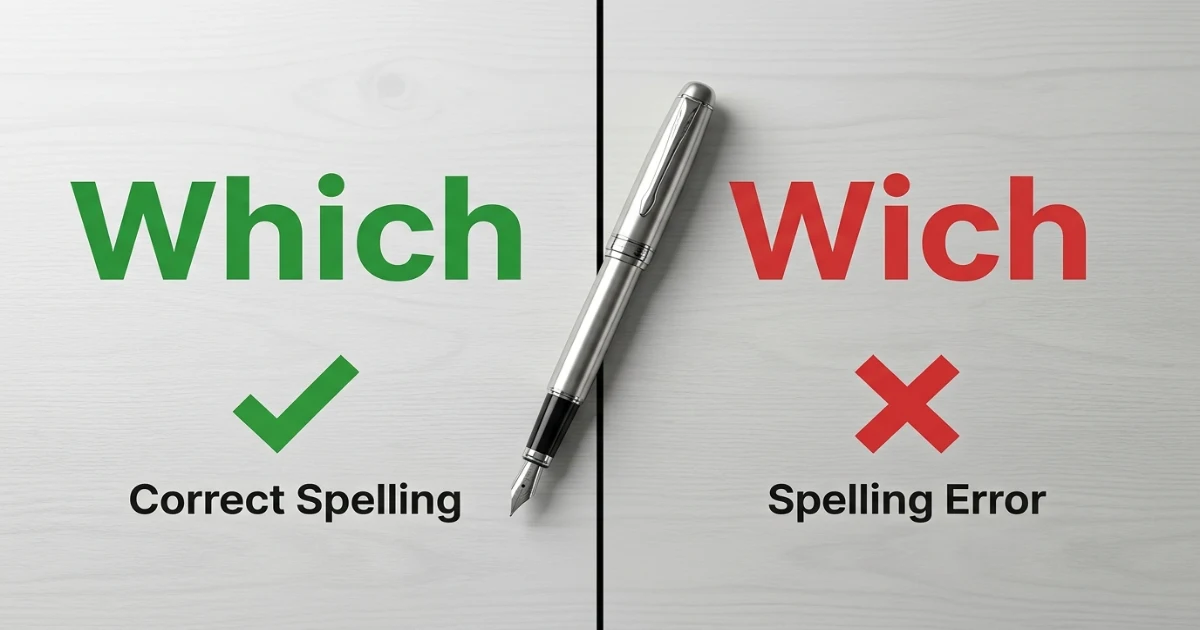
When deciding between wich or which, the correct spelling is always which.
The form wich is a common spelling mistake. While it shows up in place names like Norwich or Ipswich, and at the end of words like sandwich, it is not a standalone word in standard modern English. If you mean to ask a question, point out an option, or add details to a sentence, you must use which.
Understanding how this mistake happens and how to keep your words straight will help you write with complete confidence.
Quick Definition and Direct Answer
Which is a standard English word used as a pronoun and a determiner. It helps you identify or ask about one or more specific things from a limited group of choices.
- Which (with an H) is the correct spelling for questions, choices, and clauses.
- Wich (without an H) is a spelling error when used on its own.
Whenever you want to present options or ask someone to pick an item, make sure your word begins with the letters WH.
Quick Comparison Table
| Word or Phrase | Meaning | Example Sentence | When To Use It |
| Which | Identifying or asking about specific options | Which shirt do you like best? | Use for questions, choices, and clauses. |
| Wich | Old English root for village or trading place | Incorrect: Wich path should we take? | Do not use as a standalone word. |
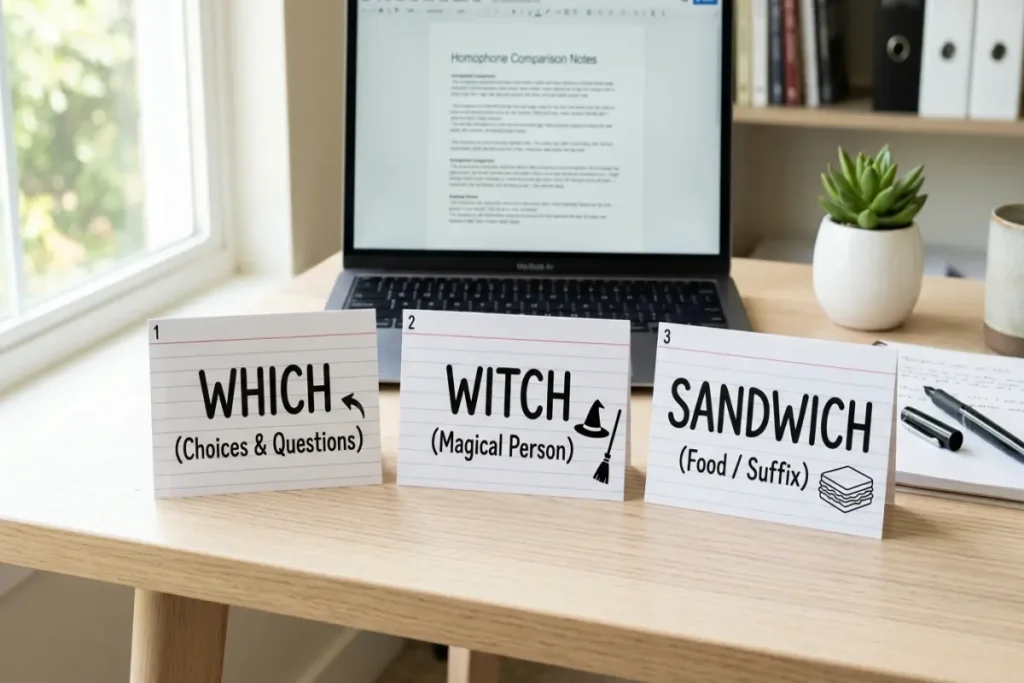
| Witch | A person in folklore or fiction who practices magic | The old story features a powerful witch. | Use only when referring to magic or folklore. |
| Sandwich | A food item made of bread and fillings | I had a turkey sandwich for lunch. | Use as a standard compound noun. |
The Grammar Behind Which
To write clearly, it helps to understand how which works in actual sentences. The word serves three main functions in everyday communication.
1. Direct Questions
Use which at the start of a sentence when asking someone to choose from a known, limited set of items.
- Which road leads back to the main highway?
- Which flavor of ice cream would you prefer?
- Which candidate has more experience in management?
2. Indirect Questions and Choices
Use which inside a longer sentence when referring to an option or an upcoming choice.
- She could not decide which college to attend next fall.
- Please let us know which date works best for your schedule.
- They weighed their options to see which strategy offered the best results.
3. Adding Extra Information to Clauses
Use which to introduce descriptive clauses that add background details about a noun. In standard written English, these descriptive clauses are usually set off by commas.
- The desk, which was built from solid oak, lasted for generations.
- My old bicycle, which sat in the garage for years, finally got fixed.
- The sales report, which took two weeks to complete, impressed the manager.
Why People Misspell Which as Wich
Errors usually happen for clear reasons. Knowing why people accidentally drop the H in which makes it much easier to avoid doing it yourself.
Silent H Sound in Spoken English
In modern English pronunciation, the wh sound at the start of words like which, what, when, and where sounds identical to a plain w sound for most speakers. Because your brain hears the w sound directly, your hands might skip the silent h while typing fast.
Confusion with the Suffix Wich
The letter combination wich is familiar because it appears in many geographic place names and household words. In Old English, wic referred to a settlement, village, or dwelling. Over time, that root evolved into place names like Greenwich, Ipswich, and Norwich, as well as common terms like sandwich.
Because readers see that exact letter pattern so often in daily life, the misspelling wich looks surprisingly natural to the eye even though it is incorrect when standing alone.

Typing Typos
Fast typing on phones and computers causes frequent missed keystrokes. Skipping the h is one of the most common keyboard slip-ups. If you regularly run into tricky letter patterns when writing essays or work emails, taking a moment to review how to spell definately correctly will help clear up another standard spelling trap.
Comparing Which, Witch, and Sandwich
Homophones are words that sound the same but have different spellings and meanings. Sorting out these similar-sounding terms keeps your writing clean and accurate.
Which vs. Witch
Mixing up these two words creates confusing sentences.
- Which deals with questions, choices, and descriptions.
- Witch deals with folklore, fiction, and magical characters.
Notice that witch includes the letter T. If your sentence has nothing to do with magic, leave the T out and keep the H.
- Incorrect: I wonder witch flight is on time.
- Correct: I wonder which flight is on time.
- Correct: The Halloween story featured a friendly witch.
Which vs. Sandwich
Remembering that wich belongs at the end of longer nouns like sandwich helps reinforce that it cannot stand on its own as a pronoun.
- Correct: I ordered a ham sandwich for lunch.
- Incorrect: I do not know wich sandwich I want.
- Correct: I do not know which sandwich I want.
Real World Examples of Correct Usage
Here are practical sentences showing how to use which naturally in different settings.
Daily Conversations
- Which jacket should I wear today?
- I cannot remember which street we turned down.
- Which movie do you want to stream tonight?
- Let me know which pair of shoes feels more comfortable.
Workplace and Business Communication
- Which department is handling the new project account?
- Please review the attached contract to see which terms need revision.
- The software update, which rolled out yesterday, fixed the login issue.
- We need to establish which goals take priority this quarter.
School and Academic Writing
- The scientific experiment, which lasted three months, yielded clear results.
- Which historical event had a greater impact on international trade?
- The research paper highlights which factors contribute to plant growth.
Simple Memory Tips
Using visual memory tricks keeps the correct form at the top of your mind when drafting.
The Question Family Trick
Think of the main question words in English. Every single one starts with WH:
- What
- Where
- When
- Why
- Who
- Which
If your word is asking a question or pointing to a choice, it needs the H to stay in the WH-family.
The Choice Trick
Look at the second letter of the word:
W H I C H has an H for Help me choose!
If you are asking someone to help you choose between items, always include that H.
Related Common Spelling Errors
Spelling slip-ups often happen in groups. Writers who accidentally drop letters in words like which frequently encounter similar patterns across other common words.
1. Dropping Letters in Simple Words
Just like dropping the H creates the misspelling wich, people often drop internal letters in words like surprise. If you want to refine your spelling habits, reviewing suprise or surprise shows how easy it is to miss a single silent letter in everyday vocabulary.
2. Doubling Letters Incorrectly
While which loses a letter when misspelled, other common word errors involve adding extra letters where they do not belong. For instance, people often struggle with single versus double letters when choosing between publically or publicly in formal writing.
3. Word Forms and Plurals
Spelling rules shift when words change forms. Writers who want to keep their vocabulary sharp across different categories can also explore our breakdown of irregular plurals like elfs or elves to master changing word endings.
American English vs. British English Usage
Some spelling choices change depending on geographic region. American English often simplifies words, while British English maintains older spelling patterns.
For example, Americans write color, center, and organize, while British writers prefer colour, centre, and organise. Similar variations show up when choosing between analyzing or analysing or when deciding between armor or armour.
However, when it comes to which, there is no regional variation at all.
- American English: Which (with an H)
- British English: Which (with an H)
- Canadian English: Which (with an H)
- Australian English: Which (with an H)
In every standard form of English across the globe, which is the only correct spelling, and wich is always marked as an error.

Clear Summary and Final Guidelines
Choosing between wich or which becomes simple once you recognize the fundamental rule of English question words. Which is the sole correct spelling when you want to ask questions, present choices, or add relative clauses to a sentence. The spelling wich is an incomplete form that should never appear on its own in modern English prose.
Paying attention to the silent H ensures your writing projects authority and clarity. Whether you are drafting a casual text message, an academic essay, or a corporate email, using which demonstrates attention to detail.
Keep the WH question family in mind whenever you write. By double-checking your work for missing letters, you can easily eliminate this common spelling error from your writing routine permanently.
Frequently Asked Questions
Is wich ever a real word on its own?
In modern English dictionaries, wich is not recognized as an independent standalone word. It exists only as a historical suffix in compound nouns like sandwich or as a root component in place names like Greenwich and Ipswich.
Why do people write wich instead of which?
People write wich primarily because the letter H is silent in modern English pronunciation. Fast typing, mobile autocorrect failures, and visual confusion with words ending in wich also contribute to leaving out the H.
What is the difference between which and that?
Use which to introduce non-essential details surrounded by commas, such as “My car, which is blue, is parked outside.” Use that for essential information without commas, such as “The car that I bought yesterday is blue.”
Is witch pronounced the same as which?
Yes. In modern English, witch and which are homophones, meaning they sound identical when spoken out loud. However, witch refers to a person in stories who practices magic, while which is used for choices and questions.
How can I avoid making this spelling mistake in my writing?
Remember that which belongs to the WH question family alongside what, where, when, why, and who. If your word asks a question or identifies a choice, make sure it starts with the letters WH.