
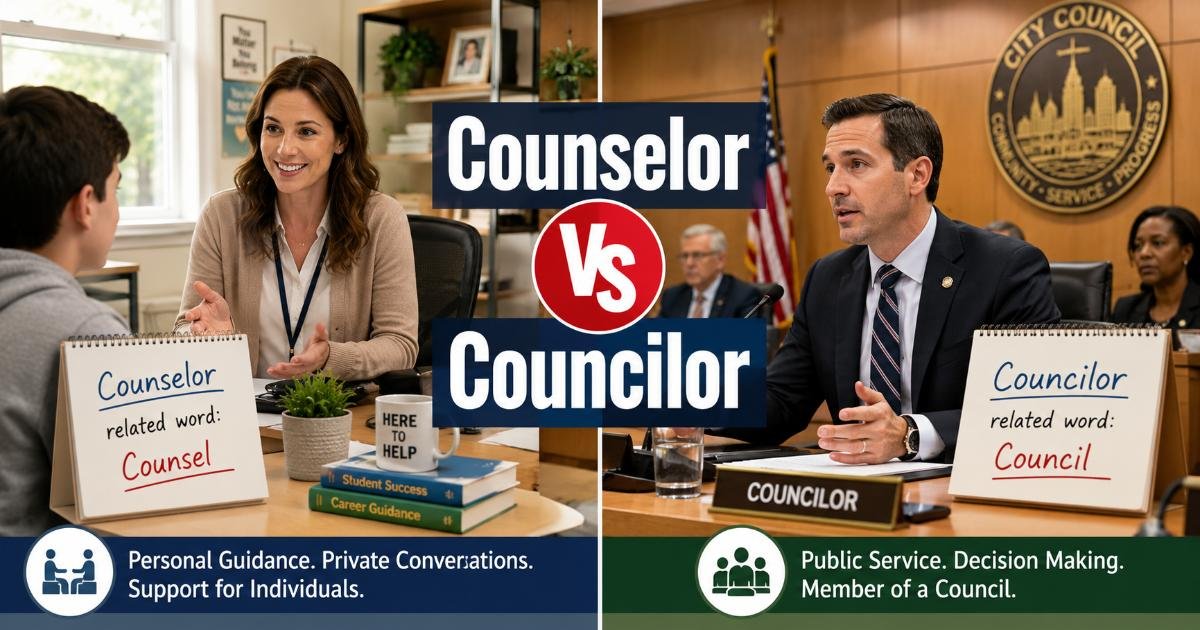
If you’re confused about counselor vs councilor, you’re not alone. These two words sound almost identical, but they refer to different kinds of people. A counselor gives advice or guidance. A councilor is a person who serves on a council and helps make decisions for a group or community.
The spelling difference is small, but the meaning changes completely. A school counselor helps students with education and personal goals. A city councilor takes part in local government. One word is connected to advice and guidance. The other is connected to a council.
The confusion often comes from the fact that both words can describe someone who helps other people. They can also sound the same when spoken. That makes the spelling easy to mix up, especially when you hear the word before you see it written.
The good news is that there’s a simple way to remember the difference. Once you connect counselor with counsel and councilor with council, the two spellings become much easier to keep apart. This guide will show you how each word works, where you’ll see it, common mistakes to avoid, and several examples you can use as a model.
Quick Definition
A counselor is someone who gives advice, guidance, or support. The word can describe a school counselor, a career counselor, a financial counselor, or a professional who provides counseling.
A councilor is a member of a council. The word is most often used for someone who serves in local government or on another official council that makes decisions.
Direct Answer
Use counselor for a person who gives advice or guidance. Use councilor for a person who serves as a member of a council.
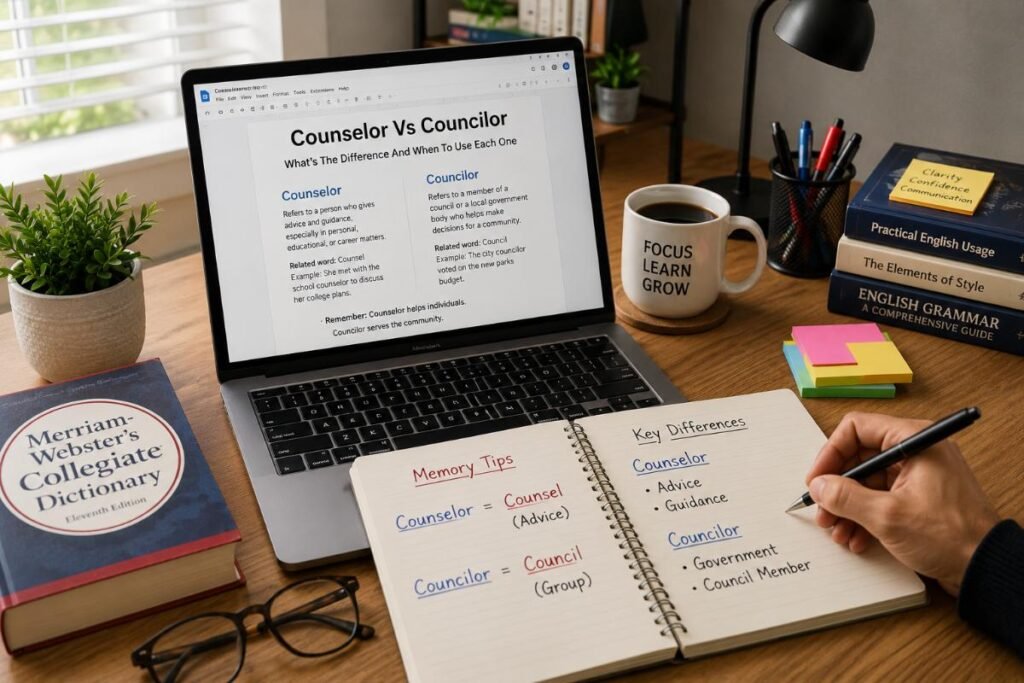
A simple memory trick is this: counselor comes from counsel, while councilor comes from council.
Comparison Table
| Word | Meaning | Example Sentence | When To Use It |
|---|---|---|---|
| Counselor | A person who gives advice, guidance, or support. | The school counselor helped Maya choose her classes. | Counseling, education, careers, personal guidance, and similar settings. |
| Councilor | A member of a council. | The councilor spoke about the new park project. | Local government and other council based groups. |
The Main Difference
The easiest way to understand these words is to focus on the noun behind each one.
A counselor is connected to counsel. Counsel means advice or guidance. A counselor is therefore someone who provides advice, support, or professional guidance.
A councilor is connected to council. A council is a group of people who meet to discuss issues, make plans, create rules, or make decisions. A councilor is one of the people who belongs to that group.
That one letter makes a big difference.
Consider these two sentences.
- The counselor helped the student deal with stress.
- The councilor voted on the new city budget.
The first person provides guidance. The second person takes part in government or another council.
Once you understand that basic distinction, the spelling becomes much easier to manage.
What A Counselor Does
A counselor helps people work through questions, problems, choices, or goals. The exact job can vary a lot depending on the setting.
A school counselor may help students choose classes, prepare for college, manage school problems, or think about career options. A career counselor may help someone choose a career path or prepare for a job search. A mental health counselor provides professional support for emotional and personal concerns.
The word can also appear in other fields.
For example, a financial counselor may help someone understand money problems and make a plan. A camp counselor may supervise children, organize activities, and provide support during a summer program.
The common idea is guidance. A counselor helps someone make a decision, solve a problem, understand a situation, or move toward a goal.
Here are some natural examples.
- The school counselor helped me choose classes for next year.
- She made an appointment with a career counselor before changing jobs.
- The camp counselor organized games for the children.
- His financial counselor helped him create a budget.
- The counselor listened carefully before offering advice.
These people may have very different jobs, but they all fit the same basic meaning.
What A Councilor Does
A councilor belongs to a council. The most common use in American English refers to an elected member of a city or town council.
A city councilor may discuss local laws, public spending, housing, roads, parks, schools, or other community issues. Councilors usually attend meetings, review proposals, listen to residents, and vote on matters that affect the community.
For example, a city might have several councilors who represent different districts. Each person may speak for local residents and take part in decisions made by the council.
Here are some examples.
- The councilor met with residents to discuss traffic problems.
- Our local councilor supported the plan for a new community center.
- The councilor voted against the proposed tax increase.
- Several councilors attended the public meeting.
- The councilor asked the mayor about the city’s housing plan.
In each sentence, the person is part of a council. That is the key point.
Why The Two Words Are So Easy To Confuse
These words create confusion for a simple reason. They sound nearly identical.
When someone says the word aloud, you may not know which spelling they mean. The difference becomes clear only when you see the word in writing or understand the context.
There’s another reason for the confusion. Both words describe people who can help others make decisions.
A counselor might help a student decide which college to attend. A councilor might help a community decide how to spend public money. Both people can give advice, listen to concerns, and discuss possible solutions.
The roles are still very different.
Think of it this way. A counselor usually works with a person or a group that needs guidance. A councilor works as part of a group that has authority to discuss or decide public matters.
The spelling gives you a useful clue.
Counselor contains counsel.
Councilor contains council.
That connection is more useful than trying to remember the spelling by sight alone.
Understanding Counsel
The word counsel is the key to understanding counselor.
As a noun, counsel means advice or guidance. For example, someone might seek legal counsel before signing an important contract. In that sentence, counsel means professional advice from a lawyer.
As a verb, counsel means to advise or guide someone.
That gives us a clear connection.
Counsel means advice.
Counselor means a person who gives advice or guidance.
Here are a few examples of counsel in use.
- She sought legal counsel before signing the agreement.
- His parents counseled him to think carefully about the decision.
- The doctor counseled the patient about healthy habits.
- The company provided professional counsel during the dispute.
The people who provide this kind of guidance can be described as counselors in the right context.
Counselor In Schools
One of the most familiar uses of counselor in the United States is school counselor.
A school counselor works with students on academic, career, and personal matters. The role can include helping students choose classes, prepare for college, explore careers, manage school concerns, and find support when they are struggling.
For example:
- My school counselor helped me plan my senior year.
- The counselor explained the college application process.
- Students can talk to a counselor about class schedules.
- The counselor helped him explore different career options.
A school counselor is not a member of a council. The person provides guidance to students. That makes counselor the correct spelling.
Counselor In Mental Health
The word also appears in mental health counselor.
A mental health counselor is a trained professional who provides counseling for emotional, behavioral, and personal concerns. The exact duties and licensing rules can vary by location and profession.
For example:
- She made an appointment with a mental health counselor.
- The counselor helped him develop ways to manage stress.
- They decided to speak with a counselor about their concerns.
Again, the connection is advice and support. The word comes from counsel, so counselor is the correct spelling.
Counselor In Other Settings
You may see counselor in many other job titles.
A career counselor helps people make career decisions.
A financial counselor helps people understand financial choices and problems.
A camp counselor supervises campers and organizes activities.
An admissions counselor may help students understand an application or enrollment process.
A legal counselor can refer to someone who provides legal advice, although terms such as lawyer and legal counsel are more common in many contexts.
These jobs have different responsibilities, but the spelling stays the same because the word is tied to counsel.

Understanding Council
Now look at the other word.
A council is a group of people who meet to discuss issues and make decisions. Councils can exist in government, organizations, schools, religious groups, and other settings.
A local city council, for example, may deal with public services, local laws, budgets, development, and community projects.
The word councilor refers to a person who belongs to such a council.
That gives you the second connection.
Council means a decision making group.
Councilor means a member of that group.
Consider these examples.
- The city council approved the new park.
- The council discussed the proposed housing plan.
- Several councilors attended the meeting.
- The councilor spoke with residents after the vote.
The council is the group. The councilor is one person who belongs to the group.
Councilor In Local Government
In the United States, you’ll most often see councilor in discussions about local government.
A city councilor may represent a district or neighborhood. The person may take part in meetings, vote on proposals, review budgets, and speak with residents about local concerns.
For example:
- The councilor represents the north side of the city.
- Residents contacted their councilor about road repairs.
- The councilor introduced a proposal for a new playground.
- The councilors voted on the city budget.
The exact duties depend on the local government system, but the basic meaning stays the same. A councilor is a member of a council.
Councilor In Other Groups
A councilor does not always have to work in city government.
The word can be used for members of other councils as well. A council might advise an organization, oversee a particular area, or make decisions for a group.
Still, you’ll usually encounter councilor in political or government contexts. If the person is serving on a city council or similar body, this is the spelling you want.
A Simple Memory Trick
If you struggle to remember the difference, focus on the middle of each word.
Counselor equals counsel.
Councilor equals council.
Now connect each base word with its meaning.
Counsel means advice.
Council means a group.
So a counselor gives advice, while a councilor belongs to a group that discusses and makes decisions.
You can picture the difference in your mind.
Imagine a student sitting in an office talking with a school counselor. The student needs guidance. That is counselor.
Now picture a city meeting where several elected officials sit around a table and vote on a new community project. Those people are councilors.
One person gives counsel. The other serves on a council.
That mental picture can help you choose the right spelling quickly.
The Related Words Counsel And Council
Learning the related nouns makes this pair even easier.
Counsel means advice or guidance.
Council means a group that meets to discuss and decide things.
They sound alike, but their meanings are different. Their related forms keep those meanings.
- Counsel → counselor.
- Council → councilor.
This is a useful spelling pattern because the base word gives you the clue.
Compare these sentences.
- She asked her counselor for advice.
- She contacted her councilor about a local issue.
The first person gives personal or professional guidance. The second person serves on a council.
If you remember the base word, you usually won’t need to guess.
Counselor Vs Councilor In Real Sentences
The easiest way to master these words is to see them in situations where the meaning is clear. When you understand the role of the person in the sentence, the spelling usually takes care of itself.
A counselor works with people who need advice, support, or guidance. A councilor works as a member of a council. That difference stays the same even when the sentence becomes more detailed.
Consider these examples.
- The school counselor helped the student choose classes for the fall.
- The city councilor spoke with residents about the proposed road project.
- Maria met with a career counselor before applying for new jobs.
- The councilor attended a public meeting about the local budget.
- The camp counselor organized activities for the children.
- The councilor voted on a proposal to improve the town park.
The first, third, and fifth examples involve guidance or support. The second, fourth, and sixth involve membership in a council.

Examples With Counselor
Here are some common situations where counselor is the correct word.
School setting:
The counselor helped the student plan a schedule for the next semester.
Career setting:
A career counselor helped James decide which training program suited his goals.
Camp setting:
The camp counselor taught the children how to safely use the climbing wall.
Financial setting:
She spoke with a financial counselor about managing her monthly expenses.
Personal support:
He decided to speak with a counselor after struggling with a difficult life change.
In every example, the person has a role that involves helping, advising, guiding, or supporting someone.
Examples With Councilor
Now compare those sentences with situations involving a councilor.
City government:
The councilor met with residents to discuss parking problems.
Local budget:
The councilor questioned the proposed spending plan during the meeting.
Community project:
Our councilor supported the plan to build a new playground.
Public concerns:
Several residents contacted their councilor about unsafe sidewalks.
Council meeting:
The councilor presented the proposal before the vote.
Here, the person is part of a council. The role has nothing to do with being a professional counselor.
Common Mistakes With These Words
The biggest mistake is choosing the spelling based on how the word sounds. Since counselor and councilor sound very similar, that approach doesn’t work well.
Instead, think about what the person actually does.
If the person gives advice, provides guidance, or offers counseling, use counselor.
If the person serves on a council, use councilor.
That simple test will solve most cases.
Mistake One
Incorrect: The city counselor voted on the new parking law.
Correct: The city councilor voted on the new parking law.
The person is part of a city council, so councilor is correct.
Mistake Two
Incorrect: I spoke with my school councilor about college applications.
Correct: I spoke with my school counselor about college applications.
The person helps students with education and career decisions, so counselor is the right word.
Mistake Three
Incorrect: The career councilor helped me update my resume.
Correct: The career counselor helped me update my resume.
The person provides career guidance. That makes the spelling counselor.
Mistake Four
Incorrect: The town counselor voted against the proposal.
Correct: The town councilor voted against the proposal.
The person is taking part in a council vote, so councilor fits the meaning.
Counselor And Councilor Are Not Synonyms
It may be tempting to treat these words as two spellings of the same word. They are not.
They are separate words with separate meanings.
A counselor can give advice without being part of any council. A councilor can serve on a council without providing counseling services.
For example, a school counselor and a city councilor may both talk with members of the public. That does not make their jobs similar enough to use the same word.
The best way to separate them is to focus on the person’s role rather than the sound of the word.
Ask yourself one question.
Is this person giving counsel or serving on a council?
If the answer is counsel, use counselor.
If the answer is council, use councilor.
The Difference Between Counsel And Council
The two base words deserve a closer look because they cause many of the spelling mistakes in the first place.
Counsel Means Advice
Counsel can mean advice, guidance, or a recommendation about what someone should do.
For example:
- She sought legal counsel before signing the contract.
- His parents offered counsel when he faced a difficult decision.
- The doctor counseled the patient about lifestyle changes.
The word can also work as a verb. To counsel someone means to advise or guide that person.
For example:
- The teacher counseled the student before the final exam.
- The lawyer counseled her client to review the agreement carefully.
The meaning stays connected to advice and guidance.
Council Means A Group
A council is a group of people who meet to discuss matters and make decisions.
For example:
- The city council approved the new budget.
- The council met Tuesday evening.
- The council discussed plans for a new library.
The people who belong to that group are councilors.
This gives you a clear word family.
Counsel → counselor.
Council → councilor.
Once you see that pattern, the spelling difference becomes much easier to remember.
How The Words Work In Job Titles
Both words commonly appear in job titles. Looking at those titles can help you recognize the correct spelling when you see it in a sentence.
Common Counselor Titles
You may come across these expressions:
- School counselor.
- Career counselor.
- Mental health counselor.
- Financial counselor.
- Camp counselor.
- Admissions counselor.
- College counselor.
- Rehabilitation counselor.
These jobs have different duties, but they share a basic idea. The person provides guidance, support, advice, or supervision.
For example, an admissions counselor may explain application requirements to students. A school counselor may help students plan their education. A camp counselor may supervise children and lead activities.
The exact job changes, but the spelling does not.
Common Councilor Uses
The word councilor is most often used when someone serves on an official council.
You may see phrases such as:
- City councilor.
- Town councilor.
- District councilor.
- Local councilor.
- Councilor at large.
The exact title depends on the government or organization.
For example, a city councilor may represent a particular district. A councilor at large may represent the city as a whole instead of a single district.
The common point is that the person belongs to a council.
What About Counselor In Government
This is where things can get a little tricky.
The word counselor can appear in government and diplomatic settings too. That does not make it the same as councilor.
For example, a government may have a person whose job involves giving legal, policy, diplomatic, or other professional advice. That person may have counselor in their title because the role involves counsel.
A councilor, by contrast, is a member of a council.
So don’t assume that every government related title uses councilor. Look at the actual role.
The key question remains the same. Is the person providing counsel, or are they serving as a member of a council?
Counselor In Legal Language
You may also see counselor in legal contexts.
A lawyer can be called counsel, especially when describing the lawyer in relation to a case. You may also encounter terms such as legal counselor in some contexts.
The underlying word is still counsel, meaning advice or professional guidance.
For example:
- The company sought legal counsel before signing the agreement.
- Her counselor advised her to review the contract carefully.
Don’t confuse this with a council. A legal counselor is not a member of a government council simply because the words sound similar.
Counselor Or Therapist
Another common question involves the word counselor in mental health.
A counselor and a therapist can have overlapping roles, but the titles are not automatically interchangeable in every situation. Training, licensing, and professional titles vary by location.
For general writing, counselor is appropriate when referring to someone whose professional role includes counseling.
For example:
- She spoke with a licensed professional counselor.
- The counselor helped him work through his concerns.
The important spelling point is straightforward. This person provides counsel, so the word contains counsel.
Councilor Or Councillor
You may notice another spelling when reading about councils outside the United States.
Councilor is the common American spelling.
Councillor is widely used in British English and in several other varieties of English.
The extra l does not create a new meaning. Both forms refer to a member of a council.
For example, American English commonly uses:
- The city councilor attended the meeting.
British English may use:
- The city councillor attended the meeting.
If you’re writing for a US audience, councilor is the spelling to use.
This is different from the counselor and councilor distinction. Counselor and councilor have different meanings. Councilor and councillor have the same basic meaning but follow different regional spelling conventions.
A Quick Test For Choosing The Right Word
When you aren’t sure which spelling belongs in your sentence, don’t stare at the two words and try to remember how they look. Use the meaning as your guide.
Replace the word with adviser.
If the sentence still makes sense, counselor may be the right choice.
For example:
- I spoke with my school counselor.
You can think of it as:
- I spoke with my school adviser.
That makes sense because a school counselor provides guidance.
Now try the same test with a government official.
- I spoke with my city councilor.
You would not normally replace councilor with adviser because the person’s defining role is membership in a council.
Another useful test is to replace the word with member of the council.
- The councilor voted on the proposal.
That becomes:
- The member of the council voted on the proposal.
The meaning stays clear.
These little tests work because they focus on meaning instead of sound.
A Simple Way To Remember The Difference
Think of counselor as the person you go to when you need help making a choice.
You might visit a school counselor because you don’t know which classes to take. You might speak with a career counselor because you’re unsure about your next job. You might meet with a counselor because you need professional support.
Now think of councilor as the person you contact when your community has a local issue.
You might contact a councilor about a road, park, budget, housing plan, or local rule. That person serves on a council and takes part in decisions.
Here is the shortest memory trick.
Counselor gives counsel.
Councilor joins a council.
If you remember those two connections, the spelling becomes much easier.
When Both Roles Appear In The Same Story
Sometimes a sentence or paragraph may contain both words. This is actually a great way to see the difference.
Imagine a student who is worried about a new development project near the school. The student talks to a school counselor about handling the situation and then contacts a city councilor to ask about the project.
You could write:
- The school counselor helped the student understand the issue, while the city councilor explained the city’s plans.
The two people have completely different roles. The counselor provides guidance. The councilor represents the community as part of the local government.
Another example might involve a community meeting.
- The counselor spoke with families about available support services, while the councilor answered questions about the proposed neighborhood changes.
Both words fit naturally in the same sentence because they describe different jobs.
This is a useful way to test your understanding. If you can explain what each person does, you can usually spell the word correctly.
More Examples To Make The Difference Clear
The fastest way to build confidence with these words is to see them in different settings. The spelling may look similar, but the context usually gives you the answer.
Consider a college setting. A student might meet with a college counselor to discuss degree programs, class choices, or career plans. The person is helping the student make informed choices, so the word comes from counsel.
Now imagine a city meeting. A resident might speak with a city councilor about a proposed parking rule. The person is part of the city council, so the word comes from council.
Here are more examples.
- The counselor helped the student prepare for the college application process.
- The councilor asked residents for their opinions about the new development.
- My career counselor suggested several training programs.
- The councilor introduced a proposal during the meeting.
- The camp counselor planned activities for the younger children.
- The councilor voted to approve the community center.
- The counselor listened to the student’s concerns.
- Residents contacted their councilor about the damaged sidewalks.
The roles may sometimes overlap in conversation. Both people can listen, speak, and offer suggestions. The important difference is the job they hold.
Common Phrases With Counselor
Some combinations appear so often that recognizing them can make spelling easier.
School Counselor
A school counselor helps students with academic, career, and personal matters.
- I talked to my school counselor about changing my schedule.
- The counselor helped seniors prepare for college applications.
Career Counselor
A career counselor helps people think about jobs, skills, education, and career choices.
- The career counselor helped me identify jobs that matched my skills.
- She met with a career counselor before changing careers.
Mental Health Counselor
A mental health counselor provides professional counseling for emotional, behavioral, and personal concerns.
- He decided to speak with a mental health counselor.
- The counselor helped her develop healthy ways to manage stress.
Camp Counselor
A camp counselor supervises campers and helps organize activities.
- The camp counselor taught the children how to swim safely.
- Every group had a counselor during the overnight trip.
Financial Counselor
A financial counselor helps people understand financial problems and choices.
- The financial counselor helped us create a monthly spending plan.
- She met with a financial counselor before making a major financial decision.
The common thread is guidance. If the person provides counsel, counselor is the word you need.
Common Phrases With Councilor
The other word appears most often alongside words connected to government and public service.
City Councilor
A city councilor serves on a city council.
- The city councilor spoke at the neighborhood meeting.
- Residents asked the city councilor about the proposed road changes.
Town Councilor
A town councilor serves on a town council.
- The town councilor supported the new library project.
- Several town councilors attended the public hearing.
Local Councilor
A local councilor represents a community as part of a local council.
- The local councilor met with residents about traffic concerns.
- She contacted her local councilor about the proposed zoning change.
Councilor At Large
A councilor at large usually represents the entire city or another broad area instead of a specific district. The exact role depends on the local government system.
- The councilor at large spoke about citywide transportation needs.
These phrases all point to membership in a council. That is the clue you need.
A Few Tricky Sentences
Some sentences can make the choice less obvious because the surrounding words don’t immediately tell you what the person does.
Consider this example.
- The counselor spoke at the community meeting.
This sentence alone does not tell us much. The person could be a school counselor, career counselor, mental health counselor, or another type of counselor. The spelling still depends on the person’s role.
Now consider:
- The councilor spoke at the community meeting.
Here, the spelling tells us that the person is a member of a council.
The setting can also provide clues.
- The counselor reviewed the student’s academic plan.
This clearly points to a school counselor.
- The councilor reviewed the city’s spending plan.
This clearly points to a government official.
When the context is unclear, ask what the person is responsible for. That question is more reliable than the sound of the word.
Is Counselor Ever Used For A Government Official
Yes, but the meaning is different from councilor.
A government office can have a counselor who provides professional advice. For example, a legal counselor might advise an official or agency. A diplomatic counselor may serve in an embassy or diplomatic mission.
In those cases, counselor is connected to counsel, meaning advice or professional guidance.
A councilor is different. That person is a member of a council.
This distinction matters because government does not automatically mean councilor. Look at the person’s actual role.
For example:
- The legal counselor advised the agency about the contract.
- The city councilor voted on the contract.
The first person provides advice. The second person takes part in a council decision.
Counselor Vs Advisor
Another useful comparison is counselor and advisor.
These words can overlap in meaning. Both can describe someone who gives advice or guidance.
A school counselor and an academic advisor may both help a student plan classes. Their official duties can differ, but both roles involve guidance.
That makes advisor a useful mental substitute when deciding if counselor is correct.
If you can replace the word with advisor and the meaning still works, counselor may fit.
For example:
- The career counselor helped me choose a training program.
You could say:
- The career advisor helped me choose a training program.
The exact job title may differ, but the basic idea of guidance remains.
You cannot use the same test with councilor because a councilor is defined by membership in a council.
Counselor Vs Council Member
A council member and a councilor can refer to the same basic role in many contexts. Both describe someone who belongs to a council.
For example:
- The council member voted for the proposal.
- The councilor voted for the proposal.
Both sentences can describe a person serving on a city council.
This makes council member another useful clue. If you can replace the word with council member, you probably need councilor.
Compare that with:
- The counselor helped the student with her college plans.
You cannot replace counselor with council member without changing the meaning completely.
Is There A Difference In Pronunciation
In many varieties of American English, counselor and councilor are pronounced the same or almost the same. This makes the spelling difference especially easy to miss when listening.
That is why context matters so much.
If someone says, I need to talk to my counselor, you need the surrounding conversation to know exactly what type of counselor they mean. If someone says, The councilor voted last night, the context tells you that the person belongs to a council.
When you are writing, you have to choose the spelling yourself. Connecting the word to its base form is the safest method.
Counselor comes from counsel.
Councilor comes from council.
Does The Spelling Change In American English
For a US audience, counselor and councilor are the standard spellings to know.
You may see councillor in British English and some other varieties of English. The extra l is a regional spelling difference for the member of a council.
For example, American English commonly uses:
- The city councilor attended the meeting.
British English may use:
- The city councillor attended the meeting.
The meaning remains the same. The difference is mainly spelling convention.
This is useful to know if you read international news or work with English speakers from different countries. Seeing councillor does not mean the writer is using a different job or concept. It is simply another regional spelling.
A Final Memory Trick
Picture two different rooms.
In the first room, someone sits across from you and listens to your problem. You ask for advice. That person is your counselor.
In the second room, several officials sit around a table and discuss a community issue. Each person is a councilor.
Now focus on the two base words.
Counsel means advice.
Council means a group.
That is the whole spelling trick.
If the person gives counsel, write counselor.
If the person belongs to a council, write councilor.
FAQs
What is the difference between counselor and councilor?
A counselor gives advice, guidance, or professional support. A councilor is a member of a council, usually a local government body. The words sound similar but have different meanings and different spellings.
Is counselor or councilor correct?
Both are correct words, but they are used for different roles. Use counselor for someone who provides guidance or counseling. Use councilor for someone who serves on a council.
Is a school counselor spelled counselor?
Yes. School counselor is the standard American English spelling. The person helps students with academic, career, personal, or other school related concerns.
Is a city councilor spelled with an o or e?
Use councilor for a member of a city council. The word comes from council, so it contains the letters found in that word.
What is the easiest way to remember the difference?
Connect each word to its base word. A counselor gives counsel, which means advice or guidance. A councilor belongs to a council, which is a decision making group.
Are counselor and councilor pronounced the same?
In many forms of American English, they are pronounced the same or very similarly. That is one reason the words are easy to confuse. The meaning and context tell you which spelling you need.
Is councillor the British spelling?
Yes. Councillor is widely used in British English and some other varieties of English. American English generally uses councilor for a member of a council.
Can a counselor work in government?
Yes. A government agency can have a counselor who provides professional advice. The person is called a counselor because the role involves counsel, not because the person belongs to a council.
Final Thoughts
The difference between counselor vs councilor comes down to two related but very different ideas. A counselor provides counsel, which means advice or guidance. A councilor serves on a council and takes part in discussions and decisions for a community or organization.
The spelling gives you a useful shortcut. Counselor contains counsel, while councilor contains council. If you remember what those two base words mean, you can usually choose the correct form without stopping to think about pronunciation.
When you’re writing for a US audience, keep the practical rule close at hand. A school counselor, career counselor, mental health counselor, or camp counselor uses counselor. A city councilor, town councilor, or councilor at large uses councilor.
The next time you face these two spellings, don’t rely on how they sound. Ask what the person actually does. If they give advice or guidance, choose counselor. If they serve on a council, choose councilor. That quick meaning check is all you need.