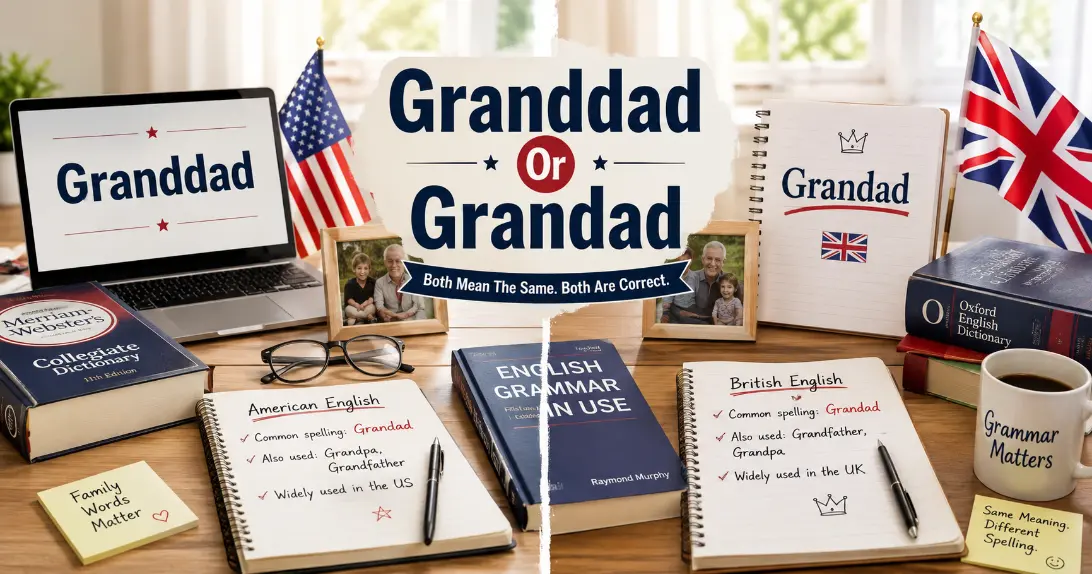
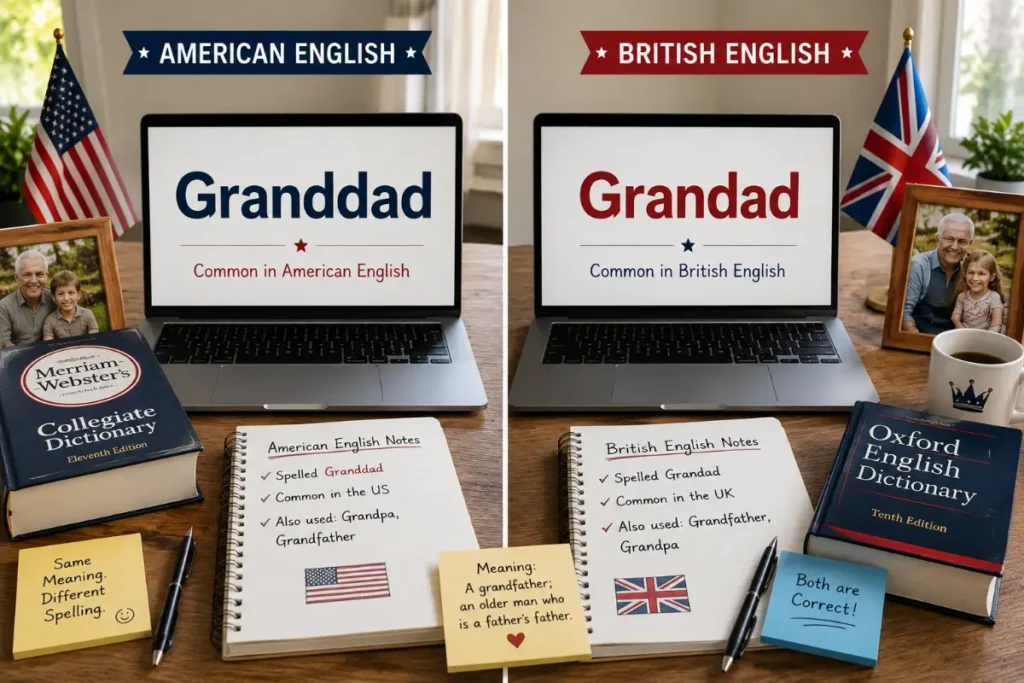
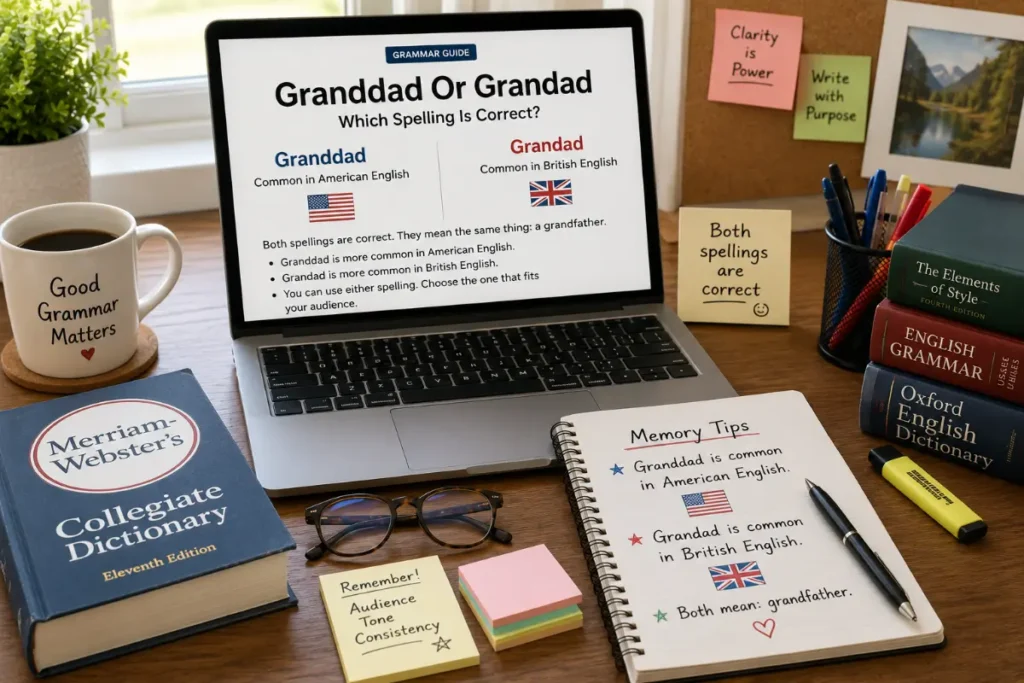
If you’ve searched granddad or grandad because you aren’t sure which spelling is correct, you’re dealing with a genuine difference in English usage. Both spellings are correct. The main difference is regional and personal. Granddad is the more common spelling in American English, while grandad is especially common in British English.
The two words have exactly the same meaning. They both refer to your grandfather or to an older man who has a grandfather like role in your family. There isn’t a difference in pronunciation or meaning that changes the relationship.
The confusion usually comes from the spelling. English has several family words that can be written in more than one way. Granddad and grandad are a good example because both forms have been used for many years.
This guide explains the difference between the two spellings, where each form is common, how to use them in real sentences, and why the shorter spelling is so strongly associated with British English. You’ll also see related words such as grandfather, grandpa, and granddaddy so you can choose the form that fits your writing and your audience.
Quick Definition
Granddad and grandad are two spellings of the same family word. Both mean your grandfather and both are correct.
Granddad is especially common in American English. Grandad is especially common in British English, although both forms can appear in different English speaking communities.
Direct Answer
Both granddad and grandad are correct spellings of the word for a grandfather. Use granddad for a more common American spelling and grandad when following British English usage.
Comparison Table
| Word | Meaning | Example Sentence | Common Use |
|---|---|---|---|
| Granddad | Grandfather | My granddad taught me how to fish. | Common in American English and also used elsewhere. |
| Grandad | Grandfather | My grandad taught me how to fish. | Very common in British English and also used elsewhere. |
| Grandfather | The formal family term | My grandfather lives in Ohio. | Standard and widely used in all major forms of English. |
| Grandpa | A familiar name for a grandfather | Grandpa is coming over for dinner. | Common in casual American English. |
| Granddaddy | A warm or affectionate name for a grandfather | My granddaddy loved telling stories. | Common in some families and regions. |
Why Both Spellings Are Correct
The first thing to understand is that granddad and grandad aren’t two different words. They are spelling variants of the same word.
The ending dad comes from the familiar family word dad. When English speakers began using this form as a familiar name for a grandfather, both spellings developed. Some speakers naturally kept the full dad sound and spelling, while others used the shorter dad form within grandad.
That small spelling difference doesn’t create a new meaning. If someone says, “My granddad is visiting,” and another person says, “My grandad is visiting,” both people are talking about their grandfather.
This is similar to other English words that have more than one accepted spelling. A different spelling doesn’t always mean that one version is wrong. Sometimes it reflects regional habits, family preferences, or changes in how people use a word over time.
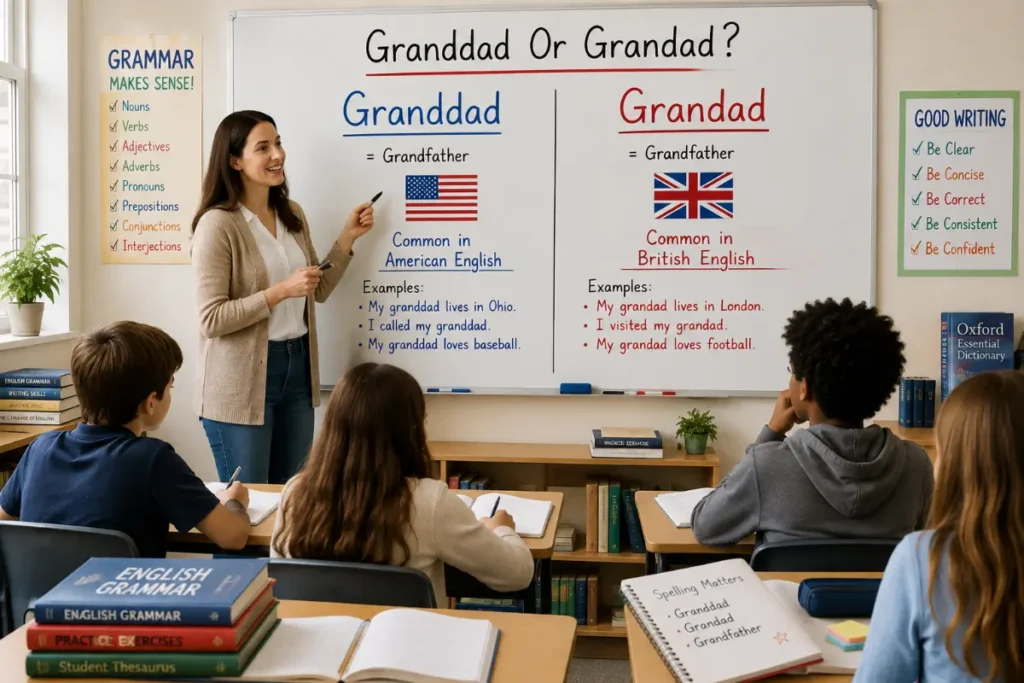
For this particular word, regional usage plays a major role. Writers in the United States are more likely to choose granddad, while writers in the United Kingdom often choose grandad.
Granddad In American English
If you’re writing for a US audience, granddad is the spelling you’ll want to recognize first. It fits naturally with other familiar family terms such as dad, grandpa, and grandfather.
Consider these examples.
My granddad used to take me fishing every summer.
I called my granddad after I graduated from college.
My granddad still has the old truck he bought when he was young.
In each sentence, the word has a warm and personal tone. It doesn’t sound formal or distant.
That tone is important because granddad is usually used as a familiar name rather than as a formal description. If you’re writing a family story, talking about your childhood, or describing a close relationship, it can sound more personal than grandfather.
For example, compare these two sentences.
My grandfather taught me how to ride a bike.
My granddad taught me how to ride a bike.
Both are correct. The first sounds more neutral. The second feels more familiar and personal.
That doesn’t mean grandfather is cold or distant. It simply has a wider range of uses. You might use it in a formal article about family history, while granddad feels more natural when you’re telling someone about your family.
Grandad In British English
Grandad is especially common in British English. You’ll often see it in British books, newspapers, family stories, and everyday conversations.
For example.
My grandad lives in Manchester.
I used to spend every Saturday with my grandad.
My grandad taught me how to fix an old bicycle.
A British speaker may find this spelling more familiar than the version with the extra d.
This doesn’t mean British English rejects granddad. Both spellings can be found in British usage. However, grandad has a strong place in British family vocabulary and is a very natural choice for a British audience.
The same pattern appears with other family terms. English speakers often have several familiar names for the same relative, and regional preferences can affect which one feels most natural.
If you’re writing specifically for readers in the United Kingdom, grandad is a good choice. If your audience is mainly American, granddad will usually feel more familiar.
The Difference Between Granddad And Grandad
The difference is mainly spelling and regional preference. The meaning stays the same.
You can think of them as two doors leading to the same room. One spelling is more common in one variety of English, while the other spelling is more common somewhere else.
| Feature | Granddad | Grandad |
|---|---|---|
| Meaning | Grandfather | Grandfather |
| Pronunciation | Usually the same | Usually the same |
| American English | Common | Less common |
| British English | Used | Very common |
| Formality | Informal | Informal |
| Possessive form | Granddad’s | Grandad’s |
| Plural form | Granddads | Grandads |
Neither spelling changes the family relationship. If your mother’s father is your grandfather, you can call him your granddad or grandad.
The choice often comes down to the English variety you’re using and the word your family prefers.
Why The Extra D Causes Confusion
At first glance, granddad may look like it contains a repeated sound. That’s one reason people sometimes wonder if the second d is unnecessary.
The word is built from grand and dad. When those parts come together, the spelling creates granddad. The final d in grand meets the first d in dad, so the result contains two written d letters.
In grandad, only one of those d letters appears between the two parts.
This is a spelling difference rather than a pronunciation rule. Most speakers don’t pronounce the word in a way that clearly separates the two d letters. In normal speech, both forms sound essentially the same.
That makes the spelling easy to forget. You may know exactly how the word sounds but still pause when you need to write it.
If that happens, think about the audience first. For US English, granddad is a safe and familiar choice. For British English, grandad is especially common.
Granddad Vs Grandfather
Although granddad and grandfather refer to the same person, they don’t always have the same tone.
Grandfather is the standard family term. It works in formal writing, legal documents, family histories, news articles, and ordinary conversation.
Granddad is more familiar. It often suggests a personal relationship and sounds like a name that a child or grandchild might use when speaking directly to the person.
Compare these examples.
My grandfather was born in 1940.
My granddad was born in 1940.
The first sentence gives a neutral fact. The second can sound more personal because the speaker is using the familiar family name.
You might also see both words in the same piece of writing. A writer could introduce someone as a grandfather and later refer to him as granddad when describing family memories.
For example, a family history might say that Robert was the grandfather of three children. Later, one of those children might remember him by saying, “My granddad always kept candy in the kitchen.”
That shift is perfectly natural. English gives speakers different words for family relationships depending on the setting and the emotional tone.
Granddad Vs Grandpa
American English has several familiar names for a grandfather. Grandpa is probably one of the most recognizable.
Grandpa and granddad mean the same thing, but families often develop their own preferences. One family might use Grandpa, another might use Granddad, and another might use a completely different family nickname.
For example.
My grandpa lives near the lake.
My granddad lives near the lake.
Both sentences are natural in American English.
The choice isn’t normally a grammar issue. It’s a matter of family preference and regional usage.
Some families even use different names for different grandfathers. A child might call one grandfather Grandpa and the other Granddad. Another family might use a person’s first name alongside the family title to make the difference clear.
That flexibility is part of what makes family vocabulary interesting. These words aren’t just dictionary terms. They’re often names that develop inside families and become part of personal history.
Granddad Vs Granddaddy
Granddaddy is another familiar form of grandfather. It often has a warm, affectionate tone.
You might hear it in family conversations, stories, songs, or regional speech.
For example.
My granddaddy taught me how to grow tomatoes.
Granddaddy always told the same funny story at Thanksgiving.
The word can sound especially affectionate because of the ending daddy. It doesn’t mean something different from grandfather. The difference is mainly tone and family preference.
For general US writing, grandfather, granddad, and grandpa are usually the safest choices. Granddaddy works well when you’re trying to preserve a personal or family voice.
How To Use Granddad In A Sentence
The word can work as a regular noun or as a familiar name. The sentence structure stays simple.
Here are some natural examples.
My granddad visits us every Sunday.
I learned to cook from my granddad.
My granddad gave me his old watch.
We spent the summer at my granddad’s house.
My granddad loves telling stories about his childhood.
These examples show how the word normally appears in everyday English. It can be used with possessive forms, prepositions, and other common sentence structures just like other nouns.
When the word shows ownership, add an apostrophe and s.
My granddad’s car is parked outside.
I found my granddad’s old photographs.
The s is important because it shows that something belongs to him.
The same rule applies to grandad.
My grandad’s garden is beautiful.
I borrowed my grandad’s tools.
The spelling of the family word changes by region, but the possessive rule stays the same.
How To Use Grandad In A Sentence
The British form works in the same grammatical positions.
My grandad lives in London.
I visited my grandad last weekend.
My grandad taught me how to play chess.
We had lunch with my grandad on Sunday.
I still have my grandad’s old watch.
The grammar doesn’t change just because the spelling does. You don’t need a special sentence structure for one version.
If you’re writing for a British audience, grandad may look more familiar and natural. If you’re writing for Americans, granddad may be the better choice.
The most important point is consistency. Once you’ve chosen a regional spelling, keep using it throughout the same piece of writing unless you’re discussing the spelling differences themselves.
Which Spelling Should You Choose
The best spelling depends on your audience and the kind of English you’re using. If you’re writing for readers in the United States, granddad is a natural choice. If you’re writing for readers in the United Kingdom, grandad will usually feel more familiar.
You don’t need to treat one form as a mistake. Both are established spellings. The important part is knowing that regional preference can affect which version readers expect to see.
For general international writing, grandfather is the safest option because it doesn’t carry the same regional preference. Still, there is nothing wrong with choosing one of the familiar forms when you want your writing to sound personal and natural.
Use Granddad For US Readers
When your content follows American English, granddad is a straightforward choice. It fits comfortably beside familiar words such as dad, grandpa, and grandfather.
For example, an American writer might say:
My granddad taught me how to fish when I was eight.
I called my granddad after I got home.
My granddad still watches baseball every weekend.
These sentences don’t sound unusual to American readers. They also make the relationship feel personal rather than formal.
Use Grandad For UK Readers
For British English, grandad is a very familiar spelling. You can use it naturally in family stories, personal writing, dialogue, and informal articles aimed at British readers.
For example:
My grandad used to walk me to school.
We stayed with my grandad during the holidays.
My grandad has a collection of old photographs.
The spelling fits naturally into British family vocabulary. It also appears in writing from other English speaking communities, so it isn’t limited exclusively to the United Kingdom.
Is Granddad Or Grandad More Common
There isn’t one spelling that is universally correct or universally preferred. Frequency depends on the country, the publication, the writer, and even the family.
American English tends to favor granddad, while British English commonly uses grandad. Other English speaking regions can use both forms, and individual speakers may have a strong preference based on what they heard growing up.
That means a simple search result doesn’t always tell you which form is best for your situation. A word can be less common overall and still be the normal choice for a particular group of readers.
For an American website, use the American spelling consistently. For a British publication, the British spelling may be a better fit. If your site serves readers around the world, choose the form that matches your established style guide or use grandfather when regional spelling isn’t relevant.
Is Granddad One Word
Yes. Granddad is normally written as one word.
The same applies to grandad. You don’t need a space between grand and dad.
Correct:
My granddad is visiting this weekend.
My grandad lives nearby.
Incorrect:
My grand dad is visiting this weekend.
My grand dad lives nearby.
The one word form is the standard spelling. Writing it as two separate words can make the phrase look unusual or incorrect to readers.
This is easy to remember because many family terms formed from grand are also written as single words. Examples include grandfather, grandmother, grandson, and granddaughter.
Is Granddad Capitalized
Usually, no. The word is lowercase when you’re using it as a common noun.
My granddad lives in Ohio.
I visited my granddad last weekend.
Her granddad loves gardening.
However, you may capitalize it when it functions as a name or a direct form of address in a particular family writing style.
For example:
Granddad, can you help me with this?
Thanks, Granddad.
This follows the same basic pattern as other family words. Compare my dad with Dad, can you help me? In the first sentence, dad is a common noun. In the second, it functions more like a name.
The same idea applies to grandad.
My grandad is coming over.
Grandad, are you ready to go?
If you’re writing formal prose, lowercase is usually the safer choice when the word follows a possessive such as my, his, or her.
Granddad And Grandad In Dialogue
Family terms often appear in dialogue because people naturally use them when speaking about relatives. In dialogue, the best spelling usually depends on the character and the English variety you’re trying to represent.
An American character might say:
“My granddad lives in Arizona.”
A British character might say:
“My grandad lives in Bristol.”
The meaning is exactly the same. The spelling can simply help reflect the character’s language background.
You don’t need to force regional spelling into every piece of dialogue. If the character’s background isn’t important to the story, either spelling can work. The key is to keep the character’s language consistent.
This is especially useful for fiction writers. Small vocabulary choices can help a character sound believable without needing a long explanation about where they come from.
Common Spelling Mistakes
Because the word sounds simple, most spelling mistakes happen when writers aren’t sure how the two parts fit together.
Writing Grand Dad As Two Words
One common mistake is separating the word.
Incorrect:
My grand dad lives in Texas.
Correct:
My granddad lives in Texas.
The same rule applies to the British form.
Correct:
My grandad lives in England.
Both accepted forms are single words.
Adding An Unnecessary Hyphen
You may also see people write grand-dad. That spelling is not the normal modern form.
Use granddad or grandad instead. Neither standard form needs a hyphen.
Confusing Granddad With Grandfather
These words refer to the same family relationship, but they don’t always fit the same tone.
Grandfather is the neutral and standard term. Granddad and grandad are familiar terms that often sound warmer and more personal.
For example, a family history might say:
My grandfather was born in 1935.
A personal story might say:
My granddad used to tell me stories about growing up on a farm.
Both sentences are correct. The writer simply chose a different level of familiarity.
Switching Spelling Without A Reason
Another mistake is using one spelling in one paragraph and the other spelling in another paragraph.
For example:
My granddad lived in London. My grandad loved gardening.
That switch isn’t automatically grammatically wrong, but it can look careless if you’re using both forms to refer to the same person. Pick one spelling and stick with it unless you’re intentionally discussing regional differences.
Consistency makes writing look polished.
Does The Spelling Change The Pronunciation
For most speakers, granddad and grandad are pronounced the same or almost the same. The extra written d doesn’t create a major difference in ordinary speech.
That can make the spelling especially tricky. You hear one sound, but you may see two different written forms.
Think of it as a spelling variation rather than a pronunciation distinction. If someone says the word aloud, you usually can’t tell which spelling they would choose on paper.
This is one reason regional usage matters so much. People learn family words through speech first. Later, when they need to write them, they often choose the spelling they’ve seen most often.
What About Grandmamma And Grandma
The same general idea appears with other family words. English has many familiar names for grandparents, and different families choose different forms.
You might hear:
- Grandma.
- Granny.
- Gran.
- Grandmother.
- Nana.
- Grammy.
These words don’t all have the same regional pattern, but they show how flexible family vocabulary can be.
The formal term is grandmother. Familiar alternatives depend on the family and the region.
The same applies to a grandfather. One family may use Grandpa. Another may use Granddad. Another may use Grandad. Someone else may simply use Grandfather.
There is no universal rule saying every family must choose the same name. Family vocabulary is often personal.
Why Family Names Have So Many Variations
Family words tend to develop naturally through speech. Children may shorten words, repeat sounds, or choose forms that are easier to say. Adults then continue using those names because they become familiar.
That helps explain why English has so many words for grandparents. These terms aren’t always created by formal grammar rules. They often grow through ordinary family conversations.
Regional speech adds another layer. A child in one part of the English speaking world may hear grandad from childhood, while a child in the United States may hear granddad or grandpa.
Once a family settles on a particular name, that word can become deeply personal. A person may keep using it for decades because it reminds them of home and childhood.
Granddad Or Grandad In Formal Writing
If you’re writing a formal document, you don’t have to avoid the familiar forms. You simply need to consider the audience and purpose.
For example, a family history can use granddad if the writer wants a personal voice. A formal genealogy report may use grandfather instead because it gives the text a neutral tone.
Consider these examples:
My granddad served in the Navy and later worked as a teacher.
My grandfather served in the Navy from 1958 to 1962.
The first sentence sounds more personal. The second sounds more factual and formal.
Neither is better in every situation. Good writing isn’t about choosing the most formal word possible. It’s about choosing the word that fits the purpose.
How Possessive Forms Work
Both spellings follow the same possessive rule. Add an apostrophe and s when something belongs to the person.
Granddad becomes granddad’s.
Grandad becomes grandad’s.
Examples include:
My granddad’s house is near the lake.
I found my granddad’s old camera.
My grandad’s garden is full of roses.
We looked through my grandad’s photographs.
The apostrophe doesn’t change based on the regional spelling. The only difference is the spelling of the family word itself.
If you’re talking about more than one grandfather, use the plural form.
Granddads can be very different from one family to another.
The neighborhood event was attended by several grandads.
The plural spelling follows the same regional preference.
Can You Use Granddad As A Name
Yes. In many families, Granddad works almost like a personal name.
Granddad is coming to dinner tonight.
I asked Granddad if he wanted some coffee.
Granddad told us the story again.
Here, the word is being used directly as the person’s familiar name. That is why capitalization can make sense.
But compare that with:
My granddad is coming to dinner tonight.
I asked my granddad if he wanted some coffee.
Here, the word is being used as a common noun after my. Lowercase is normally appropriate.
This small distinction is useful when you’re proofreading. Look at how the word functions in the sentence instead of capitalizing it automatically.
A Simple Rule For Writers
If you’re still unsure which spelling to choose, use this three step rule.
First, identify your audience. American readers will usually be comfortable with granddad, while British readers will often expect grandad.
Second, think about tone. Use grandfather when you want a neutral or formal family term. Use a familiar form when the writing is personal, conversational, or written from a family member’s point of view.
Third, stay consistent. Once you’ve chosen a spelling, keep it throughout the article, story, or document.
This approach works better than trying to memorize a strict rule that says one spelling is right and the other is wrong. Both are established forms. Your job as a writer is to choose the one that fits your audience and purpose.
Memory Tricks That Actually Help
If you often forget the difference, connect each spelling with the English variety where you’re most likely to see it.
For American English, remember granddad with the full dad spelling. The extra d can remind you of the American form.
For British English, remember grandad as the shorter form. It is especially common in British family vocabulary.
Another useful trick is to remember that both forms have the same meaning. You aren’t choosing between two different family relationships. You’re choosing between two spellings.
If you’re writing for a US audience and don’t want to think about it, choose granddad. If you’re writing for a UK audience, grandad is a natural choice.
If the regional difference doesn’t matter at all, grandfather will always give you a clear and widely understood option.
Related Spelling Questions
People often ask about this word alongside other family terms. These questions usually come from the same problem: English has several familiar forms for grandparents.
Is Grandpa More American
Grandpa is very common in American English, but it isn’t exclusively American. You can find it in other varieties of English too.
The word is informal and familiar. Many Americans use it more often than granddad, but family preference plays a major role.
Is Grandad More British
Yes. Grandad is strongly associated with British English and is a very common British term for a grandfather.
That doesn’t make it incorrect in American English. It simply means American readers may encounter granddad or grandpa more often.
Is Grandfather More Formal
Generally, yes. Grandfather is the standard neutral term and works in formal and informal contexts.
A person can use it in everyday conversation without sounding strange. It simply doesn’t carry the same familiar family tone as names such as granddad, grandad, or grandpa.
Are Granddad And Grandpa The Same
Yes. Both can refer to a grandfather. The main difference is family preference and regional usage.
Some people use one throughout their lives. Others use different names for different grandparents.
Why Context Matters More Than The Spelling
A spelling question can feel like it needs a single winner, but this one doesn’t. Context gives you the answer.
If you’re writing an American English article, granddad is a sensible choice. If you’re writing for a British audience, grandad may fit better. If you’re writing a formal document for an international audience, grandfather may be the clearest option.
The important point is that readers won’t misunderstand the family relationship because you chose one accepted spelling instead of the other. Both forms refer to the same person.
That makes this a useful example of how English spelling works. Sometimes the best answer isn’t that one word is correct and another is wrong. Sometimes both are correct, but one fits a particular audience better.
FAQs
Is granddad or grandad correct
Both spellings are correct. Granddad is especially common in American English, while grandad is especially common in British English. They have the same meaning and normally the same pronunciation.
Is granddad the American spelling
Granddad is a common American spelling for a grandfather. Americans also commonly use grandpa and grandfather, so there isn’t one required family name across the country.
Is grandad the British spelling
Yes. Grandad is very common in British English and is a familiar way to refer to a grandfather. You can find other forms in British usage too, but this spelling is strongly associated with British family vocabulary.
Should I write granddad or grandad
Choose the spelling that fits your audience. For US English, granddad is a natural choice. For UK English, grandad is often the better choice.
Is granddad one word
Yes. Granddad is normally written as one word. The same applies to grandad, so forms such as grand dad and grand ad should not be used as standard spellings.
Is granddad more common than grandad
Usage depends on the English variety and the source you’re reading. Granddad is especially common in American English, while grandad is especially common in British English. Neither spelling is the universal winner.
Is granddad formal or informal
Granddad is generally informal and familiar. It works well in personal writing, family stories, conversation, and dialogue. Grandfather is the more neutral term when you want a formal or standard description.
Can grandad be used in American English
Yes. American English can use grandad, although granddad and grandpa are often more familiar to American readers. If you’re writing for a US audience, using granddad will usually fit American spelling preferences better.
Final Takeaway
The question of granddad or grandad doesn’t have a simple right or wrong answer. Both spellings are correct, and both refer to the same family relationship. The main difference is regional preference, with granddad commonly used in American English and grandad strongly associated with British English.
The spelling also carries a slightly different feel from the more neutral word grandfather. Both forms are familiar and personal. They can make a family story sound warmer and more natural, especially when you’re writing about memories, childhood, or conversations with a beloved relative.
If you’re writing for Americans, granddad is a safe choice. If you’re writing for British readers, grandad is usually the more familiar form. If your audience is international and the regional difference doesn’t matter, grandfather is a clear option that works across English varieties.
The easiest rule to remember is this: granddad and grandad mean the same thing. Pick the spelling that matches your audience, then use it consistently. If you’re writing in US English for your website, stick with granddad and you won’t need to second guess the spelling again.