
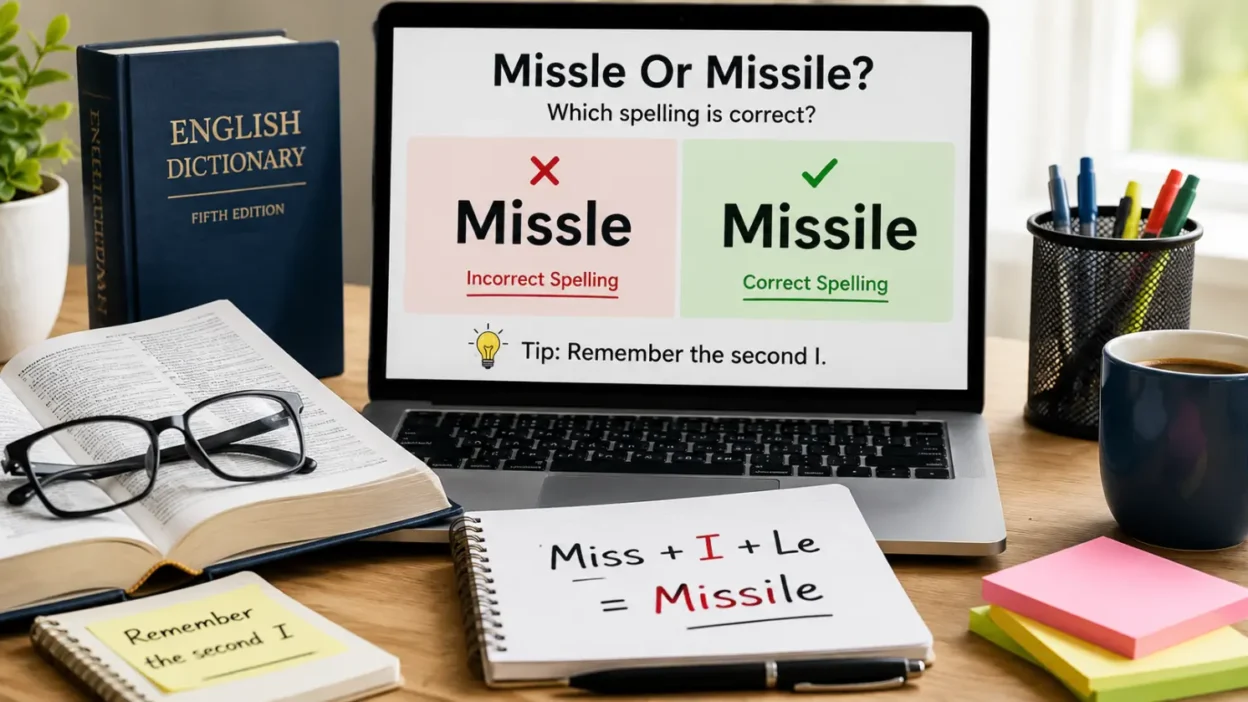
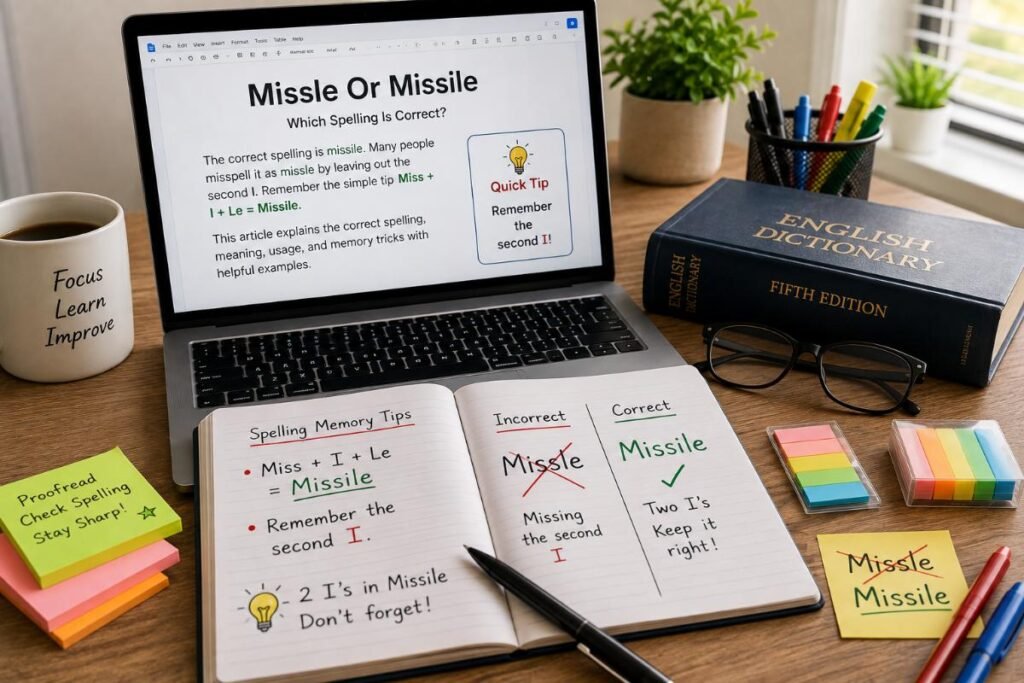
If you’ve ever typed missle or missile and stopped to check the spelling, you’re not alone. The correct spelling is missile. The word has two s letters and only one l after the first vowel. Missle is a common spelling mistake, but it isn’t the standard English spelling.
The confusion usually comes from the way the word sounds. When people say missile quickly, the second vowel can be easy to miss. That can make the incorrect spelling feel natural when you’re writing it from memory. The problem becomes even easier to make because English has many words where letters don’t match the way we expect them to sound.
The good news is that this spelling is easy to remember once you connect the word with its pronunciation and structure. This guide explains the correct spelling, why the mistake happens, how to use the word in a sentence, and which related words can cause similar confusion.
Quick Definition
Missile is the correct English spelling. A missile is an object designed to travel through the air toward a target, often as a weapon, although the word can also appear in technical descriptions of objects that are thrown or launched.
Missle is a misspelling of missile. It leaves out the second i in the middle of the word.
Direct Answer
The correct spelling is missile. Missle is incorrect and should not be used in standard English.
Comparison Table
| Spelling | Meaning | Example Sentence | When To Use It |
|---|---|---|---|
| Missile | A correctly spelled English word for a launched or thrown object, especially a guided weapon. | The report described the missile system. | Use this spelling in all standard English. |
| Missle | Incorrect spelling of missile. | Missle is not the standard spelling. | Do not use it in formal or edited writing. |
Why People Spell Missile As Missle
The mistake is mostly caused by pronunciation. When a word contains several vowels close together, speakers don’t always pronounce every sound with the same strength. That can make one of the letters disappear from memory when the word is written down.
The correct spelling contains three vowel letters in a row across the middle of the word. The structure is missile. Many people remember the first part correctly because it begins with miss. The trouble starts near the end, where the letters i and l can be easy to leave out or rearrange.
There is another reason this mistake feels reasonable. English spelling often gives us words that don’t sound exactly like they look. A person may hear a word several times before ever seeing it written. When they finally type it, they spell it according to the sounds they remember.
That can happen with missile because the middle vowel is not strongly stressed in every pronunciation. Your brain may focus on the stronger sounds and fill in the spelling later. Unfortunately, that can lead to missle.
The Correct Spelling Of Missile
The standard spelling is missile.
A useful way to look at the word is to separate it into parts:
miss + ile
The word begins with miss and ends with ile. The important letter to remember is the i between those parts.
Think of the spelling as:
M I S S I L E
There are two i letters in the word. The first appears at the beginning. The second appears after the two s letters.
If you write M I S S L E, you’ve removed one of those important letters. That creates missle, which isn’t the accepted spelling.
This simple visual pattern can help. When you type the word, pause mentally after miss and remember that another i comes next.
How To Pronounce Missile
Pronunciation can help you remember spelling, but it can also cause the mistake in the first place.
In American English, missile is commonly pronounced something like MISS uhl. The final part is often much weaker than the first syllable. The second i does not sound like a strong separate long vowel.
That means the written form can look more complicated than the spoken form.
You might hear something close to:
MISS uhl
But you need to write:
MISSILE
This is a good example of why spelling cannot always be based entirely on pronunciation. English has many words where letters are less obvious in speech. Learning the written form matters just as much as learning how the word sounds.
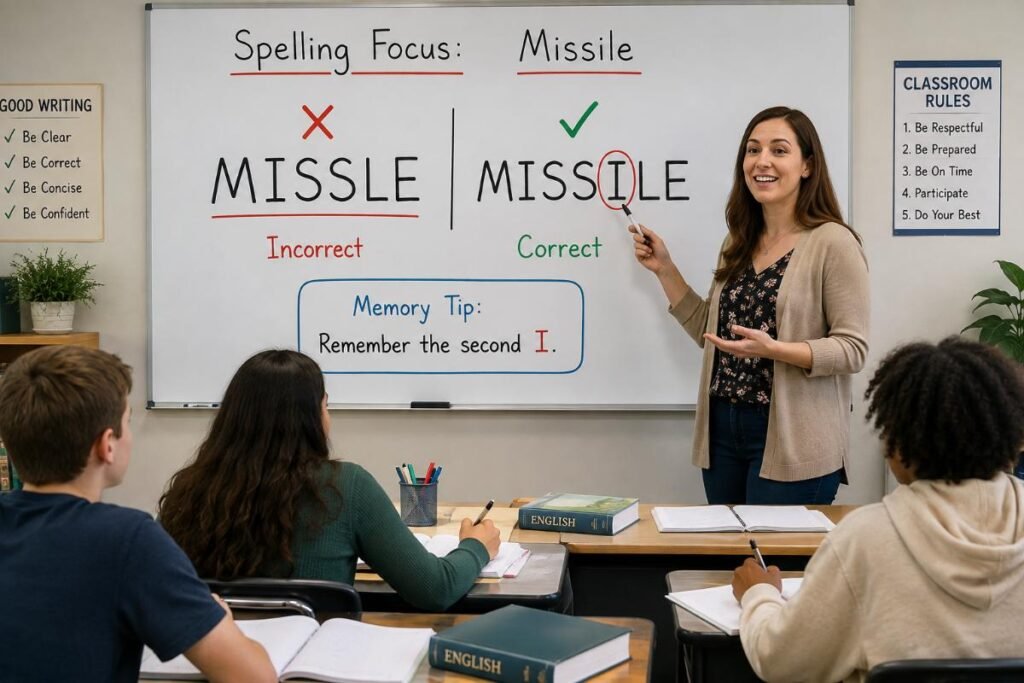
Why The Second I Is Easy To Forget
The first i is easy to notice because it starts the word. The second i is much less noticeable when you say the word aloud.
That creates a simple trap. Your ear hears something close to miss uhl, while your eyes need to remember missile.
One useful habit is to say the word slowly when you’re learning the spelling. Instead of rushing through it, think of the written pattern as miss + i + le. You don’t need to pronounce every letter separately. You just need to remember that the extra i is there.
What Missile Means
The word missile has several related uses, but its most common modern meaning refers to a weapon that is launched toward a target.
A missile can be guided or unguided. Guided missiles use some form of guidance system to help direct their path toward a target. The word often appears in news reports, military writing, history books, and discussions about defense technology.
- The military tested a new missile system.
- The report discussed the country’s missile program.
- The aircraft was designed to carry missiles.
- Officials confirmed that the missile had been launched.
The word can also have a broader meaning. In older or technical use, a missile can refer to an object that is thrown, shot, or launched through the air. The basic idea is movement through the air toward a target.
Missile As A Noun
In most everyday uses, missile functions as a noun. A noun names a person, place, thing, or idea. Here, the word names an object.
You can use it as the subject or object of a sentence.
- The missile was launched at dawn.
- The aircraft carried several missiles.
- Engineers tested the missile before deployment.
- The article explained how the missile works.
The plural form is missiles.
Notice what happens when you make the word plural. You simply add s to the end.
- one missile
- two missiles
- several missiles
The spelling of the main word stays the same.
Missile In Everyday Writing
You may not use the word missile often in casual conversation, but it appears frequently in news stories and informational writing. It is especially common in reports about military action, defense systems, international events, aviation, and history.
For example, a news report might say that officials are investigating a missile launch. A history article might discuss missile development during the Cold War. A science or engineering article might use the word when explaining guidance systems or flight paths.
Because the word appears in serious and formal contexts, correct spelling matters. A spelling mistake can make an otherwise polished article look careless.
This is especially true in school papers, research assignments, professional reports, and published content. If you are writing about military history or technology, missile should always be checked carefully before publication.
Common Examples With Missile
Seeing the word in different sentences can make its spelling easier to remember.
Consider these examples.
- The country announced a new missile defense program.
- Engineers spent years developing the missile.
- The missile traveled toward its intended target.
- The aircraft can carry several missiles.
- The museum has an exhibit about the history of missile technology.
- The researchers studied the missile’s flight path.
- The article explains how a guided missile works.
- The test involved a missile launched from a remote site.
Each example uses the same spelling. The word remains missile regardless of the sentence structure or meaning.
One useful spelling habit is to write the word several times while saying the letters in your head. Missile. Missile. Missile. After you see the correct form often enough, the missing i in missle starts to look obviously wrong.
Why Missile Is Easy To Misspell
The spelling of missile is easy to forget because the word doesn’t sound exactly the way it looks. When people speak quickly, the middle vowel can become very weak. Your ear may hear something close to miss uhl, while your eyes need to remember the full spelling missile.
This creates a common spelling trap. The beginning of the word is clear because miss sounds exactly like the first part of the spelling. The final le is also familiar. The less obvious part is the second i, which sits between the two parts.
If you write the word from memory, your brain may simply skip that letter. That’s how missle appears. The mistake doesn’t happen because the writer doesn’t understand the word. It usually happens because the spelling is less obvious than the pronunciation.
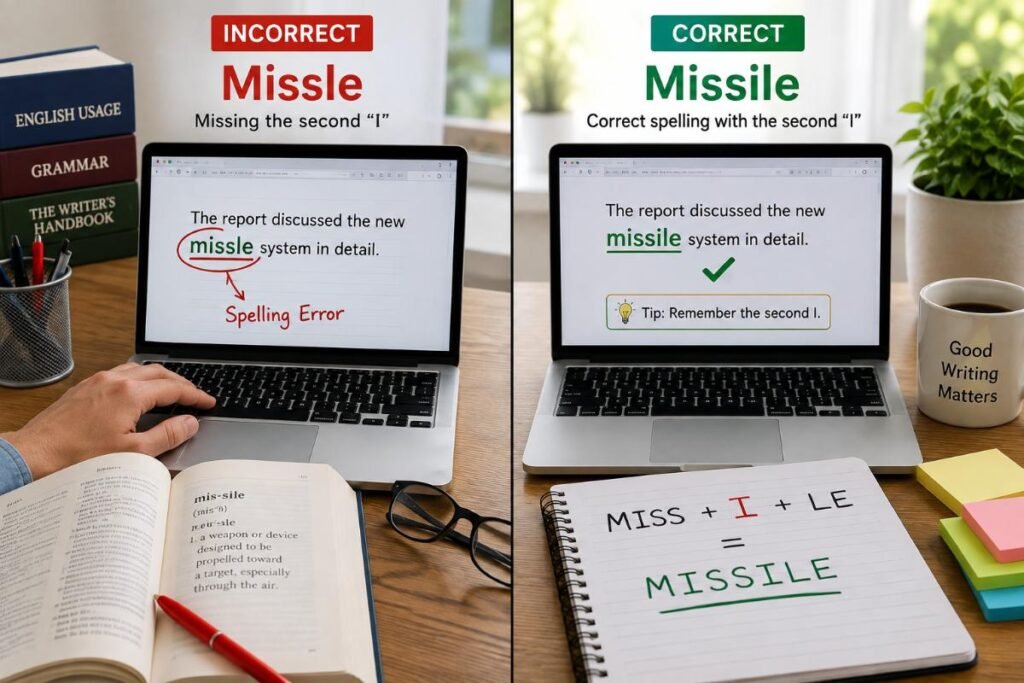
A Simple Spelling Breakdown
One useful way to remember the word is to think about its letters rather than its sound.
M I S S I L E
You can divide it mentally into miss and ile. The important point is that the word doesn’t stop after miss. You need another i before le.
Try writing it this way when you’re learning it:
MISS + ILE = MISSILE
This gives the middle letter a place in your memory. Once you know that miss is followed by ile, you’re much less likely to leave out the second i.
Missle Or Missile And The Correct Rule
The answer to missle or missile is straightforward. Missile is the correct spelling in standard English. Missle is an error created by leaving out the second i.
There isn’t a different meaning attached to the incorrect form. You won’t find missle as a standard alternative spelling of the word. If you see it in an article, post, document, or message, it is almost certainly a spelling mistake.
That makes this different from word pairs where two spellings are both correct but belong to different forms of English. For example, color and colour are accepted spellings in different varieties of English. Missle doesn’t work that way.
You should always write missile when you mean the word for a launched or thrown object.
Examples Of Correct Usage
The best way to make a spelling stick is to see it in natural sentences. Notice how the spelling stays the same in each example.
- The missile was launched during the test.
- Officials discussed the country’s missile defense system.
- The aircraft can carry several missiles.
- Engineers examined the missile before the test.
- The article explains the history of missile technology.
- The researchers studied the missile’s flight path.
- The government announced plans to improve its missile defenses.
- The museum displays an early missile from the twentieth century.
These examples also show that the word can appear in many forms. You can use missile as a singular noun, missiles as a plural noun, or missile’s when showing possession.
The spelling of the base word doesn’t change. The same missile pattern remains at the center of each form.
Singular And Plural Forms
The singular form is missile.
The plural form is missiles.
That means you don’t need to change the spelling when talking about more than one. Simply add s to the end.
For example:
- One missile was found.
- Two missiles were found.
- The aircraft carried one missile.
- The aircraft carried several missiles.
This is a regular plural form. The final e stays in place before the plural s.
A common mistake is to remove or rearrange letters when making the plural. There is no need to do that. Start with missile and add s.
How To Use Missile In A Sentence
The word is most often used as a noun. It can describe a weapon that is launched toward a target, especially one designed to travel through the air.
Here are some natural examples.
- The missile was launched from a military aircraft.
- The country tested a new missile last year.
- The report described the missile as part of a larger defense system.
- Several missiles were displayed at the military museum.
- Engineers worked on the missile’s guidance system.
The word can also appear before another noun to describe something related to missiles.
For example:
- missile defense
- missile system
- missile launch
- missile technology
- missile test
- missile program
- missile site
In these phrases, missile works as a modifier. It tells the reader that the second noun is connected to missiles.
Missile And Rocket Are Not Always The Same
People sometimes use missile and rocket as if they mean the same thing. They can be related, but the words aren’t interchangeable in every context.
A rocket is a vehicle or device that produces thrust by expelling gases. Rockets can be used for space travel, research, military purposes, and other tasks.
A missile is generally designed to reach a target. Many modern missiles use some form of propulsion and guidance, but the defining idea is the target and the weapon’s purpose.
For example, a rocket may carry a spacecraft into orbit. A missile is generally associated with a weapon designed to strike a target.
The distinction matters in technical writing. Using the right word makes your meaning more precise.
Missile And Weapon
A missile is a type of weapon, but not every weapon is a missile.
The term weapon is much broader. It can refer to many types of tools or systems designed for combat. A missile is a specific kind of weapon that is launched or propelled toward a target.
You might therefore see sentences such as:
- The missile is one part of the country’s defense system.
- The report discusses several types of weapons.
- The aircraft can carry different weapons, including missiles.
This relationship can help you understand the word when you encounter it in news reports or historical writing.
Guided And Unguided Missiles
You may also come across the terms guided missile and unguided missile.
A guided missile has a system that helps control its path toward a target. The guidance system can use different technologies depending on the type of missile.
An unguided missile does not have the same type of active guidance system. Its path is determined mainly by how it is launched and by the forces acting on it during flight.
You don’t need to know the technical details to spell the word correctly. Still, knowing these common terms can help when reading articles about military technology or history.
Common Spelling Mistakes Related To Missile
The missing i is the biggest problem, but it isn’t the only way people can get the word wrong. When a word has an unusual spelling pattern, writers may add, remove, or rearrange letters.
Here are some forms you may see:
- missle
- misile
- missil
- missele
None of these is the standard spelling. The correct form is missile.
The most common error is probably missle because the second i is easy to overlook. The other forms are less common, but they show the same basic problem. The writer is trying to spell the word from its sound rather than remembering its written pattern.
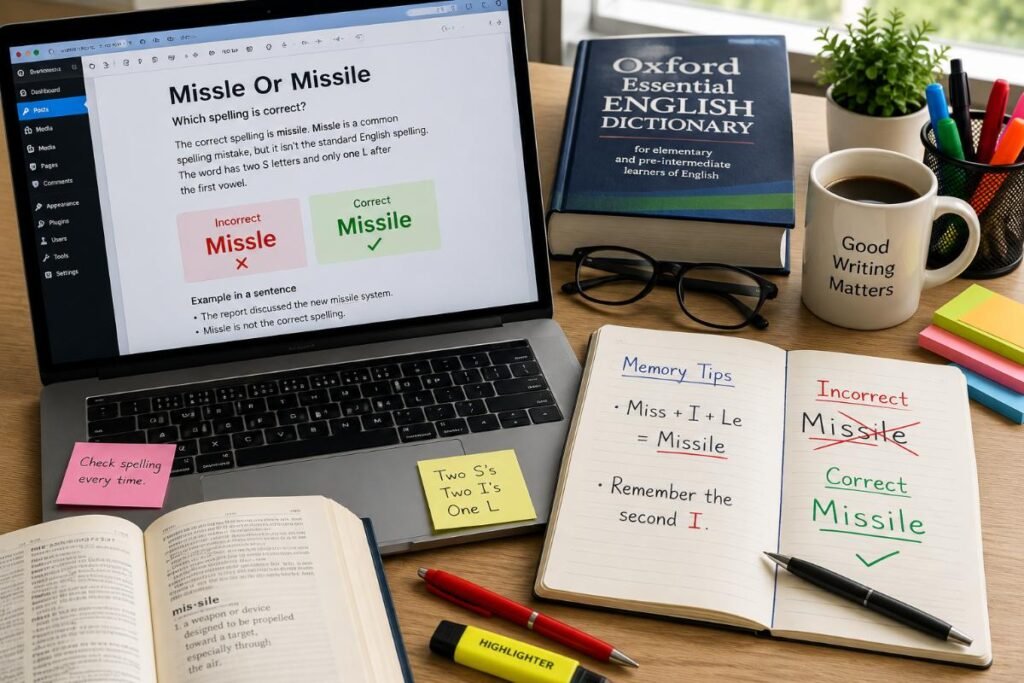
A Quick Trick To Remember The Spelling
Here’s a simple memory trick that works well.
Think of the word as miss + ile.
The first part is miss. The second part is ile. Put them together and you get missile.
Another useful trick is to remember that missile has two i letters. One starts the word, and one appears after the two s letters.
You can also connect the spelling with the word miss. Start with miss, then remind yourself that the word isn’t finished. Add i and le.
MISS + I + LE = MISSILE
That small pause can stop the most common spelling error before it happens.
How To Remember The Two I Letters
Visual memory can be more useful than pronunciation here. Write the word in capital letters a few times:
MISSILE
Now look at the two I letters. They are separated by the two S letters.
You can think of the pattern as:
I SS I
That middle pattern is the part you need to remember. The word starts with MI, contains SSI, and ends with LE.
If you type the word often, your fingers will eventually learn the pattern too. Until then, taking one second to check the middle of the word can prevent the mistake.
Why Spell Check Can Help
Modern word processors and browsers often catch missle automatically. A red underline may appear when you type the incorrect form.
Spell check is useful, but it shouldn’t replace your own knowledge. Some mistakes can slip through if the incorrect spelling resembles another word or if the software doesn’t recognize the context.
It’s better to know the correct form and use spell check as a second layer of protection.
If you’re writing something important, such as a school assignment, article, report, or professional document, give the word a quick visual check. Look for the second i before le.
When To Use The Word
The word missile appears most often in specific types of writing. You may encounter it in news reports about military events, historical accounts, defense articles, technical documents, and discussions about aviation or weapons systems.
It can also appear in educational material. A history lesson might discuss the development of missiles during the Cold War. A science article might explain how a propulsion system works. A news report might describe a missile launch.
You don’t need to avoid the word simply because it has a military meaning. The important thing is to use it accurately and spell it correctly.
For example, these sentences are natural:
- The history book describes the development of missile technology.
- The museum has a display about early missile systems.
- The report examines the country’s missile defense plans.
- Engineers tested the system before the missile launch.
The surrounding words make the meaning clear.
When The Word Is Used In A Broader Sense
The modern use of missile is strongly connected with weapons, but the word has a broader historical meaning. It can refer to something that is thrown or propelled through the air.
This older sense is related to the Latin word missilis, which means capable of being thrown. The same basic idea appears in the word missile today. Something is sent through the air toward a destination or target.
You may see this broader meaning in historical or technical writing. In everyday modern English, however, most readers will understand missile as referring to a weapon.
That difference is useful to know because context always matters. A dictionary definition may include several senses, while an ordinary news article usually relies on the modern military meaning.
Words That Sound Similar But Mean Something Different
English contains many words that sound alike or almost alike but have different spellings and meanings. Missile is not exactly a homophone of another common English word, but its pronunciation can still make its spelling less obvious.
This is a useful reminder that pronunciation and spelling don’t always match perfectly in English. You may know exactly what a word means and still have trouble writing it.
That doesn’t mean you’re a poor writer. It simply means the spelling needs to be learned separately from the sound.
For words like missile, visual memory is often the best tool. Seeing the correct form repeatedly makes it easier to recognize the incorrect version.
A Simple Proofreading Check
If you’re unsure about the spelling, don’t stare at the whole word. Check the middle.
Ask yourself:
Did I include the second i after the two s letters?
If yes, you probably have the correct form:
missile
If the word looks like this:
missle
you’ve left out the second i.
This tiny check takes less than a second. It’s especially useful when proofreading an article or document where the word appears several times.
The goal isn’t to memorize a complicated spelling rule. It’s to build a reliable habit that catches the exact mistake people commonly make.
How To Spell Missile Correctly
The easiest way to remember the spelling is to stop relying on the way the word sounds. Instead, remember its letter pattern. The correct form is missile, with two i letters and two s letters.
Think of it as:
MI + SSI + LE
That gives you MISSILE.
The most common mistake removes the second i and produces missle. If you pause after miss, you can remind yourself that one more i needs to come before le.
A useful memory sentence is: Miss has an extra i in missile. It isn’t a formal spelling rule, but it gives your brain a quick reminder when you’re writing.
Missle Or Missile In Real Sentences
When you see the correct spelling used in different contexts, it becomes easier to recognize. The word can describe a weapon, a system related to that weapon, or something connected with missile technology.
Here are some natural examples:
- The missile was launched during a military test.
- The newspaper reported on a new missile defense system.
- Engineers spent years developing the missile.
- Several missiles were displayed at the museum.
- The aircraft was designed to carry missiles.
- The report discusses the history of missile technology.
- Officials confirmed that the missile launch had taken place.
- The researchers examined the missile’s flight path.
Notice that the spelling never changes in the main word. You don’t remove the second i just because the word appears in a different sentence.
Using Missile In Different Forms
The word can appear in several grammatical forms. Knowing these forms helps you recognize the spelling when you encounter it in longer phrases.
The singular noun is missile.
The plural noun is missiles.
The possessive form is missile’s when something belongs to or is connected with one missile.
For example:
- The missile reached the target.
- The missiles were stored at the facility.
- The missile’s design was updated.
The plural form simply adds s. The final e stays in place.
This is useful because writers sometimes try to change the spelling when adding a suffix. There is no need to do that here. Keep the base spelling intact.
Common Phrases With Missile
You may recognize the word more easily when you learn some of the phrases that commonly appear with it. These combinations show up in news reports, history books, technical articles, and defense discussions.
Common examples include:
- missile system
- missile defense
- missile launch
- missile test
- missile technology
- missile program
- missile attack
- missile strike
- missile site
- missile warning
- missile range
- missile development
These phrases can also help with spelling. When you see missile next to another familiar word, your brain gets more chances to remember its correct form.
Missile Defense
One phrase you may see often is missile defense. It refers to systems or methods designed to detect, track, intercept, or otherwise defend against incoming missiles.
For example:
- The country invested in a new missile defense system.
- Officials discussed improvements to missile defense.
- The report examined the effectiveness of the missile defense program.
You don’t need to understand the technical details to use the phrase correctly. The main spelling point remains the same. Missile always contains the second i.
Missile Launch
Another common phrase is missile launch. It refers to the act of launching a missile or to the event itself.
You might read a sentence such as:
- Officials confirmed the missile launch early Tuesday morning.
The plural form can also appear:
- The report described several missile launches.
Notice that missile remains unchanged before the noun launch. The same pattern applies to many compound phrases.
Missile Technology
The phrase missile technology refers to the technology used in the design, control, propulsion, or operation of missiles.
It often appears in historical and technical writing.
- The article examines the development of missile technology.
- Advances in missile technology changed military strategy.
- The museum explains how early missile technology developed.
Again, the spelling stays missile.
The Difference Between Missile And Missle
There is no meaning difference between the two spellings because only one is a standard English word.
Missile is correct.
Missle is incorrect.
If you are proofreading a document and see missle, correct it to missile. Don’t treat the two forms as alternatives.
This point matters because some English words have accepted spelling variations. For example, American English uses center, while British English commonly uses centre. Both are correct in their own varieties of English.
That isn’t the case here. Missle is not a recognized American alternative to missile. It is simply a misspelling.
Why Pronunciation Can Lead To The Wrong Spelling
English spelling often reflects older forms of words and doesn’t always match modern pronunciation perfectly. Some sounds become weaker in normal speech, while the letters remain in the written form.
That is what makes missile tricky. The middle part doesn’t stand out when you say the word quickly. A listener may hear something close to miss uhl, which makes it easy to forget the second i.
This problem is common when people learn words mainly through conversation. They may know the word well but have rarely seen it written.
Reading helps solve that problem. The more often you see missile written correctly, the more familiar the pattern becomes.
A Spelling Trick For Students
If you’re learning the word for a spelling test, try writing it from memory several times.
Write:
MISSILE
Then cover it and write it again.
MISSILE
Now check the middle. Did you remember both s letters and both i letters?
You can also spell it aloud:
M I S S I L E
This method connects what you see with what you hear and what you write. It gives your memory several ways to hold on to the word.
Don’t write the incorrect form repeatedly during practice. Seeing missle again and again can accidentally reinforce the wrong pattern.
A Spelling Trick For Writers
Writers can use a different approach. Instead of memorizing the entire word every time, train yourself to scan the middle.
When proofreading, look for:
SSI
The word should contain ssi in the middle.
Correct:
miSSIle
Incorrect:
miSSle
That one visual check can catch the error quickly. It’s especially useful if you’re editing a long document that uses the word many times.
Examples Of Incorrect Usage
Seeing the wrong spelling can also help you recognize the mistake.
Incorrect:
- The army tested a new missle.
Correct:
- The army tested a new missile.
Incorrect:
- The report discussed missle technology.
Correct:
- The report discussed missile technology.
Incorrect:
- Several missles were displayed.
Correct:
- Several missiles were displayed.
The mistake stays the same even when the word changes form. The second i belongs in the singular word and remains there in the plural.
Is Missile A Difficult Word To Spell
For many people, yes. But it isn’t difficult because of a complicated grammar rule. It’s difficult because pronunciation doesn’t clearly reveal every letter.
The solution is to remember the visual pattern rather than trying to spell it entirely by sound.
Think MI SSI LE.
The middle SSI is the part most likely to cause trouble. Once that pattern becomes familiar, the spelling becomes much easier.
This is also a good example of why reading matters when you’re building vocabulary. Seeing a word in books, articles, and other written material teaches your brain how the word looks. Over time, correct spelling becomes automatic.
Related Words And Terms
Learning related words can give you more context and help strengthen your vocabulary.
You may encounter:
- missile
- missiles
- missile defense
- missile system
- missile technology
- missile launch
- missile test
- missile program
- missile attack
- missile range
These terms often appear together in the same types of writing. If you’re reading an article about defense technology or military history, you’ll probably see several of them in the same passage.
Understanding the surrounding vocabulary can also make the main word easier to remember.
When To Capitalize Missile
The word missile is normally written with a lowercase letter. It is a common noun, so it doesn’t need a capital letter simply because it refers to a weapon.
For example:
- The missile was launched from the aircraft.
However, capitalize it when it appears as part of a proper name, official title, or named system that uses capitalization.
For example, a specific model or official program may have its own name and capitalization rules. In that case, follow the official name rather than applying a general rule to the word itself.
The spelling still stays missile unless the official name uses a different form for a specific reason.
When To Use A Dictionary
A dictionary is useful when you aren’t sure about spelling, pronunciation, or meaning. If you type missle into a good dictionary, you may be directed toward missile.
Don’t rely only on search results. A web search can show incorrect spellings because people make mistakes online all the time.
A dictionary gives you a more reliable answer because it records standard words and their accepted forms. For professional writing, using a trusted dictionary is a simple way to check a spelling question.
How To Proofread The Word Quickly
If you’re reviewing your own writing, use a quick three step check.
First, find every occurrence of the word.
Second, look at the middle and check for ssi.
Third, make sure the word ends with le in the singular form or les in the plural form.
The correct patterns are:
missile
missiles
The incorrect pattern is:
missle
This method takes only a few seconds. It can save you from carrying a small spelling mistake into an article, report, assignment, or published page.
FAQs
Is missle or missile the correct spelling?
Missile is the correct spelling. Missle is a common misspelling caused by leaving out the second i. If you’re writing in standard English, always use missile.
Why do people spell missile as missle?
The main reason is pronunciation. The second i is not strongly heard in many common pronunciations, so writers may leave it out when spelling the word from memory. The correct written form still includes both i letters.
How do you spell missile correctly?
Spell it M I S S I L E. A simple way to remember it is miss + ile. The key is not to forget the second i after the two s letters.
What does missile mean?
A missile is generally an object that is launched or propelled toward a target, especially a guided weapon. The word can also have a broader historical meaning related to something thrown or launched through the air.
What is the plural of missile?
The plural is missiles. Simply add s to the end of the correctly spelled singular form.
Is missle an accepted spelling?
No. Missle is not a standard alternative spelling. It is simply an incorrect form of missile.
What is the difference between a missile and a rocket?
A missile is generally designed to reach a target and is commonly associated with weapons. A rocket is a propulsion device or vehicle that can be used for space travel, research, or military purposes. Some missiles use rocket propulsion, so the two terms can overlap in technical contexts.
Final Thoughts
The answer to missle or missile is clear. Missile is the correct spelling, and missle is a spelling error. The missing second i is the main reason people get the word wrong.
The easiest way to remember it is to focus on the middle. Think MI SSI LE or miss + ile. Once you remember that second i, the most common mistake disappears.
You may see the word in news reports, history books, technical articles, and discussions about defense technology. It can appear in phrases such as missile defense, missile system, and missile launch, but the spelling of the main word stays the same.
When you’re proofreading, don’t rely only on how the word sounds. Look for missile and check that the second i is there. That quick habit will help you spell the word correctly every time.