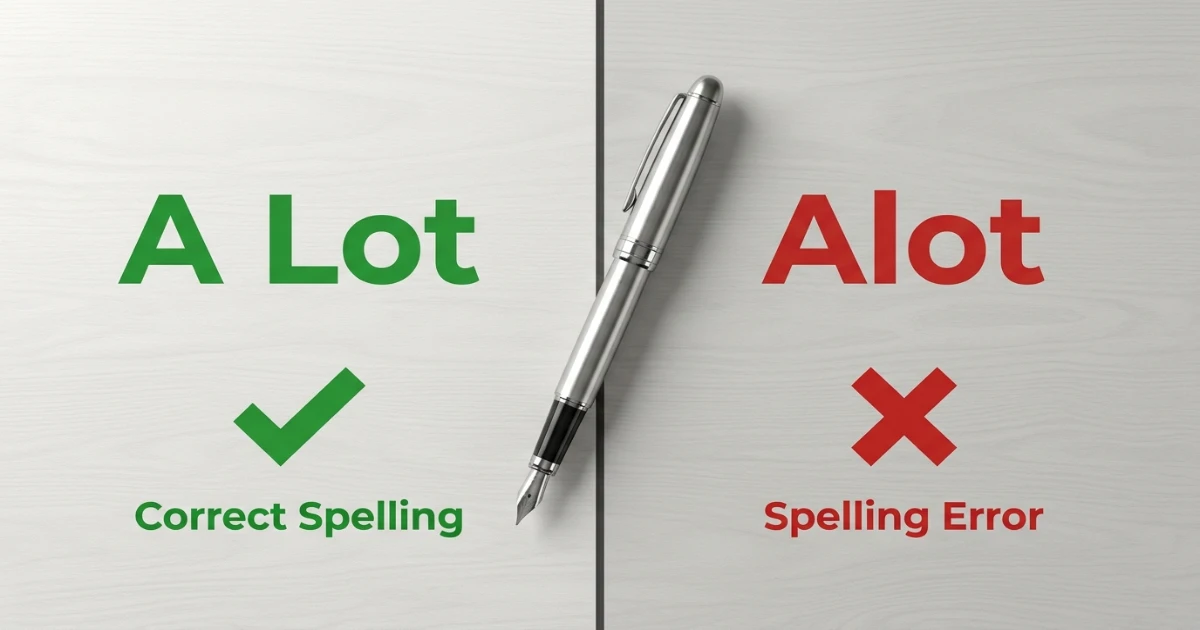
When deciding between alot or a lot, the correct spelling is always a lot.
The form alot is a very common spelling error in written English. You will see it constantly in text messages, social media posts, and quick unedited drafts. However, modern English dictionaries and style guides classify it strictly as a mistake. If you write alot as a single word in an essay, a job application, or a work email, spellcheck will highlight it immediately.
Understanding why people run these two words together and learning how the phrase functions will help you write a lot correctly every time.
Quick Definition and Direct Answer
A lot is a two-word noun phrase that functions informally as an adverb or a determiner meaning a large amount, a great number, or frequently.
- A lot (two separate words) is the only correct standard spelling.
- Alot (one single word) is a misspelling and should never be used.
If you ever feel unsure about whether to add a space, remember that a lot follows the exact same pattern as a bit, a few, or a dozen.
Quick Comparison Table
| Word or Phrase | Meaning | Example Sentence | When To Use It |
| A lot | A large quantity, number, or degree | She learned a lot from her mentor. | Use as the standard two-word phrase. |
| Alot | None (Spelling error) | Incorrect: I have alot of work to do. | Never. Do not use this form in standard English. |
| Allot | To distribute, assign, or set aside | We will allot thirty minutes for questions. | Use as a formal verb meaning to allocate. |
| Lot | A plot of land; a group; destiny | They parked their car in the empty lot. | Use as a distinct noun with specific meanings. |

The Grammar Behind A Lot
To use a lot accurately in your writing, it helps to understand how its two distinct components work together inside a sentence.
Article Plus Noun Structure
The phrase a lot consists of two standard English words:
- The indefinite article a.
- The singular noun lot.
Historically, the noun lot referred to an item used to draw choices, an assigned portion, or a parcel of land. Over time, English speakers began using “a lot” idiomatically to describe a large portion or quantity.
Because a is a separate article, merging it with the noun creates an invalid word, just like merging a cat into acat or a dog into adog.
How A Lot Functions in Sentences
Depending on how you set up your sentence, a lot fulfills two primary grammatical roles.
1. Acting as an Adverbial Phrase
When a lot modifies a verb or an adjective, it functions as an adverbial phrase meaning frequently, greatly, or to a high degree.
- Modifying a Verb: He travels a lot for his job.
- Modifying a Verb: My brother talks a lot when he gets nervous.
- Modifying an Adjective: The new office is a lot bigger than the old one.
2. Acting as a Determiner with “Of”
When a lot is paired with the preposition of, the combined phrase a lot of acts as an informal determiner signifying a large quantity or number. It can modify both countable and uncountable nouns.
- Countable Noun: There were a lot of people standing outside the theatre.
- Uncountable Noun: We spent a lot of time working on the project.
Why People Misspell A Lot as Alot
Even experienced writers occasionally run these words together. Knowing why people accidentally drop the space makes it much easier to avoid doing it yourself.
Phonetic Merging in Spoken English
In spoken English, people do not pause between the article a and the noun lot. The phrase is pronounced seamlessly as a two-syllable unit: /ə lɒt/.
Because the ear hears a single unbroken sound, your brain naturally interprets it as a single compound word like another, ahead, or around.
Visual Confusion with Real Words Starting with A-
English contains many valid compound words formed by attaching the prefix a- to a base word. Consider these everyday examples:
- Already
- Altogether
- Along
- Abroad
- Aside
Because writers encounter single words starting with a- constantly, muscle memory causes fingers to merge a and lot into alot without realizing a space belongs between them.
Confusion with the Verb “Allot”
The existence of the legitimate English verb allot (spelled with two L’s) adds another layer of confusion. Because allot is a single word pronounced similarly, writers sometimes confuse its single-word status with a lot, dropping the space while using a single L.
Simple Memory Tricks for Correct Spelling
Memory tricks make it simple to keep your space in the right place when drafting essays or emails.
The “A Bit” Swap Test
Whenever you write a lot, test the phrase by mentally replacing it with a bit or a few:
- I ate a bit of lunch. (Two words)
- I ate a lot of lunch. (Two words)
Because you would never write abit as a single word, applying the same spacing rule keeps a lot properly separated.
The “Space Between” Rule
Picture a physical plot of land (a parking lot or a building lot). You need space to park on a lot, so you must leave a space inside a lot.

The Difference Between A Lot and Allot
Confusing a lot with allot changes the meaning of your sentence entirely. Sorting them out ensures your writing stays clear and precise.
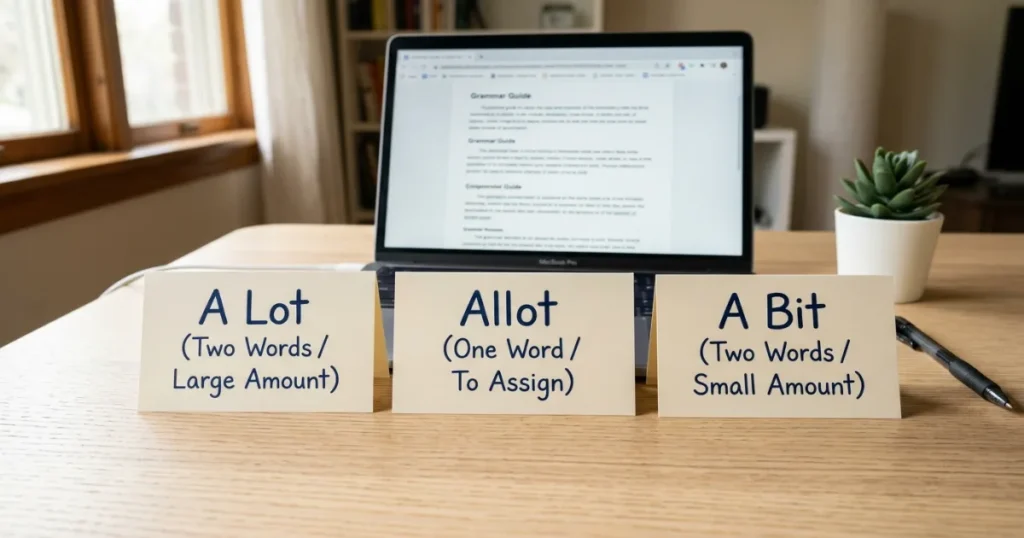
A Lot (Two Words)
Refers to a large quantity, degree, or frequency.
- Correct: She received a lot of helpful advice.
- Correct: The team improved a lot this season.
Allot (One Word, Double L)
A formal verb meaning to assign, allocate, or distribute a share of something.
- Correct: The manager will allot funds to each department.
- Correct: We were allotted twenty minutes to complete the test.
If you are trying to describe an amount rather than the act of handing something out, always use the two-word phrase a lot.
Real World Examples of Correct Usage
Here are practical sentences showing how to use a lot naturally across different daily writing scenarios.
Daily Conversations
- I have a lot of errands to run before the weekend.
- Thanks a lot for helping me move those heavy boxes.
- She reads a lot during her morning train commute.
- It rains a lot in the Pacific Northwest during the fall.
Workplace and Professional Communication
- We gathered a lot of positive feedback from the recent client survey.
- The new software saved our team a lot of time this week.
- There is still a lot of work to complete before the quarterly review.
- Our department learned a lot from the training workshop.
Academic and Formal Alternatives
While a lot is grammatically correct, formal academic or professional writing often prefers more formal alternatives.
- Informal: The study required a lot of resources.
- Formal: The study required a substantial amount of resources.
- Informal: Demand increased a lot over the summer.
- Formal: Demand increased significantly over the summer.
Related Common Spelling Errors
Spelling slip-ups often happen when words run together or letter combinations create confusion. Reviewing related words helps strengthen your overall writing accuracy.
1. Merging Independent Words
Just as people run a lot together into alot, writers frequently merge other short phrases into nonstandard single words. For instance, people often struggle with spacing and double letters when deciding between occured or occurred or when choosing between thier or their in daily sentences.
2. Dropping or Swapping Silent Letters
Dropping or swapping silent letters creates another category of widespread typos. Writers frequently miss letters when deciding between definately or definitely or when choosing between suprise or surprise.
3. Suffix Errors and Double Letters
Tricky suffix rules cause frequent errors across formal vocabulary. Writers polishing professional correspondence often review rules for single versus double letters in words like publically or publicly or phrase choices like make do or make due.
4. Regional Spelling Differences
While some English words change spellings depending on regional standards, others remain fixed worldwide. Navigating choices like analyzing or analysing or comparisons such as armor or armour requires knowing regional preferences.
American English vs. British English Usage
Some English words change their spelling based on whether you are writing for an American or a British audience. For example, American English uses color, center, and labeled, while British English uses colour, centre, and labelled.
However, when it comes to a lot, there is no regional variation whatsoever.
- American English: A lot (two words)
- British English: A lot (two words)
- Canadian English: A lot (two words)
- Australian English: A lot (two words)
In every major dialect of standard English across the world, a lot is the only accepted spelling, and alot is always marked as an error.
Clear Summary and Final Guidelines
Mastering the spelling of a lot comes down to keeping a few clear principles in mind:
- A lot (spelled as two separate words) is the only correct form in modern English.
- Alot (merged as a single word) is a spelling error caused by spoken pronunciation and visual confusion with words starting with a-.
- The verb allot (one word, double L) is a completely different word that means to allocate or assign.
- Test your sentence using a bit or a few whenever you feel unsure about leaving a space.
By remembering that a lot requires a space just like a bit, you can write this phrase accurately every single time.
Frequently Asked Questions
Is alot ever an acceptable alternative spelling?
No. Alot is not recognized as a valid word or alternative spelling in any standard English dictionary. It is considered a straightforward spelling mistake in all formal, academic, and casual writing.
What is the formal alternative to a lot of?
In formal writing, replace a lot of with terms like a large number of (for countable items), a great deal of or a substantial amount of (for uncountable items), or adverbs like significantly and frequently.
Is a lot of singular or plural?
The verb agreement after a lot of depends on the noun that follows it. If the noun is plural, use a plural verb (A lot of students are here). If the noun is uncountable or singular, use a singular verb (A lot of snow has fallen).
What does the verb allot mean?
The verb allot means to distribute, assign, or set aside a specific share or portion of something for a particular purpose (e.g., We must allot time for lunch).
How can I train myself to stop typing alot?
The easiest way to train yourself is to replace a lot with a bit whenever you write. Remind yourself that both phrases are two separate words starting with the article a.