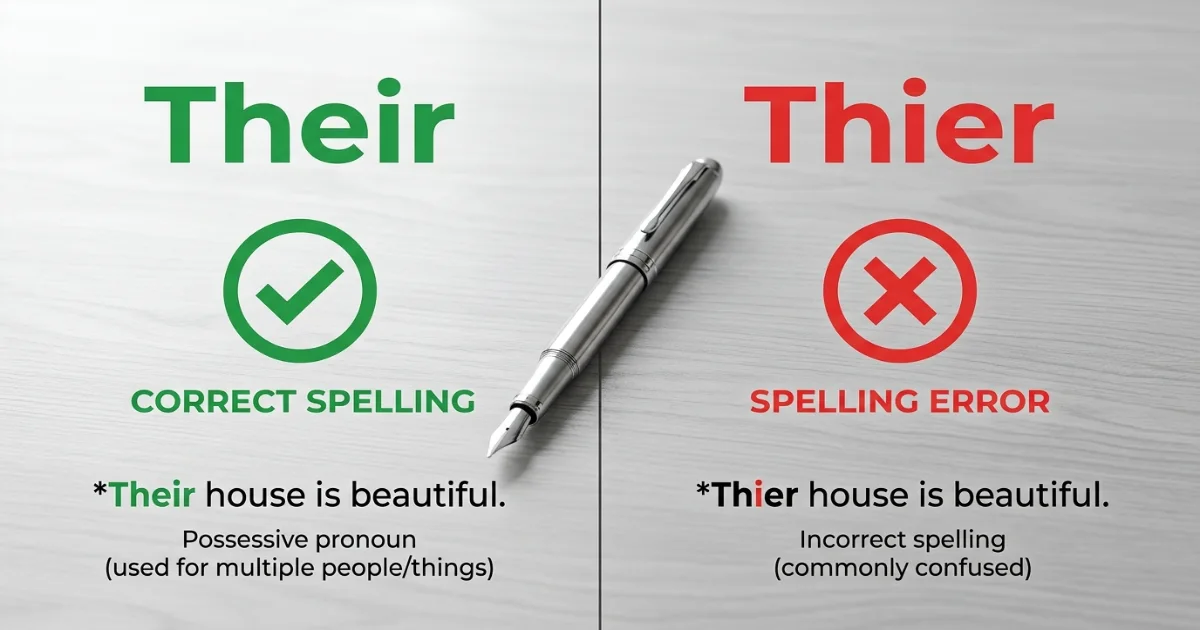
When deciding between thier or their, the correct spelling is always their.
The form thier is a very common spelling error in written English. You will see it frequently in quick text messages, social media comments, and fast personal emails. However, modern English dictionaries and style guides classify it strictly as a mistake. If you write thier in a school paper, a cover letter, or a workplace report, automated proofreading tools will flag it immediately.
Understanding why people swap these two letters and learning how to keep the possessive form clear will help you write their correctly every time.
Quick Definition and Direct Answer
Their is a possessive pronoun used to show that something belongs to or is associated with two or more people, animals, or things. It is also used as a singular possessive pronoun when referring to one person whose gender is unknown or irrelevant in context.
- Their (with EI) is the only correct standard spelling.
- Thier (with IE) is a spelling error and should never be used.
If you ever get confused while writing, remember that their contains the word heir right after the letter t. An heir inherits property that becomes their property.
Quick Comparison Table
| Word or Phrase | Meaning | Example Sentence | When To Use It |
| Their | Belonging to or associated with them | The students packed their backpacks after class. | Use to show possession or ownership. |
| Thier | None (Spelling error) | Incorrect: They left thier coats in the car. | Never. Do not use this form in standard English. |
| There | In, at, or to that place or position | Put the books over there on the table. | Use when referring to a place, location, or point. |
| They’re | Shortened form of they are | They’re going to the movies this evening. | Use only as a contraction for they are. |
The Grammar Behind Their
To use their accurately in your writing, it helps to understand its role in sentences and how it fits into the broader personal pronoun family.
Possessive Determiner Function
In English grammar, their acts as a possessive determiner (often called a possessive adjective). It must always be followed by a noun or an adjective modifying a noun.
- Example: Their house sits on top of the hill.
- Example: Their new puppy sleeps all afternoon.
Unlike independent possessive pronouns like theirs, their cannot stand alone at the end of a sentence without a noun following it.
- Correct: That car is theirs.
- Correct: That is their car.
- Incorrect: That car is their.
Plural and Singular Use
Historically, their served exclusively as a third-person plural possessive pronoun referring to multiple people or objects.
- Plural: The neighbors parked their cars in the driveway.
In modern English, their is also widely established as a singular possessive pronoun. It is used when referring to a single person without specifying gender, or when the subject is an indefinite pronoun like everyone, someone, or anyone.
- Singular: Every participant must present their ID at the front desk.
- Singular: Someone left their umbrella in the hallway.
Why People Misspell Their as Thier
Even experienced writers accidentally type thier from time to time. Recognizing why this letter reversal happens makes it much easier to avoid.
The Misleading Spelling Rule
Many English speakers learned the traditional spelling rhyme in school: “I before E except after C.”
Because their does not follow a letter C, people try to apply the rule literally and place the I before the E, creating thier.
However, their is one of the primary exceptions to that classic rule. The letters E and I must stay in the order E-I.
Pronunciation Distortions
In casual spoken English, words like there, they’re, and their are pronounced identically as homophones: /ðɛər/.
Because the sound is a flat vowel sound, your ear gives you no clue about the order of the silent internal vowels. When typing quickly, your visual memory can lapse, causing your fingers to reverse the E and the I.
Typing Speed and Finger Mobility
On modern computer keyboards, the keys for E and I are placed close to each other on the top row, operated by different hands. When typing at high speed, your dominant hand might strike the I key a fraction of a second before your non-dominant hand strikes the E key, producing thier as a pure mechanical typo.
Simple Memory Tricks for Correct Spelling
You can lock the correct spelling into your memory using simple visual clues.
The “Heir” Trick
Look closely at the word their after the initial letter T:
- T + HEIR = THEIR
An heir is someone who inherits land, money, or titles. Since inheritance is all about ownership, finding the word heir inside their reminds you that the word shows possession.
The “EI Family” Rule
Group their with other common words that share the E-I letter sequence despite not having a letter C:
- Their
- Heir
- Weird
- Height
- Neighbor
Remembering that their belongs to this special E-I word group helps break the habit of applying “I before E” indiscriminately.

Distinguishing Their, There, and They’re
Confusing their with its homophones there and they’re is one of the most widespread errors in written English. Sorting them out ensures your writing stays polished and professional.
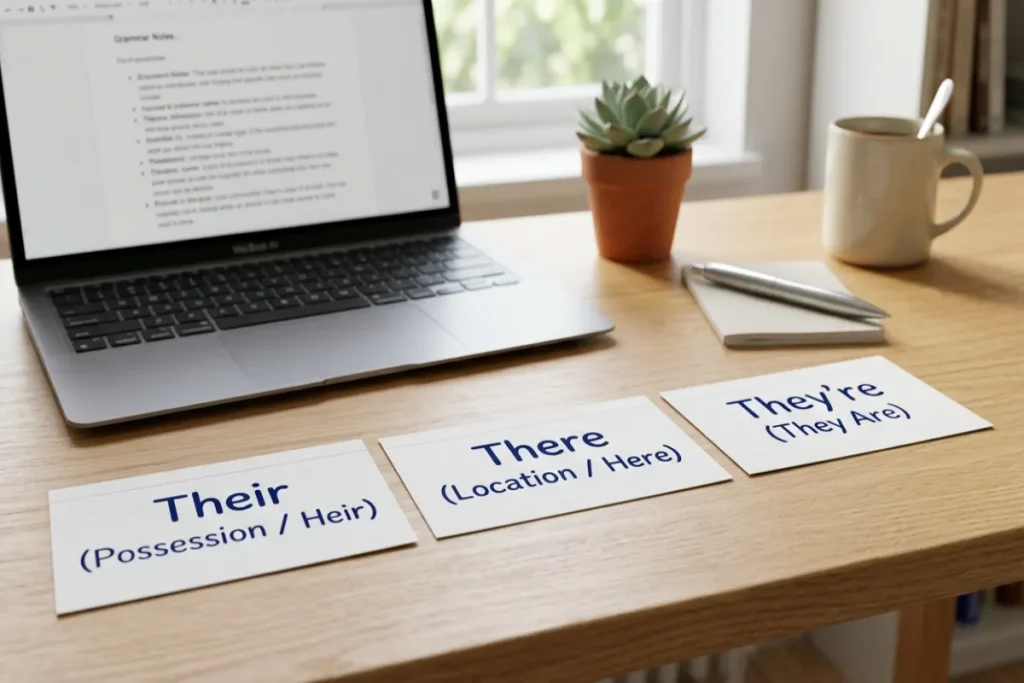
1. Their (Possession)
Use their only when showing that something belongs to someone or something.
- Their dog barked all night.
- Their flight arrived on time.
2. There (Location)
Use there when referring to a specific place, direction, or position. It contains the word here, which also refers to a place.
- T + HERE = THERE
- Please sit over there.
- There is a quiet park near our house.
3. They’re (Contraction)
Use they’re only when you can replace the word with they are. The apostrophe stands in place of the missing letter A.
- They’re (They are) coming to dinner at six o’clock.
- They’re (They are) excited about the upcoming vacation.
Examples of Correct Usage
Here are practical example sentences demonstrating how to use their naturally across various daily writing scenarios.
Daily Conversations
- The kids forgot their lunchboxes on the kitchen counter.
- Our friends called to say their car broke down on the highway.
- The birds built their nest in the high branches of the oak tree.
- Please ask the guests to leave their coats near the front entrance.
Workplace and Business Writing
- The board members expressed their full support for the new initiative.
- All employees should submit their timesheets before Friday afternoon.
- The design team shared their preliminary sketches during the morning meeting.
- Customers appreciate it when a company values their feedback.
Academic and Educational Contexts
- Researchers published their findings in an international scientific journal.
- The university welcomed incoming freshmen and their families to campus.
- Students must organize their primary sources before writing the final draft.
- Both political parties presented their economic proposals to the committee.
Related Common Spelling Errors
Spelling errors frequently cluster around silent vowels, homophones, and letter transpositions. Reviewing related words helps strengthen your overall vocabulary accuracy.
1. Letter Transpositions in Common Words
Just as people reverse the E and I in their, writers often swap adjacent vowels or drop silent letters in everyday words. For instance, people often struggle with vowel placement when deciding between definately or definitely or when choosing between suprise or surprise.
2. Dropping Silent Letters
Dropping silent letters creates another category of high-frequency typos. Writers frequently miss internal letters when choosing between wich or which in fast-paced drafting.
3. Suffix Misconceptions and Double Letters
Tricky suffix patterns lead to frequent errors across formal writing. Writers polishing professional documents often review rules for single versus double letters in words like publically or publicly or phrase choices like make do or make due.
4. Regional Variations
While some English words change spellings depending on regional standards, others remain fixed globally. Navigating choices like analyzing or analysing or comparisons such as armor or armour requires knowing regional preferences.
American English vs. British English Usage
Some English words undergo spelling alterations when shifting between American English and British English standards. For example, Americans write color, center, and traveled, while British writers prefer colour, centre, and travelled.
However, when it comes to their, there is no regional variation whatsoever.
- American English: Their (spelled E-I)
- British English: Their (spelled E-I)
- Canadian English: Their (spelled E-I)
- Australian English: Their (spelled E-I)
In every major dialect of standard English across the world, their is the only correct spelling, and thier is universally recognized as a typo.

Clear Summary and Final Guidelines
Mastering the spelling of their comes down to three fundamental rules:
- Their (spelled E-I) is the only correct possessive form in modern English.
- Thier (spelled I-E) is a misspelling caused by misapplying the “I before E” rule or typing quickly.
- The word heir lives inside their (T + HEIR), which serves as a constant reminder that the word indicates ownership and inheritance.
By keeping the heir memory trick in mind, you can eliminate this common letter reversal from your writing permanently.
Frequently Asked Questions
Is thier ever acceptable in old or archaic English?
While variable spelling existed in Middle English prior to dictionary standardization, thier is not an accepted historical variant in modern reference works. Standard English dictionaries across all eras of modern print classify thier strictly as an error.
Why doesn’t their follow the “I before E except after C” rule?
The traditional rule “I before E except after C” has dozens of common exceptions in English, especially for words where the vowel combination makes an “ay” or “air” sound (such as their, neighbor, weigh, and heir).
How can I tell if I should use their or there in a sentence?
Look at the meaning of your sentence. If you are describing something that belongs to a person or group, use their. If you are pointing to a physical location or introducing a phrase (like “there is”), use there.
Can their be used for a single person?
Yes. Modern style guides, including the Associated Press (AP), Chicago Manual of Style, and APA, accept their as a singular possessive pronoun when referring to a person whose gender is unknown or specified as nonbinary.
How can I stop accidentally typing thier?
Train yourself to look for the word heir whenever you spell their. Remind yourself that an heir inherits property, connecting the visual presence of h-e-i-r to the concept of possession.