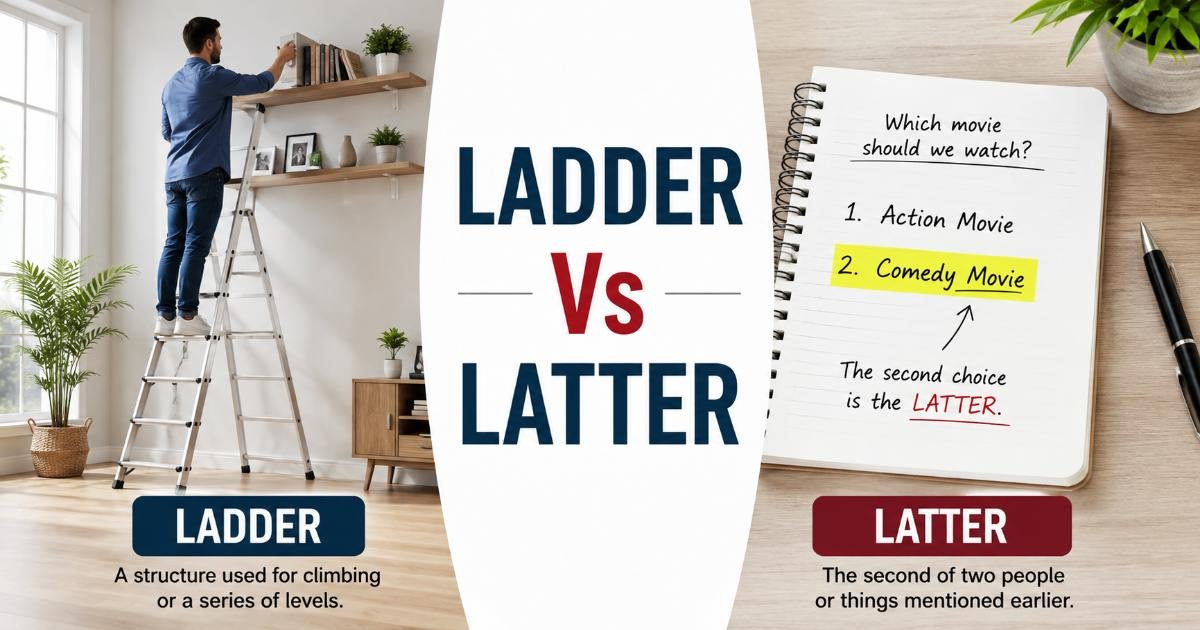
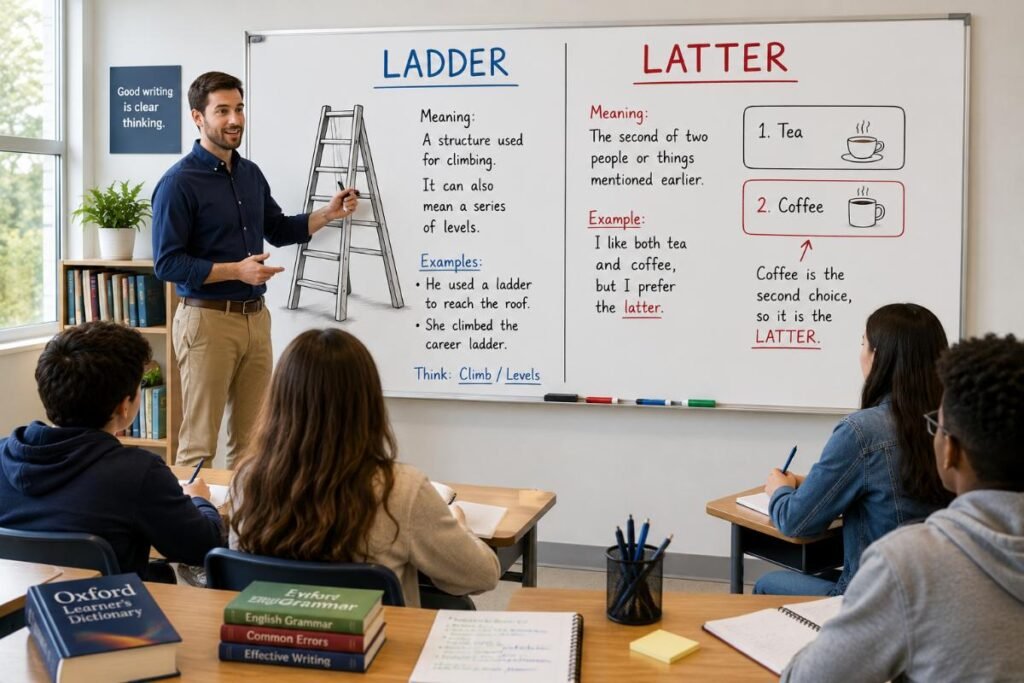
If you’re confused by ladder vs latter, you’re dealing with two words that look and sound surprisingly similar but have completely different meanings. Ladder is usually a tool used for climbing. Latter refers to the second of two people or things that were just mentioned.
The difference becomes much easier once you connect each word to a clear idea. Think of a ladder as something you can climb. Think of the latter as the second choice in a pair. That simple contrast will help you avoid one of the most common confused word mistakes in English.
These words can cause trouble because they sound almost identical in many accents. When you hear them in conversation, you may not know which spelling belongs in a sentence. The problem becomes even more noticeable when you write from memory.
This guide explains the meanings, grammar, pronunciation, common mistakes, and real world uses of both words. You’ll also see examples that show exactly how each one works in a sentence.
Quick Definition
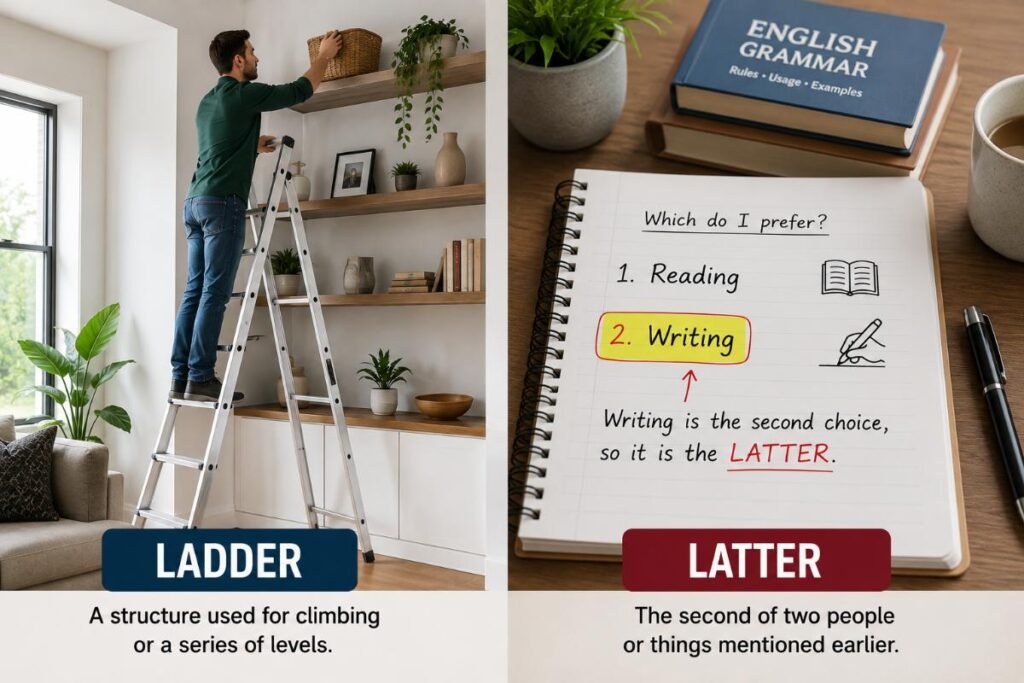
A ladder is a structure with steps or rungs that lets you climb up or down. It can also describe a series of levels or stages.
Latter means the second of two people or things that have already been mentioned. It’s mainly used in writing and careful speech when comparing two choices.
Direct Answer
Use ladder when you mean a climbing tool or a series of levels. Use latter when you mean the second of two things or people mentioned earlier.
For example, you might say, “I need a ladder to reach the roof,” but “I prefer tea and coffee, but I usually choose the latter.”
Comparison Table
| Word | Meaning | Example Sentence | When To Use It |
|---|---|---|---|
| Ladder | A tool used for climbing or a series of levels | We used a ladder to reach the roof. | Use it for climbing equipment or levels and stages. |
| Latter | The second of two things or people mentioned | I considered tea and coffee, but I chose the latter. | Use it when referring back to the second item in a pair. |
What Ladder Means
The noun ladder has a very concrete meaning. It usually refers to a piece of equipment with two long sides connected by several horizontal rungs. You climb those rungs to reach a higher place.
You’ve probably seen ladders used for painting houses, cleaning windows, trimming trees, or reaching high shelves. A ladder can be short enough to use indoors or tall enough to reach the upper part of a building.
For example, you might say, “Please hold the ladder while I climb up.” The word clearly refers to physical equipment in this sentence.
A Ladder Helps You Climb
The most common meaning is the physical object.
Consider these examples.
- The painter leaned a ladder against the wall.
- I need a ladder to change that light bulb.
- Please move the ladder away from the doorway.
- The gardener climbed a ladder to trim the tree.
- Dad stored the ladder in the garage.
In each sentence, the word describes something that helps a person move upward or work at a height.
A ladder can also be used to climb down. The direction does not matter. The key idea is that the object has rungs or steps arranged vertically.
Different Types Of Ladders
English uses ladder for many kinds of climbing equipment.
A step ladder can stand on its own and is useful for indoor tasks. You might use one to reach a high cabinet or replace a ceiling light.
An extension ladder can be made longer by sliding one section over another. People often use this type for outdoor work.
A straight ladder has one main set of rungs and normally rests against a wall or another stable surface.
A rope ladder uses rope for its sides and can be flexible. You might see one on a boat or in certain outdoor settings.
The basic meaning stays the same. A ladder gives you a way to reach a higher or lower position.
Ladder Can Also Mean A Series Of Levels
The word has another useful meaning that has nothing to do with climbing equipment.
A ladder can describe a series of steps or levels that someone moves through. The idea comes from the physical image of climbing from one rung to another.
For example, you might hear someone talk about the career ladder. This means the different levels of a career that a person may move through as they gain experience and take on more responsibility.
You could say, “She worked her way up the corporate ladder.” Here, no one is talking about an object leaning against a wall. The phrase describes progress from a lower position to a higher one.
The same idea appears in sports, rankings, social groups, and other areas.
- He is trying to climb the career ladder.
- The team moved up the league ladder.
- She worked her way up the company ladder.
- The young player is climbing the rankings ladder.
These uses all share the same basic image. Moving upward means making progress.
What Latter Means
The word latter has a very different job. It refers to the second of two people, things, choices, or ideas that have already been mentioned.
For example, consider this sentence.
“I enjoy both summer and winter, but I prefer the latter.”
The two seasons are summer and winter. Summer is the first one mentioned. Winter is the second. Therefore, latter refers to winter.
This word is especially useful when you want to avoid repeating a noun. Instead of saying, “I prefer winter,” you can say, “I prefer the latter.”
Latter Refers To The Second Choice
The easiest rule is to remember this pair.
Former means the first.
Latter means the second.
Look at this example.
“Mark and Daniel applied for the job. The former had more experience, but the latter had stronger communication skills.”
The sentence mentions Mark first and Daniel second. Former refers to Mark. Latter refers to Daniel.
Once you know this pattern, the meaning becomes much easier to recognize.
Latter Needs Two Things To Compare
A useful point to remember is that latter normally works with a pair.
For example:
“I enjoy both reading and writing, but I prefer the latter.”
The two activities are reading and writing. Writing is the second item, so latter refers to writing.
You should not normally use latter when you have a long list of several choices. The word is designed for a comparison between two things.
For example, this sentence is clear:
“You can choose between a bus and a train. I prefer the latter.”
The sentence gives you exactly two options. That makes the reference easy to understand.
If you list three or four options, using latter can become unclear. Readers may not know which item you mean. In those cases, it’s usually better to name the choice directly.
Why These Words Are So Easy To Confuse
The main problem is pronunciation. Ladder and latter can sound nearly identical in many varieties of American English.
In particular, the middle sound in both words may be pronounced with a quick flap that sounds similar to a soft d. As a result, a listener may hear almost the same sound even though the words have different meanings.
That means context becomes extremely important.
If someone says, “Please bring the ladder,” you can understand the meaning from the situation. They probably need climbing equipment.
If someone says, “I prefer the latter,” the surrounding sentence tells you that two things have been mentioned and the speaker means the second one.
The spelling is different because the words come from different language histories and serve different purposes. Learning the meaning is much more useful than trying to hear the difference alone.
Think About The Context
When you hear a word that sounds like ladder or latter, ask yourself what the speaker is talking about.
Is the person talking about climbing, reaching a high place, or moving upward? The word is probably ladder.
Are they comparing two people, things, ideas, or choices? The word is probably latter.
This quick context check works better than relying only on pronunciation.
The Former And Latter Pair
One of the best ways to remember latter is to learn it with former.
These words often appear together because they point to two different items in a pair.
Former means the first one mentioned.
Latter means the second one mentioned.
For example:
“I enjoy both hiking and swimming. I prefer the former.”
Here, former means hiking because hiking came first.
Now change the sentence:
“I enjoy both hiking and swimming. I prefer the latter.”
This time, latter means swimming because swimming came second.
The words work almost like signposts. Former points backward to the first item. Latter points backward to the second.
A Simple Memory Trick
Think of former as first.
Both words begin with a similar sound. That can help you connect the meaning.
Then think of latter as the other choice that came later in the sentence.
You don’t need to remember a complicated definition. Just keep this pair in mind.
Former means first. Latter means second.
That one rule solves most questions about latter.
Real Examples With Latter
Seeing the word in natural sentences can make the meaning stick.
“I can work in the morning or evening, but I prefer the latter.”
The speaker means evening because it was mentioned second.
“Sarah offered me tea or coffee, and I chose the latter.”
The speaker chose coffee because coffee came second.
“The store sells new and used books, but the latter are often cheaper.”
The word latter refers to used books because they were mentioned second.
“We discussed price and quality. The latter mattered more to me.”
The word refers to quality because quality came second.
“John and Peter both applied. The latter had more work experience.”
The word refers to Peter because Peter was mentioned second.
Each sentence follows the same basic pattern. Two things appear first. Latter then points back to the second one.
Real Examples With Ladder
The physical meaning of ladder is usually easy to understand once you see it in context.
“The ladder is too short to reach the second floor.”
“Please put the ladder back in the garage.”
“She climbed the ladder to clean the windows.”
“We need a taller ladder for this job.”
“The old wooden ladder needs to be replaced.”
In each example, ladder refers to equipment used for climbing.
The word can also describe progress through levels.
“He is moving up the career ladder.”
“She hopes to climb the corporate ladder.”
“The team is slowly moving up the rankings ladder.”
These expressions all use the idea of climbing from one level to another.
How To Use Latter Correctly
The word latter usually appears after two things have been mentioned. It points back to the second item.
For example, consider this sentence:
“I enjoy both cats and dogs, but I prefer the latter.”
The sentence mentions cats first and dogs second. The word latter therefore means dogs.
The order matters. If you switch the two nouns, the meaning of latter changes too.
“I enjoy both dogs and cats, but I prefer the latter.”
Now latter means cats.
This is why you should always look at the two items that appear before the word. The second one is the latter.
Latter In Longer Sentences
The two choices don’t always appear right next to each other. A sentence can contain extra information between them and still use latter correctly.
For example:
“After comparing the older model with the newer version and considering the price and features of both, I decided to buy the latter.”
The sentence contains several details, but the basic pair is still clear. The older model came first and the newer version came second. Therefore, latter refers to the newer version.
When a sentence becomes too complicated, though, naming the item again can be clearer. Good writing should help readers understand your meaning without making them search backward through a paragraph.
When Latter Can Become Unclear
The word latter works best when the two choices are close together and easy to identify. Problems start when a writer mentions several people or things before using the word.
Consider this example:
“John met Sarah at the store after speaking with David and Mark. The latter was carrying a large box.”
Who was carrying the box?
The reader may not know. Latter normally points to the second item in a pair, but this sentence gives several names. There is no clear two item comparison.
A clearer version would be:
“John spoke with David and Mark. The latter was carrying a large box.”
Now the reference is obvious. David came first and Mark came second.
Even better, you can simply use the name again if there is any chance of confusion.
“John spoke with David and Mark. Mark was carrying a large box.”
Repeating a name isn’t a weakness. Clear writing matters more than avoiding a repeated word.
Don’t Use Latter For A Long List
The word latter is most useful when you have two choices.
Suppose you write:
“I considered a house, an apartment, a condo, and a townhouse. I chose the latter.”
The sentence is unclear because latter doesn’t give the reader a reliable way to identify one item from a list of four.
A better sentence would be:
“I considered a house, an apartment, a condo, and a townhouse. I chose the townhouse.”
You can also narrow the comparison first.
“I considered a house and a townhouse. I chose the latter.”
Now the meaning is clear.
This small writing choice can make a big difference. If readers have to stop and count items to understand your reference, the sentence probably needs revision.
Latter As An Adjective
Latter can also work as an adjective. In simple terms, that means it can describe a noun.
For example:
“During the latter part of the year, sales increased.”
Here, latter describes the later part of the year.
You may also see phrases such as:
- the latter half.
- the latter stages.
- the latter years.
- the latter part.
- the latter period.
In these expressions, latter means the later part of a period or sequence. It doesn’t necessarily mean the second of exactly two items.
This is an important distinction. The most common use involves two previously mentioned choices, but the word has another established meaning related to something occurring later.
Latter Part
The phrase latter part means the later part of something.
For example:
“Sales improved during the latter part of the year.”
The sentence means sales improved during the later part of the year.
You might also say:
“She became more confident during the latter part of the course.”
This means her confidence increased toward the end of the course.
Latter Years
The phrase latter years usually refers to the later years of a person’s life or a period of history.
For example:
“In his latter years, the writer spent more time teaching.”
This means he spent more time teaching during the later part of his life.
You can also use the phrase for organizations, historical periods, and careers.
“The company struggled during the latter years of the decade.”
The meaning is simply the later years of that decade.
Ladder As A Noun
The most common use of ladder is as a noun. It names the physical object people climb.
A ladder usually has two long sides with horizontal steps called rungs. Some ladders are made from aluminum or other metals. Others are made from wood, fiberglass, or other materials.
You can use a ladder for many practical tasks.
A homeowner might use one to clean gutters. A painter might use one to reach a high wall. A worker might use one to access a roof or another elevated area.
Here are some natural examples:
“The ladder is leaning against the garage.”
“Please check the ladder before you climb it.”
“She carried the ladder into the backyard.”
“We bought a folding ladder for small jobs around the house.”
These sentences all use ladder as a regular noun.
Ladder As A Verb
Ladder can also appear as a verb in some specialized contexts. This use is much less common in everyday American English, so most learners don’t need to focus on it when learning the difference between the two words.
The noun is the form you are most likely to need. When you mean the equipment used for climbing, ladder is the word to choose.
The Expression Climb The Ladder
One of the most common figurative uses of ladder appears in the phrase climb the ladder.
Here, nobody is necessarily climbing a physical object. The phrase describes moving toward a higher position.
For example:
“She worked hard to climb the career ladder.”
The sentence means she worked hard to advance in her career.
You might also hear:
“He wants to climb the corporate ladder.”
“She climbed the political ladder over several years.”
“The young player is climbing the professional ladder.”
The image is easy to understand. Each higher rung represents another level of progress.
Career Ladder
The phrase career ladder describes the levels a person may move through during a career.
For example, someone might begin as an assistant, become a manager, and later become a director. Moving from one level to the next can be described as climbing the career ladder.
You could write:
“She started as an office assistant and gradually climbed the career ladder.”
This use has nothing to do with a physical ladder. The word describes progress from a lower position to a higher one.
Corporate Ladder
The corporate ladder refers to levels of responsibility within a company.
For example:
“After ten years with the company, he had moved high up the corporate ladder.”
The phrase often suggests career advancement. It can also carry the idea that people compete for higher positions.
Again, the physical image helps explain the expression. You climb from one rung to the next until you reach a higher level.
Ladder Vs Latter In Everyday Sentences
One of the best ways to master these words is to compare them directly.
Consider these sentences:
“I left the ladder outside.”
“I chose the latter option.”
The first sentence refers to a physical object. The second refers to the second option mentioned earlier.
Now compare another pair:
“She climbed the ladder to reach the roof.”
“She had two job offers and accepted the latter.”
The meanings are completely different even though the words sound similar.
Here are a few more examples:
“We need a ladder to paint the ceiling.”
“I can work Monday or Tuesday. I prefer the latter.”
“The ladder is in the shed.”
“Both plans have benefits, but the latter is cheaper.”
“He carried the ladder upstairs.”
“I considered a train and a bus, but I took the latter.”
Reading the words side by side makes the contrast clear. Ladder is connected with climbing and levels. Latter is connected with the second item in a pair or a later part of something.
Common Mistakes With These Words
The most common mistake is using ladder when you mean latter.
For example:
“I prefer the ladder option.”
That sentence is wrong if you mean the second option. The correct word is latter.
“I prefer the latter option.”
Now the meaning is clear.
The opposite mistake can happen too.
“Please bring the latter from the garage.”
If you mean a piece of climbing equipment, latter is incorrect. You need ladder.
“Please bring the ladder from the garage.”
The context makes the correct choice obvious.
Mistake With Former And Latter
Another common problem is mixing up former and latter.
Remember the order:
Former means first.
Latter means second.
For example:
“I considered a laptop and a tablet. The former was cheaper.”
The laptop came first, so former refers to the laptop.
“I considered a laptop and a tablet. The latter was cheaper.”
The tablet came second, so latter refers to the tablet.
A quick check can prevent mistakes. Look at the order of the two nouns. The first is the former. The second is the latter.
A Simple Memory Trick
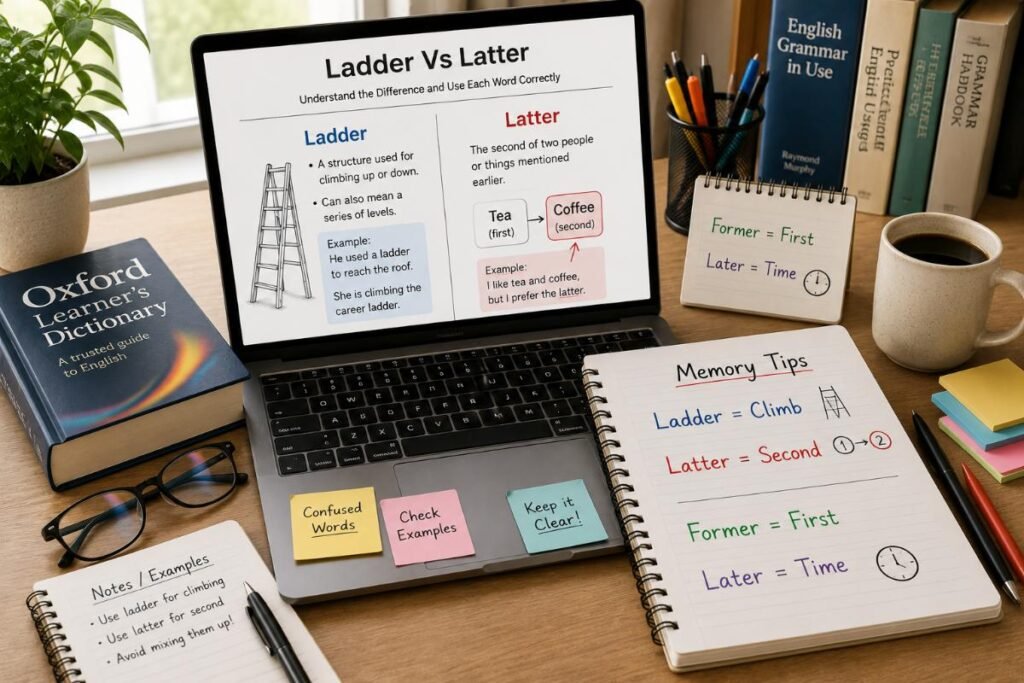
The easiest way to remember the difference is to connect each word with an image.
For ladder, picture a real ladder leaning against a house. You can climb it. You can touch it. You can put it in a garage.
For latter, picture two choices written on a piece of paper. The first choice is on top. The second choice is below it. The latter is the second one.
You can also use this short rule:
Ladder means climb. Latter means second.
That’s enough for most everyday situations.
If you see the word in a sentence, ask yourself one question.
Am I talking about something I can climb?
If the answer is yes, use ladder.
Am I talking about the second of two things already mentioned?
If the answer is yes, use latter.
This quick mental check takes only a second and can save you from a spelling mistake.
Pronunciation And Why Spelling Matters
In many American accents, ladder and latter sound almost the same. This is one reason the words get confused so often.
The middle sound in each word may sound like a quick tap. To many listeners, the difference is hard to hear. If you rely only on pronunciation, you may choose the wrong spelling when writing.
That’s why meaning should guide your spelling.
If you hear a sentence about climbing equipment, think ladder.
If you hear a sentence comparing two choices, think latter.
Context gives you the clue that pronunciation may not provide.
This is also a good reminder that English spelling doesn’t always match the way words sound. Some words are easy to distinguish when written but nearly identical when spoken. Learning their meanings and common uses is often the most reliable way to remember them.
Latter And Later Are Not The Same
Another word that sometimes causes confusion is later.
Later means at a time after now or after another time.
For example:
“I’ll call you later.”
Latter has a different meaning. It can refer to the second of two things or the later part of a period.
For example:
“I chose the latter of the two options.”
These words look similar, but they aren’t interchangeable.
Think of the difference this way:
Later is about time.
Latter is about order or position.
That distinction can help you avoid another common spelling error.
Latter And Former Work As A Pair
If you want to become comfortable with latter, learn former at the same time.
These words are natural partners.
“I like both tea and coffee. The former is my usual choice.”
Tea is first, so it is the former.
“I like both tea and coffee. The latter is my usual choice.”
Coffee is second, so it is the latter.
You can use this pattern with people too.
“Maria and Lisa joined the meeting. The former arrived early, while the latter joined a few minutes later.”
Maria came first in the sentence, so former points to Maria. Lisa came second, so latter points to Lisa.
The rule stays the same no matter what the two items are.
When To Avoid Latter
Although latter is useful, it isn’t always the clearest choice. Good writers don’t use a word simply because it sounds formal.
If the reader could become confused, repeat the noun.
For example:
“The company discussed several products before announcing that the latter would be released in July.”
This sentence makes the reader wonder which product latter means.
A clearer version would name the product directly.
“The company discussed several products before announcing that the new laptop would be released in July.”
The second version is easier to understand because there is no guessing.
This matters especially in business writing, academic writing, and technical content. Clear writing should reduce the reader’s work. If a simple noun can make your meaning obvious, use it.
A Quick Editing Test
When proofreading your own writing, search for every use of latter.
Then ask three questions.
Have I clearly mentioned two things before this word?
Can the reader easily tell which two things I mean?
Does latter clearly point to the second one?
If the answer to all three is yes, the word is probably working well.
If the answer to any question is no, rewrite the sentence. You may need to name the item again or restructure the comparison.
This simple editing habit is useful because latter can sometimes sound polished while still being unclear. Good editing isn’t only about using correct words. It’s also about making the reader’s job easy.
FAQs
What is the difference between ladder and latter?
Ladder usually means a piece of equipment used for climbing. Latter usually means the second of two people or things that were mentioned earlier. The words sound very similar in many American accents, but their meanings and spellings are completely different.
Is latter the same as second?
In many situations, yes. Latter refers to the second of two things or people that have already been mentioned. For example, in “I prefer tea and coffee, but I chose the latter,” the word latter refers to coffee.
Does latter mean later?
No. Later relates to time, while latter relates mainly to order or position. You might say, “I’ll call you later,” but “I chose the latter of the two options.”
What is the difference between former and latter?
Former refers to the first of two things or people mentioned. Latter refers to the second. If you mention apples and oranges in that order, apples are the former and oranges are the latter.
Can latter refer to more than two things?
It is best to use latter for a clear pair of two things or people. Using it after a list of three or more items can make your meaning unclear. If the reader could struggle to identify the item you mean, simply name it again.
Is ladder only used for climbing?
No. The most common meaning refers to climbing equipment, but ladder can also describe a series of levels or stages. Expressions such as career ladder and corporate ladder use the word to describe progress from one level to another.
Why do ladder and latter sound the same?
In many American accents, the middle sounds in the two words are very similar. This makes them easy to confuse when you hear them but much easier to distinguish when you see them in writing. Context usually tells you which word the speaker means.
How can I remember ladder and latter?
Use the simple rule ladder means climb and latter means second. Picture a physical ladder when you see ladder. When you see latter, think of two choices and remember that it points to the second one.
Final Thoughts
The easiest way to understand ladder vs latter is to connect each word with one strong idea. Ladder is connected with climbing. Latter is connected with the second of two things or people. Once those meanings become familiar, the spelling difference becomes much easier to remember.
The word ladder is usually straightforward. It can name a physical object with rungs that people climb, and it can also describe progress through a series of levels. That’s why you can climb a ladder to reach a roof or climb the career ladder to move into a better position.
The word latter works differently. It points back to the second item in a pair, such as the second person, choice, idea, or object mentioned. It can also describe the later part of a period, as in “the latter part of the year.” Just remember that former means first and latter means second.
When you’re unsure which spelling to use, don’t rely on the sound alone. Ask what the sentence means. If you’re talking about something you can climb, write ladder. If you’re referring to the second of two choices, write latter. That quick meaning check is usually all you need.
Practical Takeaway
Remember these four words as two separate pairs.
Ladder means climb.
Latter means second.
Former means first.
Later means time.
If you keep those four ideas separate, you can handle most sentences without hesitation. Read the surrounding words, identify the meaning, and let the meaning guide the spelling.