
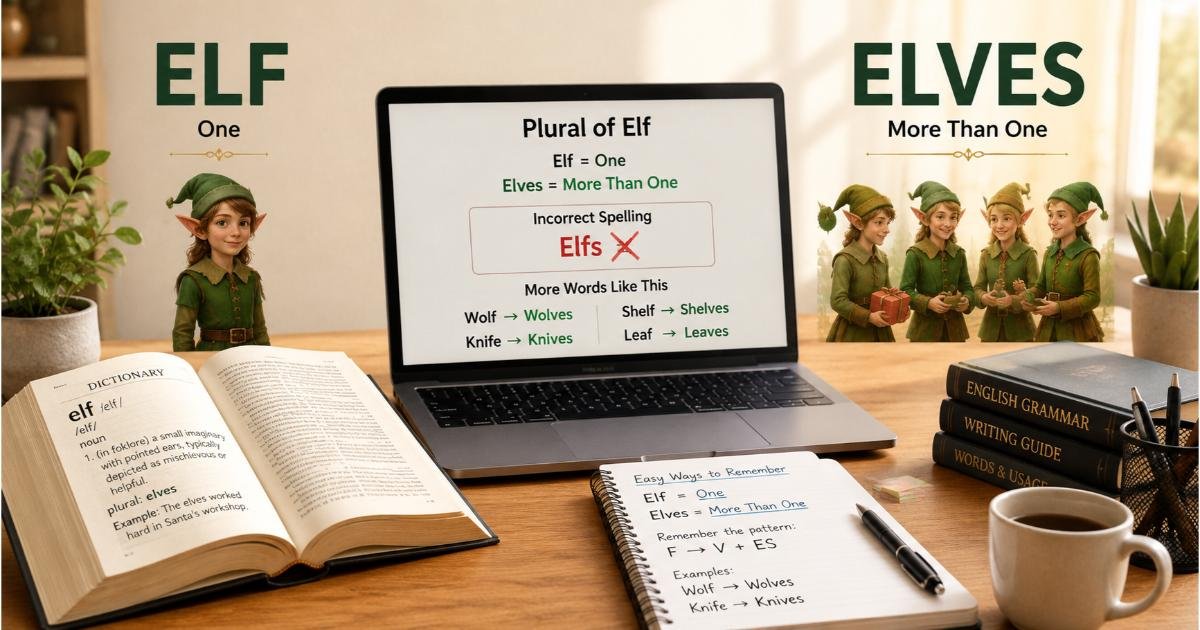
If you have searched elfs or elves because you aren’t sure which plural spelling is correct, you’re not alone. The correct plural of elf is elves. The spelling elfs is generally considered incorrect in standard modern English.
The reason this word causes trouble is easy to understand. Many English nouns simply take s when they become plural. We say books, cats, cars, and trees. So it seems logical to write elfs when talking about more than one elf. English has a different rule for this word.
The change from elf to elves follows a spelling pattern that appears in several other common English words. You can see the same kind of change in words such as half and halves and knife and knives. Once you understand that pattern, the spelling becomes much easier to remember.
This guide explains why the plural changes from elf to elves, how to use the word in real sentences, and why you may sometimes see the spelling elfs. We’ll also look at related words that follow the same pattern so you can avoid similar spelling mistakes in the future.
Quick Definition
Elf is the singular form. It refers to one mythical or magical creature in folklore and fantasy stories.
Elves is the standard plural form. It refers to two or more elves. In standard modern English, elfs is not the usual plural spelling.
Direct Answer
The correct plural spelling is elves. Use elf for one creature and elves for two or more.
For example, you would write, One elf lives in the forest, but Three elves live in the forest.
Comparison Table
| Word | Meaning | Example Sentence | When To Use It |
|---|---|---|---|
| Elf | One mythical creature | An elf helped the traveler. | Use it when you mean one. |
| Elves | More than one elf | The elves gathered in the village. | Use it when you mean two or more. |
| Elfs | Nonstandard plural spelling | The story mentions several elfs. | Avoid it in standard English. |
Why Elf Becomes Elves
The spelling change can look strange at first. If you know the usual plural rule, you might expect elfs because most English nouns form their plural by adding s.
For example, one book becomes books. One chair becomes chairs. One tree becomes trees. Nothing inside the word changes.
Some English nouns do not follow that simple pattern. Their spelling changes when they become plural. Elf belongs to this group in standard modern English, so the f changes to v and the word takes es.
That gives us:
- elf → elves
- half → halves
- knife → knives
- life → lives
- wife → wives
- wolf → wolves
- shelf → shelves
The pattern isn’t completely regular across all English words, but it is common enough to be useful. Learning a few examples together can make the spelling much easier to recall.
The F To V Pattern
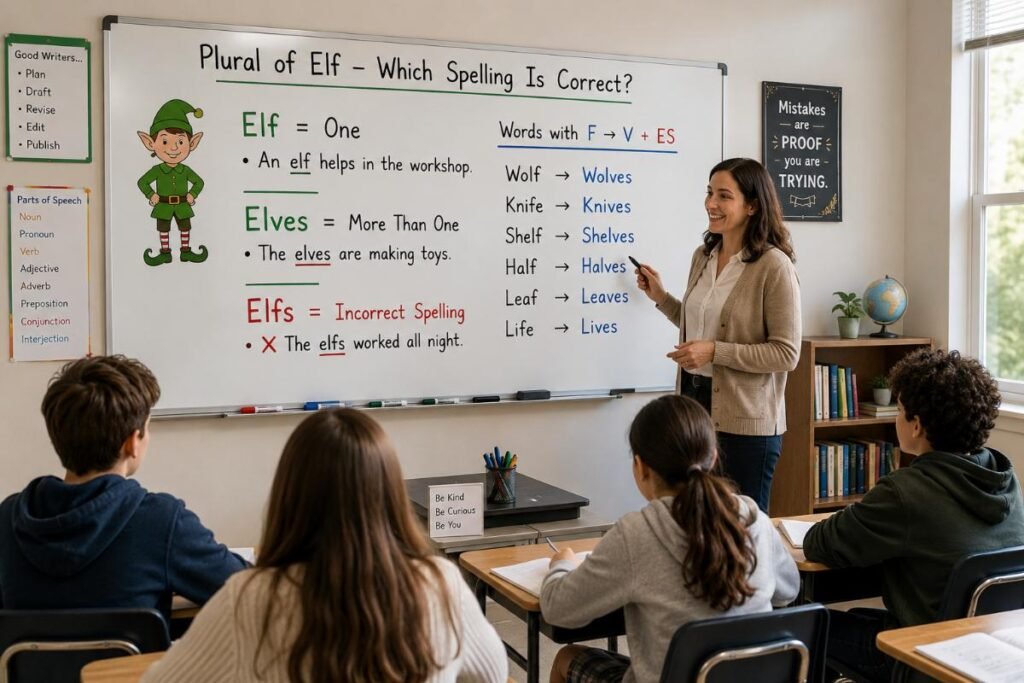
The important spelling change is the move from f to v.
In the singular, we have:
- elf
- wolf
- knife
- shelf
In the plural, we have:
- elves
- wolves
- knives
- shelves
The ending changes too. The plural does not simply add s. Instead, the word usually takes es after the spelling changes.
This is why elfs looks wrong in standard English. It treats elf like a regular noun such as desk or lamp. Standard English treats it as one of the nouns that changes its final sound and spelling in the plural.
You don’t need to know the full history of English to use the word correctly. Just remember the pattern and a few familiar examples.
Where The Word Elf Comes From
The word elf has a long history in English. It comes from old Germanic languages and has been used for centuries to describe supernatural beings connected with folklore.
Older stories did not always portray elves the way modern fantasy books and movies do. Their appearance, behavior, and role changed across different cultures and periods. In some traditions, elves were mysterious supernatural beings. In modern fantasy, they are often shown as magical people with pointed ears, special skills, or a close connection to forests and nature.
The spelling has also changed over time. Modern English eventually settled on elf as the singular form and elves as the standard plural form.
That history helps explain why the plural does not look as simple as elf + s. English contains many words that have kept older plural patterns even though they may seem unusual today.
Why The Spelling Elfs Looks So Logical
There is a good reason people write elfs by mistake. The ordinary English plural rule tells us to add s to a singular noun.
Consider these examples.
- one dog becomes two dogs
- one house becomes two houses
- one book becomes two books
- one tree becomes two trees
- one friend becomes two friends
When someone sees elf, the natural instinct is to apply the same rule.
That gives elfs.
The problem is that English has many exceptions and special plural patterns. Some words change their spelling instead of simply adding s. That means a person can understand the general rule perfectly and still make this particular spelling mistake.
The same thing happens with words like knife. Most learners know that nouns can become plural by adding s, so knifes might seem reasonable at first. But standard English uses knives.
The lesson is simple. English plural forms are not always predictable from one general rule. Some common nouns need to be learned as special forms.
Examples Of Elves In Real Sentences
Seeing the word in context is one of the best ways to remember it. The following examples show how elves works naturally in different kinds of sentences.
- The elves gathered around the old tree before sunrise.
- Two elves helped the children find their way home.
- The story follows a group of young elves who live in a hidden forest.
- The elves built small houses beneath the ancient trees.
- Several elves appeared at the festival wearing green coats.
- The children imagined that friendly elves lived behind the garden wall.
- The old tale describes elves as mysterious creatures with magical powers.
- The village believed the elves protected the forest from harm.
Notice that elves works just like other plural nouns in a sentence. The unusual part is the spelling. Once you know the plural form, using it is straightforward.
You can also use elves with numbers and words that show quantity.
- three elves
- several elves
- many elves
- a group of elves
- two small elves
- hundreds of elves
The word itself does not change again. Elves is the plural form you use for any number greater than one.
Elves In Fantasy Stories
Modern readers often know the word through fantasy fiction. Elves appear in fairy tales, novels, games, films, and holiday stories. Their role can change a lot depending on the story.
In one story, elves may be tiny magical creatures who help people. In another, they may be tall warriors with long lives and powerful skills. Christmas stories often use elves as Santa’s helpers who work in a workshop and prepare toys.
Despite these different meanings, the plural spelling stays the same.
- The Christmas elves made toys all night.
- The fantasy novel features a kingdom ruled by elves.
- The game allows players to create powerful elves.
The context may change the type of elf you mean, but it does not change the plural form.
Elf And Elves In Everyday Grammar
The singular and plural forms are easy to use once you pay attention to the number of creatures involved.
Use elf when you are talking about one.
- An elf appeared beside the door.
Use elves when you are talking about more than one.
- Three elves appeared beside the door.
Articles can also help you spot the difference. The singular form can appear with an because elf begins with a vowel sound.
- an elf
The plural form does not use an.
- three elves
- several elves
- the elves
You would not write an elves. That combination mixes the singular article with the plural noun.
This small detail can help you check your sentence quickly. If you are talking about one creature, use an elf. If you are talking about more than one, use elves.
The Difference Between Elf And Elves
The distinction is the same as the difference between many other singular and plural nouns.
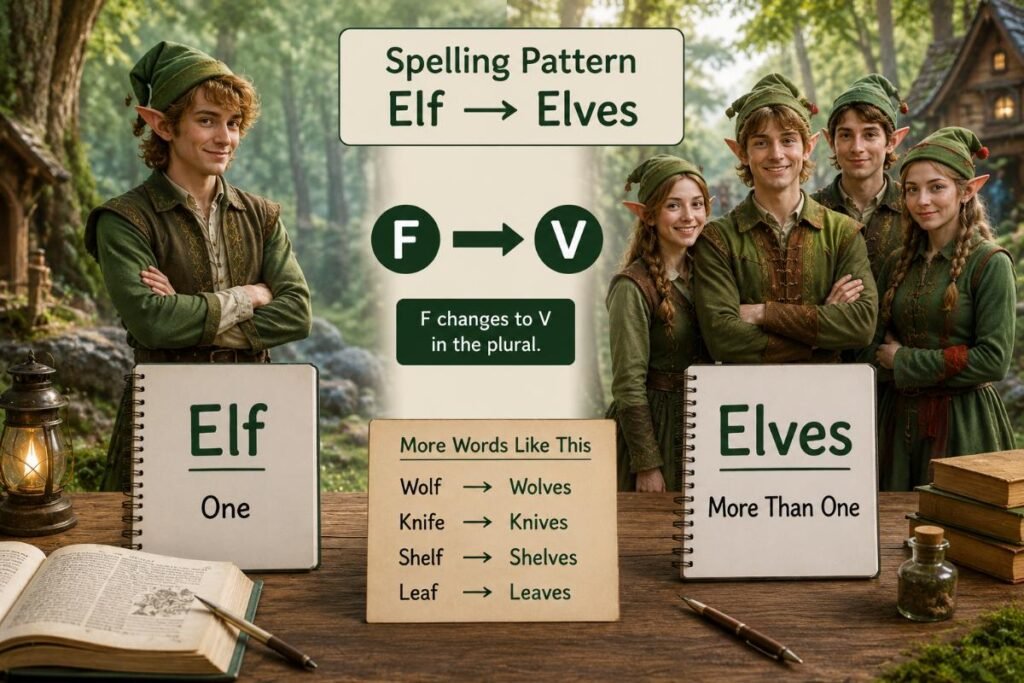
Elf means one.
Elves means more than one.
Compare these sentences.
- An elf lives in the forest.
- Several elves live in the forest.
The first sentence talks about a single creature. The second talks about a group.
You can also see the difference through verbs.
- The elf is hiding behind the tree.
- The elves are hiding behind the tree.
The singular noun takes is, while the plural noun takes are. This is useful when checking your own writing because the verb can help you decide which noun form you need.
Another example makes the pattern clear.
- The elf was carrying a lantern.
- The elves were carrying lanterns.
The spelling changes from elf to elves, and the verb changes to match the plural subject.
This connection between noun and verb is worth remembering. Good grammar isn’t only about spelling one word correctly. The words around it need to agree too.
Common Words That Follow The Same Pattern
The spelling of elves makes more sense when you compare it with other English words that change from f to v in the plural. You have probably used some of these words many times without thinking about the spelling rule.
Consider wolf and wolves. One wolf can be seen in the distance. If there are several of them, you write wolves. The same pattern appears with knife and knives, wife and wives, and life and lives.
Here are some useful examples.
| Singular | Plural | Example |
|---|---|---|
| elf | elves | The elves live in the forest. |
| wolf | wolves | The wolves moved through the valley. |
| knife | knives | The chef cleaned the knives. |
| wife | wives | The two wives arrived together. |
| life | lives | Many lives were saved. |
| half | halves | Cut the apples into halves. |
| loaf | loaves | The bakery sells fresh loaves. |
| shelf | shelves | The books filled the shelves. |
| leaf | leaves | The leaves covered the ground. |
| calf | calves | The calves stayed close to their mothers. |
This pattern is useful because it gives you a memory group. Instead of trying to remember one unusual plural by itself, connect it with words you already know.
If you know that wolf becomes wolves, the spelling of elf becomes easier to remember. Both words change their final f to v and take es.
Not Every F Word Becomes V
There is an important catch. You cannot apply the f to v pattern to every English noun that ends in f.
English has several plural patterns. Some words simply take s.
For example:
- roof → roofs
- belief → beliefs
- chef → chefs
- chief → chiefs
- proof → proofs
- cliff → cliffs
- safe → safes
You would not normally write rooves, believs, or cheves. Those forms are not the standard modern plurals.
This is why it is better to learn the common plural forms instead of trying to create a universal rule. The f to v pattern helps with many words, but it does not cover every noun ending in f.
Why English Has Different Plural Patterns
English has borrowed words from many languages over a very long period. As a result, it contains several older plural patterns that do not always fit one simple rule.
Some words changed their spelling over time because of older pronunciation patterns. Others kept a form that had already become common. Modern speakers usually do not think about this history when they say the words. They simply learn the plural form through reading and conversation.
That is why English learners sometimes find plural spelling frustrating. A general rule can help, but you also need to recognize the exceptions.
For elf, the safest approach is simple. Learn the pair together.
elf → elves
Once that pair becomes familiar, there is no reason to think about the spelling every time you use it.
Why Elves Is Pronounced Differently
The spelling change also affects pronunciation.
The singular word elf ends with an f sound. The plural elves ends with a v sound followed by a z sound.
You can hear the difference clearly when you say the words aloud.
- elf
- elves
The change is small but noticeable. This is another reason the plural spelling is not simply elfs. The spelling reflects a change in the final sound.
The same thing happens in several other word pairs.
- knife → knives
- life → lives
- wife → wives
- wolf → wolves
Knowing the pronunciation can help reinforce the spelling. When you say elves, the v sound can remind you that the written word also uses v.
Is Elfs Ever Used
You may occasionally see elfs in older texts, unusual writing, names, or creative works. That does not make it the standard plural in modern English.
Some writers may intentionally use a nonstandard spelling for a character, fictional language, historical setting, or stylistic reason. A proper name can also preserve an unusual spelling that would not be used in ordinary English.
For normal writing, though, use elves.
If you are writing a school assignment, article, story, email, or social media post and you mean more than one elf, elves is the form you want.
This distinction matters because a word can appear somewhere without being the standard form. Seeing a spelling online does not automatically make it correct. Context, source, and purpose all matter.
Elves In Christmas Writing
The word appears especially often during the holiday season. Christmas stories commonly describe groups of elves who help Santa Claus prepare gifts.
Here are some natural examples.
- Santa’s elves worked late into the night.
- The children left cookies for the elves.
- The elves wrapped hundreds of presents before Christmas Eve.
- Several cheerful elves decorated the workshop.
- The story follows a group of young elves who want to help Santa.
In each sentence, the noun refers to more than one elf, so elves is the correct plural.
You may also see compounds such as Christmas elves, Santa’s elves, and workshop elves. The spelling remains the same in each case.
Elves In Fantasy And Fiction
The word has a much broader use outside Christmas stories. Fantasy writers often create entire societies of elves with their own languages, cultures, kingdoms, and traditions.
You might read sentences such as these.
- The elves defended their kingdom from the invading army.
- A group of elves crossed the mountains before dawn.
- The young elf wanted to become a skilled archer.
- The ancient elves had lived in the forest for hundreds of years.
Notice the switch between singular and plural. One character is an elf. A group is made up of elves.
This distinction remains the same even when the story creates a fictional version of elves. A writer can invent new traits and traditions, but standard English still uses elves as the plural unless the writer intentionally creates a different form.
Common Spelling Mistakes
Knowing the correct form is useful, but it also helps to understand the mistakes people commonly make.
Writing Elfs
The most direct mistake is writing elfs instead of elves.
Incorrect:
- The elfs gathered around the fire.
Correct:
- The elves gathered around the fire.
The mistake happens because adding s is the most common way to form an English plural. Remembering the word pair elf and elves will prevent it.
Adding An Before Elves
Another mistake is using the singular article with the plural noun.
Incorrect:
- An elves appeared near the house.
Correct:
- An elf appeared near the house.
Or:
- Two elves appeared near the house.
The word an belongs with the singular noun elf. Once you have more than one, you need a plural word such as two, several, or many.
Using Elf For A Group
Some sentences use the singular form even when the meaning is plural.
- The elf were hiding in the forest.
Correct:
- The elves were hiding in the forest.
The verb provides a useful clue here. Elf is singular, so it normally takes a singular verb. Elves is plural, so it takes a plural verb.
How To Remember The Correct Spelling
A good memory trick is to connect elf with wolf.
You probably already know this pair.
- wolf → wolves
Now use the same pattern.
- elf → elves
Both words end in f in the singular. Both change that f to v in the plural.
Another useful pair is knife and knives. If you remember that one knife becomes several knives, you can use the same spelling pattern for elf.
You can even make a short mental chain.
- elf → elves
- wolf → wolves
- knife → knives
- shelf → shelves
The more often you see these pairs together, the faster your brain recognizes the correct spelling.
A Simple Test You Can Use
When you are unsure about the plural, put the word into a sentence.
Try this:
- I saw three ___ in the forest.
If you instinctively want to write elfs, stop and compare it with a familiar word.
- I saw three wolves in the forest.
The pattern should now be easier to recall.
You can also say the word aloud. The v sound in elves gives you another clue about the spelling.
This kind of quick check is often more useful than trying to remember a long grammar rule. You only need to remember one familiar word pair.
Singular And Plural Examples
The easiest way to build confidence is to see the forms side by side.
- One elf lives near the river.
- Two elves live near the river.
- An elf entered the workshop.
- Several elves entered the workshop.
- The elf was carrying a bag.
- The elves were carrying bags.
- A young elf helped the traveler.
- Three young elves helped the traveler.
- The story follows one elf.
- The next book follows several elves.
These examples show another useful point. The noun changes, but the rest of the sentence changes too. Singular and plural nouns affect articles, verbs, and sometimes other words around them.
When To Use Elf In A Sentence
Use elf when you mean one.
You can usually place a or an before it depending on the sentence.
- I saw an elf near the tree.
- A friendly elf helped the child.
- The elf carried a small lantern.
The word can also appear after numbers or descriptions that refer to one creature.
- one elf
- a young elf
- the old elf
- that elf
- this elf
All of these refer to a single creature.
When To Use Elves In A Sentence
Use elves when you mean two or more.
You can place numbers or quantity words before it.
- two elves
- three elves
- several elves
- many elves
- a group of elves
- the elves
- those elves
For example, you might write, Several elves gathered outside the castle. You could also write, The elves returned home before sunset.
The word does not need an extra ending after elves. You do not write elveses or elves’s simply because you are talking about a group.
Related Words That Can Cause Confusion
The spelling question becomes easier when you compare elves with other unusual plural forms. English has many nouns that change internally instead of simply adding s.
For example, man becomes men, woman becomes women, child becomes children, and person often becomes people. These forms have to be learned because you cannot always predict them from the singular word.
The same idea applies to elf. You do not need to create the plural yourself. Learn the two forms as a pair.
Elf means one. Elves means more than one.
That simple connection is enough for most writing situations.
Elf And Fairy
People sometimes use elf and fairy as if they mean exactly the same thing. In modern fantasy, the creatures can overlap, but the words have different histories and traditions.
The plural of fairy is fairies. The plural of elf is elves.
For example:
- The fairy flew over the garden.
- The fairies flew over the garden.
- The elf entered the forest.
- The elves entered the forest.
Knowing related words can help you avoid transferring the wrong plural pattern from one noun to another.
Elf And Dwarf
Fantasy stories often mention elves and dwarves together. These two words also have unusual plural forms.
- one elf → several elves
- one dwarf → several dwarves
Both are commonly used in fantasy writing, and both show how English can change a word rather than simply adding s.
You may sometimes see dwarfs as well, especially in certain contexts. That does not change the standard plural of elf. For ordinary modern English, the plural remains elves.
Why Spell Check May Not Always Be Enough
Modern spelling tools are useful, but they should not replace your own understanding of a word. Most spell checkers will flag elfs in standard English, but unusual names and creative writing can sometimes make automated tools less reliable.
Imagine a fantasy author creates a fictional group called the Elfs as part of a special invented language. A spell checker may not understand the author’s intention.
That is why context matters. For ordinary English, use elves. If you encounter elfs in a book, game, website, or fictional setting, check how the writer is using the term before assuming it is a standard plural.
For everyday writing, though, there is no need to overthink it.
How Editors Handle The Word
An editor checking a normal English text would generally change elfs to elves when the writer means more than one elf. The standard plural is clear, familiar, and widely accepted.
This matters in published writing because spelling mistakes can distract readers. A reader may understand the meaning but still pause when seeing elfs. That small interruption can make the writing feel less polished.
The same principle applies to other common irregular plurals. Editors expect forms such as wolves, knives, leaves, and children because these are established parts of standard English.
Correct spelling is not just about passing a grammar test. It helps readers move through your writing without unnecessary distractions.

Examples Of Incorrect And Correct Usage
Seeing the mistake next to the correction can make the pattern stick.
Incorrect:
- The elfs lived beyond the mountain.
Correct:
- The elves lived beyond the mountain.
Incorrect:
- We saw four elfs near the old castle.
Correct:
- We saw four elves near the old castle.
Incorrect:
- An elves helped the children.
Correct:
- An elf helped the children.
Incorrect:
- The elf were preparing gifts.
Correct:
- The elves were preparing gifts.
Incorrect:
- Several elf worked in the workshop.
Correct:
- Several elves worked in the workshop.
The key is not to memorize every sentence. Focus on the form that keeps appearing in the correct examples.
Elf is singular.
Elves is plural.
Once those two forms are fixed in your memory, most of these errors disappear.
A Quick Grammar Check
If you want to check your sentence quickly, ask one question.
How many elves am I talking about?
If the answer is one, use elf.
If the answer is two or more, use elves.
For example, An elf is sitting beside the fireplace describes one creature. Three elves are sitting beside the fireplace describes more than one.
Then check the verb. Singular elf usually pairs with a singular verb. Plural elves usually pairs with a plural verb.
- The elf is ready.
- The elves are ready.
This two step check catches most errors in seconds.
Why Learning Plural Pairs Helps
Memorizing isolated spelling rules can be tiring. Learning word pairs is much easier.
Instead of trying to remember a rule about every noun ending in f, keep a few common pairs in your vocabulary.
- elf → elves
- wolf → wolves
- knife → knives
- leaf → leaves
- shelf → shelves
- half → halves
When you see one of these words in a sentence, the plural may come to you automatically.
Reading helps too. Every time you see elves in a book or article, your brain gets another example of the correct form. Over time, the spelling becomes familiar enough that you no longer have to think about it.
That is how many spelling patterns become natural. You see them, use them, and eventually recognize them without effort.
FAQs
Is elfs or elves correct?
The standard plural form is elves. Elfs is not the normal plural spelling in modern standard English.
Why does elf change to elves?
The word follows a plural pattern found in several English nouns. The final f changes to v, and the plural ending becomes es. Similar examples include wolf and wolves and knife and knives.
Is elfs ever correct?
You may see elfs in unusual contexts, such as a fictional language, a proper name, or a creative work that intentionally uses a nonstandard form. For normal modern English, use elves.
What is the plural of elf?
The plural of elf is elves. For example, you can write, The elves returned to the forest.
Is elves singular or plural?
Elves is plural. The singular form is elf. You use elf for one creature and elves for two or more.
What is the difference between elf and elves?
Elf refers to one creature. Elves refers to more than one. For example, an elf describes one, while three elves describes a group.
Why do some words ending in f change to ves?
Some English nouns have older plural patterns that change the final f sound and spelling. This happens with words such as knife, wolf, life, and shelf. It does not happen with every noun ending in f, so individual plural forms still need to be learned.
How can I remember the spelling elves?
Connect elf with another familiar pair such as wolf and wolves. Both words change f to v when they become plural. Remembering elf → elves as one word pair is usually enough.
Final Thoughts
If you came here wondering elfs or elves, the answer is elves. Use elf when you mean one creature and elves when you mean two or more. That rule works for ordinary English writing across school assignments, stories, articles, emails, and everyday communication.
The spelling can seem unusual because English often forms plurals by adding s. However, elf belongs to a group of nouns with a different plural pattern. The change from f to v also appears in familiar words such as wolf and wolves, knife and knives, and shelf and shelves.
You do not need to memorize a complicated history lesson to spell the word correctly. Keep the pair together in your mind: elf and elves. If you are talking about one, use the first form. If you are talking about a group, use the second.
The next time you write about a fantasy kingdom, a Christmas workshop, or a magical forest, you can use the word with confidence. Elf means one. Elves means more than one. That is the spelling rule worth remembering.