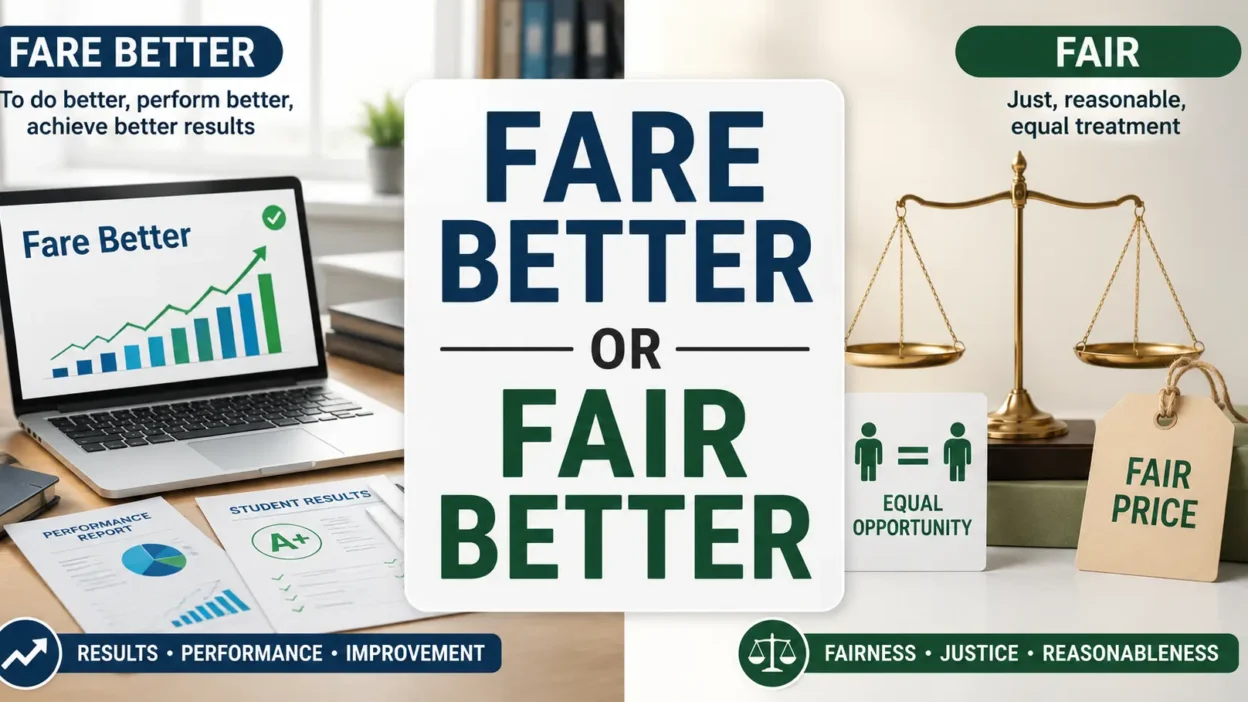
You may have seen fare better or fair better and wondered which spelling is correct. The answer is fare better. Here fare means to do or perform in a particular way. The phrase fair better is usually a spelling mistake when the intended meaning is to perform better or have a better result.
The confusion comes from the fact that fair and fare sound exactly the same in many English accents. They are homophones, which means they have the same pronunciation but different meanings and spellings. Since both are real English words, it can be easy to choose the wrong one when you’re writing.
The phrase fare better usually describes an improvement in someone’s results, experience, health, performance, or situation. You might say that one treatment fares better than another, that a student fares better with extra practice, or that a business fares better during a certain season.
This guide explains the difference in simple terms. You’ll learn what fare better means, why fair better is usually incorrect, how to use the phrase in natural sentences, and how to remember the correct spelling without having to look it up every time.
Quick Definition
Fare better means to do better, perform better, or have a better result in a particular situation. The word fare is correct because it can describe how someone or something performs or gets along.
Fair has a different meaning. It can describe something reasonable, just, acceptable, or light in color. It does not normally mean to perform or do well.
Direct Answer
The correct phrase is fare better when you mean to perform better or have a better outcome. Fair better is normally incorrect in this context because fair does not have the required meaning.
Comparison Table
| Word Or Phrase | Meaning | Example Sentence | When To Use It |
|---|---|---|---|
| Fare better | To do better or have a better result | Some students fare better when they study in the morning. | Use it when talking about performance, results, or how someone or something handles a situation. |
| Fair | Reasonable, just, acceptable, or light in color | The teacher gave everyone a fair chance. | Use it when describing fairness, equal treatment, or certain physical qualities. |
| Fair better | Not the standard phrase for better performance | Fair better is incorrect when you mean perform better. | Avoid it when talking about results or performance. |
Why Fare Better Is The Correct Phrase
The key to this spelling is the meaning of fare. As a verb, fare means to get along or perform in a particular way. It often appears when we talk about someone’s results or experience in a specific situation.
For example, consider this sentence:
- New employees often fare better when they receive clear instructions.
Here, fare better means that the employees perform better or have a better experience when they receive clear instructions. The word has nothing to do with fairness.
You can use the same structure in many situations.
- Children may fare better with a regular bedtime.
- Small businesses often fare better when they know their customers well.
- Some plants fare better in bright sunlight.
- The team fared better after changing its strategy.
In each sentence, fare describes how well someone or something does.
The phrase can also appear with comparisons. If one person performs better than another, you can say that person fares better in a certain situation.
For example:
- Maria fares better in quiet classrooms than in noisy ones.
This means Maria performs better or works more effectively in quiet classrooms.
The word fare can also describe a difficult situation. You might ask how someone fared after an accident, an exam, an interview, or a major change. In that use, the question is basically asking how things went.
For example:
- How did you fare on your final exam?
A natural answer might be:
- I fared better than I expected.
The same idea explains the spelling in fare better.
What Fare Means As A Verb
Many people know fare only because they have seen the phrase fare better. The verb has a useful meaning that is easy to understand once you connect it with results.
To fare means to get along or do in a particular way. It often tells us about the outcome of an experience.
Consider these examples:
- How did you fare at the interview?
- The patient fared well after the procedure.
- The company fared poorly during the first year.
- Our team fared better in the second half.
- The new plan fared worse than expected.
Notice how naturally the word works with words such as well, poorly, better, and worse. These words describe the result or performance of the person or thing being discussed.
That pattern is one of the easiest ways to recognize fare.
If you can replace the phrase with do, perform, or get along, fare is probably the word you need.
For example:
- The new system fared better.
You can understand this as:
- The new system did better.
Or:
- The new system performed better.
The meaning stays almost the same, although fare can sound slightly more polished or formal than simply saying do.
What Fair Means
The word fair is also common, but it belongs to a completely different group of meanings.
The most familiar meaning of fair relates to justice and equal treatment. If something is fair, people receive reasonable treatment and the rules apply equally.
For example:
- The judge made a fair decision.
- Everyone deserves a fair chance.
- That does not seem fair.
- We need a fair way to divide the money.
In these sentences, fair means reasonable or just.
The word has several other meanings too. Fair can describe something that is acceptable or good enough.
- The weather was fair.
- She gave a fair answer.
- The movie received fair reviews.
It can also describe a light color.
- He has fair hair.
- She has fair skin.
There is another use that you may know from expressions such as county fair or book fair. In that sense, a fair is an event where people gather for entertainment, trade, displays, or sales.
None of these meanings connects fair with the idea of performing better.
That is why fair better does not work when you want to say that someone or something achieved a better result.
Why The Two Words Are Easy To Mix Up
The main reason for the spelling mistake is pronunciation. Fair and fare sound the same in standard American English. If you hear someone say the phrase, you cannot tell which spelling they mean from the sound alone.
That problem disappears when you understand the meaning.
Think about this sentence:
- The new students fare better with smaller classes.
If you hear it aloud, you might imagine fair better. But once you understand the sentence, the correct spelling becomes clear. The students are performing better in smaller classes, so the verb fare is required.
This is a common problem with homophones. Other examples include there, their, and they’re, or to, too, and two. Sound alone cannot tell you which spelling to choose. You have to look at the role and meaning of the word in the sentence.
The same principle applies here.
When the idea is performance, think fare.
When the idea is justice or equal treatment, think fair.
That small distinction can save you from a surprisingly common spelling error.
How To Use Fare Better In A Sentence
The phrase fare better works best when you compare one result with another. It tells the reader that someone or something performs more successfully under one condition than another.
For example:
- I fare better when I work in the morning.
This means the speaker works more effectively in the morning than at another time.
You can also compare two groups.
- Students who review their notes regularly tend to fare better on exams.
The sentence says those students generally achieve better results.
The phrase can describe physical conditions too.
- Some flowers fare better in partial shade.
Here, fare better means the flowers grow or remain healthier under those conditions.
You can use it with people, animals, businesses, teams, products, plans, systems, and many other subjects.
Fare Better With People
When talking about people, fare better often describes how they perform or cope in a certain environment.
- New workers may fare better with clear goals.
- Some children fare better in smaller classes.
- I think you’ll fare better if you ask for help.
- She fares better when she has time to prepare.
These sentences all describe improved results or performance.
Fare Better With Things
The subject does not have to be a person. We can also use the phrase for objects, plans, products, and systems.
- This laptop fares better with light tasks.
- The older model fares better in cold weather.
- The second plan may fare better with investors.
- The new software fares better on faster computers.
In each case, the phrase tells us how well something performs under certain conditions.
Fare Better In A Comparison
The phrase often appears when two situations are being compared.
- The team fares better at home than on the road.
- Some people fare better in the morning than at night.
- This method fares better than the old one.
- The company fared better last year than it did the year before.
The comparison does not always need to appear in the same sentence. Sometimes the context makes it clear.
For example:
- We changed the training plan, and the players fared better.
The reader understands that the players performed better after the change.
Fare Better In Different Verb Tenses
The verb fare changes like other regular verbs. Knowing its common forms can help you use the phrase naturally.
In the present tense, use fare with plural subjects and fares with singular subjects.
- I fare better with a written schedule.
- They fare better under pressure.
- She fares better with clear instructions.
- The business fares better during the summer.
In the past tense, use fared.
- We fared better than expected.
- She fared better after changing her study habits.
- The team fared better in the second game.
- The company fared poorly during its first year.
The future form uses will fare.
- I think you’ll fare better next time.
- The new design will fare better with younger customers.
- They will probably fare better with more practice.
These forms all keep the same basic meaning. The spelling changes because the verb changes tense, not because the meaning changes.
Fare Better Compared With Do Better
One useful way to understand fare better is to compare it with the much more common phrase do better.
In many sentences, the two expressions have nearly the same meaning.
- You may fare better with a different approach.
- You may do better with a different approach.
Both sentences tell the reader that the new approach may produce a better result.
The difference is mostly about tone and style. Do better is simple and very common in everyday speech. Fare better is also natural, but it often appears in more careful writing or when discussing results, conditions, or comparisons.
For example, a friend might say:
- You’ll probably do better if you practice more.
A teacher or writer might say:
- Students often fare better when they practice consistently.
Neither sentence is wrong. The second simply has a slightly more formal tone.
This is useful to remember because fare may seem unusual when you first encounter it. You can mentally replace it with do and check the meaning. If do better makes sense, fare better may be the correct phrase.
A Simple Test For The Correct Spelling
When you’re unsure about fare better, ask yourself one question.
Are you talking about how well someone or something performs?
If the answer is yes, use fare.
- Employees fare better with flexible schedules.
The employees are performing or functioning better, so fare is correct.
Now consider this sentence:
- The manager treated everyone fairly.
Here, the idea is equal and reasonable treatment. That requires fairly, which comes from fair.
This quick meaning test is more reliable than trying to remember how the phrase sounds. Since fair and fare are homophones, pronunciation will not help you. Meaning will.
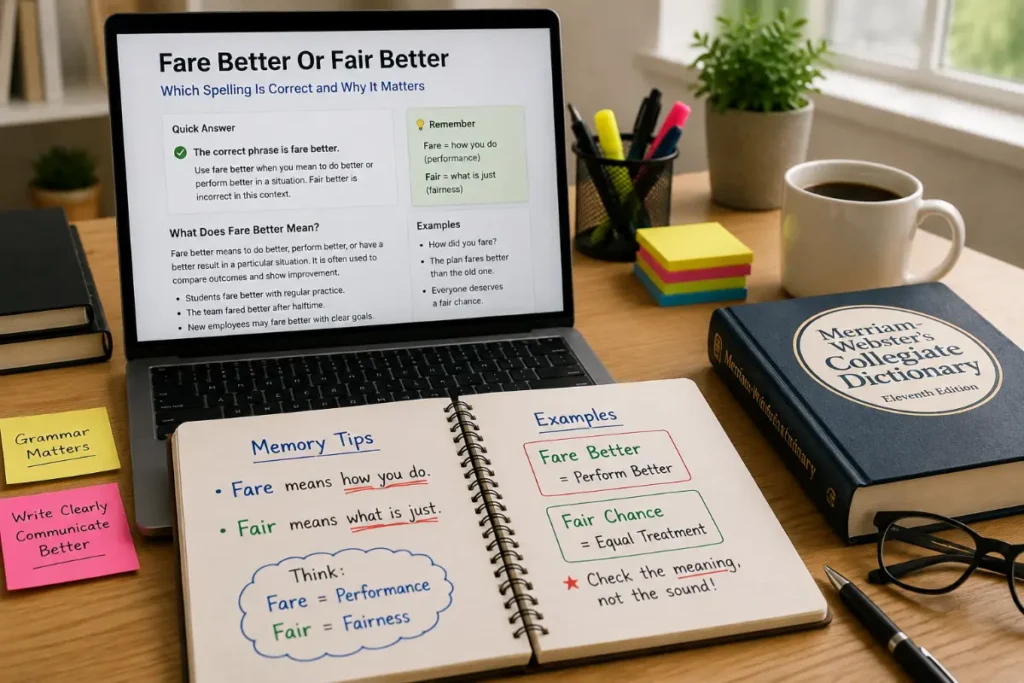
The easiest memory line is this:
Fare is about how you do. Fair is about what is just.
Keep that distinction in mind and this spelling question becomes much easier.

Common Situations That Use Fare Better
Once you know that fare describes performance or results, the phrase becomes much easier to spot. It can appear in many kinds of writing because people often need to explain how a person, plan, product, or group performs under certain conditions.
The phrase is especially common when two situations are being compared. You might discuss how students perform with different study methods, how a company performs during a difficult period, or how a product works in a certain environment. In each case, fare connects the subject with its result.
At Work
Work is one of the most common settings for this expression. Managers, writers, and employees often use it when discussing performance, working conditions, or business results.
Consider these examples.
- New employees may fare better when they receive regular feedback.
- Some workers fare better with flexible hours.
- The company fared better after it reduced unnecessary costs.
- Smaller teams often fare better when they have clear goals.
The phrase doesn’t always mean that something is successful. It simply describes the result compared with another situation.
For example, a business might fare better after changing its prices, even if it still faces serious problems. The phrase only tells us that the new situation produced a better result than the old one.
In School And Education
Teachers and students can also use this expression when talking about grades, learning methods, or classroom conditions.
- Students often fare better when they review material regularly.
- Some children fare better in smaller classes.
- I tend to fare better on tests when I get enough sleep.
- She fared better in math after getting extra practice.
These examples show why fare works so well. The subject is doing something or experiencing something, and the sentence describes the result.
You could replace the phrase with do better in each example.
- Students often do better when they review material regularly.
- Some children do better in smaller classes.
The meaning remains clear. Fare better simply gives the sentence a slightly more formal or polished tone.
In Health And Recovery
You may also see the verb in discussions about health and recovery. In this context, it describes how a person responds to treatment, an illness, an injury, or a change in routine.
For example:
- Patients often fare better when treatment begins early.
- Some people fare better with a slower recovery plan.
- He fared better than expected after the accident.
- She is faring better now that she has more time to rest.
This usage can be useful because fare does not automatically promise a good outcome. It simply reports how things are going.
Compare these sentences.
- He fared well after the surgery.
- He fared poorly after the surgery.
- He fared better than expected.
- He fared worse than expected.
The verb works with both positive and negative results.
In Sports
Sports writing uses fare often because sports naturally involve comparisons and results.
You might read a sentence such as:
- The team fared better after halftime.
That tells us the team performed better in the second half than it did before halftime.
Other examples include:
- The players fared better on their home field.
- The rookie fared better than expected in his first season.
- The team fared poorly against stronger opponents.
- The defense fared better after the coach changed the lineup.
Notice that fare works with different adverbs and comparisons. It can describe success, failure, improvement, or decline.
Fare Better And Fared Better
A common point of confusion is the difference between fare better and fared better. Both are correct. The choice depends on the time of the action.
Use fare better for the present or for general situations.
- People fare better when they have enough time to prepare.
- I usually fare better when I plan ahead.
- Small businesses often fare better with loyal customers.
Use fared better for the past.
- The team fared better in the second game.
- We fared better than expected last year.
- She fared better after changing her study routine.
You can also use faring better when the improvement is happening now.
- The patient is faring better today.
- The business is faring better than it was last month.
- The plants are faring better after we moved them indoors.
The basic meaning stays the same. Only the verb form changes to show time.
Fare Better And Fare Well
These expressions are related, but they don’t mean exactly the same thing.
Fare well means to do well or have a good outcome.
- I hope you fare well in your new position.
- The company fared well during the busy season.
- She fared well on the exam.
Fare better means to do better compared with another result or situation.
- She fared better on the second exam.
- The company fared better after changing its strategy.
- I fare better when I study in the morning.
The word better creates a comparison. Something is doing better than it did before or better than something else.
This distinction can help you understand why the phrase appears so often in comparisons. The writer isn’t simply saying that someone did well. The writer is saying that the outcome improved.
Fare Better And Fare Worse
The word better is not required after fare. You can use several words to describe the result.
- The team fared well.
- The team fared poorly.
- The team fared better.
- The team fared worse.
- The team fared badly.
Each sentence gives a different picture of the result.
This also explains why fare is useful in careful writing. It lets you describe an outcome without repeating words such as perform, succeed, or do.
For example, instead of writing:
- The company performed better after the change.
You could write:
- The company fared better after the change.
Both sentences are clear. The second has a slightly different rhythm and can fit naturally into formal or analytical writing.
Why Fair Does Not Work Here
The problem with fair better becomes clearer when you look at what fair actually does in a sentence.
Fair can be an adjective.
- That is a fair price.
- The teacher gave us a fair chance.
- The rules seem fair.
It can also describe color.
- She has fair hair.
- The child has fair skin.
It can refer to an event.
- We went to the county fair.
- The school held a science fair.
None of these meanings expresses the idea of performance. That is why the phrase does not work when you want to say that someone or something did better.
Consider this sentence:
- The new system fair better under pressure.
It may sound right when you hear it because fair and fare sound alike. But the meaning requires a verb that means perform or do. Fare is that verb.
The corrected version is:
- The new system fares better under pressure.
That one letter changes the word from an adjective or noun into the verb the sentence needs.
Common Mistakes With Fair And Fare
Homophones create spelling mistakes because sound can hide the difference between two words. The best way to avoid these errors is to learn the meaning of each word rather than trying to memorize the sound.
Mistake With Performance
Incorrect:
- Some students fair better with visual lessons.
Correct:
- Some students fare better with visual lessons.
The students are performing better under a certain learning method. That requires fare.
Mistake With Fair Treatment
Incorrect:
- The manager gave everyone a fare chance.
Correct:
- The manager gave everyone a fair chance.
Here the meaning is reasonable or equal treatment. That requires fair.
Mistake With A Fair Price
Incorrect:
- We found a fare price for the car.
Correct:
- We found a fair price for the car.
The price is reasonable. It has nothing to do with performance.
Mistake In A Question
Incorrect:
- How did the team fair?
Correct:
- How did the team fare?
This is an especially common mistake because the two words sound identical.
The question How did the team fare? means How did the team do? Once you make that connection, the spelling is easier to remember.

How To Remember Fare
A good memory trick can make this distinction almost automatic.
Think of fare as the word connected to how things go.
You might ask:
- How did she fare?
- How did the business fare?
- How did the team fare?
- How did the students fare?
In each question, you’re asking about performance or results.
Now connect fair with fairness.
- A fair decision.
- A fair price.
- A fair chance.
- Fair treatment.
The words fair and fairness are closely connected in meaning. That gives you a simple mental shortcut.
You can remember it this way:
Fare means how you do. Fair means how you are treated.
The trick isn’t perfect for every use of the words, but it works very well for this spelling problem.
Related Homophones To Watch
The confusion between fair and fare belongs to a larger group of English spelling problems. Homophones can be especially tricky because the spoken form gives you no clue about the spelling.
Here are a few common pairs.
There Their And They’re
- There refers to a place.
- Their shows possession.
- They’re means they are.
For example:
- The books are over there.
- Their books are on the desk.
- They’re reading now.
The words sound alike in many accents, but their meanings are different.
To Too And Two
- To often shows direction or connects a verb.
- Too means also or excessively.
- Two refers to the number 2.
For example:
- I want to go to the store.
- I want one too.
- I bought two apples.
Your And You’re
- Your shows possession.
- You’re means you are.
For example:
- Your phone is ringing.
- You’re going to miss the bus.
These examples show why context matters. When two words sound the same, the meaning of the sentence tells you which spelling you need.
When Fare Is Used Without Better
You don’t always need the word better after fare. The verb can stand alone or work with other words that describe results.
For example:
- How did you fare?
- She fared well.
- The company fared poorly.
- We fared worse than expected.
- The team fared surprisingly well.
The question How did you fare? is especially useful. It means How did you do? or How did things go for you?
You might ask someone this after an exam.
- How did you fare on the test?
You could also ask it after an interview.
- How did you fare in the interview?
Or after a competition.
- How did your team fare in the tournament?
This broader use helps show that fare is a real verb with a useful meaning. It isn’t simply a word that appears in one fixed expression.
When Fair Is The Right Word
It is just as important to know when fair is correct. You don’t want to replace every use of fair with fare.
Use fair when you mean reasonable or just.
- That seems fair.
- Everyone deserves a fair chance.
- The judge made a fair decision.
Use fair when talking about a reasonable price.
- The seller offered us a fair price.
Use fair when describing light coloring.
- He has fair hair.
Use fair for an event.
- We visited the state fair.
These meanings have nothing to do with performance. Keeping them separate from the verb fare will help prevent spelling mistakes.
A Quick Editing Test
If you’re proofreading your own writing and see fair better, don’t immediately change it. First, check what the sentence means.
Ask yourself if the sentence is talking about performance or results.
If it is, replace fair with fare.
For example:
- Older workers may fair better with flexible schedules.
Ask what the sentence means. It says that older workers may do better with flexible schedules.
The corrected sentence is:
- Older workers may fare better with flexible schedules.
If the sentence is about fairness, keep fair.
- Employees deserve a fair chance to apply.
Here, fair means equal and reasonable. Changing it to fare would make the sentence incorrect.
This meaning based test is faster and more reliable than relying on pronunciation.
A Note About Fare As A Noun
There is another meaning of fare that can cause confusion. As a noun, fare can mean the price you pay for transportation.
For example:
- The bus fare is five dollars.
- Train fares have increased.
- I paid the taxi fare with a card.
This meaning has no connection to the verb in fare better.
The two uses happen to share the same spelling. Context tells you which meaning is intended.
There is also fare in the phrase bus fare, while fair appears in phrases such as fair price and fair treatment. Seeing these examples side by side can make the distinction easier to remember.
Fare can mean a transportation price as a noun or how someone or something performs as a verb.
Fair usually relates to justice, reasonableness, appearance, or an event.
The spelling stays the same within each word, but the meanings change based on context.
Practical Examples To Study
The best way to make the difference stick is to see the words used naturally.
- Students fare better when they have enough time to study.
- The new product fared better than the older version.
- Some patients fare better with early treatment.
- The team fared better after making a few changes.
- I usually fare better when I prepare the night before.
- The company is faring better this year.
- How did you fare in the interview?
- We fared worse than expected during the first round.
Now compare them with examples using fair.
- Everyone deserves a fair chance.
- The judge made a fair decision.
- We paid a fair price.
- The teacher treated the students fairly.
- She has fair hair.
- We went to the county fair last weekend.
The difference becomes much easier to see when the words appear in real sentences. Fare connects to performance and outcomes, while fair connects to ideas such as justice, reasonableness, appearance, and events.
Fare Better Or Fair Better In Everyday English
The difference between fare and fair becomes much easier once you stop listening to the sound and start looking at the meaning. Since the two words sound alike, your ears can’t tell you which spelling belongs in a sentence. Your understanding of the sentence has to do that job.
When you mean that someone or something performs well or gets a better result, use fare. You can think of it as a more formal way of saying do or perform.
For example:
- New employees may fare better with more training.
- The team fared better after the break.
- Some people fare better when they have a clear routine.
In each sentence, the subject is doing or experiencing something. The phrase describes the result.
Now compare those examples with sentences using fair.
- Everyone should get a fair chance.
- The store offered a fair price.
- The teacher made a fair decision.
Here, fair describes something reasonable or just. The meaning has nothing to do with performance.
This simple distinction works in most cases. If you can replace the word with do or perform, choose fare. If you can replace it with reasonable, just, or equal, choose fair.
More Examples With Fare Better
Real examples are often easier to remember than rules. The following sentences show how the phrase works in different situations.
In Daily Conversation
You don’t need formal language to use fare better. It can fit naturally into an everyday conversation.
Imagine a friend is deciding when to exercise.
- I usually fare better when I work out in the morning.
The speaker means that morning workouts produce better results.
Someone discussing a new job might say:
- I think I’ll fare better with a smaller team.
The person expects to perform or work more effectively in that setting.
A student could say:
- I fare better when I study somewhere quiet.
Again, the meaning is simple. The student does better in a quiet place.
In Professional Writing
The phrase is also useful in reports and other forms of professional writing.
- Smaller companies may fare better by focusing on a specific group of customers.
- Businesses that plan ahead often fare better during slow periods.
- The new process fared better than the old system during testing.
These sentences sound natural because fare clearly refers to results or performance.
You could use do better instead, but fare better can make the sentence sound more precise without becoming difficult to understand.
In Advice
The expression often appears when someone is giving advice.
- You may fare better if you arrive early.
- You’ll probably fare better with a simpler plan.
- She might fare better if she gets more practice.
The phrase doesn’t guarantee success. It only suggests that one choice or condition may produce a better result.
That distinction matters.
If you say:
- You’ll fare better with more practice.
You aren’t promising that the person will succeed. You’re saying that more practice is likely to improve the result.
What Does It Mean To Fare Well
The verb fare is not limited to the word better. You can use it with several words that describe an outcome.
Fare well means to do well.
- She fared well in the competition.
- The business fared well during its first year.
- He fared well on the exam.
Fare poorly means to do poorly.
- The company fared poorly after the change.
- The team fared poorly in the second half.
Fare worse means to have a worse result.
- The second plan fared worse than the first.
- Some students fare worse when they study late at night.
This range of uses shows why fare is a useful verb. It gives you a simple way to talk about outcomes without repeating the phrase do well.
How To Answer The Question How Did You Fare
You may come across the question How did you fare? in books, articles, interviews, or conversations.
It simply means:
How did you do?
Someone might ask:
- How did you fare on your test?
You could answer:
- I did pretty well.
- I fared better than I expected.
- I didn’t fare very well.
The same question works for many situations.
- How did you fare at the interview?
- How did your team fare?
- How did the new product fare?
- How did the plan fare?
This is one of the best examples to remember because it clearly shows the verb meaning of fare.
If you know that How did you fare? means How did you do?, you’ll have an easier time remembering the spelling of fare better.
Why Spell Check Can Miss This Error
A spelling checker may not always catch this mistake. That’s because fair is a correctly spelled English word.
If you write:
- The students fair better with practice.
The spelling checker may see fair as a valid word. It cannot always understand that the sentence needs the verb fare.
This is an important lesson about proofreading. A word can be spelled correctly and still be the wrong word.
The same thing happens with other homophones.
For example:
- Their going to the store.
The word their is spelled correctly, but the sentence needs they’re.
Likewise:
- The students fair better with practice.
The word fair is spelled correctly, but the sentence needs fare.
Good proofreading checks meaning as well as spelling. Reading a sentence slowly and asking what each word means can catch errors that automated tools miss.
How To Proofread Fare And Fair
If you’re editing an article, essay, email, or report, use a simple three step check.
First, find the word fair or fare.
Next, ask what the sentence is saying.
Finally, choose the word that matches the meaning.
Suppose you write:
- The players fair better when they train together.
Ask yourself what the players are doing. They are performing better under a certain condition.
The correct sentence is:
- The players fare better when they train together.
Now look at this sentence:
- The players deserve a fair chance.
The meaning is different. The sentence is about equal treatment.
So fair is correct.
This approach is better than trying to memorize every possible sentence. Once you understand the meanings, you can make the right choice in new situations too.
A Simple Memory Trick
If you often forget this spelling, use this short reminder.
Fare is about performance. Fair is about fairness.
You can make the connection even stronger by remembering two questions.
How did they fare?
Means:
How did they do?
Was that fair?
Means:
Was that reasonable or just?
Those two questions separate the words clearly.
Another useful connection is fairness. The word fair and the word fairness belong to the same meaning group. If you’re talking about justice, equal treatment, or something reasonable, think fair.
When you’re talking about results, think fare.
Common Search Questions
Is fare better the correct spelling?
Yes. Fare better is the correct phrase when you mean to do better, perform better, or have a better result. The word fare works as a verb in this expression.
Is fair better ever correct?
In standard English, fair better is not the normal phrase when you mean perform better. Use fare better for that meaning. Fair has different meanings related to justice, reasonableness, appearance, and events.
How do you remember fare and fair?
Connect fare with performance and fair with fairness. If you can replace the word with do, fare is probably correct. If you can replace it with reasonable or just, use fair.
What does fare better mean?
It means to do better or achieve a better result in a particular situation. For example, Some students fare better when they study in the morning means those students get better results when they study at that time.
What does fare mean in English?
As a verb, fare means to get along or perform in a particular way. It can also be a noun meaning the price paid for transportation, as in bus fare or train fare.
What does fair mean?
Fair has several meanings. It can mean reasonable or just, as in a fair decision. It can also describe light coloring or refer to an event such as a county fair.
Is fare better formal English?
Yes. Fare better is standard English and works well in both formal and everyday writing. It can sound slightly more polished than do better, but it remains easy for most readers to understand.
Is how did you fare correct?
Yes. How did you fare? is a correct English question. It means How did you do? or How did things go?
Final Takeaway
The spelling question fare better or fair better has a clear answer when the meaning is to perform better. Use fare better because fare is the verb that means to do or perform in a particular way. Fair doesn’t carry that meaning.
The easiest way to remember the difference is to connect each word with its main idea. Fare relates to performance and results. Fair relates to justice, reasonableness, equal treatment, light coloring, or an event.
When you’re proofreading, don’t rely on pronunciation. The two words sound alike, so your ears won’t help. Instead, ask yourself what the sentence means. If you could replace the word with do, perform, or get along, fare is the right choice.
Keep one sentence in mind: If you’re talking about how well something does, use fare. If you’re talking about what is fair, use fair. That simple rule will help you choose the correct spelling the next time you write the phrase.