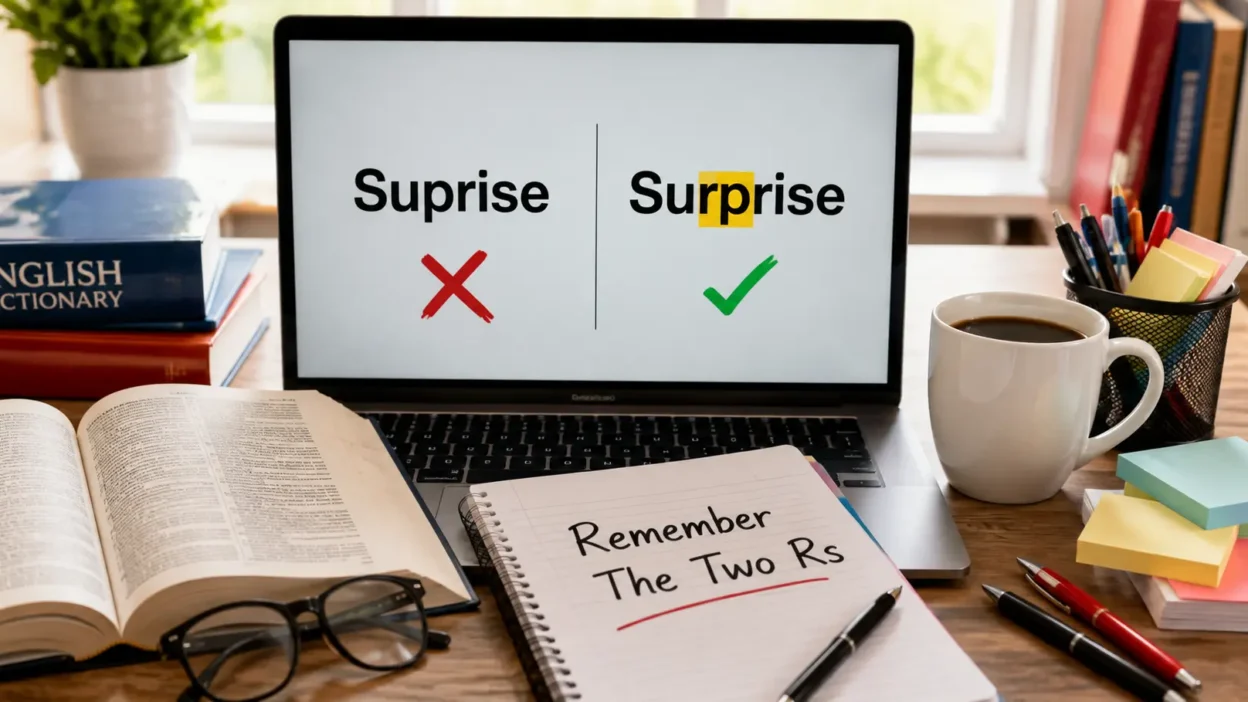
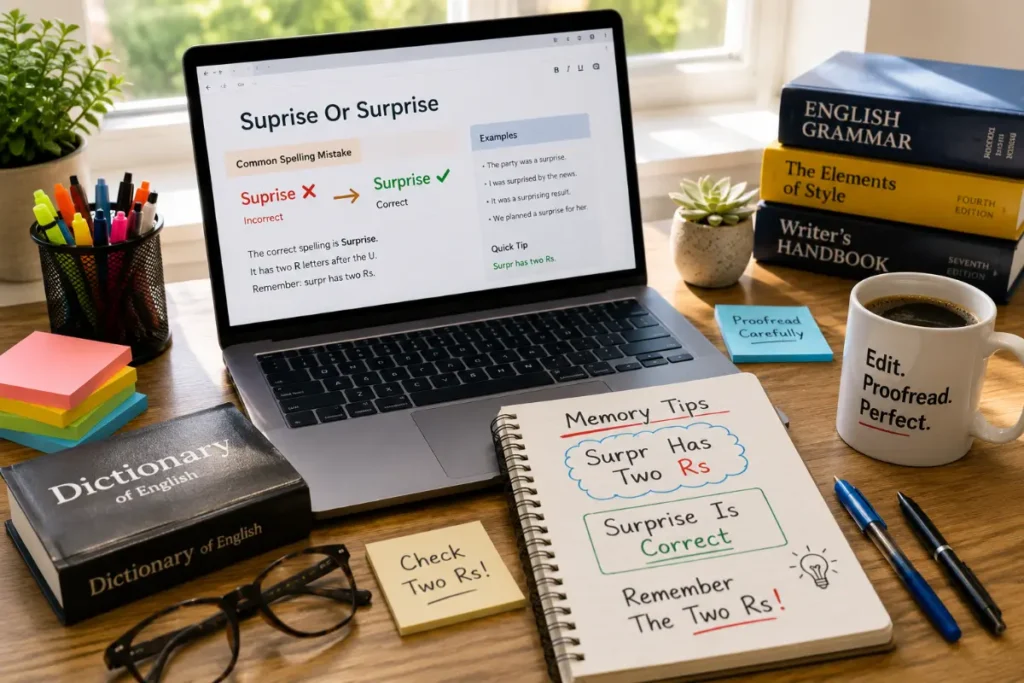
If you’re searching suprise or surprise you’re probably wondering which spelling is correct. The correct spelling is surprise. The word has an extra r after the u, so suprise is a spelling mistake.
This is an easy error to make because the word doesn’t sound like every letter looks. When you say surprise quickly, the second r can be easy to miss. That’s why people often type suprise when they mean the correct word.
The good news is that there’s a simple way to remember it. Once you know where the letters go, you’ll be much less likely to leave out that important r. This guide explains the correct spelling, the meaning of the word, common mistakes, pronunciation, related words, and simple memory tricks you can use right away.
Quick Definition
Surprise is the correct spelling. It can be a noun, verb, or adjective depending on how it appears in a sentence. The word describes something unexpected or the feeling caused by something unexpected.
Suprise is an incorrect spelling of the same word. It’s a common typo, but it shouldn’t be used in formal or polished writing.
Direct Answer
The correct spelling is surprise. The spelling suprise is incorrect because it leaves out the second r.
Comparison Table
| Spelling | Meaning | Example Sentence | When To Use It |
|---|---|---|---|
| Surprise | Something unexpected or an unexpected feeling | The party was a complete surprise. | Use this spelling in all types of writing. |
| Suprise | Incorrect spelling of surprise | I was suprised by the news. | Do not use this spelling. |
Why People Spell Surprise Incorrectly
The mistake usually happens because of pronunciation. When people say surprise aloud, they often move quickly from the first syllable to the second. The second r doesn’t stand out as strongly as the other sounds, so it’s easy to forget when typing or writing the word.
There’s also a visual reason for the mistake. The sequence surpr can look unusual if you haven’t seen the word often. Your brain may expect a simpler pattern and turn surprise into suprise without you noticing.
This kind of spelling mistake is common with words that contain repeated or closely placed letters. English has many words where a letter is easy to overlook because the pronunciation doesn’t make every sound equally clear.
The best way to avoid the problem is to stop thinking about how the word sounds and focus on its letter pattern. Break it into smaller parts and remember that the beginning is surpr.
The Correct Spelling Of Surprise
The correct spelling is:
S U R P R I S E
There are two r letters in the word. The first appears after u, and the second appears after p.
A useful way to see the pattern is:
sur + prise
The word starts with sur and then continues with prise. You don’t need to treat this as a strict rule for every word in English. It’s simply a helpful visual pattern for remembering this particular spelling.
For example:
- The birthday party was a surprise.
- Her reaction was a complete surprise.
- We planned a surprise for Dad.
- The sudden storm surprised everyone.
- I was surprised to see him there.
Notice the spelling in all of these forms. The r after the u stays in place.
Surprise As A Noun
As a noun, surprise refers to something unexpected or the feeling you have when something unexpected happens.
For example:
- The gift was a wonderful surprise.
- Her visit came as a surprise.
- We planned a surprise for his birthday.
- The final result was a surprise to everyone.
- I had a pleasant surprise when I opened the package.
In these examples, the word names an event, thing, or feeling. You can often replace it with a phrase such as something unexpected and the basic meaning will remain.
Consider this sentence:
- The party was a surprise.
That means the person who received the party did not expect it. The event was kept secret until the right moment.
The noun can also describe an emotional reaction.
- His face showed surprise.
Here, surprise refers to the feeling caused by something unexpected.
Surprise As A Verb
Surprise can also work as a verb. In this form, it means to cause someone to feel surprised or to catch someone without warning.
For example:
- The news surprised me.
- You surprised me with that gift.
- The teacher surprised the class with a quiz.
- Her phone call surprised everyone.
- The sudden change surprised us.
The verb changes form when you talk about something that already happened.
- The news surprised me.
- I was surprised by the news.
The spelling still contains both r letters. The related form surprised follows the same basic spelling pattern.
Surprise As An Adjective
The word surprise can also appear before another noun to describe something unexpected or secretly planned.
For example:
- We bought a surprise gift.
- She organized a surprise party.
- He received a surprise visit.
- The team made a surprise announcement.
In these phrases, surprise tells the reader that the event or thing was not expected.
This is useful because the word can appear in several parts of speech without changing its basic spelling. Learning the word as a whole helps you recognize it in different sentence patterns.
Why The Extra R Matters
The missing r is the entire reason the incorrect version looks different. Compare the two spellings carefully.
Surprise
Suprise
The second version has one fewer r. That small difference changes a correctly spelled word into a misspelling.
This is a good example of why proofreading matters. A missing letter can be easy for the writer to overlook, especially when the sentence is familiar. Readers may still understand what you mean, but the error can make your writing look careless.
That matters more in certain situations. A spelling mistake in a quick text message may not matter much. The same mistake in a school paper, job application, website, email, or published article can affect how readers view the writer.
The solution isn’t to worry about every word you type. Instead, learn the spelling of words that commonly cause trouble and build a few simple checks into your writing routine.
Surprise And Surprised
Another common point of confusion is the difference between surprise and surprised. They are related, but they have different jobs in a sentence.
Surprise can be a noun or verb.
- The gift was a surprise.
- The gift will surprise her.
Surprised is commonly used as the past tense of the verb or as an adjective describing someone’s reaction.
- The gift surprised her.
- She was surprised by the gift.
The important spelling point is that surprised keeps the same surpr beginning.
A common mistake is to write suprised. That version removes the same r that people sometimes leave out of the base word. If you remember the correct spelling of surprise, you’ll have a much easier time spelling surprised correctly too.
Surprise And Surprising
The same pattern appears in surprising.
For example:
- The result was surprising.
- It was surprising to see so many people there.
- Her answer was surprisingly accurate.
The word begins with surpr just like surprise and surprised.
This gives you a useful spelling family:
- surprise
- surprised
- surprising
- surprisingly
When you learn the base spelling correctly, the related forms become easier to recognize. You can mentally connect them through the shared surpr pattern.
A Simple Memory Trick
One of the easiest ways to remember the spelling is to focus on the first four letters.
Think:
SURP
Then add the rest:
SURP + RISE = SURPRISE
The important point is that the word contains SURPR before the final part. If you write only SUPR or SURP without the second R, you’ve lost the correct pattern.
Another useful trick is to connect the word with surprised. Imagine writing the sentence:
- I was surprised.
If you can remember the r in surprised, you can carry that spelling back to surprise.
You can also say the word slowly when you’re unsure how to spell it. Don’t focus only on the sounds. Picture the letters in your mind:
sur prise
Then write the full word:
surprise
The goal is not to create a complicated spelling rule. You simply want a small mental hook that stops you from dropping the second r.
Common Examples With The Correct Spelling
Seeing the word in natural sentences can make the spelling easier to remember. Here are some everyday examples.
- The birthday gift was a surprise.
- I wanted to surprise my sister.
- We planned a surprise dinner.
- His visit was a pleasant surprise.
- The announcement surprised everyone.
- She looked surprised when she saw the cake.
- It was surprising to hear the news.
- The children were surprised by the decorations.
- We decided to surprise our parents.
- The result came as a surprise.
Each sentence uses a form of the same spelling family. The r after the u remains in the word.
That detail is easy to overlook when you’re writing quickly. If you train yourself to notice the surpr pattern, the correct spelling becomes much more familiar.
What Does Surprise Mean
The basic meaning of surprise is something unexpected. It can describe an event, an action, a feeling, or the act of making someone feel unexpected emotion.
As a noun, it can mean an unexpected event.
- The party was a surprise.
As a verb, it can mean to cause someone to feel surprised.
- The party surprised her.
As an adjective in compounds, it can describe something that was planned or presented without the person knowing in advance.
- They organized a surprise party.
The meaning changes slightly based on the sentence, but the core idea stays the same. Something happens that a person did not expect.
That connection can also help with spelling. When you think of a surprise party, surprise gift, or someone being surprised, you can connect all those forms to the same base word.
Suprise Or Surprise In Real Sentences
The spelling question becomes much easier when you see the word in situations you might actually talk about. The correct form always contains two r letters. That stays true when the word works as a noun, verb, or part of a related word.
Consider a simple birthday example. You might say, We planned a surprise for Maria. Here, surprise is a noun because it names the unexpected event. You could also say, We wanted to surprise Maria. In that sentence, surprise is a verb because it describes the action of causing someone to feel unexpected excitement.
The spelling does not change at the point where the word changes its job. You still need the surpr pattern at the beginning.
Everyday Examples
Here are some natural examples you might hear in American English.
- I have a surprise for you.
- The surprise party starts at seven.
- We tried to surprise him.
- She was surprised when she opened the door.
- The news came as a surprise.
- That was a surprising result.
- I didn’t expect such a big surprise.
- The children were surprised by the decorations.
- He wanted to surprise his wife.
- The ending of the movie was a surprise.
These examples show how useful the word is in everyday English. It appears in conversations about birthdays, gifts, visits, news, events, movies, sports, and personal reactions.
Common Spelling Mistakes With Surprise
The missing r isn’t the only mistake people can make with this word. Some errors happen because writers spell the word based on how it sounds. Others happen because they type quickly and skip a letter.
Suprise
Suprise is the most common incorrect spelling. It leaves out the first r after the u.
Correct:
- surprise
- surprised
- surprising
Incorrect:
- suprise
- suprised
- suprising
The easiest fix is to remember the beginning as surpr. Once you see that pattern often enough, the incorrect version starts to look strange.
Suprize
Another mistake is suprize. Some people use z because the word can sound like it contains a z sound in fast speech.
The correct spelling uses s at the end of the word.
Correct:
- surprise
Incorrect:
- suprize
English has many words where pronunciation can make spelling less obvious. That doesn’t mean the spelling is random. It means you need to learn the standard written form instead of relying only on sound.
Suprise
Some people accidentally write suprise because the second r is easy to overlook. This mistake is especially common when typing quickly.
A useful proofreading trick is to search for supris in your document. If you find it, check the word carefully. In the correct spelling, the beginning should be surpris.
How To Pronounce Surprise
Pronunciation can help explain why this spelling mistake happens so often.
In American English, surprise is commonly pronounced with the stress on the second syllable. It sounds roughly like sur PRIZE. The first part is usually said quickly, so the r after the u may not feel very noticeable.
That can make the written word harder to remember than the spoken word. You hear a quick first part and then a stronger second part. Your brain may focus on the sound rather than the letters.
Try saying it slowly:
sur prise
Now look at the spelling:
s u r p r i s e
The first r comes after u. The second r comes after p. Both belong in the word.
The Stress Pattern
The main stress falls on the second syllable.
You can think of the word as:
sur PRIZE
That pronunciation pattern is useful because it explains why the first part may sound less clear. It doesn’t give you the spelling by itself, but it helps you understand why writers sometimes leave out a letter.
When you’re learning English, this is a good reminder that pronunciation and spelling don’t always match perfectly. English spelling often requires you to remember letter patterns that aren’t obvious from speech.
Surprise In American English
The word surprise is extremely common in American English. You may see it in casual conversations as well as formal writing.
People use it when talking about unexpected events.
- What a surprise.
- I have a surprise for you.
- That was a big surprise.
- The result surprised me.
- I was surprised to hear that.
You may also see it in common phrases such as surprise party, surprise visit, surprise gift, and surprise announcement.
Because the word appears so often, learning the correct spelling is worth the effort. You don’t want to keep making the same small mistake in emails, schoolwork, social posts, or professional documents.
Surprise Party And Other Common Phrases
Some word combinations are especially useful for remembering the correct spelling. Surprise party is one of the most familiar.
A surprise party is an event organized secretly for someone. The person usually doesn’t know about it until the event begins.
For example:
- We’re planning a surprise party for Dad.
- Don’t tell Lisa about the surprise party.
- The surprise party went better than we expected.
Other common combinations include surprise visit, surprise guest, surprise attack, surprise ending, and surprise announcement.
These phrases all use the same spelling. Learning common word pairs can make spelling easier because you start recognizing the word as part of a familiar phrase rather than as an isolated collection of letters.
Surprise And Surprised
The words surprise and surprised are closely related, but they don’t work the same way in a sentence.
Use surprise when you name an unexpected event or describe the action of causing an unexpected reaction.
- The party was a surprise.
- I wanted to surprise my brother.
Use surprised when describing how someone felt or when using the past form of the verb.
- My brother was surprised.
- The party surprised him.
Notice the spelling.
surprise
surprised
The base word stays intact. You simply add d to form the past tense.
This is useful because people who miss the first r in surprise often make the same mistake in surprised. Once you learn the base word, you can use it as a guide for the other forms.
Surprise And Surprising
The same spelling pattern appears in surprising.
For example:
- The answer was surprising.
- It was surprising to see him there.
- Her decision was surprising.
- The team made a surprising comeback.
Here, surprising describes something that causes surprise. It keeps the same beginning as surprise.
You can connect the words like this:
surprise → surprised → surprising → surprisingly
The spelling family gives you a useful memory tool. If you know the first word, the others become easier to recognize.
Why The E Disappears
You may notice that surprise becomes surprising without the final e.
That is a normal spelling change when many English words ending in silent e take the suffix ing.
For example:
- surprise → surprising
- excite → exciting
- create → creating
- invite → inviting
The final e drops before ing, but the important r letters remain.
So don’t let the change from surprise to surprising make you think the word has a different base spelling. The same surpr pattern is still there.
Surprise And Surprisingly
Surprisingly is the adverb form. It describes how something happens or gives information that goes against what you expected.
- Surprisingly, the small restaurant was packed.
- She surprisingly finished the project early.
- The test was surprisingly easy.
- Surprisingly, nobody complained.
The spelling can look long at first, but you can build it from the familiar word surprise.
Think:
surprise + ly = surprisingly
The word changes slightly when the suffix is added, but the main spelling pattern stays recognizable.
A Simple Spelling Test
If you’re unsure how to spell the word, don’t rely only on how it sounds. Ask yourself one quick question.
Did I include the first r after the u?
If the answer is no, you probably have the common misspelling.
Compare these carefully.
surprise
suprise
The difference is tiny, but it matters.
You can also cover the word and try to write it from memory. Write surpr, then finish the word with ise.
surpr + ise = surprise
This isn’t a complicated spelling rule. It’s simply a visual reminder that can help you catch the missing letter before you submit your writing.
How To Avoid The Mistake When Typing
Typing creates its own spelling problems. Your fingers can move faster than your attention, especially when you’re writing a familiar sentence.
One practical habit is to proofread common trouble words separately. Don’t read only for meaning. Look at the letters.
For example, if you’ve written:
- I was suprised by the news.
Your brain may automatically read the sentence as I was surprised by the news because it knows what you intended. That makes spelling mistakes easy to miss.
Instead, slow down and inspect the word itself.
suprised
Ask yourself if the beginning contains surpr.
It doesn’t.
The corrected form is:
surprised
This kind of targeted proofreading works well because you aren’t trying to inspect every letter in an entire document. You’re checking the specific pattern that causes trouble.
Why Spell Check Doesn’t Always Solve Everything
Most modern writing tools can catch a misspelling like suprise. Still, you shouldn’t depend on spell check for every error.
A spell checker may catch an obvious misspelling, but it can’t always understand what you intended. It also won’t teach you why the mistake happened.
For example, if you repeatedly type the wrong spelling, you may correct the word without actually learning the pattern. The same error can return the next time you write it.
Learning the spelling yourself gives you a stronger long term solution. Once surpr becomes familiar, you’ll recognize the correct form almost automatically.
Spell check is useful. It just works best as a second layer of protection rather than your only defense.
When The Correct Spelling Matters Most
A typo isn’t always a major problem. If you send a quick text to a friend and accidentally leave out an r, your friend will probably understand you immediately.
Formal writing is different. A spelling error can distract readers and make the writer appear less careful.
Pay extra attention to this word in:
- School assignments.
- College applications.
- Job applications.
- Business emails.
- Website content.
- Blog posts.
- Marketing materials.
- Professional reports.
- Customer messages.
- Public announcements.
You don’t need to become nervous about every spelling choice. Just give familiar trouble words an extra look before you publish or send something important.
Related Words That Follow The Same Pattern
Learning related words together can make spelling easier. The following words all connect directly to the same idea.
Surprise
This is the base word.
- The gift was a surprise.
Surprised
This describes a person or shows the past form of the verb.
- She was surprised by the gift.
Surprising
This describes something that causes surprise.
- The result was surprising.
Surprisingly
This tells us how something happened or introduces an unexpected fact.
- Surprisingly, the small team won.
Seeing the words together helps your brain notice the shared pattern. You don’t have to memorize each one as if it were unrelated.
Other Words People Commonly Misspell
The spelling problem with surprise is part of a larger pattern in English. Many common words contain letters that people forget because pronunciation doesn’t make every letter obvious.
Consider these examples.
Separate is often written as seperate.
Definitely is often written as definately.
Necessary is often written as neccessary or necesary.
Receive is sometimes written as recieve.
Occasionally is often missing one of its repeated letters.
These mistakes have different causes, but they share one useful lesson. A word can sound familiar while its spelling still requires careful attention.
That is why visual memory matters. The more often you see the correct spelling, the easier it becomes to recognize it.
A Better Way To Learn Difficult Spellings
When a word keeps giving you trouble, don’t simply write it twenty times. Try to understand the exact part that causes the mistake.
For surprise, the trouble spot is usually the r after the u. Focus on that letter instead of treating the entire word as difficult.
Write:
surpr
Then complete it:
surprise
Next, use it in a sentence.
- The party was a surprise.
Then use a related form.
- She was surprised by the party.
This gives your brain several connections at once. You see the pattern, say the word, and use it in context. That tends to be more useful than repeating an isolated spelling with no meaning attached.
Is The Spelling Different In British English
No. The spelling surprise is used in both American and British English.
There is no standard American version with one r and a separate British version with two. The correct spelling remains surprise in both varieties.
The pronunciation can vary slightly between speakers and regions, but the written form stays the same.
That makes this an easy word to use across English speaking countries. Once you learn the correct spelling, you don’t need to change it based on your audience.
Is Surprise A Difficult Word To Spell
For many people, it is simply a word that is easy to mistype. The difficulty comes from the placement of the two r letters and the fact that the first part is not strongly stressed in normal speech.
The word itself isn’t unusually long. It has only eight letters.
S U R P R I S E
The challenge is remembering that both r letters belong there.
Once you recognize the pattern, the spelling becomes much easier. The key is to remember surpr, not just the sound of the whole word.
Memory Tricks For The Correct Spelling
The easiest way to remember surprise is to focus on the letters that people most often leave out. The word begins with surpr. That small pattern is the part worth remembering because the incorrect spelling usually loses the first r.
Try saying the beginning slowly in your head.
surpr
Then finish the word.
ise
Put them together and you get surprise.
Another useful trick is to connect the word with surprised. If you remember the sentence I was surprised, the extra r becomes easier to notice. You can then connect the two forms in your mind instead of trying to memorize them separately.
You can also picture a common phrase such as surprise party. The more familiar the phrase becomes, the easier it is to recognize the correct spelling when you see it. Memory works better when a word has a clear meaning and context instead of being treated as a random group of letters.
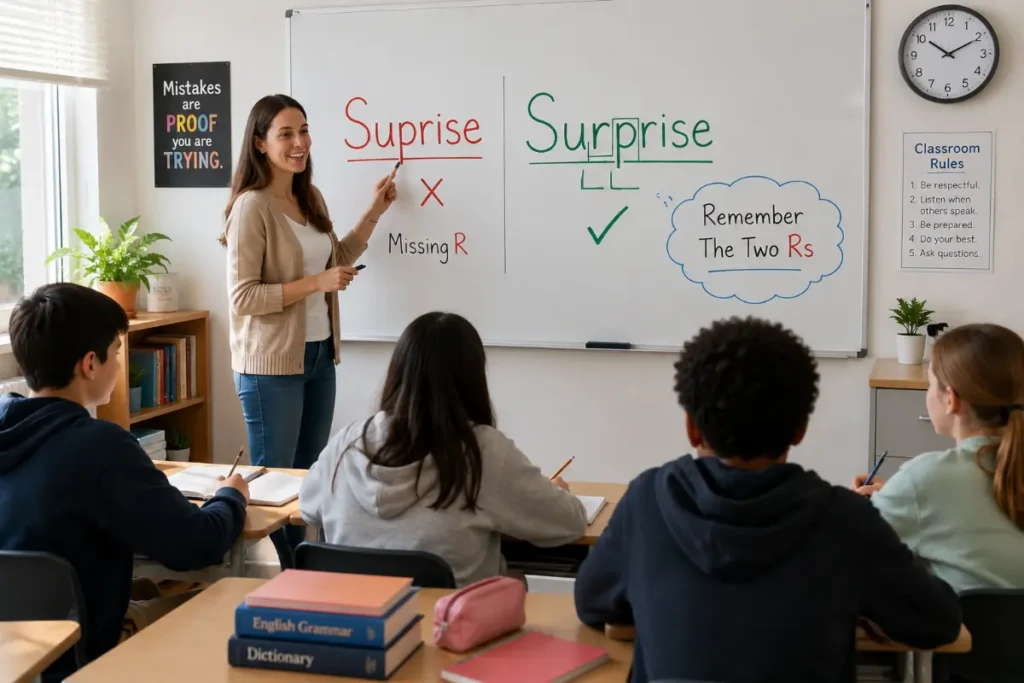
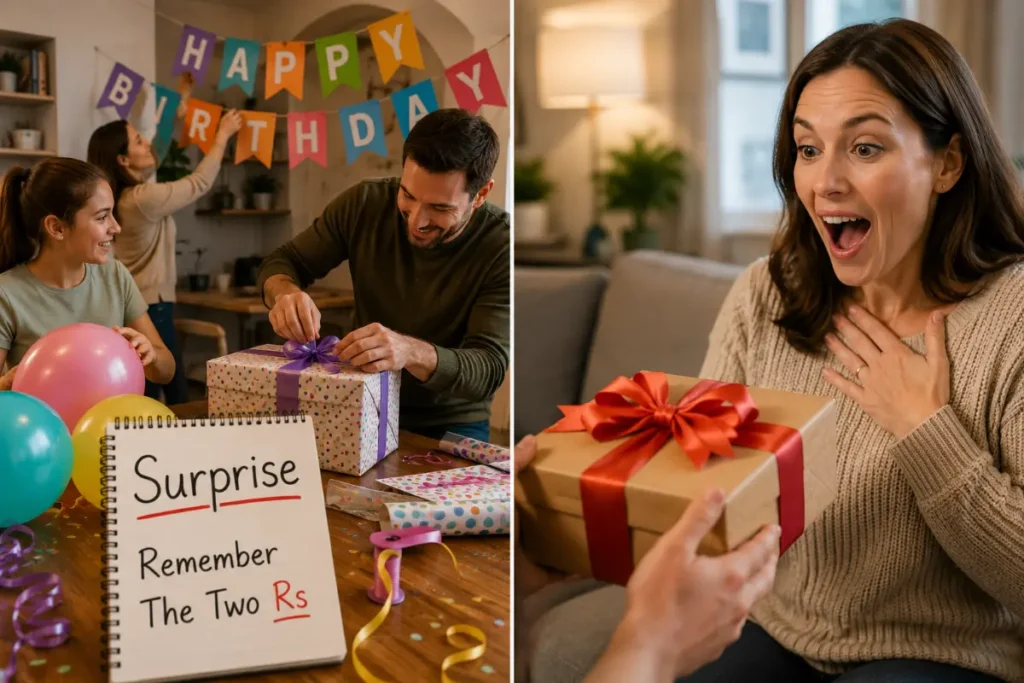
Remember The Two Rs
A very simple rule is to remember that surprise has two Rs.
One r comes after u.
The other r comes after p.
So the beginning looks like this:
surpr
That is enough to catch the most common mistake. If you write supr, stop and add the missing r.
Common Mistakes In Real Sentences
Seeing an incorrect spelling inside a sentence can make the problem easier to spot. Here are some examples of mistakes and their corrections.
Incorrect:
- The party was a suprise.
Correct:
- The party was a surprise.
The problem is the missing r after the u.
Here is another example.
Incorrect:
- I was suprised by the news.
Correct:
- I was surprised by the news.
The same missing letter appears in the related form.
Now look at this example.
Incorrect:
- It was a very suprising result.
Correct:
- It was a very surprising result.
Again, the surpr pattern needs to stay intact.
These mistakes are easy to make because the incorrect versions still look close to the correct ones. A reader can usually understand the meaning, but that doesn’t make the spelling correct. In polished writing, the extra few seconds needed to check the word are worth it.
How To Proofread This Word
Proofreading doesn’t have to mean reading an entire document several times. You can use a quick check whenever you know a particular word causes you trouble.
First, find the word in your document. Then look at the letters instead of reading the sentence for meaning. Check the beginning and make sure it says surpr.
For example, don’t just look at this sentence as a whole:
- I was surprised by the announcement.
Look directly at the word:
surprised
Now check the letters one by one.
s u r p r i s e d
This method works because your brain often reads familiar words as complete shapes. It may overlook a missing letter when you read quickly. Looking at the word itself forces you to notice the actual spelling.
When To Use Surprise In A Sentence
The word can appear in many common sentence patterns. Learning these patterns gives you another way to remember the spelling.
Talking About An Unexpected Event
Use surprise as a noun when something unexpected happens.
- The announcement was a surprise.
- Her visit was a pleasant surprise.
- The final score came as a surprise.
- His decision was a complete surprise.
In each case, the word names the unexpected thing or event.
Talking About Making Someone Feel Surprised
Use surprise as a verb when someone causes another person to feel unexpected emotion.
- I wanted to surprise my friend.
- The gift surprised her.
- The news surprised everyone.
- We decided to surprise our teacher.
The word remains correctly spelled in each sentence.
Talking About Someone’s Reaction
Use surprised when describing how someone feels.
- I was surprised by the result.
- She looked surprised.
- They were surprised to see us.
- He seemed surprised by the question.
This form is especially common in everyday English. It is worth learning because people often make the same spelling mistake in surprised that they make in the base word.
Describing Something Unexpected
Use surprising when something causes surprise.
- The result was surprising.
- Her answer was surprising.
- It was surprising to see so many people there.
- The ending was surprisingly good.
The word still starts with surpr. The final e is removed before ing, which is a normal spelling change.
Surprise And Surprised In Everyday English
One useful distinction is the difference between an event and a person’s reaction.
Consider this example:
- The party was a surprise.
- Maria was surprised by the party.
The first sentence describes the event. The second describes Maria’s reaction.
Now look at another pair.
- The news was a surprise.
- The news surprised me.
The first uses the noun. The second uses the verb.
These small differences are useful when you’re writing because they help you choose the right form instead of using the same structure repeatedly. They also give you more control over your sentences.
Is Surprise Always About Something Good
No. A surprise can be pleasant, unpleasant, or simply unexpected.
For example:
- The birthday gift was a pleasant surprise.
- The sudden bill was an unpleasant surprise.
- The storm was a complete surprise.
- The election result was a surprise to many people.
The word itself doesn’t tell us if the event is good or bad. The surrounding words provide that information.
This matters because people sometimes connect surprise only with parties, gifts, and happy events. Those are common uses, but the word has a much wider meaning. Anything unexpected can be a surprise.
Surprise And Shock
Surprise and shock are related, but they aren’t always interchangeable.
A surprise happens when something is unexpected. A shock usually involves a much stronger emotional reaction.
For example:
- I was surprised to see him at the restaurant.
This simply means you didn’t expect him to be there.
Now consider:
- I was shocked to hear that the company had closed.
This suggests a much stronger reaction.
You can also have a pleasant surprise without feeling shocked at all. The two words overlap in some situations, but surprise is the broader and more neutral term.
Surprise And Amazement
Amazement describes strong wonder or admiration. Surprise focuses on the fact that something was unexpected.
For example:
- I was surprised by the result.
You didn’t expect the result.
- I was amazed by the result.
The result impressed or astonished you.
You can feel both at the same time.
- I was surprised and amazed by how quickly she finished.
Knowing these related meanings helps you use the word with greater accuracy. It also gives you a better sense of why the word appears in so many different situations.
Why Correct Spelling Matters
A single missing letter may seem minor, especially when the meaning is obvious. Still, spelling affects how readers experience your writing.
Imagine reading a professional website that repeatedly spells surprise incorrectly. You may understand every sentence, but the mistakes can make the page seem less carefully edited. The same thing can happen with a resume, school assignment, business email, or article.
Good spelling isn’t about trying to impress people with difficult words. It’s about making your writing easy to trust and easy to read.
That doesn’t mean every typo is a serious problem. Everyone makes mistakes. The goal is to recognize the words that often cause trouble and check them before your writing reaches the reader.
A Quick Test Before You Publish
Before you finish an important piece of writing, search for the common incorrect form. If your document contains supris, look closely at each result.
You can also search for surpr to find every form of the word family. That can help you check surprise, surprised, surprising, and surprisingly at the same time.
This is a practical proofreading habit because it targets the exact spelling pattern that causes the problem. You don’t have to read your entire document from the beginning again.
For important writing, combine this check with your normal spell checker. The tool can catch obvious errors, while your own review helps you understand and remember the correct pattern.
A Fast Spelling Check
Ask yourself three questions.
Does the word start with surpr?
Does it contain two r letters?
Did I accidentally replace the s in the final part with z?
If the answer to all three checks is correct, your spelling is almost certainly on the right track.
FAQs
Is suprise or surprise the correct spelling?
Surprise is the correct spelling. Suprise is a common misspelling caused by leaving out the first r. The correct word has two r letters.
Why do people spell surprise as suprise?
The mistake often happens because the first part of the word is pronounced quickly. The r after the u can be easy to overlook when people write from sound or type quickly. Remembering the pattern surpr can help prevent the error.
How do you spell surprise correctly?
Spell it s u r p r i s e. A simple memory trick is to remember surpr at the beginning and then add ise.
Is suprised also wrong?
Yes. Suprised is an incorrect spelling of surprised. The correct form keeps both r letters: surprised.
How do you spell surprising?
The correct spelling is surprising. The final e from surprise is removed before the ing ending is added, but both r letters remain.
Is surprise spelled differently in British English?
No. Surprise is the standard spelling in both American and British English. The pronunciation may vary slightly among speakers, but the written spelling stays the same.
What is the difference between surprise and surprised?
Surprise can name an unexpected event or describe the act of causing an unexpected reaction. Surprised usually describes how someone feels or works as the past form of the verb.
Final Thoughts
The answer to suprise or surprise is clear. Surprise is the correct spelling, while suprise leaves out the first r. The same spelling pattern appears in surprised, surprising, and surprisingly, so learning the base word gives you a useful guide for several related forms.
The easiest memory trick is to focus on surpr. The word starts with s u r p r before the final ise. If you remember those two r letters, you can avoid the most common spelling mistake.
It’s also worth remembering that pronunciation doesn’t always give you every letter in an English word. When a word sounds different from the way it looks, rely on the correct written pattern instead of spelling it only by sound. That small habit can save you from repeated errors.
Next time you type the word, pause for one second and check the beginning. Surpr should be there. Once that pattern becomes familiar, you’ll write surprise correctly without having to stop and think about it.