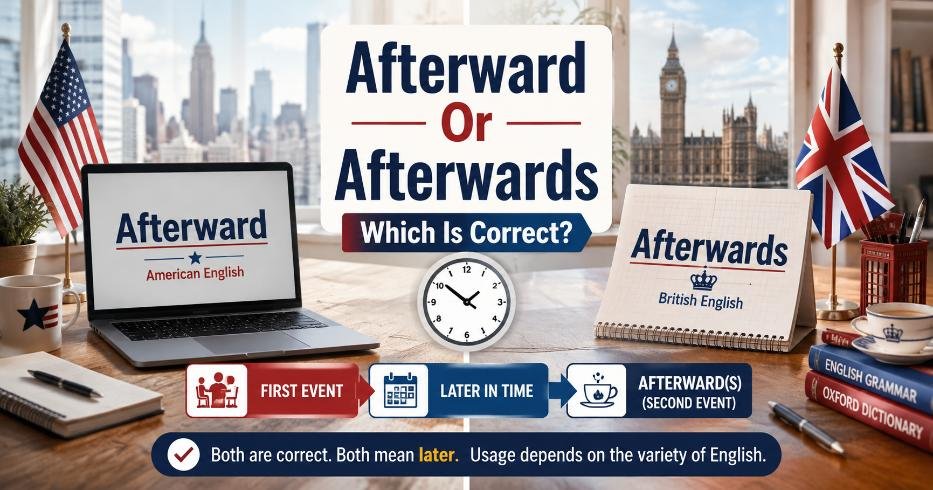
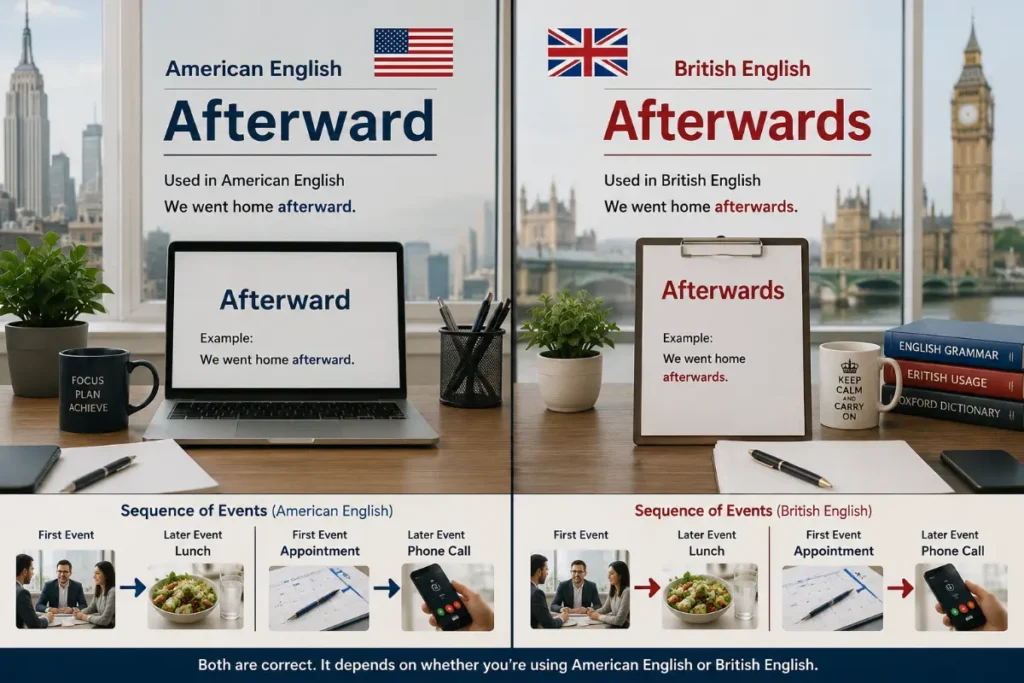
If you’re wondering about afterward or afterwards, both spellings are correct. They have the same meaning and are used as adverbs to mean later or at a later time. The main difference is regional preference. Afterward is more common in American English, while afterwards is especially common in British English.
For most readers in the United States, afterward is the spelling you’ll see more often. You can use it in a sentence like this: We went out for dinner afterward. There’s no grammar problem with afterwards, but it may sound a little less typical in American writing.
This spelling question often comes up because many English words ending in ward can also appear with an extra s. Words such as forward and backward can create similar questions. Once you understand how afterward and afterwards work, the pattern becomes much easier to recognize.
This guide explains the meaning, spelling, regional difference, grammar, pronunciation, common mistakes, and everyday usage of both forms. You’ll also see plenty of natural examples so you can choose the right form without second guessing yourself.
Quick Definition
Afterward and afterwards are adverbs that mean later or after something has happened. Both are standard English words, and neither is a misspelling.
The main difference is usage by region. Afterward is preferred in American English, while afterwards is more common in British English and some other varieties of English.
Direct Answer
Both afterward and afterwards are correct. If you’re writing for a US audience, afterward is usually the better choice because it’s more common in American English.
Comparison Table
| Word | Meaning | Example Sentence | Best Use |
|---|---|---|---|
| Afterward | Later or after something happens | We had dinner afterward. | Common in American English. |
| Afterwards | Later or after something happens | We had dinner afterwards. | Common in British English and other varieties. |
Why Are There Two Spellings
The two forms exist because English has developed differently in different regions. American and British English share the same basic grammar, but they do not always prefer the same spelling or word choice.
In this case, the difference is especially small. The meaning stays exactly the same. If someone says, We went home afterward, and another person says, We went home afterwards, both are saying that they went home later.
The extra s does not change the meaning. It also does not turn one version into a different part of speech. Both forms function as adverbs.
That makes this a usage question rather than a simple right versus wrong spelling question. You don’t need to worry about using the supposedly wrong word because there isn’t one. The better choice depends mainly on the variety of English you’re using and the audience you’re writing for.
What Afterward Means
Afterward refers to a time that comes after an event or action. It often appears when the writer has already mentioned something that happened earlier.
For example:
- We finished the meeting and went to lunch afterward.
- She called her mother afterward.
- I felt tired afterward.
- He apologized afterward.
- They talked about the problem afterward.
In each sentence, the word points back to an earlier action. The meaning is close to later or after that.
Consider this short conversation:
- We watched a movie last night.
- What did you do afterward?
- We went for ice cream.
The word tells us that getting ice cream happened after watching the movie. It saves the speaker from repeating the earlier event.
Afterward Can Refer To A General Later Time
The word doesn’t always refer to one clearly named event. Sometimes it simply means at some later point.
For example:
- I’ll tell you about it afterward.
- We can discuss the details afterward.
- She regretted the decision afterward.
- He realized his mistake afterward.
The exact time may not matter. The important point is that the action happens after something else.
That makes this word useful in everyday storytelling. Instead of saying after the meeting or after the conversation every time, you can use afterward when the earlier event is already clear.
Afterward Often Appears At The End Of A Sentence
A common position is at the end of the sentence.
- We went home afterward.
- She felt much better afterward.
- I called him afterward.
- They talked about it afterward.
This position sounds very natural in American English. It also makes the timing easy to understand because the word comes after the action being described.
The word can also appear earlier in a sentence.
- Afterward, we went home.
- Afterward, she called her sister.
- We afterward discovered that the information was wrong.
The first two examples sound natural in everyday English. The last one is grammatically possible but much less natural. In most cases, placing afterward at the beginning or end of a sentence will sound smoother.
What Afterwards Means
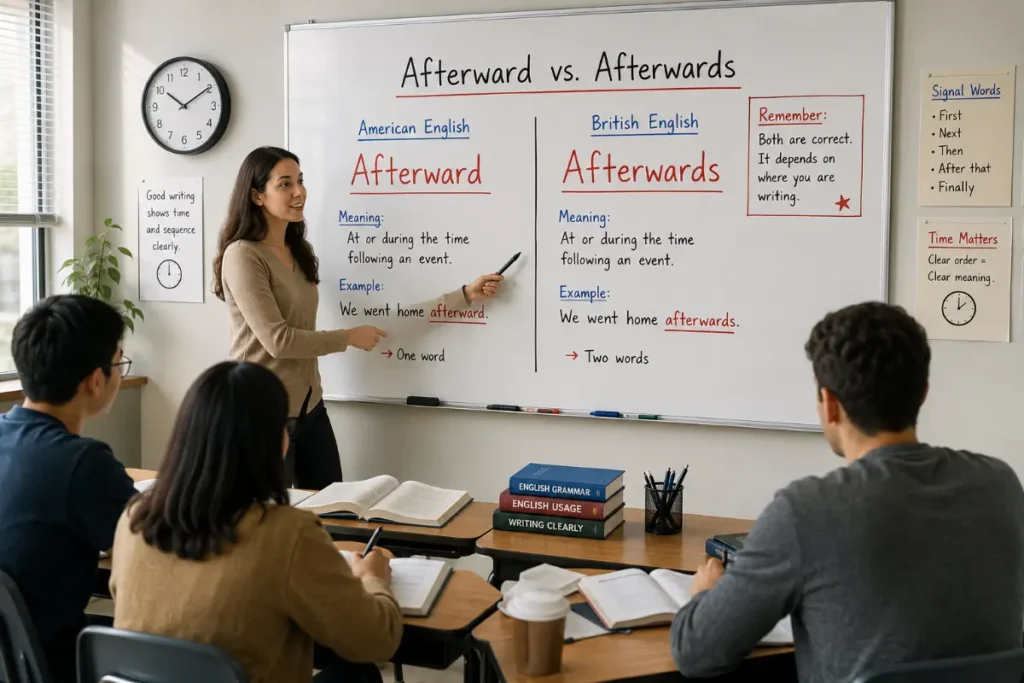
Afterwards has the same basic meaning as afterward. It means later or after something has happened.
For example:
- We went home afterwards.
- She felt tired afterwards.
- They had coffee afterwards.
- He called me afterwards.
Nothing about the meaning changes because of the final s. The difference is mainly regional preference.
British writers and speakers commonly use afterwards. American writers and speakers commonly prefer afterward.
That distinction can be useful when you’re editing content for a specific audience. If your website targets readers in the United States, afterward will usually feel more familiar. If you’re writing specifically for a British audience, afterwards may sound more natural.
The Final S Does Not Make It Plural
A common misunderstanding is that the s in afterwards somehow changes the meaning or makes the word plural. It doesn’t.
The word is an adverb in both forms. The final s is simply part of the spelling.
Compare these sentences:
- We talked afterward.
- We talked afterwards.
Both mean that the talking happened later. There is no difference in number, tense, or meaning.
This is a useful point to remember because English has many words whose endings can look meaningful even when they aren’t. The extra letter here doesn’t add a new grammatical function.
American English Preference
For a US audience, afterward is generally the more natural choice. American dictionaries and style references commonly list it as the standard form used in American English.
That doesn’t mean afterwards is wrong in the United States. An American reader will understand it immediately, and the word is still used by some US speakers and writers. It simply has a stronger association with British English.
For example, an American writer might naturally write:
- We went to a restaurant afterward.
A British writer might naturally write:
- We went to a restaurant afterwards.
Neither sentence has a grammar error. The difference is similar to other regional preferences in English where both forms are accepted.
If you’re writing an article, essay, website page, or email for a US audience, consistency matters more than treating the other form as incorrect. Pick afterward and use it consistently.
Why American English Often Uses Afterward
The preference for afterward fits a broader pattern in American English. American usage often favors the shorter ward form in several related words.
You can see this in pairs such as:
- toward and towards
- backward and backwards
- forward and forwards
- afterward and afterwards
The shorter form is not always preferred in every word or region, but it is common in American usage.
This doesn’t mean Americans never use the versions ending in s. They do. It simply means the shorter forms tend to be more common in standard American writing.
That’s why afterward is a good default for a US audience. It fits common American usage and avoids making a simple word choice more complicated than it needs to be.
How To Use Afterward In A Sentence
The easiest way to use afterward is to connect it to an action that happened earlier. The word tells your reader that something else happened later.
For example:
- We finished the movie and went home afterward.
- She spoke with her manager afterward.
- I felt much better afterward.
- They went out for coffee afterward.
- He apologized afterward.
In each example, the meaning is clear because the earlier action appears before the word. The reader knows what happened first and what happened later.
You can also use afterward when the earlier event appears in a different sentence. This is common in stories and explanations.
- The doctor explained the procedure. I felt less nervous afterward.
Here, afterward refers to the doctor’s explanation. You don’t need to repeat after the doctor’s explanation because the context already makes the meaning clear.
Using Afterward At The Beginning
You can place afterward at the beginning of a sentence when you want to emphasize the later event.
- Afterward, we went back to the hotel.
- Afterward, she called her brother.
- Afterward, everyone felt relieved.
When the word begins the sentence, a comma usually follows it. This structure works especially well when you’re describing a sequence of events.
For example, you might write:
- We finished the presentation. Afterward, we answered questions from the audience.
The order is easy to follow. First the presentation ended. Then the questions began.
Using Afterward At The End
Putting the word at the end is also very common.
- We talked about it afterward.
- She apologized afterward.
- They laughed about it afterward.
- I realized what had happened afterward.
This position often sounds more relaxed and natural in American conversation. It also works well in most types of writing.
If you’re unsure where to put the word, the end of the sentence is usually a safe choice.
How To Use Afterwards
The same sentence patterns work with afterwards.
- We finished the movie and went home afterwards.
- She spoke with her manager afterwards.
- I felt much better afterwards.
- They went out for coffee afterwards.
The meaning doesn’t change. The only noticeable difference is the regional preference.
For an American audience, afterward usually sounds more familiar. For a British audience, afterwards may sound more natural.
The Two Forms Can Replace Each Other
In most sentences, you can replace one form with the other without changing the meaning.
- We went shopping afterward.
- We went shopping afterwards.
- He called me afterward.
- He called me afterwards.
- She regretted the decision afterward.
- She regretted the decision afterwards.
The message stays the same. The choice is mainly about style and regional usage.
That makes this spelling question easier than many other English word comparisons. You don’t have to learn two separate meanings. You only need to remember that the two forms have the same meaning.
Afterward And Later
Another word that often appears in this discussion is later. It has a very similar meaning, but the two words don’t always work in exactly the same way.
Later can refer to a future time from the current point.
- I’ll call you later.
- We can talk about it later.
- She’ll finish the project later.
Afterward usually points to a time after a particular event.
- We’ll go out afterward.
- She felt tired afterward.
- I called him afterward.
The difference becomes clearer when you compare the sentences.
If you say, I’ll call you later, you’re talking about a future time. You haven’t necessarily mentioned the event that will happen first.
If you say, I’ll call you afterward, the listener expects a specific event to happen before the call.
For example:
- I’ll call you later.
This simply means at some future time.
- I’ll call you afterward.
This suggests that something else will happen first.
That small difference makes afterward useful when you’re explaining a sequence.
Afterward And After
The words afterward and after are closely related, but they don’t work in exactly the same way.
After can work as a preposition, conjunction, adverb, or part of a larger phrase. Afterward functions as an adverb.
Compare these examples:
- We went home after the meeting.
- We went home afterward.
In the first sentence, after is followed by the event that happened first. In the second sentence, afterward stands on its own because the earlier event is already understood.
You can also write:
- After we finished dinner, we went home.
Here, after introduces a clause. You cannot replace it directly with afterward.
You would instead write:
- We finished dinner. Afterward, we went home.
This difference is useful because it shows why the two words aren’t always interchangeable. They share a basic idea of time, but they play different roles in a sentence.
Common Mistakes With These Words
Most mistakes involving these forms aren’t serious grammar errors. They usually involve spelling, regional usage, or choosing a word that doesn’t fit the sentence.
Treating Afterwards As Incorrect
Some people believe the final s makes afterwards wrong. That’s not true.
Afterwards is a standard English word. It is especially common in British English and is also understood and used in the United States.
So this sentence is correct:
- We went out afterwards.
If you’re writing for American readers, you may prefer afterward, but that doesn’t make the other form a spelling mistake.
Treating Afterward As Incorrect
The opposite mistake happens too. Some people assume that afterwards is the only proper form because they learned it from British English.
That isn’t correct either.
Afterward is standard American English and is also used in other varieties of English. It is completely acceptable in sentences such as:
- We talked about the issue afterward.
The best choice depends on your audience and your preferred variety of English.
Adding An Extra S
Another spelling mistake is writing afterwards with too many letters.
The correct forms are:
- afterward
- afterwards
You don’t need to add another ending. If you’re writing American English, afterward is the simple form to remember.
Confusing Afterward With Afterwards
Some writers treat the two words as if they have different meanings. They don’t.
The sentence She called afterward means the same thing as She called afterwards.
The difference is mainly regional style. That’s why you shouldn’t change the meaning of a sentence just because you switch from one spelling to the other.
Which Form Should You Use In American English
If your audience is in the United States, afterward is the best default. It is common in American writing and sounds natural to US readers.
This is especially useful for website content, school papers, business writing, and general American English. Using the shorter form also keeps your spelling consistent with common US usage.
For example:
- We discussed the problem afterward.
- She went home afterward.
- The team celebrated afterward.
All three sentences sound natural to an American reader.
If you are writing for a British audience, afterwards may be the better choice. The same applies to publications or organizations that follow British English conventions.
The key is consistency. If your article uses American English throughout, choose afterward. If the rest of your writing follows British English, afterwards may fit better.
Is Afterwards Ever Better
Yes. If you’re writing specifically for British readers, afterwards may be the more natural choice. It is also common in several other varieties of English around the world.
The important point is that this is not a case where one spelling is correct and the other is wrong. Both belong to standard English.
Think of them as regional cousins. They mean the same thing and perform the same job, but one may feel more familiar depending on where your reader lives.
For a US focused article, afterward is the stronger default. For British English, afterwards is often the more natural choice.
Related Words With The Same Pattern
The difference between these forms becomes easier to remember when you see similar examples.
Toward And Towards
Both toward and towards are correct. American English often prefers toward, while British English commonly uses towards.
- She walked toward the door.
- She walked towards the door.
The meaning is the same.
Backward And Backwards
Both forms are also used.
- He took a step backward.
- He took a step backwards.
American English often favors backward, while British English frequently uses backwards.
Forward And Forwards
Again, both forms exist.
- Move forward.
- Move forwards.
The shorter form is common in American English. The longer form is also standard English.
Seeing these pairs helps explain why the spelling of afterward and afterwards can vary. English has several words where regional usage affects the presence of the final s.
A Simple Memory Trick
If you write American English, remember this simple pattern.
Afterward is the shorter US choice.
You can connect the shorter spelling with American English and use it as your default. This isn’t a strict rule for every word ending in ward, but it works well for this particular word.
Another useful trick is to remember the meaning rather than the spelling. Both forms mean later or after that.
If you can replace the word with later and the sentence still makes sense, you’re probably using the word correctly.
For example:
- We went home afterward.
You could also say:
- We went home later.
The meaning changes slightly depending on context, but the time relationship remains clear.
Examples In Everyday American English
The best way to learn a word is to see it used naturally. Here are several situations where afterward fits comfortably.
After a meal:
- We grabbed some coffee afterward.
After a meeting:
- I talked with my manager afterward.
After a movie:
- We discussed the ending afterward.
After an appointment:
- She went straight home afterward.
After an argument:
- They both felt bad afterward.
After a trip:
- We shared our photos afterward.
After a test:
- I felt relieved afterward.
After a phone call:
- He sent me an email afterward.
These examples all share the same basic pattern. An event happens first, and afterward refers to something that happens later.
That simple relationship is the heart of the word.
How Dictionaries Treat Both Forms
A useful way to settle the spelling question is to look at how major English references treat these words. Both afterward and afterwards are established English adverbs. Neither one is simply a misspelling of the other.
The main distinction is usage rather than meaning. American English tends to favor afterward, while British English commonly uses afterwards. Dictionaries may list both forms while giving notes about regional or frequency differences.
This matters because people sometimes learn one version and assume the other must be wrong. That assumption can lead to unnecessary corrections. If you see afterwards in a British article, for example, there is no reason to change it just because you normally write American English.
The same applies in reverse. A British reader may prefer afterwards, but afterward is still a standard form. Good editing means recognizing the variety of English being used instead of treating every regional difference as an error.
When Afterward Refers To A Specific Event
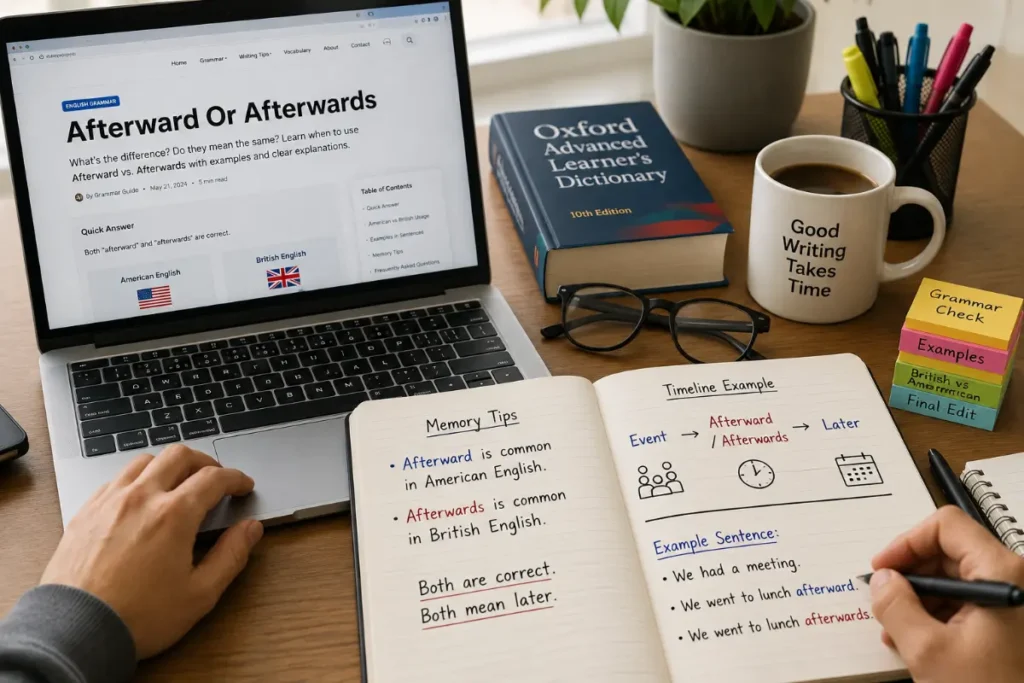
One of the most useful features of afterward is its ability to point back to an event that has already been mentioned.
- The students took the exam. They went out for lunch afterward.
The word clearly refers to the exam. The lunch happened after the exam.
You can use the same pattern in many situations:
- Maria finished her interview and called her husband afterward.
- We cleaned the kitchen and watched a movie afterward.
- The doctor examined him and spoke with his family afterward.
- I read the contract carefully and signed it afterward.
The earlier event provides the reference point. You don’t have to repeat it.
This makes the word especially useful in stories and explanations. It keeps the writing smooth because you can refer to an earlier event without using the same phrase again and again.
When The Earlier Event Is Clear
You don’t always need to mention the earlier event in the same sentence.
For example:
- The meeting lasted nearly two hours. I felt exhausted afterward.
The reader knows what caused the feeling of exhaustion. The second sentence doesn’t need to say after the meeting again.
This also works in conversation.
- How was your dentist appointment?
- It went fine. My mouth was sore afterward.
The listener already knows what afterward refers to. The context does the work.
When Afterward Means At A Later Time
Sometimes the word refers to a later time without pointing to one sharply defined event.
- We can talk about that afterward.
- I’ll explain everything afterward.
- She thought about the decision afterward.
- He decided to deal with the problem afterward.
In these examples, the exact time isn’t given. The word simply places the action later than something understood from the conversation.
This is common in spoken English. People often leave information unstated because the listener already knows what they mean.
For instance, a parent might tell a child:
- Finish your homework first. We can play afterward.
There is no need to say after you finish your homework. The relationship is obvious.
When Not To Use Afterward
Although afterward is useful, it cannot replace after in every sentence.
Consider this example:
- After dinner, we went for a walk.
You cannot simply replace after with afterward and keep the same structure.
The natural alternatives would be:
- We had dinner. Afterward, we went for a walk.
- We went for a walk afterward.
This happens because after can introduce a noun or a clause, while afterward normally stands alone as an adverb.
Compare these structures:
- after the meeting
- after lunch
- after she arrived
- afterward
The first three forms connect the word after directly to information about the earlier event. Afterward does not work that way.
This distinction is worth learning because it prevents a common mistake. The two words are related, but they do different jobs inside a sentence.
Afterward Vs Then
Then is another word that can mean something happened later. However, the two words aren’t always interchangeable.
Then often shows the next step in a sequence.
- First we had dinner. Then we watched a movie.
Afterward usually connects a later action to something that happened before it.
- We had dinner and watched a movie afterward.
The difference is small, but the focus changes. Then often moves the reader from one step to the next. Afterward looks back at an earlier event and identifies what happened later.
You can sometimes use either word, but the sentence may sound slightly different.
- We finished the game and went home afterward.
- We finished the game. Then we went home.
Both are natural. The first sentence treats going home as something that happened after the game. The second presents going home as the next step.
Common Questions About Afterward And Afterwards
Is afterward one word or two
Afterward is one word. You should not write it as after word when you mean later or after an event.
The same applies to afterwards. It is also written as one word.
Is afterward American English
Yes. Afterward is very common in American English and is generally the preferred form for US writing.
It is also used in other varieties of English. The main point is that American writers tend to favor the shorter form.
Is afterwards British English
Afterwards is especially common in British English. It is also used in other English varieties around the world.
American readers understand it without difficulty. It simply may sound less typical in US focused writing.
Is one spelling more formal
Neither spelling is inherently more formal. The difference is mainly regional.
A formal American document can use afterward, while a formal British document can use afterwards. The important thing is to follow the English variety used by the publication or audience.
Can I use afterward at the beginning of a sentence
Yes. For example, you can write, Afterward, we went back to the office.
When the word begins the sentence, a comma commonly follows it because the word acts as an introductory adverb.
Can I use afterward at the end of a sentence
Yes. This is very common.
For example, you can write, We went back to the office afterward. This placement often sounds especially natural in everyday American English.
Does afterward mean later
Yes. Afterward means later or after something has happened.
For example, We went to dinner afterward means that dinner happened after the event already being discussed.
Does afterwards mean the same thing
Yes. Afterwards has the same meaning as afterward.
The difference is mainly regional preference. American English tends to favor afterward, while British English often favors afterwards.
Final Thoughts
The easiest way to settle afterward or afterwards is to remember that both forms are correct. They have the same meaning and serve the same grammatical role. The main difference is regional preference, with afterward being more common in American English and afterwards being especially common in British English.
If you’re writing for readers in the United States, afterward is the best default. It fits naturally in school writing, website content, business communication, and everyday conversation. You don’t need to worry about using the shorter form because it is a standard part of American English.
If your audience follows British English, afterwards may be the more natural choice. The same principle applies to other regional differences in English. Good writing isn’t about forcing every reader to use the same form. It’s about choosing words that fit your audience and keeping your usage consistent.
The practical rule is simple. Use afterward for American English unless a specific style guide or audience calls for afterwards. Both are correct, both mean later, and neither should be treated as a spelling error simply because it isn’t the version you normally use.