
If you’ve searched for fewer meaning, you’re probably trying to understand what the word means or when you should use it. The simple answer is that fewer means a smaller number of people or things. We normally use it with things we can count one by one, such as books, cars, students, or mistakes.
The word often gets confused with less because both words describe a smaller amount. The difference is simple once you know what kind of noun comes after them. Use fewer with countable nouns and less with things treated as one amount or mass.
You’ll also see fewer in everyday phrases such as “fewer people,” “fewer problems,” and “fewer than ten.” It can describe a real number, compare two amounts, or appear in signs and instructions. In some cases, modern English also uses less with nouns that can technically be counted.
This guide explains the meaning of fewer, how to use it naturally, and how it differs from less. You’ll see clear examples, common mistakes, special cases, and simple ways to remember the rule.
Quick Definition
Fewer means a smaller number of something that can be counted. For example, “fewer students” means a smaller number of students.
Use fewer with plural countable nouns. You can count students, books, tickets, and mistakes as separate items.
Direct Answer
Fewer means a smaller number of people or things that can be counted individually. For example, “fewer cars” means a smaller number of cars.
What Fewer Means In English
The basic meaning of fewer is not complicated. It describes a number that is smaller than another number.
Suppose one classroom has 25 students and another has 18. You can say the second classroom has fewer students. Students are individual people, so you can count them.
The same idea works with many everyday nouns. You might have fewer emails, fewer appointments, fewer cookies, fewer questions, or fewer customers. Each noun refers to separate things that you can count.
Here are a few natural examples.
- We have fewer customers this morning.
- She made fewer mistakes on the second test.
- There are fewer seats available than we expected.
- I bought fewer books this month.
- The new plan requires fewer steps.
In each sentence, the word describes a smaller number of separate items or people.
Fewer Means A Smaller Number
Think of fewer as a number word. It doesn’t tell you the exact number. It simply tells you that one group contains a smaller number than another group.
For example, imagine that you had 12 apples yesterday and eight apples today. You could say, “I have fewer apples today.”
The sentence doesn’t tell us exactly how many apples you have. It only tells us that the number has gone down.
You can use the same pattern with almost anything that has individual units.
- fewer emails
- fewer workers
- fewer houses
- fewer questions
- fewer meetings
- fewer children
- fewer packages
- fewer accidents
The important point is that you can count each item separately.
Fewer Vs Less
The biggest source of confusion is the difference between fewer and less. Both words express a smaller amount, but standard English usually uses them with different types of nouns.
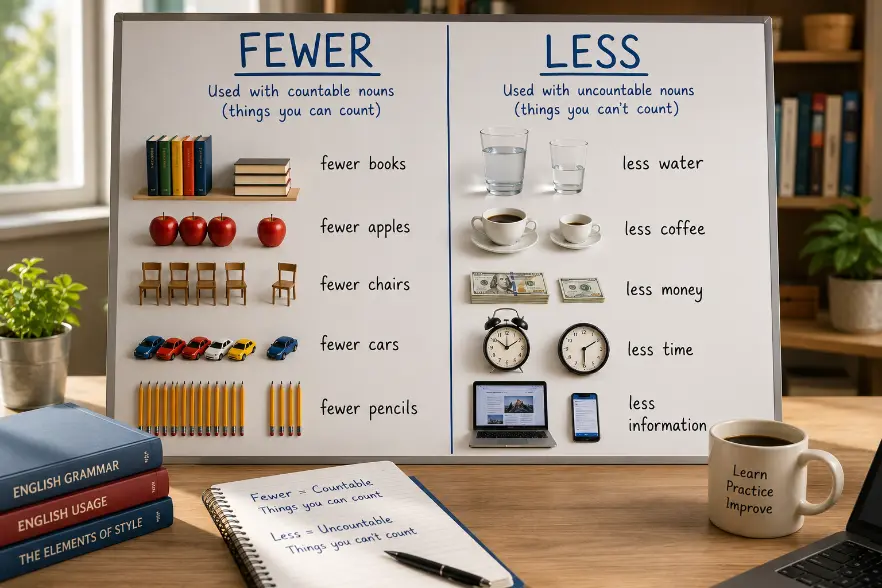
Use fewer with plural countable nouns.
Use less with uncountable nouns or amounts that we normally treat as a whole.
Compare these sentences.
- We need fewer chairs.
- We need less furniture.
You can count chairs one by one. You can say one chair, two chairs, or ten chairs. Furniture works differently. You normally don’t say one furniture or two furnitures when talking about furniture as a general category.
Here are more examples.
| Use Fewer | Use Less |
|---|---|
| fewer books | less information |
| fewer people | less traffic |
| fewer mistakes | less noise |
| fewer cars | less water |
| fewer questions | less money |
| fewer meetings | less time |
This distinction is the main rule you need to remember.
Countable Nouns
A countable noun names something you can count as separate units. These nouns usually have both singular and plural forms.
For example, you can have one dog, two dogs, or ten dogs. You can also have one ticket, three tickets, or fifty tickets.
Because these nouns can be counted, fewer works naturally with their plural forms.
- We need fewer tickets.
- There are fewer dogs at the park today.
- I made fewer phone calls this week.
- The store has fewer employees now.
- She wants fewer distractions while studying.
Notice that the nouns after fewer are plural. This is another useful clue.
Uncountable Nouns
Uncountable nouns describe things that we usually treat as a substance, idea, or general amount rather than separate units.
Common examples include water, money, time, advice, information, traffic, furniture, and equipment.
We normally use less with these nouns.
- I have less time today.
- We need less information.
- There is less traffic this morning.
- She spent less money this month.
- The room has less furniture now.
You can sometimes measure these things, but that doesn’t automatically make them countable nouns. For example, you can have three gallons of water, but water itself remains an uncountable noun.
That’s why we say “less water” rather than “fewer water.”
How To Know If You Need Fewer
There’s a quick test that can help.
Ask yourself if you can count the noun as individual units.
If the answer is yes, fewer is usually the right choice.
You can count:
- people
- chairs
- cars
- houses
- books
- cookies
- questions
- dollars
- students
So you can say:
- fewer people
- fewer chairs
- fewer cars
- fewer houses
- fewer books
- fewer cookies
- fewer questions
- fewer students
If the noun refers to an amount that isn’t normally counted as separate units, less is usually better.
You can say:
- less water
- less time
- less money
- less noise
- less traffic
- less information
- less advice
This test works in most everyday situations.
Fewer In Everyday Sentences
You probably use the idea behind fewer more often than you realize. The word appears whenever someone compares numbers or talks about reducing the number of things.
Imagine you’re planning a party and expect 30 guests. Later, ten people cancel. You could say, “We have fewer guests than expected.”
A manager might say, “We need fewer meetings so the team can focus on its work.” A teacher might say, “There are fewer students in class today.” A shopper might notice, “This store has fewer checkout lines than it used to.”
The word fits naturally into all of these situations because each example involves things that can be counted.

Fewer People
Fewer people is one of the most common combinations you’ll hear.
- Fewer people came to the event this year.
- The restaurant is quieter when fewer people are there.
- We need fewer people on the project now.
People are countable because you can count individual people.
You might have one person, two people, or 100 people. That’s why fewer people is standard English.
Fewer Things
The same rule applies to physical objects.
- I have fewer shoes than I used to.
- The new apartment has fewer rooms.
- We bought fewer decorations this year.
Each item can be counted separately, so fewer works naturally.
Fewer Than
You’ll often see fewer followed by than when two numbers or groups are compared.
For example:
- Fewer than 20 people attended.
- She made fewer than five mistakes.
- The package arrived in fewer than three days.
- We received fewer than 100 applications.
The phrase fewer than means that the number is below a stated amount.
If someone says “fewer than ten minutes,” they mean the amount of time is below ten minutes. In careful traditional grammar, less than is generally used with an amount of time rather than individual countable units, but fewer than can appear when the speaker is emphasizing individual units or events.
Fewer As A Comparative Word
Fewer is the comparative form related to few.
Think of the pattern this way:
Few means a small number.
Fewer means a smaller number.
Fewest means the smallest number.
Here is how the three forms work.
- Few students missed the class.
- Fewer students missed the class today.
- This class had the fewest absences.
The first sentence simply says the number was small. The second compares one number with another. The third identifies the smallest number among three or more groups.
This pattern is useful because it shows that fewer is not simply another word for few. It specifically expresses comparison.
Few
Use few when you mean a small number without directly comparing it with another number.
- Few people knew the answer.
- Few stores were open.
- Few students finished early.
The meaning is that the number was small.
Fewer
Use fewer when comparing a smaller number with another number.
- Fewer people came this year.
- We have fewer options now.
- She made fewer errors than before.
The comparison can be stated directly with than, but it doesn’t have to be.
Fewest
Use fewest when something has the smallest number among several groups.
- This store has the fewest customers.
- Monday had the fewest visitors.
- She made the fewest mistakes in the final test.
This gives you a simple three step pattern: few, fewer, and fewest.
Why Fewer Is Important In Clear Writing
Choosing fewer instead of less can make your writing more precise. The reader immediately knows you’re talking about a number of separate things.
Compare these two sentences.
“Fewer employees are working today.”
“Less staff is working today.”
The first sentence is clear and follows the traditional countable noun rule. The second sentence can be heard in casual speech, but staff is a collective noun and works differently from a simple plural countable noun such as employees.
For clear writing, the first version is often better because it tells the reader exactly what is being counted.
This matters in many settings. Reports, instructions, websites, school assignments, and business documents all benefit from precise wording. A small word like fewer can make a sentence easier to understand.
Common Mistakes With Fewer
The most common mistake is using less with a plural countable noun.
For example:
- Less people attended the meeting.
In traditional standard English, this should be:
- Fewer people attended the meeting.
People can be counted, so fewer is the standard choice.
Another common mistake is using fewer with an uncountable noun.
For example:
- Fewer information was available.
That sentence is incorrect because information is normally uncountable. The better version is:
- Less information was available.
The easiest way to avoid both mistakes is to look at the noun rather than the whole sentence. Ask if you’re counting separate units or describing one general amount. That small check can prevent a surprising number of grammar errors.
The Difference Between Few And A Few
Another useful distinction involves few and a few.
These expressions are close, but they create different feelings.
Few usually suggests a very small number. It can even suggest that the number is smaller than expected.
A few simply means some.
Compare these examples.
- Few people came to the party.
- A few people came to the party.
The first sentence can sound disappointed. It suggests that not many people showed up.
The second sentence sounds more neutral. It tells us that some people came without suggesting that the number was unusually small.
Now look at fewer.
- Fewer people came this year.
This sentence compares the number of people this year with another number, such as last year’s attendance.
These small differences can change the tone of a sentence. Grammar isn’t only about correctness. Good word choice also helps readers understand the feeling behind your message.
When Fewer And Less Can Both Work
The basic rule says fewer goes with countable nouns and less goes with uncountable nouns. That rule is useful, but real English has a few situations that make the choice less obvious.
One common example is time. We often say less time because time is treated as an amount. For example, “I have less time today” sounds completely natural. But we can also count units of time, as in “fewer than three days” or “fewer than ten minutes.” The choice depends on what you’re focusing on.
Consider these examples.
- We spent less time at the museum.
- We stayed for fewer than two hours.
- I have less than five minutes.
- The project took fewer than six days.
The first sentence treats time as a general amount. The other examples use specific units of time as countable periods.
Money works in a similar way. We usually say less money because money is treated as an amount.
- I have less money than I expected.
- She spent less money this month.
- We need less money for the new plan.
But you can count individual units of currency.
- I have fewer than ten dollars.
- He gave me fewer than five coins.
- She received fewer than 20 bills.
The noun after fewer matters. If you’re counting separate units, the word can make sense. If you’re talking about the general amount, less is usually the natural choice.
Fewer With Numbers
You’ll often see fewer before a number. This is especially common when talking about people, objects, events, or other things that can be counted.
For example:
- Fewer than 50 people attended.
- The store sold fewer than 100 tickets.
- We received fewer than 20 applications.
- The school has fewer than 500 students.
These sentences all describe a number that is below a stated amount.
The phrase fewer than is especially useful when you don’t know the exact number. If a concert had somewhere between 200 and 300 visitors, you might say, “Fewer than 300 people attended.” You don’t need to give the exact figure because the comparison already gives the reader useful information.
Fewer Than Ten
Fewer than ten means a number below ten.
If six people came to your meeting, you could say, “Fewer than ten people came.” The sentence is accurate because six is below ten.
The same structure works with almost any countable noun.
- fewer than ten books
- fewer than ten questions
- fewer than ten cars
- fewer than ten mistakes
- fewer than ten customers
The phrase is common in everyday speech, news reports, instructions, and business writing.
Fewer Than And Less Than
This is where many people hesitate because both fewer than and less than are common.
Use fewer than when you’re comparing a number of countable things.
- Fewer than 30 students attended.
- Fewer than 15 tickets remain.
- Fewer than five people complained.
Use less than when you’re talking about an amount or quantity that isn’t being treated as separate countable units.
- It took less than an hour.
- The bottle contains less than a gallon.
- The repair cost less than $100.
There are also common expressions where less than appears before numbers even though a strict countable noun rule might suggest fewer. This is especially common when the number is being treated as an amount, measurement, distance, or period rather than a count of individual objects.
That is why native English isn’t always as simple as memorizing one formula. The type of thing being measured matters.
Fewer With People
The phrase fewer people follows the standard rule because people are countable.
You can have one person, two people, or 200 people. Each person is an individual unit.
Here are some natural examples.
- Fewer people are working today.
- Fewer people attended the meeting than expected.
- The park is quieter when fewer people visit.
- Fewer people are buying large homes this year.
You may sometimes hear less people in casual speech. It appears often enough that many speakers don’t notice it. Still, fewer people is the traditional standard form and the better choice for careful writing.
Fewer People Or Less People
If you’re deciding between these two phrases, choose fewer people.
For example:
- Correct: Fewer people came to the event.
- Common in casual speech: Less people came to the event.
The second version is easy to understand, but it does not follow the traditional countable noun rule. If you’re writing an article, school paper, report, or professional message, fewer people is the stronger choice.
Fewer With Time
Time deserves special attention because it can behave differently depending on the sentence.
When time is treated as an amount, use less.
- I need less time to finish the task.
- We have less time than we expected.
- She spends less time on social media now.
When you count separate periods or units, fewer can work.
- The trip took fewer than five days.
- We have fewer than ten minutes left.
- The project lasted fewer than three weeks.
Think about what you’re measuring. If you’re talking about time as a general resource, less usually sounds best. If you’re counting individual days, weeks, or other units, fewer can be appropriate.
This distinction also explains why both forms can appear in the same conversation.
Someone might say, “I have less free time this week because I have fewer days off.” The first phrase describes time as an amount. The second describes a number of individual days.
Fewer With Distance
Distance can work in much the same way.
When you describe distance as a general measurement, less is common.
- The new route requires less driving.
- We walked less distance than yesterday.
When you count individual units, fewer can appear.
- The trail has fewer than five miles left.
However, native speakers often prefer less than five miles because miles are being treated as a measurement rather than as separate objects. This is a good example of how everyday usage can be more flexible than a simple grammar rule.
The safest approach is to think about the meaning of the sentence. Ask yourself if you’re counting individual items or describing a measurement. That usually points you toward the more natural choice.
Fewer In Signs And Advertising
You may have noticed fewer in public messages and advertisements.
Businesses often use phrases such as:
- Fewer lines.
- Fewer steps.
- Fewer clicks.
- Fewer fees.
- Fewer delays.
- Fewer restrictions.
These phrases work because the nouns refer to things that can be counted. A customer can count lines, steps, clicks, fees, or delays.
The word can also make a claim sound direct and easy to understand. “Fewer steps” tells the reader that a process has been reduced. “Fewer fees” tells a customer that there are not as many separate charges.
In this setting, fewer often appears because the writer wants to emphasize a smaller number of individual things.
Fewer In Questions
You can use fewer in questions when asking about a smaller number.
For example:
- Why are there fewer customers today?
- Can we use fewer boxes?
- Did fewer people attend this year?
- How can we make fewer mistakes?
- Why are fewer students choosing this course?
These questions don’t ask for an exact number. They ask about a reduction or comparison.
You can also use fewer with than in questions.
- Are there fewer than 20 seats available?
- Did fewer than 100 people sign up?
- Can we finish in fewer than five steps?
The structure is simple and common in everyday English.
Fewer In Negative Sentences
The word can also appear naturally in negative sentences.
- We don’t have fewer problems now.
- The company did not hire fewer workers.
- I don’t want fewer options.
- She isn’t making fewer mistakes.
These sentences can sound slightly different depending on the context because fewer already introduces a comparison. For example, “I don’t want fewer options” means the speaker does not want the number of options to decrease.
A more natural sentence in many situations might be “I want more options.” English speakers often choose the positive comparison because it is shorter and clearer.
Still, negative sentences with fewer are grammatically possible. The important point is that the word continues to describe a smaller number.
Common Mistakes With Fewer
Knowing the main rule doesn’t always prevent mistakes. Some errors happen because words that look countable are actually treated as uncountable in standard English.
Fewer Information
Information is uncountable.
So this is not standard English:
- Fewer information was available.
The better sentence is:
- Less information was available.
You can count pieces or facts of information, though.
- Fewer pieces of information were available.
That version works because pieces is countable.
Fewer Advice
The same idea applies to advice.
Don’t say:
- Fewer advice was given.
Use:
- Less advice was given.
If you want to count individual suggestions, change the noun.
- Fewer suggestions were given.
- She gave me fewer pieces of advice.
The second version counts pieces rather than treating advice as one general amount.
Fewer Furniture
Furniture is also normally uncountable.
So this sounds incorrect:
- The house has fewer furniture.
Use:
- The house has less furniture.
If you want to count individual objects, name them.
- The house has fewer chairs.
- The apartment has fewer tables.
- We bought fewer pieces of furniture.
This pattern is useful because it shows how changing the noun can change the correct word.
Words That Commonly Follow Fewer
Once you understand the rule, you’ll start noticing certain combinations again and again.
Some common examples include:
- fewer people
- fewer students
- fewer employees
- fewer customers
- fewer cars
- fewer books
- fewer problems
- fewer mistakes
- fewer questions
- fewer choices
- fewer opportunities
- fewer meetings
- fewer emails
- fewer calls
- fewer tickets
- fewer products
- fewer accidents
- fewer complaints
- fewer steps
- fewer rules
These combinations all involve nouns that can normally be counted.
Learning common word combinations can make grammar feel more natural. Instead of stopping to analyze every sentence, you’ll begin to recognize patterns automatically.
How Fewer Changes The Meaning Of A Sentence
A small change from less to fewer can affect the way a reader understands a sentence.
Compare:
- We have fewer employees.
- We have less staff.
These sentences may communicate a similar idea, but they focus on different things. The first sentence counts individual employees. The second treats staff as a group or general amount.
Another example is:
- She made fewer mistakes.
- She made less progress.
The first sentence counts separate errors. The second describes progress as an overall amount.
This is why word choice matters. Fewer doesn’t simply mean “not much.” It points to a smaller number of separate units.
A Simple Test For Fewer
When you’re unsure, use this quick test.
Look at the noun after the word.
Can you put a number directly in front of it?
If yes, fewer is probably the right choice.
For example:
- one book
- two books
- three books
So you can say fewer books.
The same works with:
- one mistake
- two mistakes
- three mistakes
So you can say fewer mistakes.
Now try the test with information.
You normally don’t say:
- one information
- two informations
- three informations
So fewer information doesn’t work. Use less information instead.
You can change the noun to something countable.
- one fact
- two facts
- three facts
Now fewer facts works perfectly.
This little test won’t solve every unusual case in English, but it handles most everyday situations.
Fewer And The Word Few
The connection between few and fewer is worth understanding because it helps explain the meaning.
Few describes a small number.
- Few customers complained.
Fewer compares one number with another.
- Fewer customers complained this month.
Fewest identifies the smallest number.
- This month had the fewest complaints.
You can think of the pattern as a scale.
Few means a small number.
Fewer means a smaller number.
Fewest means the smallest number.
The same pattern appears with many adjectives in English, although the forms are not always built in the same way. Once you understand this pattern, sentences with fewer become easier to recognize.
When Less Sounds More Natural
There are times when speakers choose less even though a noun might seem countable at first glance.
Measurements are a good example.
You might hear:
- less than five miles
- less than ten minutes
- less than three years
- less than 100 dollars
Why? In these phrases, the number is often understood as one measurement or amount. The speaker isn’t thinking about five separate miles or ten separate minutes. They’re thinking about the total distance, duration, or cost.
This usage is firmly established in everyday American English. You don’t need to force fewer into every sentence simply because a number appears.
The key is meaning. Standard grammar gives you a useful starting point, but natural English also depends on how speakers understand the noun in context.
Fewer In Modern American English
American English has become flexible about the traditional fewer versus less rule. You may hear less before plural nouns in signs, advertisements, conversations, and informal writing.
One famous example is the phrase less people. Many speakers use it without hesitation. It is easy to understand, and it has become common enough to appear in many forms of everyday communication.
Still, common usage doesn’t mean the traditional distinction has disappeared. Fewer people remains the preferred form in careful edited English.
If you’re writing for a professional audience, following the standard rule is usually the best approach. If you’re listening to casual speech, don’t be surprised when people use less more broadly.
The important thing is to recognize both forms without assuming that every informal usage belongs in formal writing.
A Practical Way To Remember It
You don’t need a complicated grammar trick.
Remember this simple pair:
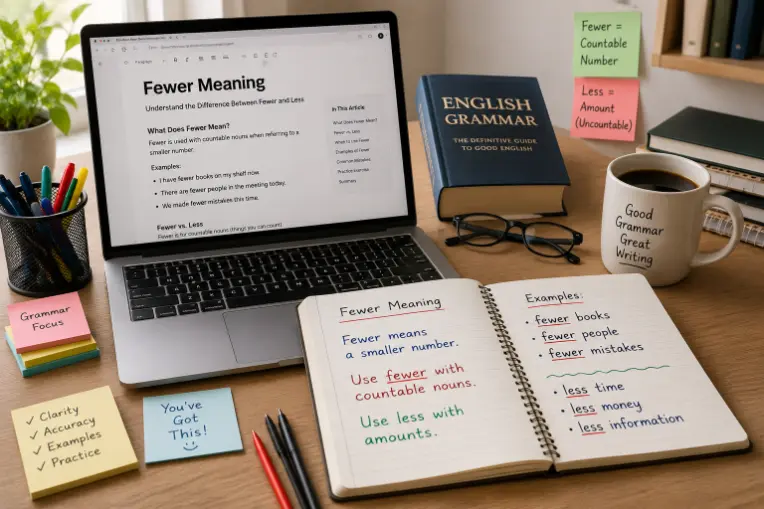
Fewer means a smaller number.
Less means a smaller amount.
If you can count the things, start with fewer.
If you’re talking about an amount, start with less.
For example:
- fewer apples
- fewer people
- fewer emails
- fewer problems
But:
- less water
- less money
- less time
- less information
If you’re still unsure, look at the noun itself. That usually gives you the answer faster than trying to remember a long grammar rule.
Why The Rule Still Matters
Some people wonder why the difference matters if native speakers understand both forms. The answer is that clear writing benefits from consistent word choice.
When you’re writing a school paper, professional article, business report, or formal email, readers expect standard grammar. Using fewer with plural countable nouns shows that you understand the distinction and helps your writing look polished.
The rule is also useful because it removes ambiguity. Fewer employees clearly refers to a number of individual employees. Less work clearly refers to the overall amount of work.
You don’t need to obsess over the distinction in casual conversation. Good communication doesn’t require perfect grammar in every informal sentence. But knowing the standard rule gives you control over your language, and that control becomes useful when the situation calls for careful writing.
FAQs
What does fewer mean in simple English?
Fewer means a smaller number of people or things that can be counted. For example, fewer books means a smaller number of books. The word is commonly used with plural countable nouns.
What is the meaning of fewer?
The basic fewer meaning is a smaller number. You use it when comparing two numbers or saying that the number of something has decreased. For example, if 20 people attended last year and 15 attended this year, you can say that fewer people attended this year.
What is the difference between fewer and less?
Use fewer with plural countable nouns such as people, books, cars, and mistakes. Use less with uncountable nouns or general amounts such as time, money, water, and information. A simple memory trick is to think of fewer as a smaller number and less as a smaller amount.
Is fewer always followed by a plural noun?
In normal use, fewer is followed by a plural countable noun. You can say fewer students, fewer questions, or fewer problems. The noun refers to separate things that can be counted.
Is fewer people correct?
Yes. Fewer people is the standard form because people can be counted individually. You can have one person, two people, or many people, so fewer is the traditional choice.
Is less people ever correct?
You may hear less people in casual American English, and many speakers use it naturally. However, fewer people remains the preferred form in careful and formal writing. If you’re writing for school, work, or publication, fewer people is the safer choice.
Can I use fewer with time?
Yes, but the best choice depends on how you’re describing time. Use less when time is treated as a general amount, as in less time. Use fewer when you are counting separate periods or units, as in fewer than five days.
What is the opposite of fewer?
The most direct opposite is more. If a store has fewer customers today, it has more customers on another day when the number is higher. The related comparison forms are few, fewer, and fewest on one side, with more and most on the other.
Final Thoughts
The fewer meaning is simple once you focus on the idea behind the word. It means a smaller number of people or things that can be counted. You can use it with words such as people, books, students, questions, cars, mistakes, and customers.
The main distinction to remember is the difference between number and amount. Fewer normally describes a smaller number of separate items. Less normally describes a smaller amount of something that we treat as a whole.
For example, you can have fewer books but less information. You can have fewer employees but less staff. You can make fewer mistakes but spend less time. Once you see the noun this way, the choice becomes much easier.
Don’t worry if you sometimes hear people use less with plural nouns in casual speech. Language changes through everyday use, and American English has become flexible in several areas. Still, fewer is the best choice when you want standard grammar and clear formal writing.
The practical rule is easy to carry with you. Ask yourself one question before choosing the word: am I talking about a smaller number of separate things or a smaller amount? If you’re counting separate things, reach for fewer. If you’re describing an amount, less will usually be the right choice.
Key Takeaways
- Fewer means a smaller number.
- Use fewer with plural countable nouns.
- Use less with uncountable nouns and general amounts.
- Fewer people is the standard form.
- Fewer mistakes means a smaller number of mistakes.
- Less information is correct because information is normally uncountable.
- Fewer than ten students means the number of students is below ten.
- Less than ten minutes is common because time can be treated as a measurement.
- Few means a small number.
- Fewer means a smaller number.
- Fewest means the smallest number.
The word may be small, but using it correctly makes your writing more precise. When you see a plural noun that represents separate things, fewer is usually the word you need.