

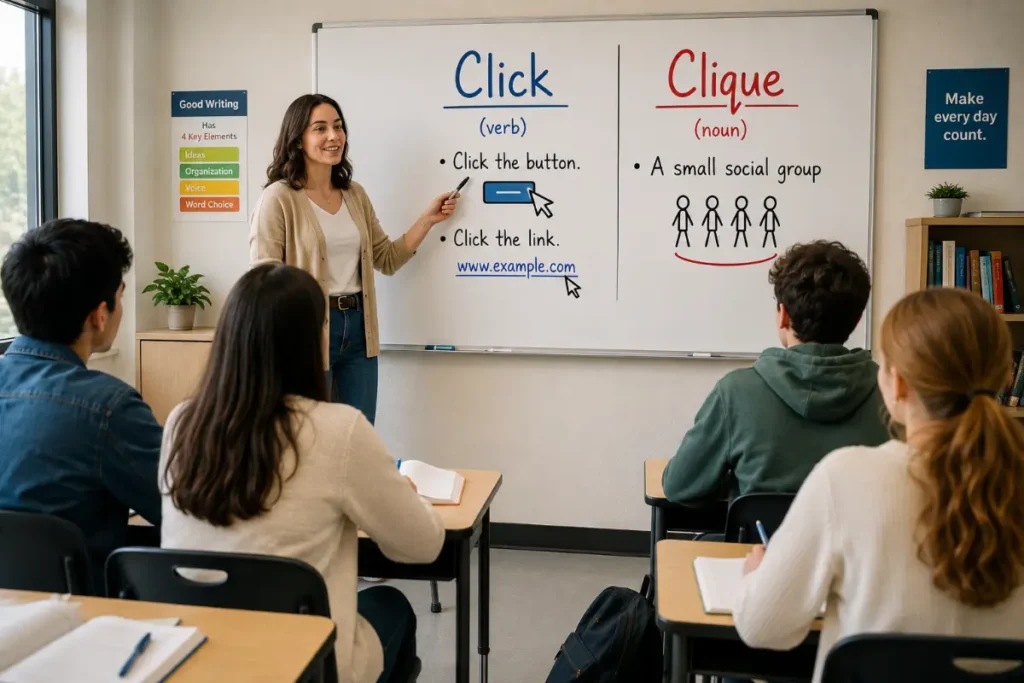
If you’re wondering about click or clique, the answer depends on what you mean. Click is the word you need for pressing a mouse button, making a short sharp sound, or becoming popular with someone. Clique means a small and often exclusive group of people who spend time together.
The two words sound almost identical when spoken. That’s why they’re easy to mix up in writing. A sentence like She joined the popular click at school looks reasonable at first glance, but it uses the wrong spelling if you mean a social group.
The difference becomes much easier once you connect each word with its meaning. Think of click as an action or sound. Think of clique as a group. This article explains the meanings, pronunciation, common mistakes, memory tricks, and real examples so you can choose the right word without stopping to second guess yourself.
Quick Definition
Click is a verb or noun related to pressing something, making a short sound, or forming a connection. For example, you can click a button, hear a click, or click with someone.
Clique is a noun that means a small group of people who spend time together and may not welcome outsiders. It often describes a social group at school, work, or in another community.
Direct Answer
Use click when you mean pressing something, making a short sound, or getting along with someone. Use clique when you mean a small social group that tends to stay together.
Comparison Table
| Word | Meaning | Example Sentence | When To Use It |
|---|---|---|---|
| Click | To press something, make a short sound, or connect well with someone. | Click the button to continue. | Use it for actions, sounds, computers, or personal connections. |
| Clique | A small and often exclusive social group. | She never felt welcome in their clique. | Use it when talking about a group of people. |
Why These Words Are Confusing
The main reason these words cause trouble is their sound. In most American English speech, click and clique are pronounced the same way. They are homophones, which means they sound alike but have different spellings and meanings.
That creates a problem that pronunciation alone can’t solve. If someone says, She’s part of a clique, you can’t tell from the sound alone how the word is spelled. You need to understand the meaning of the sentence first.
English has many words that work this way. Words like right and write sound the same but have different meanings. Their, there, and they’re create a similar problem. The spelling depends on the job the word does in the sentence.
The same idea applies here. If you’re talking about a computer mouse, a button, a sound, or getting along with someone, click is the right choice. If you’re talking about a tight social group, clique is the word you want.
What Click Means
Click has several meanings, which explains why you see it in so many different situations. It can describe a physical action, a sound, a sudden understanding, or a good connection between people.
The most familiar use probably comes from computers and phones. You can click a link, click an icon, or click a button. In these cases, the word describes pressing something with a mouse or another pointing device.
For example:
- Click the blue button to submit the form.
- I clicked the link in the email.
- She clicked the icon on her desktop.
- Click here to see the full article.
The word can also describe a short, sharp sound.
- I heard a click from the lock.
- The camera made a quiet click.
- The door clicked shut behind him.
In each sentence, the meaning is connected to an action or sound. None of these examples refers to a group of people.
Click As A Verb
As a verb, click often describes pressing something or making a short sound. It can also describe the moment when two people connect easily.
For example:
- Click the arrow to open the menu.
- The light switch clicked into place.
- We clicked as soon as we met.
The last sentence has a different meaning from the first two. Here, clicked means that two people got along well or felt an immediate connection.
That use is common in everyday American English. Someone might say, I really clicked with my new coworker. They mean the two people understood each other and developed a comfortable connection.
Click As A Noun
Click can also work as a noun.
You might hear someone say:
- I heard a click behind me.
- Give the mouse a quick click.
- One click will open the file.
The noun refers to a short sound or a single pressing action.
You may also see click used in digital language. A website might report the number of clicks on a link or advertisement. In that setting, a click means one instance of someone selecting something on a screen.
What Clique Means
Clique has a much narrower meaning. It refers to a small group of people who spend a lot of time together and often share interests, habits, or social connections.
The word can describe a group at school.
- The popular clique always sat together at lunch.
- She wanted to join the drama club clique.
- He never felt comfortable around that clique.
It can also describe groups at work or in other social settings.
- There was a small clique in the office that always ate lunch together.
- The neighborhood had several different social cliques.
- She felt like an outsider around the group’s clique.
The word often carries a slightly negative feeling. It can suggest that the group keeps outsiders away or acts as if it is better than everyone else.
However, clique does not always describe a cruel or unfriendly group. The meaning depends on the context. A writer may simply use it to describe a tight group of people who spend most of their time together.
Clique Is A Noun
Unlike click, which can be a verb or a noun, clique is normally used as a noun.
You can say:
- She joined a clique.
- He belongs to a clique.
- The clique met after school.
- Their clique has known each other for years.
You would not normally use clique as a verb. You wouldn’t say, We cliqued at lunch to mean that you joined a social group. That would be incorrect in standard English.
This difference gives you another useful clue. If you need a word for an action, click may be the answer. If you need a word for a group of people, clique is the clear choice.
Click Or Clique In Real Sentences
Seeing the words in natural sentences can make the difference much easier to remember. The context usually tells you which spelling belongs there.
Consider this sentence:
Please click the button below.
The word click is correct because the sentence describes pressing a button.
Now look at this example:
The students formed a clique during their first year.
Here, clique is correct because the sentence refers to a social group.
The spelling changes because the meaning changes. The pronunciation stays almost the same.
Examples With Click
Here are some common ways you might see click used in everyday English.
- Click the image to enlarge it.
- I heard the click of the door closing.
- The camera made a loud click.
- Click the link in the message.
- She clicked on the wrong file.
- I clicked the button twice.
- The pieces clicked together perfectly.
- We clicked right away when we met.
- Something clicked in my mind during the lesson.
- The lock clicked into place.
Notice how varied the word can be. It can relate to technology, sounds, physical movement, understanding, or relationships.
Examples With Clique
Now look at examples using clique.
- The girls formed a tight clique in high school.
- He never felt accepted by the office clique.
- That clique always sat at the same table.
- She became part of a small group of friends.
- The school tried to discourage exclusive cliques.
- Several cliques developed within the organization.
- He avoided the popular clique at school.
- The group looked like a clique from the outside.
- She felt uncomfortable around the wealthy social clique.
- The new student struggled to break into the clique.
In all of these sentences, the word refers to people forming a close social group.
How To Tell Which Word You Need
When you’re unsure, don’t focus on the sound. Focus on the meaning.
Ask yourself what the sentence is talking about. If it involves a button, mouse, link, sound, connection, or sudden understanding, use click. If it describes a small group of people who stay together, use clique.
For example, imagine you want to write:
I joined the school click.
That spelling looks close, but the meaning tells you something is wrong. You’re talking about a group of students, so the correct sentence is:
I joined the school clique.
Now consider a different sentence:
Click the link to register.
There is no group of people here. The sentence describes an action involving a link, so click is the correct word.
This approach is much more reliable than trying to remember the spelling by sound. Since the two words sound the same, pronunciation won’t give you enough information.
Why Clique Has A Different Spelling
The spelling clique can look strange if you have only seen the word in writing. The final letters do not sound the way an English reader might expect. That unusual spelling comes from French.
The English word clique was borrowed from French. In French, clique referred to a group or a band of people. English kept much of the original spelling when the word became part of the language.
That history explains why clique does not look like a normal form of click. The two words developed separately even though they now have the same pronunciation in English.
You don’t need to remember the French history to spell the word correctly. Still, knowing where the unusual spelling comes from can make it easier to understand why the word has a qu instead of a ck.
The Best Memory Trick
The easiest way to remember the difference is to connect each spelling with its meaning.
Think of click as something you can do with a computer. You can click a button, click a link, or click a mouse. The spelling with ck fits the familiar action you probably perform every day.
Think of clique as a group. The unusual spelling can remind you that this isn’t an ordinary action word. It describes people who form a close social circle.
Another useful trick is to connect clique with the word group. Both describe a collection of people. You might remember the phrase this way.
Clique means group.
Click means action or sound.
That simple contrast covers most situations.
Use Click For Technology
When you see words such as button, link, mouse, screen, website, or icon, you will probably need click.
For example:
- Click the button to continue.
- Click the link below.
- Click the image to open it.
- Click the menu icon.
- Click the mouse once.
- Click the file to open it.
These sentences all describe an action involving a computer or another device.
You can also use click for online activity.
- The article received thousands of clicks.
- One click took me to the checkout page.
- The ad got more clicks this month.
- You can open the file with one click.
In modern English, this is one of the most common uses of the word.
Use Clique For Social Groups
If the sentence is about friends, students, coworkers, celebrities, or another group of people, clique may be the word you need.
For example:
- The students formed a clique.
- She became part of the popular clique.
- Several cliques existed at the school.
- He didn’t feel welcome in their clique.
- The office clique always ate lunch together.
The key idea is social grouping. A clique is not simply any group of people. The word usually suggests a small and close group that may be difficult for outsiders to join.
Clique Does Not Mean Any Group
This point matters because clique has a more specific meaning than group.
You can call a team a group. You would not normally call every team a clique.
For example, these sentences are natural.
- Our soccer team is a close group.
- The students formed a study group.
- Several employees created a volunteer group.
Calling these groups cliques could change the meaning. A clique usually suggests that the members have a strong social bond and that people outside the group may feel excluded.
Compare these examples.
- The students formed a study group to prepare for the exam.
- The students formed a clique that excluded other classmates.
The first sentence describes cooperation. The second suggests social separation.
That difference is important because clique often has a negative or critical tone. A writer may use it to suggest that a group is closed off, unfriendly, or overly concerned with who belongs.

Clique Can Have A Negative Tone
Imagine a teacher says:
There are too many cliques in this school.
The teacher probably isn’t simply saying that students have friends. The statement suggests that students are dividing themselves into small groups and leaving others out.
The same idea can appear at work.
The management clique always makes decisions together.
This sentence suggests that a small group has influence and may not include everyone in important discussions.
Still, the word isn’t always harsh. Context matters.
You might read:
Her close knit clique of childhood friends still meets every summer.
Here, the writer may simply be describing a group that has stayed close for many years. The word still suggests a sense of closeness, even though it can carry a slightly exclusive feeling.
Common Spelling Mistakes
The most common error is writing click when you mean a social group.
For example:
❌ The popular click invited her to lunch.
✔ The popular clique invited her to lunch.
The first sentence makes it sound like the popular group is an action or sound. The second sentence clearly identifies the group of people.
Another common mistake is using clique for a computer action.
❌ Clique the button below.
✔ Click the button below.
The second version is correct because the sentence tells the reader to press something on a screen.
These mistakes are easy to make because the words sound identical. You can’t always catch the error by reading the sentence aloud. You have to look at the meaning.
Click And Clique In Past Tense
The word click can change form because it can work as a verb.
For example:
- I click the link.
- I clicked the link.
- She clicks the button.
- We were clicking through the pages.
The past tense is clicked. The spelling keeps the same basic click pattern.
The word clique normally stays a noun.
You can say:
- She joined a clique.
- He left the clique.
- They formed a clique.
- The clique became popular.
You don’t normally create a past tense form from clique because it isn’t being used as a standard verb.
This gives you another practical test. If you’re trying to describe something someone did, click may be the word you need. If you’re naming a social group, clique is usually correct.
Click Can Describe A Connection
There is one use of click that causes another kind of confusion. The word can describe people who connect well.
You might say:
- I clicked with my new roommate.
- We clicked immediately.
- They didn’t really click.
- The two coworkers clicked from the start.
Here, click doesn’t mean pressing a button or making a sound. It means that people understand each other and get along naturally.
The expression click with someone is common in American English. It often describes an easy connection that happens quickly.
For example, you might meet someone at a party and discover that you have the same sense of humor. You talk for an hour and feel as if you’ve known each other for years. You could say, We really clicked.
This meaning has nothing to do with clique. A clique is the group. Click describes the connection between people.
Click With Someone
The phrase click with someone is especially useful in everyday conversation.
- I really clicked with my new teacher.
- She clicked with everyone on the team.
- We didn’t click at first.
- They clicked after working together for a few weeks.
The meaning is close to get along or connect well.
You could say:
- I really clicked with my new neighbor.
Or:
- I really got along with my new neighbor.
Both sentences communicate a similar idea. The word click simply gives the idea of an easy personal connection.
Click Can Also Mean Sudden Understanding
There is another common meaning that has nothing to do with computers or social groups.
Sometimes an idea suddenly becomes clear. English speakers often describe that moment by saying that something clicked.
For example:
- The math problem finally clicked.
- Her explanation made everything click.
- It suddenly clicked that I had the wrong address.
- Once I saw the example, the rule clicked.
In these sentences, click means that something became clear or understandable.
This use is common in school and everyday conversation. A teacher might explain a difficult grammar rule several times. Then a student suddenly understands it and says, Oh, now it clicks.
You can also use click as a noun in the expression make something click.
- The new example made the lesson click for me.
That means the example helped the speaker understand the idea.
Click Or Clique In School Writing
Students often encounter this spelling problem in essays and assignments because school is one of the places where social groups are discussed.
Suppose you’re writing about a group of students who spend all their time together. You might write:
The eighth grade clique often sat together during lunch.
That spelling is correct because the sentence refers to a social group.
Now imagine you’re writing instructions for a school website.
Click the registration button to sign up for the event.
Here, click is correct because the reader needs to press a button.
The two words may appear in the same assignment.
The school clique shared a website where students could click a link to register.
The first word refers to the social group. The second refers to an action.
This is a useful reminder that spelling depends on meaning, not just sound.
Click Or Clique At Work
The same difference appears in workplace writing.
You might see a sentence like:
Click the file to open the report.
That is a simple instruction.
Now consider:
Several employees felt excluded by the office clique.
This sentence is about workplace relationships.
Both words can appear in professional writing, but they serve completely different purposes. Mixing them up can make an otherwise clear sentence look careless.
If you’re writing an email or report, take a second to check the meaning before choosing the spelling. This is especially useful when proofreading because spell check may not catch the mistake. Both click and clique are correctly spelled English words, so a computer can easily miss the fact that you’ve chosen the wrong one.
Why Spell Check May Not Catch The Error
This is an important point for anyone who writes online.
Suppose you type:
The popular click invited me to join.
Your spell checker may not underline click because click is a real English word. The problem isn’t the spelling itself. The problem is that the word doesn’t fit the meaning of the sentence.
This is called a contextual spelling error. The word is spelled correctly, but it is the wrong word for the sentence.
The same thing happens with many English homophones.
A spell checker can recognize there, their, and they’re as valid words. It may not know which one you intended. The same issue applies to click and clique.
That is why proofreading requires more than checking for red underlines. You also need to read the sentence for meaning.

A Simple Proofreading Test
When you aren’t sure about the spelling, replace the word with a simpler description.
Ask yourself:
Am I talking about an action or sound?
If yes, use click.
Am I talking about a small social group?
If yes, use clique.
For example:
She joined the ___ at school.
Replace the missing word with small social group. The sentence makes sense, so clique is correct.
Now try:
___ the button to continue.
Replace the missing word with press. That works, so click is correct.
This test takes only a few seconds. It can save you from a spelling mistake that a normal spell checker may miss.
Related Words That Cause Similar Problems
The confusion between these two words belongs to a larger group of spelling problems in English. Homophones often cause trouble because pronunciation doesn’t tell you which spelling to choose.
Consider site, sight, and cite.
- A website is a site.
- Your ability to see is your sight.
- To mention a source is to cite it.
The words sound alike, but their meanings are different.
Another example is stationary and stationery.
- Stationary means not moving.
- Stationery means writing materials.
The same basic lesson applies. Don’t choose a spelling based only on sound. Think about the meaning and the role of the word in the sentence.
Why Context Matters
Context gives you the information pronunciation can’t provide.
If someone says:
I joined the clique.
You know from the context that they are talking about people.
If they say:
Click the link.
You know they are describing an action.
When you see the words in writing, the spelling gives you an extra clue. When you hear them spoken, you have to rely on context.
That is why listening and reading skills work together when learning English. Good writers learn to notice meaning as well as sound.
How To Remember The Difference
The easiest way to remember click or clique is to connect each word with one clear idea.
Click is connected with an action or a sound. You can click a button. You can hear a click. You can click with someone. You can also say that an idea finally clicked.
Clique is connected with people. A clique is a small social group that often stays close and may leave outsiders out.
A quick memory line can help:
Click is something you do. Clique is a group you join.
That isn’t a rule for every possible use of the words, but it works well for the spelling confusion that causes most mistakes.
Think About The Letters
The unusual qu in clique can actually help you remember the word.
Think of the u as part of the unusual spelling that belongs to the social group. If you’re talking about a group of friends, students, or coworkers, clique is the spelling you want.
For computer actions and sounds, use the shorter and more familiar click.
You don’t need to memorize the full history of the word. A simple connection between spelling and meaning is enough.
Common Mistakes With Click And Clique
Most mistakes happen because the writer hears the word in their head instead of thinking about its meaning. Since both words sound the same, that can lead to the wrong spelling.
Mistake One
❌ The popular click was sitting together at lunch.
✔ The popular clique was sitting together at lunch.
The sentence describes a social group, so clique is correct.
Mistake Two
❌ Clique the button below to continue.
✔ Click the button below to continue.
The sentence gives the reader an instruction. It means to press the button, so click is correct.
Mistake Three
❌ I really cliqued with my new neighbor.
✔ I really clicked with my new neighbor.
The phrase click with someone means to connect well with them. The word is click, not clique.
Mistake Four
❌ The math lesson finally cliqued for me.
✔ The math lesson finally clicked for me.
Here, clicked means that the idea suddenly became clear. Again, the correct word comes from click.
When Click And Clique Appear Together
Sometimes both words can appear in the same sentence. This is a good way to see how different their meanings are.
For example:
The school clique shared a page where students could click a link.
The first word refers to a group. The second refers to an action.
Here is another example:
The office clique created a private chat and asked everyone to click the invitation link.
Again, clique describes the people. Click describes what someone does with the link.
These examples show why context matters so much. The words may sound identical when spoken, but their meanings are completely different.
Click And Clique In Everyday American English
Both words are common in the United States, but they appear in very different situations.
You probably use click often when talking about computers and phones. Websites, apps, online forms, and digital instructions use the word constantly.
You may also hear click in conversations about relationships.
We clicked right away.
That sentence sounds natural and casual.
Clique appears more often when people discuss social groups. You might hear it when talking about high school, college, workplaces, clubs, neighborhoods, or social circles.
For example:
Every school seems to have at least one popular clique.
The word can sound critical, especially when the group excludes people.
Click In Digital Language
Modern technology has given click many common uses.
A website may tell you to click a button. An online report may count clicks. A marketer may talk about getting more clicks on an ad. A teacher may ask students to click a link in an online lesson.
You may see sentences like these:
Click the menu to see more options.
The article received more clicks this week.
Click the image for a larger version.
The link only works after you click it.
None of these uses has anything to do with a social group.
Clique In Social Language
Clique often appears in discussions about friendships and social behavior.
For example:
The new student struggled to fit into the clique.
Several cliques formed during the first semester.
She never liked the idea of joining a clique.
The office had a small clique that rarely included other employees.
The word can suggest exclusivity. That means the group may make it hard for people outside the group to join.
Still, don’t assume that every use of clique is strongly negative. Context controls the tone.
Is Clique Always Negative
No. A clique can simply be a close group of people. However, the word often carries a suggestion of exclusivity.
Compare these sentences:
She has a close group of friends.
She belongs to a clique.
The first sentence sounds neutral and friendly. The second can suggest that the group is closed to outsiders.
That difference matters in careful writing. If you want to describe a friendly group without implying exclusion, group, circle of friends, team, or social circle may be better choices.
For example:
She has a close circle of friends from college.
That sentence does not suggest that the friends deliberately exclude other people.
If you write:
She belongs to a college clique.
The reader may picture a more exclusive social group.
Is Clique The Same As A Group
Not exactly.
A group is a broad word. It can describe almost any collection of people who share something.
A clique is more specific. It usually refers to a small social group with a strong sense of membership.
A sports team is a group. A study group is a group. A committee is a group. A group of friends can become a clique when the members form a close social circle that tends to keep others out.
That distinction is useful when choosing words for an article, essay, or story. Don’t automatically replace group with clique just because several people are involved.
Pronunciation Of Click And Clique
In standard American English, click and clique are pronounced the same way.
Both are commonly pronounced like klik.
That shared pronunciation is called a homophone relationship. The words have different spellings and meanings but the same sound.
This is why listening alone can’t tell you which word someone means.
If a friend says:
I’m part of a clique.
You hear the same basic sound as click. The surrounding words give you the meaning.
For English learners, this is a useful reminder that English spelling doesn’t always match pronunciation in a simple way. Some words have silent letters. Others have several possible spellings for the same sound.
The best solution is to learn the spelling together with the meaning.
Click Or Clique In Professional Writing
Professional writing needs extra care because small word errors can affect credibility. A reader may understand what you mean, but a wrong word can still make your writing look rushed.
Imagine a workplace article that says:
The office click often excludes new employees.
The reader may understand that the writer means a social group. Still, click is the wrong word.
The correct sentence is:
The office clique often excludes new employees.
Now imagine a website instruction that says:
Clique the button to download the file.
That is also incorrect.
The correct version is:
Click the button to download the file.
These errors are especially easy to miss because both words are real English words. A spell checker may not flag either one.
A Quick Editing Checklist
Before publishing or submitting your writing, ask yourself three questions.
First, am I talking about pressing something, making a sound, understanding something, or connecting with someone? If so, use click.
Second, am I talking about a small social group? If so, use clique.
Third, could the sentence make sense with both words? If it could, read the surrounding sentence and focus on the intended meaning.
This takes very little time. It is much more useful than trying to remember how the words sound because their pronunciation is almost identical.
A Fast Practice Test
Try choosing the correct word in these sentences.
Please ___ the link below.
The answer is click.
The students formed a small ___.
The answer is clique.
I really ___ with my new coworkers.
The answer is clicked.
The popular ___ rarely invited new students.
The answer is clique.
The idea finally ___ after my teacher explained it.
The answer is clicked.
If you can make these choices without thinking too hard, you’ve understood the main difference.
Other Spellings You Should Avoid
Because the words sound alike, people sometimes invent spellings that look like combinations of the two.
You may occasionally see mistakes such as clik, clikque, or clique used where click is needed. These forms are not standard English spellings.
The two standard words you need are simple:
click
clique
Don’t add extra letters to either word. The spelling depends on the meaning.
FAQs
Is click or clique the correct spelling for a social group?
Clique is the correct spelling for a small social group. For example, The popular clique sat together at lunch. Click is not correct when you mean a group of people.
Is click or clique correct for pressing a button?
Click is correct. You can click a button, click a link, or click an icon on a computer or phone. Clique does not describe this action.
Do click and clique sound the same?
Yes. In standard American English, they are normally pronounced the same way. Their different meanings and spellings are what separate them.
What does clique mean?
A clique is a small group of people who spend a lot of time together. The word often suggests that the group is close and may not easily accept outsiders.
What does click mean besides using a computer?
Click can describe a short sound, a sudden moment of understanding, or a good connection between people. For example, you can say We clicked right away when two people get along easily.
Is clique always a negative word?
No. It can simply describe a close social group, but it often carries a suggestion of exclusivity. If you want a completely neutral term, group or circle of friends may work better.
Why does clique have a different spelling?
Clique entered English from French and kept its unusual spelling. Click developed separately and has a different history. They now sound alike in English even though they have different meanings and spellings.
How can I remember the difference?
Think of click as an action and clique as a group. You click a button, but you join a clique. That simple contrast will help you choose the correct spelling in most situations.
Final Thoughts
The difference between click or clique becomes much easier once you stop focusing on how the words sound. They sound the same in American English, but their meanings are completely different. Click relates to an action, a sound, understanding, or a personal connection. Clique refers to a small social group.
The most useful rule is simple. If you can replace the word with press, sound, connect, or understand, use click. If you can replace it with small social group, use clique.
Remember the sentence You click a button but join a clique. It gives you a quick mental picture and covers the most common spelling mistake. Once that distinction becomes familiar, you won’t need to stop and think every time you write either word.
The next time you hear one of these words, ignore the sound and look at the meaning. If people are involved as a social group, choose clique. If someone is pressing something, hearing a sound, connecting with another person, or suddenly understanding an idea, choose click. That small habit will keep this common spelling error out of your writing.