
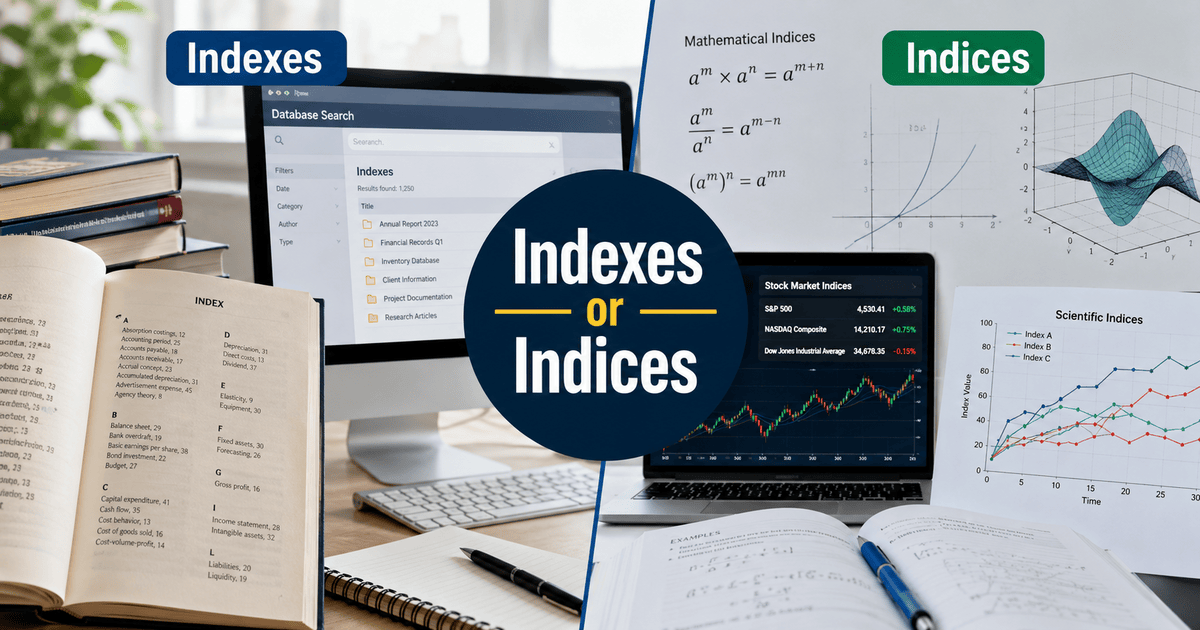
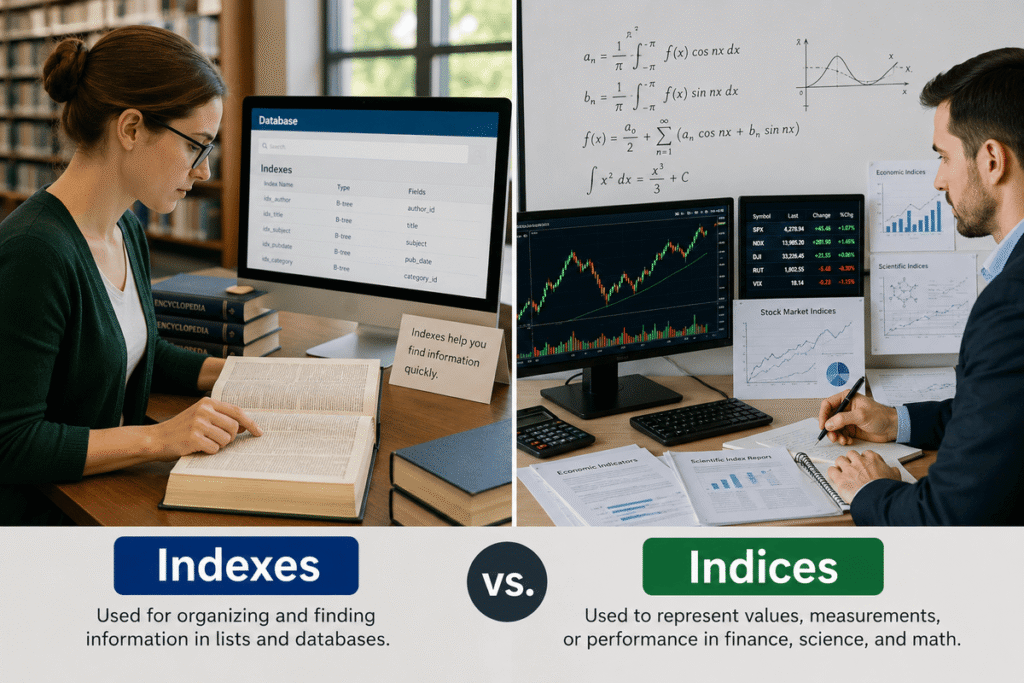
If you’re wondering indexes or indices, the short answer is that both spellings are correct. The best choice depends on what you’re writing about. In general, indexes is the preferred form in everyday English, publishing, databases, and search engines. Indices is more common in mathematics, science, finance, economics, and academic writing.
This can be confusing because many English words have only one accepted plural. In this case, both plurals are correct, but they are not always used in the same situations. Choosing the right one helps your writing sound natural and appropriate for your audience.
This guide explains the difference in plain English. You’ll learn when to use each plural, why both forms exist, where the confusion comes from, and how to remember the correct choice. You’ll also find plenty of real examples and common mistakes to avoid.
By the time you finish reading, you’ll know exactly which plural fits your sentence.
Quick Definition
Indexes and indices are both plural forms of the word index.
In modern English, indexes is usually used for book indexes, search indexes, databases, and general writing. Indices is often used in technical subjects like mathematics, economics, finance, statistics, and science.
Direct Answer
Both “indexes” and “indices” are correct. Use “indexes” for general English and publishing. Use “indices” in technical, scientific, mathematical, and financial contexts unless a style guide says otherwise.
Indexes and Indices Comparison
| Word | Meaning | Example Sentence | Most Common Use |
|---|---|---|---|
| Indexes | Plural of index | The librarian updated the book indexes. | Books, databases, search engines, general writing |
| Indices | Plural of index | The stock market indices ended higher today. | Math, science, economics, finance, academic writing |

Why People Get Confused
Most English nouns have one standard plural.
For example:
- Book becomes books.
- Table becomes tables.
- Car becomes cars.
The word index is different because it has two accepted plural forms.
That naturally leads people to ask which one is correct.
The answer is simple.
Both are correct.
The challenge is knowing which one sounds more natural in a particular subject.
You may read a business article that talks about market indices. Later the same day, you might hear someone mention the indexes at the back of several textbooks. Both writers are using the correct plural because the context is different.
This makes index one of the most interesting plural nouns in English.
What Does Index Mean?
Before choosing the correct plural, it helps to understand what an index actually is.
An index is something that points to, measures, organizes, or lists information.
Depending on the subject, it can have several meanings.
An Index in a Book
This is the meaning most people learn first.
A book index is an alphabetical list of important topics with page numbers that help readers quickly find information.
Example:
Open the index to find every page that mentions Abraham Lincoln.
Many nonfiction books include detailed indexes because they make information easier to find.
An Index in Computing
Computers also use indexes.
A database index helps software locate information faster.
Search engines create indexes of web pages so users can quickly find websites.
Examples:
- The search engine updated its indexes overnight.
- Database indexes improve performance.
- The software automatically rebuilds damaged indexes.
In computing, indexes is almost always the preferred plural.
An Index in Finance
In finance, an index measures the performance of a group of investments.
Examples include stock market averages and economic measurements.
Examples:
- Investors watched the market index closely.
- The economic index showed steady growth.
- Inflation index numbers increased this month.
Technical and financial writing often prefers indices for these uses.
An Index in Mathematics
Mathematics uses the word in another way.
An index can refer to an exponent or another mathematical value that describes a number or expression.
Example:
In the expression 2³, the number 3 is called the index in some educational systems.
Because mathematics follows long established academic traditions, indices is usually the preferred plural.
Why Are There Two Plurals?
The answer comes from history.
English borrowed the word index from Latin.
Many Latin words originally kept their Latin plural forms after entering English.
Over time, English also created regular plurals by simply adding es.
That left us with two acceptable choices.
Examples of similar word pairs include:
- Appendix and appendixes or appendices.
- Matrix and matrixes or matrices.
- Vertex and vertexes or vertices.
- Formula and formulas or formulae.
- Cactus and cactuses or cacti.
Some of these words now have one form that is much more common than the other. Others, like index, continue to use both depending on the situation.
When to Use Indexes
In modern everyday English, indexes is usually the safest choice.
If you are writing for a general audience, most readers expect to see indexes instead of indices.
It sounds natural and matches standard English plural rules.
Books and Publications
Publishing professionals almost always use indexes when talking about the lists found at the back of books.
Examples:
- The publisher revised all the indexes before printing.
- Several indexes were added to help readers.
- Digital textbooks often include interactive indexes.
Libraries
Libraries organize huge collections of information.
Examples:
- The librarian checked the indexes before helping students.
- Old newspaper indexes were stored in special cabinets.
- The library digitized thousands of historical indexes.
Databases
Database software commonly uses indexes.
Examples:
- The administrator optimized the database indexes.
- Missing indexes slowed the system.
- Automatic indexes improved search speed.
Search Engines
Modern search engines build massive collections of web pages called indexes.
Examples:
- Search engines update their indexes every day.
- Broken pages were removed from the indexes.
- Fresh indexes help deliver better search results.
In technology, indexes is considered standard usage.
When to Use Indices
While indexes works in many situations, some fields strongly prefer indices.
These areas often follow older academic traditions or specialized terminology.
Mathematics
Mathematics textbooks frequently use indices.
Examples:
- Students learned how to simplify expressions with indices.
- The teacher explained negative indices.
- Fractional indices require special rules.
If you’re writing about algebra or exponents, indices will usually sound more natural to teachers and mathematicians.
Economics
Economists often measure changes using various indices.
Examples include:
- Consumer price indices.
- Economic indices.
- Productivity indices.
- Inflation indices.
These measurements help governments and businesses understand changes over time.
Finance
Financial professionals also favor indices.
Examples:
- Global stock market indices closed higher today.
- Several indices reached record highs.
- Investors compare international indices before making decisions.
Many financial publications consistently use indices because it matches long standing industry practice.
Science
Scientists sometimes use indices when describing measurements, classifications, or statistical values.
Examples:
- Environmental indices improved this year.
- Health indices showed positive trends.
- Researchers compared several biological indices.
Academic journals commonly prefer this form.
How Style Guides Treat These Words
One reason people stay confused is that different style guides and industries have different preferences.
Most modern dictionaries accept both indexes and indices as correct plurals of index.
Instead of calling one right and the other wrong, they explain that the best choice depends on the subject and your audience.
For general writing, business communication, websites, and everyday English, indexes is usually the better option because it sounds more natural to most readers.
Technical fields often keep indices because it has been used in academic writing for many years.
If you’re writing for a school assignment, workplace, or publication that follows a style guide, check its recommendations before making a final choice.
How Different Industries Use the Word
Looking at real world usage makes the difference much easier to understand.
Publishing
Book publishers almost always use indexes.
Examples:
- The editor checked every one of the book indexes.
- The new edition contains updated indexes.
- The reference guide includes separate indexes for names and subjects.
Readers expect this wording because it has become the standard in publishing.
Technology
The technology industry also prefers indexes.
Examples:
- Database indexes speed up searches.
- The application rebuilt all its indexes overnight.
- Search indexes are updated automatically.
Programmers, database administrators, and software developers rarely use indices in these situations.
Mathematics
Math is one of the few subjects where indices is much more common.
Examples:
- Simplify expressions with positive indices.
- Students practiced laws of indices.
- Negative indices represent reciprocals.
If you open a mathematics textbook in many countries, you’ll probably see indices throughout the chapters.
Finance
Financial professionals often talk about market indices instead of market indexes.
Examples:
- Asian stock market indices gained value.
- Global indices reacted to the news.
- Investors monitor several economic indices.
This wording has become standard across many financial reports and investment publications.
Science
Scientists also lean toward indices, especially in research papers.
Examples:
- Researchers compared several climate indices.
- Health indices improved over five years.
- The report measured environmental indices.
The technical tone fits academic writing.
Can You Use Either One?
In many cases, yes.
Both plurals are grammatically correct, and most readers will understand what you mean.
Still, choosing the form that matches your topic makes your writing feel more polished.
Imagine these sentences.
The librarian updated all the indices.
This is not wrong, but many readers would expect indexes because the topic is books.
Now look at this sentence.
Scientists analyzed several climate indexes.
Again, it is not technically incorrect, but indices sounds more natural in scientific writing.
Matching the common usage in your field helps your writing sound professional.
Real World Example Sentences
Seeing the words in context is one of the best ways to remember them.
Examples Using Indexes
- The librarian updated the indexes before the new semester.
- Search engine indexes grow every day.
- The software repaired damaged database indexes.
- The editor reviewed all the indexes carefully.
- Online bookstores create searchable indexes for readers.
- Library indexes make research much easier.
- Digital indexes save users a lot of time.
Examples Using Indices
- The teacher explained the laws of indices.
- Global market indices rose after the announcement.
- Researchers compared several health indices.
- The report included economic indices from five countries.
- Students solved equations involving negative indices.
- Financial indices reflected stronger investor confidence.
- Scientists tracked environmental indices over several decades.
Reading these examples makes it easier to notice the patterns.
Common Mistakes People Make
Here are some mistakes that appear often.
Using Indices for Book Indexes
Incorrect:
The textbook includes detailed indices at the back.
Better:
The textbook includes detailed indexes at the back.
Publishing almost always prefers indexes.
Using Indexes in Mathematics
Less natural:
The chapter explains fractional indexes.
More natural:
The chapter explains fractional indices.
Math teachers usually expect indices.
Mixing Both Forms in the Same Document
Choose one style that fits your topic.
For example, a mathematics textbook should not switch back and forth between indexes and indices without a good reason.
Consistency makes writing easier to read.
Assuming One Form Is Wrong
Some writers think only one plural is correct.
That is not true.
English accepts both forms.
The better choice depends on context.
Easy Memory Tricks
You do not have to memorize dozens of grammar rules.
A few simple memory tricks can help.
Think About Your Audience
Ask yourself who will read your writing.
If you’re writing for everyday readers, students, customers, or website visitors, indexes is usually the safer choice.
If you’re writing for mathematicians, economists, scientists, or financial professionals, indices often sounds more natural.
Remember the Pattern
Think of it this way.
- Books use indexes.
- Computers use indexes.
- Search engines use indexes.
But
- Math uses indices.
- Finance uses indices.
- Science often uses indices.
This simple pattern covers most situations.
Use the Regular Rule First
Most English nouns form their plurals by adding es or s.
Since indexes follows the regular English pattern, it is usually the easier choice unless you’re writing in a technical field.

Related Word Pairs With Two Accepted Plurals
English has several nouns that can form more than one plural.
Learning them helps you understand why index behaves this way.
Appendix
Both are correct.
- appendixes
- appendices
General writing often uses appendixes, while medical and academic writing commonly uses appendices.
Matrix
Both forms are accepted.
- matrixes
- matrices
Scientific writing usually prefers matrices.
Formula
Both are correct.
- formulas
- formulae
Modern English often uses formulas, while some scientific fields still use formulae.
Vertex
Both are accepted.
- vertexes
- vertices
Geometry usually prefers vertices.
These examples show that English sometimes keeps older Latin plurals while also accepting regular English plurals.
Practice Quiz
Fill in each blank with the best choice.
- The librarian organized several book ______.
- Investors watched the major stock market ______ throughout the day.
- The database administrator rebuilt all the search ______.
- Students learned about negative ______ in algebra class.
- The editor checked every ______ before approving the textbook.
Answers
- indexes
- indices
- indexes
- indices
- index
Notice that the singular form remains index. Only the plural changes.
Quick Tips for Choosing the Right Word
If you’re still unsure, remember these simple guidelines.
- Use indexes in everyday writing.
- Use indexes for books, libraries, databases, and search engines.
- Use indices in mathematics, economics, finance, and many scientific fields.
- Follow your organization’s style guide if one exists.
- Stay consistent throughout your document.
- Remember that both forms are correct. The topic determines which one sounds best.
After you’ve used these words a few times, choosing the right plural becomes much easier. Most writers naturally develop a feel for which one fits the context.
FAQs
Are indexes and indices both correct?
Yes. Both indexes and indices are accepted plural forms of index. The best choice depends on the context. Indexes is more common in general English, while indices is often preferred in mathematics, science, finance, and economics.
Which is more common in everyday English?
Indexes is the form most people use in everyday writing and conversation. It is the standard choice for books, libraries, databases, websites, and search engines. If you’re writing for a general audience, indexes is usually the safest option.
Why do mathematicians use indices?
Mathematics has kept many traditional Latin word forms. Because of that history, indices became the preferred plural in algebra and other areas of math. Many textbooks and teachers continue to use it today.
Should I say stock market indexes or stock market indices?
Both are grammatically correct, but stock market indices is more common in financial reports, investment news, and academic writing. It matches the terminology used by many economists and financial professionals.
Is indexes wrong in scientific writing?
No. Readers will still understand your meaning. However, many scientific journals and research papers prefer indices because it follows long established academic conventions.
What is the plural of index in a book?
The most common plural is indexes. Publishers, editors, librarians, and readers almost always use indexes when referring to the alphabetical lists found at the back of books.
Do dictionaries prefer one spelling over the other?
Most modern dictionaries list both plurals as correct. They explain that indexes is generally used in everyday English, while indices appears more often in technical and academic subjects.
How can I remember the difference?
Think about your audience. If you’re writing for everyday readers, use indexes. If you’re writing about mathematics, finance, economics, or science, indices will usually sound more natural.
Conclusion
Choosing between indexes or indices is easier once you know that both forms are correct. The difference is not about right versus wrong. It is about matching your word choice to the subject and your audience.
For most everyday writing, indexes is the better choice. It is the standard plural for book indexes, library catalogs, databases, and search engines. Most readers expect to see this spelling because it follows the regular English pattern.
Technical subjects often prefer indices. Mathematics, economics, finance, and many scientific fields have used this plural for years, so it continues to appear in textbooks, research papers, and professional publications.
The next time you pause over indexes or indices, think about what you’re writing. If your topic is general English or technology, indexes will almost always fit. If you’re writing for a technical or academic audience, indices is often the more natural choice. Following this simple rule will help your writing sound accurate, polished, and professional every time.