
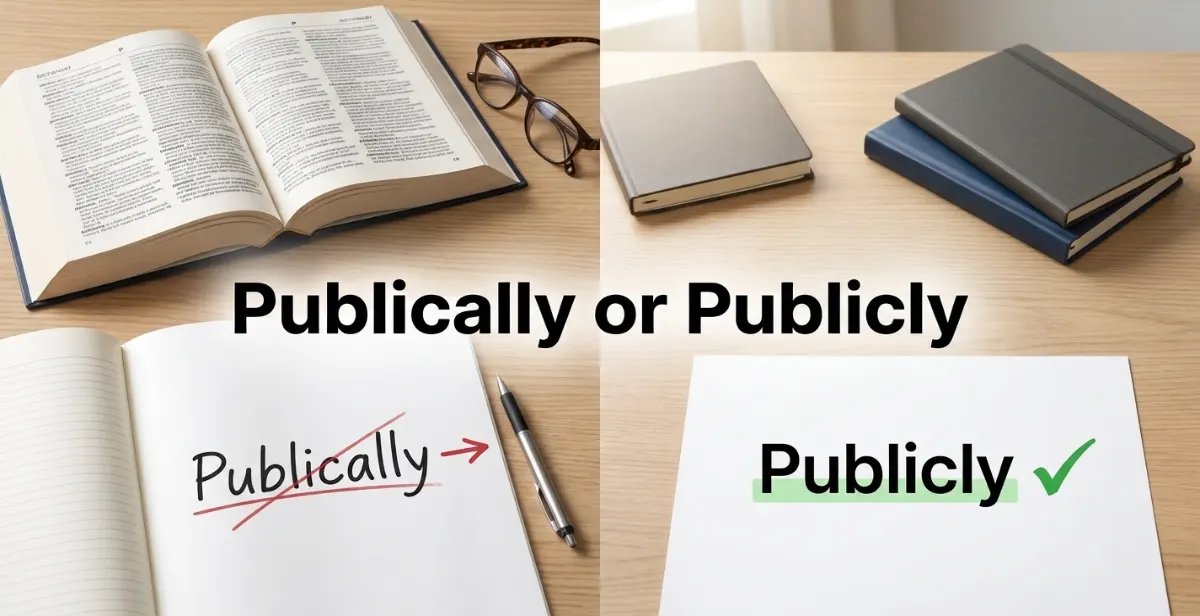
If you’re stuck on publically or publicly, use publicly in your writing. It’s the standard and much more common spelling of the adverb that means openly, in front of people, or in a way that is available to the public. Major dictionaries such as Merriam Webster and Oxford list publicly as the main form, while Merriam Webster also records publically as a less common variant.
The confusion makes sense. Many English words ending in ic form their adverbs with ically. For example, basic becomes basically, dramatic becomes dramatically, and automatic becomes automatically. That pattern can make publically look perfectly reasonable.
There’s a small twist, though. Publicly is the form you’ll usually want, especially in American English and in formal writing. Publically does appear in real English and some dictionaries recognize it, but it’s far less common and may be treated as nonstandard or disputed depending on the dictionary and style guide.
This guide explains why the spelling causes so much trouble, what the word means, how to use it in a sentence, and why English breaks its usual pattern here. You’ll also see common mistakes, easy memory tricks, and examples that show exactly when to use the standard form.
Quick Definition
Publicly is an adverb that means openly, in front of other people, or in a way that is available for people to see or know about. It can also describe something done by, for, or on behalf of the public or government.
Publically has the same basic meaning, but it is much less common and is treated as a variant or disputed form by some dictionaries. For clear, standard writing, publicly is the safest choice.
Direct Answer
The standard spelling is publicly. Use it in school, work, academic writing, professional communication, and most edited content.
Publicly And Publically Compared
| Word or phrase | Meaning | Example sentence | When to use it |
|---|---|---|---|
| Publicly | Openly or in a way that the public can see or know about | She publicly apologized for the mistake. | Use this as the standard form |
| Publically | Same basic meaning as publicly | He publically discussed the issue. | Recognized by some dictionaries as a variant, but uncommon and best avoided in formal writing |
The two forms do not normally have different meanings. The main difference is spelling, frequency, and acceptance in edited English.
Merriam Webster lists publicly as the main entry and gives publically as a less common variant. Collins also recognizes publically but labels it a variant in British English and a disputed variant in American English.
That distinction matters because you may see publically in published material and wonder if your spelling checker is wrong. It isn’t necessarily a meaningless or invented form. It is a real variant that has been used for a long time. Still, publicly is the form that will look natural to most readers and editors.
Why The Spelling Causes Confusion
The biggest reason for the confusion is the way English usually forms adverbs from adjectives ending in ic.
Take the adjective dramatic. Its adverb is dramatically.
Basic becomes basically.
Automatic becomes automatically.
Scientific becomes scientifically.
Specific becomes specifically.
These examples create a strong pattern. When writers see public, they may expect the adverb to follow the same general idea and become publically.
There is also a visual reason for the mistake. The word public already ends with ic, so adding ally can seem more complete than adding ly. A writer may think that public plus ally should produce publically.
But English spelling does not always follow the pattern that seems most logical. Publicly is one of those unusual forms.
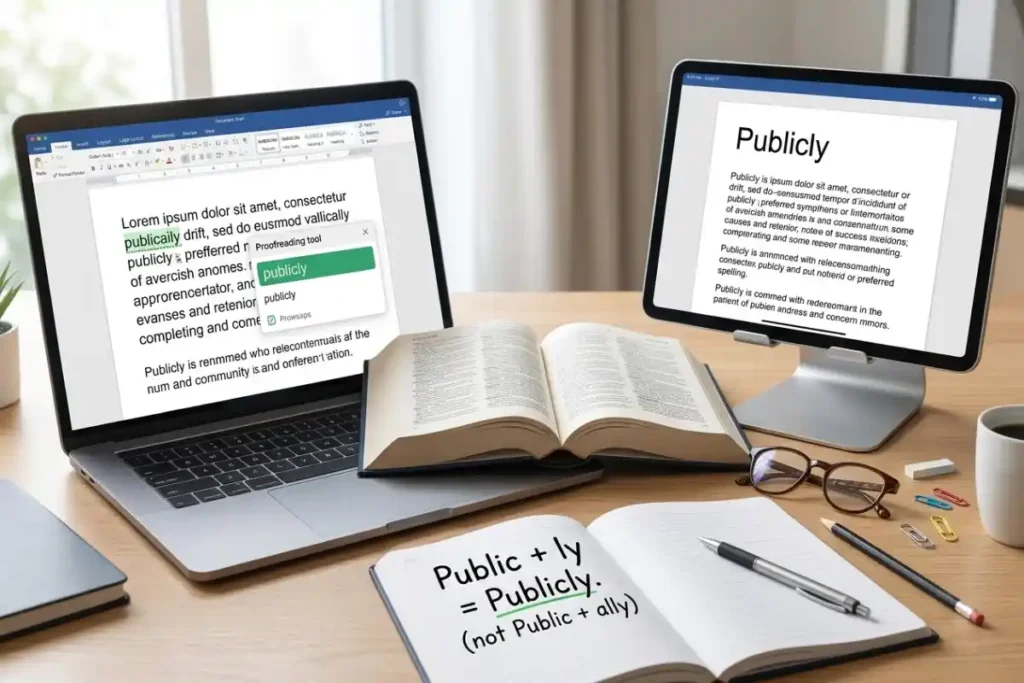
The standard adverb is formed directly from public and ly. That gives us public plus ly, producing publicly.
The word may look unusual beside words such as basically and logically, but unusual does not mean wrong. English contains many spelling patterns that have developed through history rather than through a single simple rule.
Why Publicly Is The Standard Form
Publicly has been used for centuries. Merriam Webster gives its first known use as 1534 and lists publicly as the main entry. It defines the word as meaning in a way observable by or accessible to the public, openly, by the people generally, or by a government.
Oxford also lists publicly as an adverb. Its meanings include being done by the government, being done openly for people to hear or know about, and being available for general use.
That gives us a useful rule for everyday writing.
When you need the adverb form of public, write publicly.
For example:
The company publicly announced the change.
She publicly accepted responsibility.
The report is publicly available.
He spoke publicly about the problem.
The research was publicly funded.
These sentences all use the standard form.

What Publicly Means
Publicly can have several closely related meanings. The exact meaning depends on the sentence, but the central idea is that something is open to other people rather than kept private.
Openly In Front Of Other People
The most common meaning is openly or in public.
If someone speaks publicly, other people can hear what that person says. If someone apologizes publicly, the apology is made in a setting where other people can know about it.
Consider these examples.
The actor publicly apologized to the audience.
The mayor publicly defended the decision.
She publicly criticized the proposal.
He publicly thanked his team.
The company publicly admitted that the report contained errors.
In each sentence, the action is not private. It is exposed to a wider audience.
Available To The Public
Publicly can also describe information, services, records, or resources that people can access.
For example:
The records are publicly available.
The data is publicly accessible.
The report was posted publicly online.
The library provides publicly accessible research materials.
The results are now publicly available.
Here, publicly does not necessarily mean that someone stood in front of a crowd. It means that the information or material is open for people to access.
Oxford gives examples such as publicly available and publicly accessible for this use.
Done By The Government
Publicly can also mean by the government or through public funds.
For example:
The project was publicly funded.
The hospital is publicly owned.
The research was publicly financed.
The program is publicly supported.
This meaning appears often in government, business, finance, and policy writing. Cambridge defines publicly in this sense as something done, owned, or paid for by the government.
The word therefore does more than describe something happening in front of a crowd. It can also describe something connected with public ownership, funding, access, or responsibility.
Publicly In Real Sentences
Seeing the word in different situations is one of the easiest ways to understand it.
Public Apologies
A public apology is made openly rather than privately.
The company publicly apologized after the product recall.
The player publicly apologized to the fans.
She publicly admitted that she had made a mistake.
The manager publicly accepted responsibility for the decision.
Notice that publicly tells us how the action happened. The person apologized, admitted, or accepted responsibility in an open way.
Public Statements
The word is common when people make statements that are intended for a wider audience.
The senator publicly rejected the accusation.
The organization publicly supported the new policy.
The director publicly addressed the rumors.
The school publicly announced the schedule.
The company publicly confirmed the news.
These sentences are common in journalism, business writing, government communication, and everyday reporting.
Public Information
Publicly also works naturally with words such as available, accessible, known, listed, posted, and recorded.
The information is publicly available.
The documents are publicly accessible.
The decision is now publicly known.
The results were publicly posted.
The records are publicly listed.
These combinations are worth learning because they appear often in professional and academic writing.
Public Funding
Another common group of expressions includes publicly funded, publicly owned, and publicly supported.
The museum is publicly funded.
The hospital is publicly owned.
The program is publicly supported.
The research was publicly financed.
The road was built with publicly funded resources.
These phrases describe government involvement or support rather than simply something happening in front of people.
Publicly Does Not Mean The Same As Public
Public and publicly are related, but they do different jobs in a sentence.
Public is commonly used as an adjective or noun.
Publicly is an adverb.
Compare these sentences:
The meeting was public.
The mayor spoke publicly about the meeting.
The first sentence uses public to describe the meeting.
The second uses publicly to describe how the mayor spoke.
Another example makes the difference clearer.
The information is public.
The information is publicly available.
In the first sentence, public describes the information.
In the second sentence, publicly modifies available. It tells us that people can access the information.
Understanding this difference can help you avoid another common mistake. If you need to describe an action, you will often need the adverb publicly rather than the adjective public.
Publicly And Privately
A useful way to understand publicly is to compare it with privately.
Publicly means openly or in a way that other people can know about.
Privately means away from the public or with only a limited group of people.
Compare these sentences:
She discussed the issue publicly.
She discussed the issue privately.
He apologized publicly.
He apologized privately.
The company responded publicly.
The company responded privately.
The meanings are clear because the two adverbs point in opposite directions.
Oxford lists privately as an opposite of publicly in several uses.
This contrast can also help you remember the spelling. If you would normally say privately for something done away from the public, the matching open form is publicly.
Why Publically Looks So Right
There is a useful spelling lesson hidden inside this word.
English has many adverbs that end in ically. Writers see this pattern again and again.
Basic becomes basically.
Economic becomes economically.
Historic becomes historically.
Scientific becomes scientifically.
Automatic becomes automatically.
That pattern is so common that publically feels natural.
The problem is that English has exceptions. Publicly is the established standard form.
This is similar to many other spelling questions where a familiar pattern encourages us to add letters that do not belong. The eye expects one form because it has seen similar words so often.
That does not make the alternative spelling completely random. Publically has been used and is recognized by some dictionaries. Merriam Webster calls it a less common variant, while Collins gives it variant status but notes that it is disputed in American English.
So the best practical rule is not that the longer spelling has never existed. The better rule is that publicly is the standard form you should choose.
Is Publically A Misspelling
The answer needs a little care.
If you write publically, many editors and spell checkers will prefer publicly. Some style guides and dictionaries may treat publically as nonstandard. Other dictionaries recognize it as a variant.
Merriam Webster lists publically as a less common variant of publicly. Collins also recognizes the form but describes its status differently in British and American English. The American Heritage Dictionary calls it a nonstandard variant.
That means calling publically simply wrong can be too strong if we’re talking about the English language as a whole.
For practical writing, though, the choice is easy.
Use publicly.
If you’re writing an essay, article, report, email, application, business document, or professional message, publicly is the clear choice. It is the form readers are most likely to expect, and it avoids unnecessary questions about spelling.
Why Spell Checkers Often Flag Publically
You may have typed publically into a word processor and seen a red or blue underline.
That happens because spelling tools often favor the standard and more common form. Since publicly is much more common, software may suggest it when you type the less common variant.
A spell checker is not a complete dictionary of the English language. It is a practical tool designed to help users write common and accepted forms.
So a spelling warning does not always mean that a word has never existed. It can mean that the software prefers another form.
This is especially useful to remember with disputed or less common spellings. Dictionary status and spelling tool behavior are not always identical.
In this case, though, the software is giving you a useful recommendation. If it changes publically to publicly, accepting the correction is usually the right move.
Common Mistakes With This Word
The most common mistake is adding the extra al.
Incorrect for standard formal writing:
The company publically announced the results.
Preferred:
The company publicly announced the results.
Another mistake is using public when an adverb is needed.
Less natural:
The company announced the results public.
Better:
The company announced the results publicly.
The problem in that second example is not just spelling. Public and publicly have different grammatical jobs.
Adding Too Many Letters
The word can look strange because it contains the letters public followed by ly.
Some writers expect an extra al because they are thinking of words such as specifically or practically.
Do not let those examples control your spelling here.
Remember the standard form:
publicly
Not:
publically
Confusing Publicly With In Public
The phrases publicly and in public are closely related, but they are not always interchangeable.
She spoke publicly about the problem.
She spoke in public about the problem.
Both sentences can be correct.
Publicly is often shorter and more natural when you want to describe the manner of an action. In public is a phrase that can place more focus on the setting or social situation.
For example:
He rarely speaks publicly about his family.
He rarely talks about his family in public.
The meanings overlap, but the focus can be slightly different.
Confusing Publicly With Openly
Openly is another close synonym.
She publicly criticized the policy.
She openly criticized the policy.
Both can work, but publicly focuses on the public nature of the action. Openly focuses more on the fact that the person did not hide the opinion.
That distinction can matter in careful writing.
Publicly In Formal Writing
Publicly is a strong choice for formal writing because it is standard, clear, and widely recognized.
You can use it in academic papers.
The researchers publicly released the dataset.
You can use it in business writing.
The company publicly confirmed the acquisition.
You can use it in government writing.
The department publicly released the report.
You can use it in news writing.
The mayor publicly defended the decision.
You can use it in everyday communication.
She publicly thanked everyone who helped.
There is no need to replace publicly with a more complicated phrase just to sound formal. The word is already clear and professional.
Publicly In Academic Writing
Academic writers often use publicly with words such as available, funded, accessible, reported, stated, and recognized.
Examples include:
The dataset is publicly available.
The research was publicly funded.
The results were publicly reported.
The documents are publicly accessible.
The theory is publicly recognized in the field.
The archive contains publicly available records.
These phrases are useful because academic writing often needs to explain how information can be accessed or how a finding was shared.
If you’re writing a research paper, thesis, report, or study summary, publicly is the form to use.
Publicly In Business Writing
Business communication uses the word often, especially when discussing announcements, companies, markets, and information.
For example:
The company publicly announced its new policy.
The executive publicly addressed the concerns.
The firm publicly disclosed the information.
The organization publicly supported the proposal.
The shares are publicly traded.
The company is publicly listed.
The last two examples show another common use. Publicly can describe a company whose shares are available on a public market.
This is why phrases such as publicly traded company and publicly listed company appear so often in financial writing.
Publicly In News Writing
News reports often describe statements, reactions, decisions, and announcements.
The president publicly addressed the issue.
The organization publicly rejected the claim.
The team publicly confirmed the transfer.
The officials publicly defended the decision.
The company publicly responded to the criticism.
The word works well because it quickly tells readers that something happened in an open or widely visible way.
It can also help distinguish between public statements and private discussions.
The two sides discussed the issue privately before responding publicly.
That sentence gives the reader a clear sequence. The discussion happened in private first. The response came later in public.
Publicly Available And Publicly Accessible
These two expressions are especially common, but they are not exactly identical.
Publicly available usually means that information or material can be obtained or viewed by members of the public.
For example:
The report is publicly available online.
The data is publicly available through the agency website.
Publicly accessible often emphasizes access.
For example:
The archive is publicly accessible.
The database is publicly accessible to researchers.
A building can also be publicly accessible if members of the public can enter or use it.
The distinction is small in many situations, and the phrases can overlap. Both are standard and useful expressions.
Publicly Funded And Publicly Owned
These phrases appear frequently in government and policy discussions.
A publicly funded project receives money from public sources, often government funds.
A publicly owned organization or facility is owned by a government or public body.
For example:
The bridge was built through a publicly funded program.
The university operates several publicly funded research centers.
The hospital is publicly owned.
The museum receives publicly funded support.
The terms describe different relationships with public money and ownership, so they should not be treated as exact synonyms.
A Simple Memory Trick
The easiest way to remember the standard spelling is to focus on the base word.
Public plus ly gives publicly.
You do not need to add al.
Think:
Public → publicly.
Private → privately.
Open → openly.
Clear → clearly.
The pattern becomes easier when you see publicly beside other common adverbs.
You can also remember this sentence:
The public sees it publicly.
That gives you a simple visual link between public and publicly.
Another useful trick is to remember that publicly is the form used in the common phrase publicly available.
If you write publicly available often enough, the spelling becomes automatic.
A Second Memory Trick
Think of the word as having only one extra ending:
public + ly
That is all.
Do not mentally build it as:
public + al + ly
The second version is exactly what creates the extra letters.
When you’re writing quickly, pause for one second if the longer spelling looks tempting. Ask yourself whether you mean the common adverb that goes with public.
If you do, write publicly.
Related Words That Follow Different Patterns
One reason spelling rules can be frustrating is that related words do not always behave in the same way.
Look at these examples:
Basic becomes basically.
Tragic becomes tragically.
Logic becomes logically.
Public becomes publicly.
The first three follow the familiar ically pattern. Publicly does not.
This is a useful reminder that spelling patterns are guides, not absolute laws.
You can learn the common pattern and still memorize exceptions. Good spelling often works this way.
There is no need to invent a complicated rule to explain every exception. Sometimes the most useful approach is simply to know the standard form and recognize the unusual pattern.
Does The Meaning Change
No meaningful difference normally exists between publicly and publically.
If someone uses publically, they generally mean openly or in a way that is available to the public.
For example, these two sentences are intended to communicate the same idea:
She publicly discussed the issue.
She publically discussed the issue.
The difference is not one of meaning. The difference is that the first spelling is standard and much more common.
This is why changing publically to publicly during editing usually changes the spelling rather than the message.
Does American English Prefer Publicly
Yes. For American English, publicly is clearly the safer and more standard choice.
Merriam Webster lists publicly as the main form and publically as a less common variant. Collins describes publically as a disputed variant in American English.
That makes the practical advice simple for US writers.
Use publicly in school assignments, workplace documents, websites, articles, reports, and professional communication.
You may encounter publically in older material, online writing, quotations, or publications that accept variant spellings. Seeing it does not mean you need to copy it.
Is Publically Used In British English
It does appear in British English too.
Collins lists publically as a variant spelling in British English. At the same time, its entry for publicly treats publically as nonstandard in the main definition area.
So British usage does not create a strong reason to choose the longer spelling.
If you’re writing for a British audience, publicly remains the better general choice.
The same advice works across major varieties of English. It gives you a form that is familiar, standard, and unlikely to attract an editor’s correction.
Why Some Dictionaries Accept Publically
English dictionaries do not all follow the same approach.
Some dictionaries focus on describing forms that people actually use. If a spelling appears often enough in real writing, a descriptive dictionary may record it as a variant.
Other dictionaries place more emphasis on standard usage and may label the same form nonstandard, disputed, or uncommon.
That explains why you can search for publically and find a dictionary entry.
It does not mean that publicly has stopped being the preferred spelling. It simply shows that English contains variation.
Merriam Webster’s entry is a good example. It gives publicly as the main word and then lists publically as a less common variant.
The practical lesson is more useful than the dictionary debate.
A word can exist in the language and still not be the best choice for your writing.
When You Might See Publically
You may encounter publically in several places.
It can appear in older texts.
It can appear in informal online writing.
It can appear in material that has not been professionally edited.
It can appear in sources that accept variant spellings.
It can also appear because a writer followed the common ically pattern without checking the standard form.
You do not need to assume every use is a serious spelling error. Context matters.
If you are quoting someone exactly, you may preserve the original spelling. If you are editing the text, though, publicly is usually the better choice.
Editing Examples
Here are some examples of how an editor might improve the spelling.
Original:
The company publically denied the claim.
Edited:
The company publicly denied the claim.
Original:
The report was publically available online.
Edited:
The report was publicly available online.
Original:
She publically criticized the decision.
Edited:
She publicly criticized the decision.
Original:
The organization publically released the findings.
Edited:
The organization publicly released the findings.
In each case, the meaning stays the same. Only the preferred spelling changes.
A Quick Editing Checklist
When you see this word in your draft, check three things.
First, ask if you need an adverb. If the word describes how an action happens, publicly may be the right form.
Second, check the spelling. Use publicly rather than adding an extra al.
Third, look at the phrase around it. Common combinations such as publicly available, publicly funded, publicly known, publicly traded, and publicly announced can help confirm the intended form.
This takes only a few seconds and can prevent an easy spelling mistake from appearing in a finished document.
Common Phrases With Publicly
Learning common word combinations can make the spelling easier to remember.
Here are some useful examples:
Publicly available.
Publicly accessible.
Publicly funded.
Publicly owned.
Publicly traded.
Publicly listed.
Publicly announced.
Publicly stated.
Publicly known.
Publicly recognized.
Publicly supported.
Publicly criticized.
Publicly confirmed.
Publicly released.
Publicly reported.
Publicly apologized.
Publicly defended.
Publicly discussed.
Publicly admitted.
Publicly acknowledged.
These phrases cover many areas of modern English. You will see them in news reports, business documents, government information, academic writing, and everyday communication.
How To Use Publicly Naturally
The word usually comes before the verb it modifies or after the verb in a way that clearly shows how the action happened.
For example:
The company publicly announced the change.
The company announced the change publicly.
Both sentences are grammatical.
The first version is often more direct because publicly appears next to the verb.
Another example:
She publicly criticized the proposal.
She criticized the proposal publicly.
Again, both work.
English gives writers some flexibility with adverbs. The best position depends on the sentence and the emphasis you want.
Publicly At The Start Of A Sentence
You can also begin a sentence with publicly when the context makes the meaning clear.
For example:
Publicly, the company supported the proposal.
Privately, several executives disagreed.
This structure creates a useful contrast between public and private positions.
Another example is:
Publicly, he accepted the decision.
Privately, he remained unhappy with it.
Here, the sentence structure highlights the difference between what people could see and what happened behind closed doors.
Publicly And Openly In Comparison
Publicly and openly are close in meaning, but they emphasize different ideas.
Publicly focuses on an audience or the public.
Openly focuses on a lack of secrecy.
Compare:
The manager publicly discussed the problem.
The manager openly discussed the problem.
The first tells us that the discussion was made available to the public.
The second suggests that the manager did not hide the discussion or feelings about the problem.
Sometimes both meanings are present, so either word can work.
Choosing between them is often a matter of emphasis rather than grammar.
Publicly And Officially
These words are also sometimes confused.
Publicly means openly or before the public.
Officially means in an official or formally recognized way.
Consider:
The company publicly announced the decision.
The company officially announced the decision.
The first focuses on the announcement being made openly.
The second focuses on the announcement having official status.
A company can make something public without it necessarily being an official decision. Likewise, an official decision can exist before it is publicly announced.
Understanding that difference can make your writing more precise.
Publicly And Socially
Publicly can sometimes appear in discussions about social behavior, but it does not simply mean socially.
For example:
He publicly thanked his parents.
This means he thanked them in a public setting or in a way others could see.
It does not mean he thanked them as part of a social event in general.
Choosing the right adverb depends on the exact idea you want to express.
Why The Shorter Form Is Easier
There is also a practical reason to prefer publicly.
It is shorter.
It is more common.
It is recognized across major varieties of English.
It appears in standard dictionary entries.
It is the form most editors expect.
That makes it the better default.
When two spellings communicate the same idea but one is clearly more common and standard, the common standard form is usually the smart choice.
FAQs
Is publically or publicly correct
Publicly is the standard spelling. Publically is also recorded as a less common variant by some dictionaries, but it is not the preferred form for most formal writing.
Why is publicly spelled without an extra al
Publicly is formed from public plus ly. It does not follow the common pattern seen in words such as basically and dramatically. English has many spelling patterns with exceptions, and publicly is one of them.
Is publically a real word
Yes, some dictionaries recognize publically as a variant of publicly. Its status varies by dictionary, with some sources calling it uncommon, disputed, or nonstandard.
Should I use publically in formal writing
It is better to use publicly. The standard form is more familiar to readers and is the safer choice for academic, professional, business, and edited writing.
What does publicly mean
Publicly means openly, in front of other people, or in a way that is available to the public. It can also describe something done by, funded by, or owned by a government.
Is publicly an adverb
Yes. Publicly is an adverb. It commonly modifies verbs and explains that an action happened openly or in a way that other people could see or know about.
What is the opposite of publicly
The most common opposite is privately. Publicly describes something open or visible to others, while privately describes something done away from the public or with limited people.
Is publicly used in American English
Yes. Publicly is the normal standard spelling in American English. Publically appears in American usage as a less common or disputed variant, but publicly is the better choice for standard writing.
Conclusion
If you have to choose between publically or publicly, choose publicly. It is the standard spelling used for the adverb meaning openly, in front of people, or in a way that is available to the public.
The confusion comes from a common spelling pattern. Many adjectives ending in ic form adverbs with ically, so publically looks natural. But public is an exception, and its standard adverb is publicly.
Publically is not simply an imaginary spelling. Some dictionaries record it as a variant, and it has appeared in real English for a long time. Still, that does not make it the best choice for everyday formal writing. Merriam Webster identifies it as a less common variant, while other dictionaries give it a weaker status.
The easiest rule to remember is simple: public becomes publicly. When you’re writing an email, essay, article, report, or professional document, use publicly and move on. That one small spelling choice will keep your writing clear, standard, and natural.