
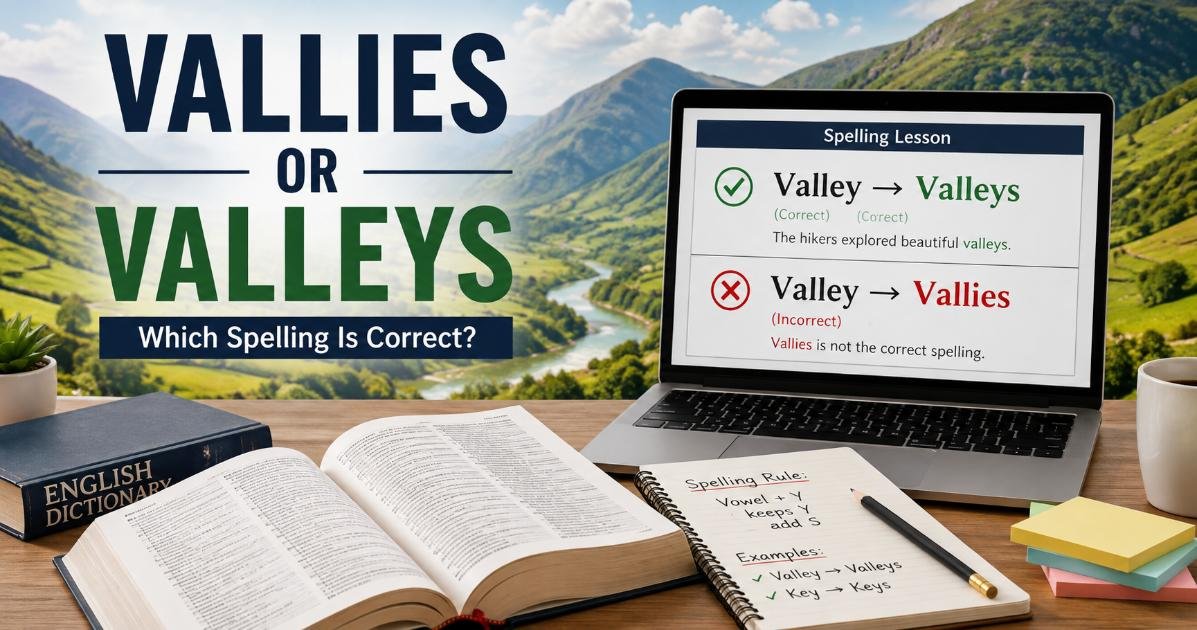
If you’ve ever wondered about vallies or valleys you aren’t alone. The two spellings look close enough to cause a quick typo, especially when you’re writing about mountains, hills, or a low area between high pieces of land. The correct spelling for that geographical word is valleys.
Vallies is not the standard spelling for the plural of valley. If you’re talking about more than one valley, write valleys. The word keeps its original ending and adds s to form the plural.
This spelling mistake is easy to make because English has many words that change y to ies when they become plural. Words such as city and family follow that pattern. Valley looks like it should work the same way, but it doesn’t because of the letter that comes before the final y.
Once you see that rule, the spelling becomes much easier to remember. This guide explains the correct spelling, the plural rule behind it, common mistakes, useful examples, and a few simple memory tricks that can help you avoid the error.
Quick Definition
A valley is a low area of land between hills or mountains. The plural form is valleys.
Vallies is not the standard plural spelling of valley. Use valleys when you mean two or more valleys.
Direct Answer
The correct spelling is valleys. Write valleys when you mean more than one low area of land between hills or mountains.
Comparison Table
| Word Or Spelling | Meaning | Example Sentence | When To Use It |
|---|---|---|---|
| Valley | One low area between hills or mountains. | The valley is covered with green grass. | Use for one valley. |
| Valleys | More than one valley. | The river runs through several valleys. | Use for two or more valleys. |
| Vallies | Incorrect spelling of the plural form. | The hikers crossed three valleys. | Do not use this spelling for the plural of valley. |
Why The Spelling Causes Confusion
The mistake usually comes from a real English spelling rule. When some words end in a consonant followed by y, the y changes to ies when the word becomes plural.
For example, city becomes cities. The word country becomes countries. A baby becomes babies, and a story becomes stories.
Because valley also ends in y, it can seem logical to write vallies. That spelling looks as if it follows the same rule. The problem is that the letter before the y matters.
In valley, the letter before the final y is e. That means the word does not follow the consonant plus y rule. Instead, you simply add s.
So the pattern is simple.
Valley + s = valleys.
The y stays exactly where it is.

The Letter Before Y Matters
This is the detail that makes the spelling rule much easier to understand.
Look at these words.
- City becomes cities.
- Family becomes families.
- Country becomes countries.
- Baby becomes babies.
In each case, the letter before the final y is a consonant. The plural form changes y to ies.
Now compare them with these words.
- Valley becomes valleys.
- Key becomes keys.
- Boy becomes boys.
- Day becomes days.
- Journey becomes journeys.
Here the letter before the y is a vowel. The plural is formed by adding s.
This small difference explains why vallies looks plausible but isn’t correct.
The Correct Plural Of Valley
The singular word is valley. The plural word is valleys.
You use valley when you’re talking about one place.
For example:
- The valley looks beautiful in the morning.
- A small village sits in the valley.
- We walked through the valley before sunset.
You use valleys when you’re talking about more than one.
For example:
- The mountains contain several narrow valleys.
- Snow covered the valleys below.
- The road passes through three valleys before reaching the town.
Nothing changes inside the word when you make it plural. You simply add s.
That makes the spelling easier than it may first appear. You don’t need to replace the final y. You don’t need to add es. You only need to add s.
Why Valley Uses S Instead Of Ies
The spelling rule becomes clearer when you look at the structure of the word.
The ending y can behave in two different ways when a noun becomes plural. The key question is the letter immediately before it.
If a consonant comes before y, the spelling often changes to ies.
For example:
- Puppy becomes puppies.
- Library becomes libraries.
- Enemy becomes enemies.
- Company becomes companies.
If a vowel comes before y, the word normally keeps the y and takes s.
For example:
- Toy becomes toys.
- Key becomes keys.
- Monkey becomes monkeys.
- Journey becomes journeys.
- Valley becomes valleys.
The word valley belongs to the second group.
The final two letters are ey. Since e is a vowel, the plural keeps the y.
This rule works for many common English nouns. Learning it can help you spell more than just this one word correctly.
Real Examples With Valley
Seeing the word in natural sentences is one of the best ways to make the spelling stick. The word can describe a wide range of places, from small areas between hills to huge regions surrounded by mountains.
Here are some examples.
The valley was covered in fog early in the morning.
This sentence refers to one specific low area. The singular form valley is correct.
The farmers grow crops in the fertile valley.
Again, the sentence describes one place, so the singular form works.
Several valleys surround the mountain range.
Here the sentence refers to more than one valley. The correct plural is valleys.
Heavy rain caused flooding in the nearby valleys.
The plural form is needed because the rain affected more than one area.
The hikers spent two days exploring the valleys.
The word valleys tells us that the hikers visited multiple low areas.
These examples also show that the plural spelling stays the same regardless of the sentence. The word always remains valleys when you mean more than one.
How The Word Is Used In Geography
A valley is more than just a low place. In geography, it usually refers to an elongated area of lower land between higher areas such as hills or mountains. Many valleys contain rivers or streams because water naturally moves toward lower ground.
Some valleys form through erosion. Moving water can slowly wear away rock and soil over long periods. Glaciers can also shape valleys as they move through mountainous regions.
That is why you may see the word in geography books, travel writing, nature articles, maps, and hiking guides.
For example:
- The river flows through a narrow valley.
- Glaciers helped shape many mountain valleys.
- The valley floor is wider near the river.
- Several valleys connect the mountain communities.
In all of these examples, valleys is the correct plural spelling.
The word can also appear in names of places. A region might be known for its valleys, farms, vineyards, rivers, or mountain views. When the name refers to several low areas, the same spelling rule applies.
A Simple Rule To Remember
Here’s the easiest way to remember the spelling.
Look at the letter before the final y.
If it is a consonant, the plural often changes y to ies.
If it is a vowel, keep the y and add s.
For valley, the letter before y is e. Since e is a vowel, the plural is valleys.
You can remember it with this quick pattern.
Valley has ey. Keep the y.
That short reminder is enough to prevent the most common spelling mistake.
Another useful trick is to compare valley with city.
A city becomes cities because t is a consonant.
A valley becomes valleys because e is a vowel.
Once you compare the two words, the difference becomes much easier to see.
Common Spelling Mistakes
The most common mistake is changing the final y to ies.
Incorrect:
vallies
Correct:
valleys
Another mistake is adding es.
Incorrect:
valleyes
Correct:
valleys
Some writers also accidentally leave out one of the letters in the middle of the word.
Incorrect:
valeys
Correct:
valleys
These errors usually happen because the word is being written from memory rather than from a clear spelling rule. Knowing the rule gives you something reliable to check.
If you are unsure, look at the ending. You should see ey before the final s.
Valley → valleys.
That is the complete change.
When To Use Valley
Use valley when you’re talking about one place.
You might say:
- The valley is quiet at night.
- We stopped in the valley for lunch.
- A river runs through the valley.
- The town lies in a wide valley.
The singular form can also appear after numbers or words that refer to one place.
For example:
- One valley separates the two towns.
- This valley is famous for its vineyards.
- The entire valley was covered in snow.
The key idea is simple. One place means valley.
When To Use Valleys
Use valleys when you’re talking about two or more places.
For example:
- The hikers crossed several valleys.
- The region has deep valleys and high peaks.
- Rivers run through many valleys.
- The mountains divide the neighboring valleys.
Words such as several, many, two, three, and many different can signal that you need the plural form.
If you can count more than one valley, use valleys.
That gives you a quick practical test. Ask yourself how many you’re talking about. One gives you valley. Two or more gives you valleys.
Valley In Common Expressions
The word valley appears in many common phrases and descriptions. Learning these can help you recognize the correct spelling more quickly.
You might hear valley floor when someone refers to the lower part of a valley. A river valley is a valley shaped or occupied by a river. A mountain valley describes a valley surrounded by higher mountain land.
You may also see phrases such as deep valley, narrow valley, wide valley, green valley, and fertile valley.
When these phrases become plural, only the noun needs to follow the normal plural rule when appropriate.
For example:
- The region has several river valleys.
- The hikers explored two narrow valleys.
- Green valleys stretched across the landscape.
- The farmers depend on fertile valleys.
The spelling stays valleys every time.
How To Tell Valley And Valleys Apart
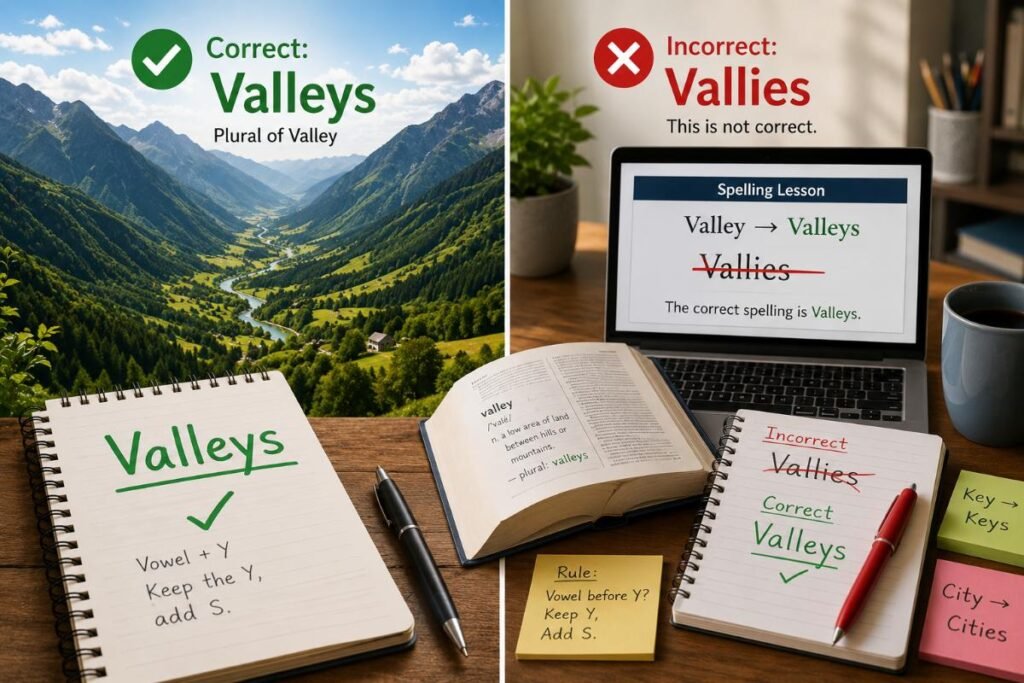
The difference between valley and valleys is simply the number of places you’re talking about. Use valley for one low area between hills or mountains. Use valleys for two or more.
For example, you could say, The valley is surrounded by tall mountains. The sentence describes one specific area. If you say, The valleys are surrounded by tall mountains, you’re talking about several different low areas.
This singular and plural difference is easy to overlook because the two forms look almost identical. The only change is the s at the end. Still, that small letter changes the meaning of the sentence.
Singular Examples
Use valley when one place is involved.
- The valley looks beautiful after the rain.
- A small river runs through the valley.
- The village sits at the bottom of the valley.
- We could see the entire valley from the mountain.
- Snow covered the valley during the winter.
Each sentence refers to one valley.
Plural Examples
Use valleys when you’re talking about more than one.
- The mountain range contains several valleys.
- Heavy snow covered the valleys below.
- The hikers explored three valleys during their trip.
- Rivers flow through many of the valleys in this region.
- The road connects several valleys.
The plural form doesn’t require any special spelling change. Just add s to valley.
Examples That Show The Difference
Sometimes the easiest way to understand a spelling rule is to see two similar sentences side by side.
Consider these examples.
The valley is surrounded by forests.
This means one valley is surrounded by forests.
The valleys are surrounded by forests.
This means several valleys are surrounded by forests.
Now look at another pair.
A river flows through the valley.
Only one valley is being discussed.
Several rivers flow through the valleys.
The sentence refers to multiple valleys.
Here’s another useful example.
The farmer owns land in the valley.
The farmer has land in one particular valley.
The farmers own land in several valleys.
Now the sentence refers to more than one valley.
These examples show why choosing the right form matters. A spelling mistake can sometimes change the meaning of a sentence. In this case, the difference is small but clear.
Words That Follow The Same Spelling Pattern
The rule behind valleys isn’t unique. Many English words ending in a vowel plus y form their plural by simply adding s.
Consider these examples.
- Key becomes keys.
- Boy becomes boys.
- Toy becomes toys.
- Day becomes days.
- Journey becomes journeys.
- Donkey becomes donkeys.
- Monkey becomes monkeys.
- Birthday becomes birthdays.
The same pattern appears in valley.
The final part is ey. The e is a vowel, so the y stays in place when the noun becomes plural.
This is useful because you can apply the same idea to unfamiliar words. You don’t have to memorize every plural separately. Looking at the letter before the final y often gives you the answer.
Words That Change Y To Ies
Now compare those words with nouns that end in a consonant plus y.
- City becomes cities.
- Baby becomes babies.
- Family becomes families.
- Story becomes stories.
- Country becomes countries.
- Party becomes parties.
- Library becomes libraries.
- Puppy becomes puppies.
Here the letter before y is a consonant. The plural spelling changes y to ies.
This is the main reason vallies looks tempting. It resembles the correct plural pattern for words such as city and family. But valley belongs to a different group.
The spelling rule is based on the letter before the y, not simply on the fact that the word ends in y.
A Quick Test For Y Endings
When you see a noun ending in y, don’t automatically change the y to ies. First check the letter directly before it.
Ask yourself one simple question.
Is the letter before y a vowel or a consonant?
If it’s a vowel, normally keep the y and add s.
For example:
- Valley becomes valleys.
- Day becomes days.
- Key becomes keys.
- Boy becomes boys.
If it’s a consonant, normally change y to ies.
For example:
- City becomes cities.
- Baby becomes babies.
- Story becomes stories.
- Family becomes families.
This quick test works for many common nouns and can save you from a lot of unnecessary spelling mistakes.
Why Vallies Looks Right At First
There’s a reason people often type vallies even though it isn’t correct. The spelling looks familiar because English has many words that use the ies ending in their plural forms.
Think about these common words:
- City.
- Country.
- Family.
- Party.
- Story.
- Company.
Their plural forms are cities, countries, families, parties, stories, and companies.
If you already know that rule, your brain may try to apply it to valley. That makes vallies feel logical.
The problem is that English spelling rules often depend on small details. In this case, the e before the y changes the pattern.
It’s a bit like sorting objects into two boxes. Words ending in consonant plus y go into one box. Words ending in vowel plus y go into another. Valley belongs in the second box.
Once you notice the ey ending, the correct plural becomes much easier to remember.

Common Sentences With Valleys
The plural form appears often in travel writing, geography, nature articles, news reports, and everyday descriptions.
Here are some natural examples.
The valleys are green after the spring rains.
This sentence describes more than one low area.
Several valleys surround the small mountain town.
The word several clearly tells us that the plural form is needed.
The road winds through the valleys before reaching the coast.
Again, more than one valley is involved.
Farmers in the valleys grow fruit and vegetables.
The sentence describes farmers living or working in multiple valleys.
The valleys become colder after sunset.
The plural form works because the sentence refers to multiple areas.
These examples can help you recognize the correct spelling when you’re writing your own sentences.
Valleys In Travel Writing
You’ll often see the plural form in travel articles because mountain regions can contain many low areas. Writers may describe the scenery, roads, rivers, towns, hiking trails, and views found across several valleys.
For example, a travel writer might say:
- The region is known for its green valleys and snow covered peaks.
- Visitors can hike through several valleys in one day.
- Small villages are scattered throughout the valleys.
- The winding road offers views of the valleys below.
These sentences sound natural because the word describes multiple geographical areas.
If a travel article describes only one location, the singular form is used instead.
- The village sits in a peaceful valley.
- The trail follows the river through the valley.
- Visitors can see the valley from the old bridge.
The number of places determines the form.
Valleys In Geography
Geography is another area where this word appears frequently. A valley can form through erosion caused by rivers, glaciers, or other natural forces. Some valleys are narrow and steep, while others are broad and open.
A river valley often develops around a flowing river. A glacial valley may have a broad shape caused by the movement of ice over a long period.
When geographers discuss several landforms, they use valleys.
For example:
- Rivers have shaped many valleys over thousands of years.
- Glaciers carved deep valleys through the mountains.
- The region contains narrow valleys and high ridges.
- Several valleys meet near the northern part of the range.
The spelling stays the same regardless of the type of valley.
Valleys In Everyday Writing
You don’t have to be writing a geography report to use the word. It appears in many everyday contexts.
A person might write about a road trip and say:
- We drove through three valleys before reaching the lake.
A photographer might describe a trip like this:
- The morning light made the valleys look golden.
A farmer might say:
- The valleys are good places to grow crops because the soil is rich.
A local resident might explain:
- The nearby valleys are popular with hikers.
The word is useful because it describes both a physical landform and a place where people live, work, travel, and explore.
Can Vallies Ever Be Correct
For the standard English word meaning more than one valley, vallies is not the correct spelling. If you’re writing about geographical landforms, use valleys.
You may occasionally encounter unusual spellings in names, usernames, historical texts, or other special contexts. A proper name can have its own spelling, so an unusual form in a name doesn’t automatically follow the normal English spelling rules.
That doesn’t change the standard plural form. In ordinary English writing, the correct word is valleys.
If you’re writing an essay, article, school assignment, travel guide, report, or email, choose valleys when you mean more than one valley.
Memory Tricks That Actually Work
A good memory trick should be short enough to recall when you’re writing. You don’t need a complicated rhyme or a long grammar lesson.
Try this one:
Valley has ey, so keep the y.
The e before the y tells you to add s instead of changing y to ies.
You can also compare the word with city.
City → cities.
Valley → valleys.
Why are they different? Look at the letter before the y.
City has ty. The t is a consonant.
Valley has ey. The e is a vowel.
That one comparison can make the rule stick.
Another useful trick is to say the plural slowly.
Valleys.
You can hear the word still contains the sound and spelling of valley. You’re simply adding an s at the end.
A Simple Spelling Check
If you’re writing quickly and suddenly wonder how to spell the plural, don’t try to remember the whole word from scratch.
Start with the singular form.
Valley.
Then ask how many you’re talking about.
If it’s one, use valley.
If it’s more than one, add s.
Valley + s = valleys.
This method is simple because it removes the temptation to change the spelling in the middle of the word.
It also works well when you’re proofreading. If you see vallies, stop and check the singular form. Once you see that the base word is valley, the correct plural is obvious.
Related Spelling Questions
People often confuse words that follow different plural rules. Understanding a few related examples can make the pattern much clearer.
Valley And City
These two words are a useful pair to compare.
City becomes cities because the final y follows a consonant.
Valley becomes valleys because the final y follows a vowel.
This is probably the most useful comparison for remembering the rule.
Valley And Family
The word family becomes families. It follows the consonant plus y pattern.
The word valley becomes valleys. It follows the vowel plus y pattern.
Even though the words look similar at the end, their plural forms are different.
Valley And Journey
Both words keep their y when they become plural.
Journey becomes journeys.
Valley becomes valleys.
In both words, a vowel comes before the final y.
These comparisons show that English spelling becomes much easier when you look for patterns instead of memorizing isolated words.
Why Correct Spelling Matters
A single spelling mistake may seem harmless, but repeated mistakes can affect how readers view your writing. In school or professional work, incorrect spelling can make otherwise strong writing look rushed.
The good news is that this particular mistake is easy to prevent. Once you understand why valleys keeps the y, you don’t have to rely on memory alone.
Correct spelling also makes your meaning clear. When you’re describing mountains, rivers, hiking routes, or places, readers should be able to focus on the information rather than stopping over a spelling error.
That is especially useful for websites and other published content. A clean spelling style builds trust with readers and makes the writing easier to read.
FAQs
Is vallies or valleys correct?
Valleys is correct when you mean more than one valley. Vallies is not the standard plural spelling.
Why is valley pluralized as valleys?
The word valley ends with a vowel followed by y. Words with this ending normally keep the y and add s to form the plural. That’s why valley becomes valleys.
Is vallies a real word?
Vallies is not the standard plural form of valley. You may find it as an unusual name or other special spelling, but ordinary English uses valleys for the plural.
What is the plural of valley?
The plural of valley is valleys. The spelling does not change inside the word. Simply add s to the singular form.
Why does city become cities but valley become valleys?
The letter before the final y determines the spelling pattern. City has a consonant before y, so it becomes cities. Valley has a vowel before y, so it becomes valleys.
How do you remember the spelling of valleys?
Remember this simple rule: Valley has ey, so keep the y. Since e is a vowel, you keep the final y and add s.
What is the difference between valley and valleys?
Valley means one low area between hills or mountains. Valleys means two or more such areas.
Final Thoughts
The answer to vallies or valleys is clear. The correct plural spelling is valleys. You don’t change the final y to ies because the letter before the y is the vowel e.
The easiest rule to remember is to check the letter before the final y. A consonant often leads to ies, as in city to cities. A vowel usually means you keep the y and add s, as in valley to valleys.
Once you know that pattern, this spelling error becomes much easier to avoid. If you’re talking about one low area, write valley. If you’re talking about two or more, write valleys.
When you’re proofreading, use the singular word as your starting point. Write valley, add s, and you have valleys. That’s the quick check you can use every time you need the plural form.