
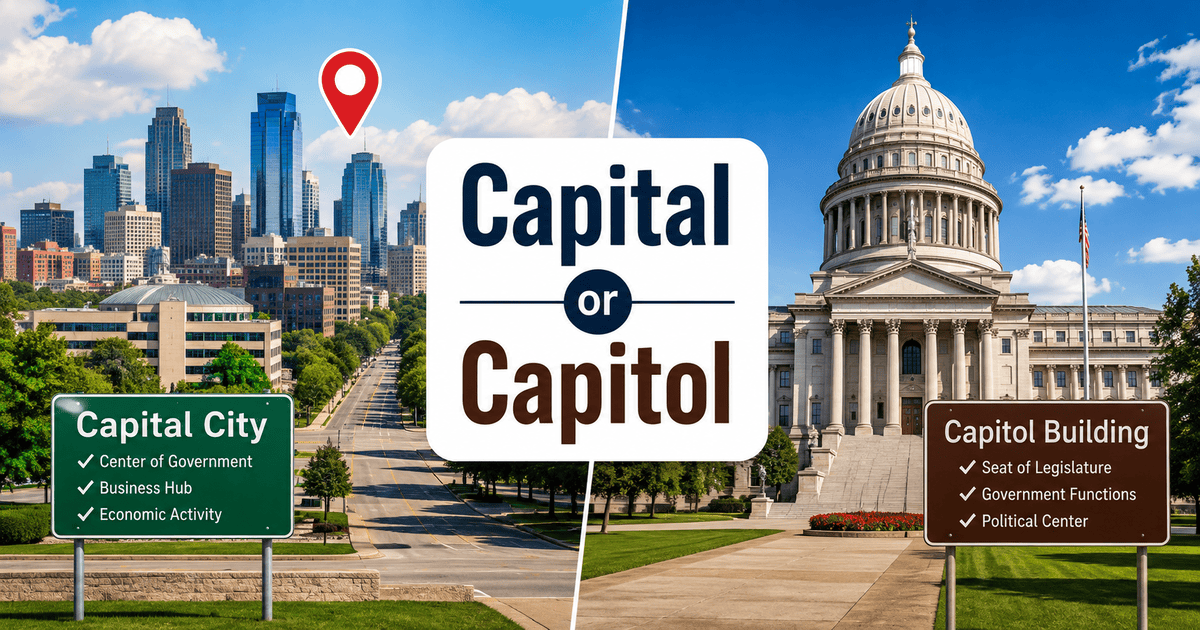
If you’re stuck choosing between capital or capitol, here’s the simple rule: capital is the word you need almost every time. It can mean a city, an uppercase letter, or money and resources. Capitol refers only to the building where a legislature meets, such as the United States Capitol in Washington, DC.
It is an easy mistake to make because the two words sound exactly alike. They are homophones, which means they have the same pronunciation but different meanings and spellings. Spellcheck may not catch the mistake because both words are correct English words.
This guide explains the difference in plain English. You’ll learn what each word means, why people confuse them, simple ways to remember the correct spelling, and plenty of real examples you can use with confidence.
By the end, you’ll know exactly which word belongs in every situation.
Quick Definition
Capital has several meanings. It most commonly refers to the main city of a country or state, but it can also mean an uppercase letter or money used for business and investment.
Capitol has only one meaning. It is the building where lawmakers meet to create laws.
Direct Answer
Use “capital” for cities, uppercase letters, money, wealth, or anything considered most important. Use “capitol” only when talking about a legislative building where elected officials meet.
Capital vs Capitol Comparison
| Word | Meaning | Example Sentence | When to Use It |
|---|---|---|---|
| Capital | Main city, uppercase letter, money, or something important | Austin is the capital of Texas. | Use for cities, finance, grammar, and importance. |
| Capitol | A building where lawmakers meet | The visitors toured the state capitol. | Use only for legislative buildings. |
Why People Mix Up These Words
The confusion comes down to one simple fact. The two words sound exactly alike.
When people hear someone say the word, they cannot tell which spelling is correct without knowing the meaning. That makes capital and capitol one of the most commonly confused word pairs in English.
Another reason is that both words sometimes appear in news stories about government. You might read about the capital city of a state in one sentence and the state capitol building in the next. Since both words relate to government, many people assume they mean the same thing.
They do not.
Think of it this way:
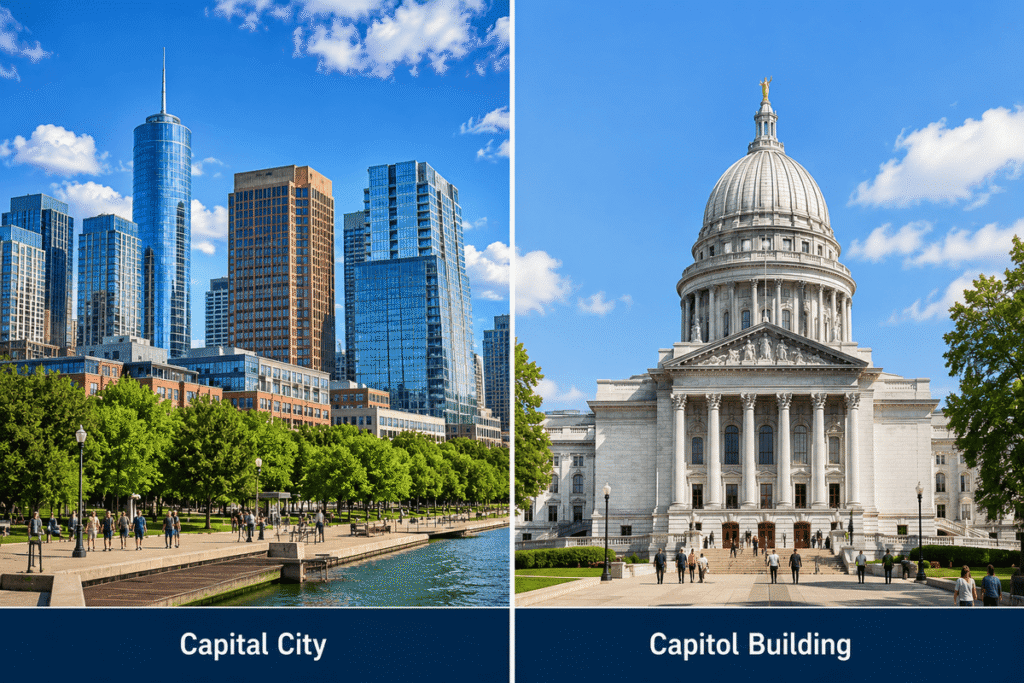
- Every state has a capital city.
- Every state also has a capitol building.
For example:
- Sacramento is the capital of California.
- The California State Capitol is located in Sacramento.
Both words belong in the same conversation, but they describe different things.
What Does Capital Mean?
The word capital has several meanings. Context tells you which one is being used.
Capital as the Main City
This is the meaning most people learn first.
A capital is the city where a country’s or state’s government is based. Important government offices are usually located there.
Examples:
- Washington, DC is the capital of the United States.
- Ottawa is the capital of Canada.
- Paris is the capital of France.
- Tallahassee is the capital of Florida.
- Albany is the capital of New York.
Notice that these examples refer to cities, not buildings.
Capital City Does Not Always Mean Largest City
Many people assume the capital must also be the biggest city. That is not always true.
For example:
- New York City is much larger than Albany.
- Sydney is larger than Canberra.
- Toronto is larger than Ottawa.
Governments choose capital cities for many historical, political, or geographic reasons.
Capital as an Uppercase Letter
In writing, a capital is a large version of a letter.
Examples:
- Begin the sentence with a capital letter.
- Don’t forget the capital A.
- Every proper noun starts with a capital letter.
Teachers often remind students to use capital letters at the beginning of sentences and for names of people, countries, and places.
Capital in Finance
The word also refers to money or other resources used to start or grow a business.
Examples:
- The company raised enough capital to expand.
- Investors provided additional capital.
- Small businesses often need extra capital during their first year.
Here, capital means financial resources instead of a city.
Capital as Something Most Important
Sometimes the word describes something of great importance.
Examples:
- Safety is our capital concern.
- Time is one of your greatest forms of capital.
- Trust is valuable social capital.
This meaning appears often in business, education, and economics.
What Does Capitol Mean?
Unlike capital, the word capitol has only one definition.
It refers to a building where lawmakers meet to debate, vote, and pass laws.
That is all.
If you remember this single meaning, you’ll avoid almost every spelling mistake.
Examples include:
- The United States Capitol.
- The Texas State Capitol.
- The Colorado State Capitol.
- The Arizona State Capitol.
Each of these is a physical building.
The United States Capitol
The best-known example is the United States Capitol in Washington, DC.
It is where Congress meets.
The Senate meets in one wing of the building.
The House of Representatives meets in another wing.
Many visitors tour the Capitol every year because it is one of the country’s most recognizable landmarks.
Notice something interesting.
Washington is the nation’s capital.
The Capitol is one building inside that capital city.
That simple comparison helps many people remember the difference.
State Capitols
Every U.S. state has its own capitol building.
Examples:
- The Illinois State Capitol stands in Springfield.
- The Georgia State Capitol is in Atlanta.
- The Utah State Capitol overlooks Salt Lake City.
- The Nebraska State Capitol has a unique tower instead of a dome.
Each building houses part or all of the state’s legislature.
The building is the capitol.
The city is the capital.
The Biggest Difference to Remember
Many grammar mistakes disappear once you remember this one sentence.
A capital is usually a city. A capitol is always a building.
If you are talking about:
- a country
- a state
- a government city
- money
- uppercase letters
- importance
use capital.
If you are talking about the building where lawmakers meet, use capitol.
Nothing else uses the spelling capitol.
Side by Side Examples
Reading examples is one of the fastest ways to lock the rule into your memory.
Correct:
- Denver is the capital of Colorado.
- We visited the Colorado State Capitol.
- Tokyo is Japan’s capital.
- The capitol building attracts thousands of tourists.
- Please write your name using capital letters.
- The startup secured enough capital to hire new employees.
Incorrect:
- Denver is the capitol of Colorado.
- We drove to the capital building.
- Use capitol letters.
- The company needs more capitol to grow.
Each incorrect sentence uses the wrong spelling because the meaning does not match.
Why Spellcheck Doesn’t Always Catch the Error
One frustrating part of this word pair is that both spellings are valid English words.
Spellcheck usually looks for words that do not exist.
Since capital and capitol both exist, your computer often cannot tell that you’ve chosen the wrong one.
Grammar tools sometimes notice the context, but they are not perfect.
That is why understanding the meaning matters more than relying on software.
Common Situations Where People Choose the Wrong Word
Some situations cause confusion more often than others.
Talking About Government
News articles often mention both words in the same paragraph.
For example:
“The governor returned to the capital after speaking at the capitol.”
Both spellings are correct because one refers to the city and the other refers to the building.
Writing School Reports
Students frequently write about states and countries.
Many accidentally write:
“The capitol of Texas is Austin.”
The correct sentence is:
“The capital of Texas is Austin.”
Austin is the city.
The Texas State Capitol is the building located in Austin.
More Real World Examples
Sometimes the easiest way to remember the difference is to see the words used naturally. Here are examples from everyday conversations, news, school, and business.
Correct examples with capital:
- The capital of Italy is Rome.
- Our class learned about every state capital.
- Start every sentence with a capital letter.
- The business needs more capital before it can open another location.
- Education is a country’s greatest human capital.
- The museum is located in the nation’s capital.
Correct examples with capitol:
- The governor gave a speech at the state capitol.
- Thousands of visitors toured the capitol during the summer.
- Security was increased around the capitol before the event.
- The legislature returned to the capitol after the holiday.
- The capitol building is open for guided tours.
Notice how every sentence with capitol talks about a building. None of them refer to a city, money, or grammar.
A Simple Memory Trick That Actually Works
Many memory tricks sound clever but are hard to remember. This one is simple.
Look at the word capitol.
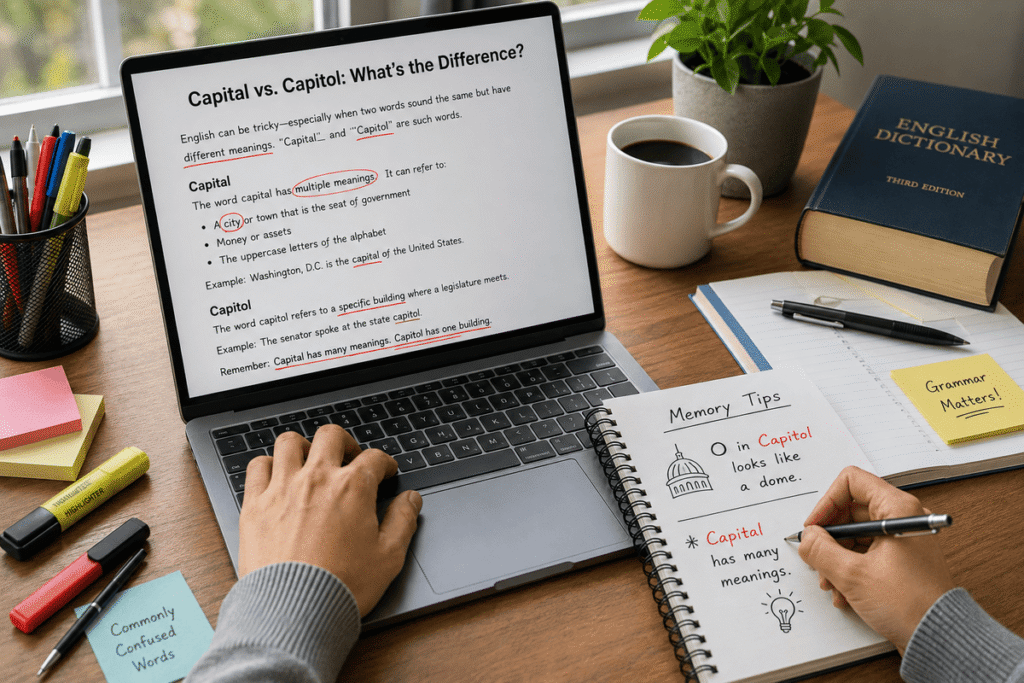
It contains the letter O.
That O looks like the rounded dome found on many capitol buildings.
Think of it like this.
Capitol has an O like a dome.
Now look at capital.
It ends with AL, which can remind you of all the other meanings.
Capital can mean:
- A city.
- An uppercase letter.
- Money.
- Wealth.
- Resources.
- Something important.
So you can remember it this way.
- Capitol equals one building.
- Capital equals almost everything else.
Many teachers use this trick because it is easy to picture in your mind.
Another Way to Remember
Ask yourself one question before you write the word.
Can I walk inside it?
If the answer is yes, you are probably talking about a capitol because it is a building.
If the answer is no, you probably need capital.
For example:
Can you walk inside Washington, DC?
No. It is a city.
Use capital.
Can you walk inside the United States Capitol?
Yes.
Use capitol.
This quick question works surprisingly well.
Common Mistakes People Make
Many writers repeat the same errors. Once you know them, they become much easier to avoid.
Mistake One
Incorrect:
The capitol of Canada is Ottawa.
Correct:
The capital of Canada is Ottawa.
Ottawa is a city, not a building.
Mistake Two
Incorrect:
We visited the capital building.
Correct:
We visited the capitol building.
The sentence refers to the government building.
Mistake Three
Incorrect:
Please write your answer in capitol letters.
Correct:
Please write your answer in capital letters.
Uppercase letters always use capital.
Mistake Four
Incorrect:
The company needs more capitol to expand.
Correct:
The company needs more capital to expand.
Money and business resources use capital.
Mistake Five
Incorrect:
The state built a new capital downtown.
Correct:
The state built a new capitol downtown.
A building is a capitol.
Capital Has More Than One Meaning
One reason this word pair causes trouble is that capital wears many hats.
English often gives one word several meanings. The meaning depends on the sentence.
Here are the most common uses.
Capital City
The city where the government is based.
Example:
Madrid is the capital of Spain.
Capital Letter
An uppercase letter.
Example:
Always capitalize the first word in a sentence by using a capital letter.
Financial Capital
Money used for business.
Example:
The entrepreneur raised enough capital to launch the company.
Human Capital
The knowledge, education, and skills that people bring to work.
Example:
Training employees increases human capital.
Political Capital
Influence that helps leaders achieve their goals.
Example:
The mayor spent political capital to pass the new law.
You do not need to memorize every definition. Just remember that capital has many meanings, while capitol has only one.
Capital in Place Names
Many official names include the word capital.
Examples include:
- Capital Region.
- Capital City Airport.
- Capital District.
- National Capital Area.
- Capital Improvement Plan.
These names refer to the city or something connected with it.
They do not refer to legislative buildings.
Capitol in Official Names
Many government buildings officially include the word Capitol in their names.
Examples:
- United States Capitol.
- Texas State Capitol.
- California State Capitol.
- Florida State Capitol.
- Wisconsin State Capitol.
Since these are proper names, Capitol is usually capitalized.
Does Every Country Have a Capitol?
Every country has a capital city because every country has a seat of government.
Many countries also have a parliament or legislative building.
Some countries call that building a parliament, national assembly, congress, or another official name instead of a capitol.
In American English, the word capitol is used mainly for the United States Capitol and state capitol buildings.
Outside the United States, people often use the building’s official name instead.
The History Behind the Words
These words share the same origin but developed different meanings over time.
Both come from the Latin word caput, meaning head.
From that idea came words connected with leadership, importance, and government.
The word capital eventually became linked to the chief city of a country or region because it was considered the head of government.
It also became associated with wealth and important resources.
The word capitol came from the Capitoline Hill in ancient Rome.
Important government buildings stood there, and the name later became associated with legislative buildings.
That historical connection explains why the spellings are similar but the meanings are different.
Similar Word Pairs That Cause Confusion
If you confuse capital and capitol, you are not alone.
English has many word pairs that sound alike but have different meanings.
Here are a few common examples.
Principal and Principle
Principal usually means the head of a school or the main person or thing.
Principle means a rule, belief, or moral standard.
Affect and Effect
Affect is usually a verb that means to influence.
Effect is usually a noun that means a result.
Stationary and Stationery
Stationary means not moving.
Stationery means paper, envelopes, and other writing supplies.
Compliment and Complement
A compliment is praise.
A complement is something that completes or goes well with something else.
Learning these word pairs helps improve your writing because they depend on meaning instead of pronunciation.
Practice Quiz
Try these questions before checking the answers.
- Paris is the ______ of France.
- We toured the state ______ during our vacation.
- The company needs more ______ to hire new workers.
- Please write your full name in ______ letters.
- The governor returned to the ______ after speaking inside the ______.
Answers:
- capital
- capitol
- capital
- capital
- capital, capitol
If you answered all five correctly, you already understand the difference that trips up many writers.
Tips for Never Mixing Them Up Again
The rule becomes easy once you practice it a few times.
Keep these tips in mind.
- Remember that capitol always means a government building.
- Remember that capital has several different meanings.
- Think about the dome-shaped O in capitol.
- Ask yourself if you are talking about a city or a building.
- Read your sentence aloud and picture the object you are describing.
- Do not depend only on spellcheck because both words are correctly spelled.
After a little practice, choosing the right spelling becomes automatic.
FAQs
Is it capital or capitol city?
The correct phrase is capital city. A capital is the main city where a country’s or state’s government is based. A capitol is the building where lawmakers meet, so it cannot replace the word city.
Why do capital and capitol sound the same?
They are homophones, which means they are pronounced the same but have different meanings and spellings. English has many homophones, which is why context is important when choosing the correct word.
Is the White House the Capitol?
No. The White House and the United States Capitol are different buildings with different purposes. The White House is where the President lives and works. The United States Capitol is where Congress meets to make federal laws.
Why is Capitol spelled with an O?
The spelling comes from the Capitoline Hill in ancient Rome, where important government buildings once stood. Over time, the word became associated with legislative buildings, and the spelling remained the same.
Is every government building called a capitol?
No. The word capitol is mainly used for legislative buildings where lawmakers meet. Other government buildings, such as city halls, courthouses, and executive offices, are not called capitols.
Can capital mean money?
Yes. In business and economics, capital means money or other resources used to start, run, or grow a business. This meaning has nothing to do with cities or government buildings.
Why doesn’t spellcheck catch this mistake?
Spellcheck checks spelling, not meaning. Since both capital and capitol are real English words, your computer may not recognize that you’ve chosen the wrong one for the sentence.
What is the easiest way to remember the difference?
Picture the O in capitol as the dome on a government building. If you’re talking about a building where lawmakers meet, choose capitol. For every other meaning, use capital.
Conclusion
Knowing the difference between capital or capitol is much easier than it first appears. The key is to focus on what you’re describing instead of how the word sounds. If you’re talking about a city, an uppercase letter, money, or something important, the correct spelling is capital. If you’re talking about the building where lawmakers meet, the correct spelling is capitol.
A simple way to remember the rule is that capitol has one job and one meaning. It refers only to a legislative building. Capital, on the other hand, does the heavy lifting. It can describe a nation’s main city, business funding, capital letters, or something of great importance.
The next time you stop to think about capital or capitol, ask yourself one question. Am I talking about a city or a building? If it’s a building where lawmakers meet, choose capitol. In almost every other situation, capital is the right choice.
With that one rule in mind, you’ll avoid one of the most common spelling mistakes in English and write with confidence every time.