
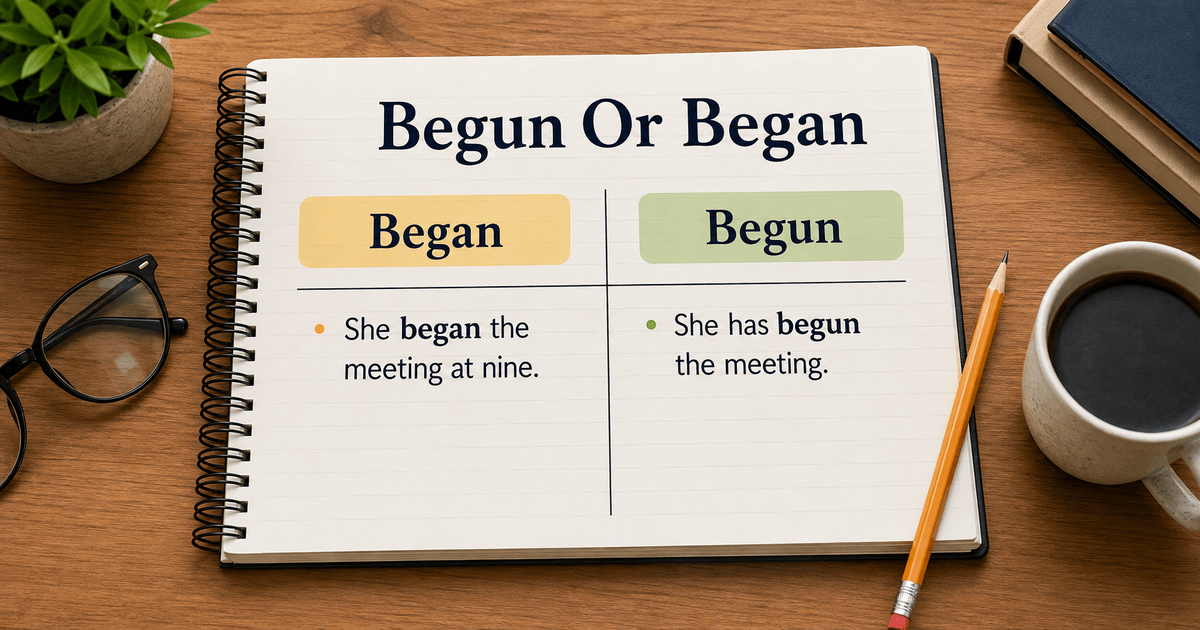
If you have ever stopped to ask begun or began, you are not alone. These two words come from the same verb, but they are not interchangeable. Began is the simple past tense of begin. Begun is the past participle and must be used with a helping verb such as has, have, or had.
Many people mix them up because both words refer to something that started in the past. The difference is not about meaning. It is about grammar. Once you understand how each form works, choosing the correct one becomes surprisingly easy.
This mistake appears everywhere. Students make it in school assignments. Professionals sometimes use the wrong form in emails. Even native English speakers stop and think before writing these words because they sound so similar.
This guide explains the difference in plain English. You will learn the grammar behind each word, see plenty of real examples, avoid common mistakes, and pick up a few simple tricks that make the rule easy to remember.
Quick Definition
Began is the simple past tense of the verb begin. Use it when you are talking about something that started in the past.
Begun is the past participle of begin. It must be used with a helping verb such as has, have, had, or had been.
Direct Answer
Use began when no helping verb comes before it.
Use begun only after a helping verb like has, have, or had.
Comparison Table
| Word | Meaning | Example Sentence | When To Use It |
|---|---|---|---|
| Began | Simple past tense of begin. | She began reading after dinner. | A completed action in the past without a helping verb. |
| Begun | Past participle of begin. | She has begun reading the new book. | After has, have, had, or another helping verb. |
Why People Mix Up Began And Begun
At first glance, these words seem almost identical. They both come from the verb begin, and both refer to something that started in the past. That is why so many people assume they can replace one with the other.
English does not work that way. Many common verbs have more than one past form. One form is the simple past tense, while the other is the past participle. Each has its own job, and using the wrong one creates a grammar mistake.
Think about the verb eat. You would naturally say, I ate breakfast this morning. You would never say, I eaten breakfast this morning. Instead, you would say, I have eaten breakfast.
The same pattern applies here.
- Begin.
- Began.
- Begun.
Once you recognize this pattern, the difference becomes much easier to remember.
Understanding The Three Forms Of Begin
Every English verb has different forms. Some verbs follow a simple pattern by adding ed, while others change completely. The verb begin belongs to the second group because it is an irregular verb.
Here are its three main forms.
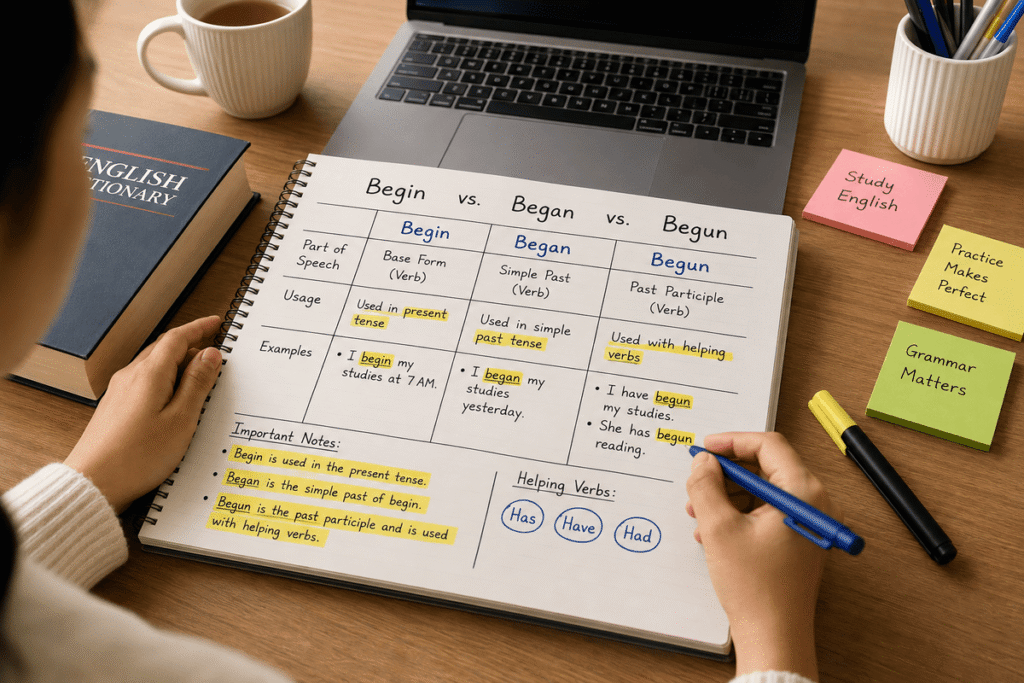
| Verb Form | Word | Example |
|---|---|---|
| Base form | Begin | I begin work at eight every morning. |
| Simple past | Began | I began work at eight yesterday. |
| Past participle | Begun | I have begun my new job. |
Learning these three forms together is much easier than memorizing each one separately. Once they become familiar, you will know which word belongs in almost every sentence.
When To Use Began
Use began when you are talking about something that started and happened at a specific time in the past. This form does not need a helping verb.
Look at these examples.
- The meeting began at nine o’clock.
- Our vacation began on Monday.
- She began learning Spanish last year.
- It began raining during the afternoon.
- They began building the house in May.
Each sentence tells you about an action that started in the past. Notice that began stands on its own without has, have, or had.
This is the biggest clue. If there is no helping verb before it, began is usually the correct choice.
Common Time Words That Go With Began
The simple past often appears with words that point to a finished time.
For example.
- Yesterday.
- Last night.
- Last week.
- In 2024.
- Two hours ago.
- This morning.
Look at these sentences.
- The concert began two hours ago.
- School began last Tuesday.
- The storm began during the night.
- My interest in photography began when I was a teenager.
These time expressions show that the action happened at a definite point in the past, making began the natural choice.
When To Use Begun
Begun works differently. It cannot stand alone as the main verb. It always needs a helping verb before it.
Some of the most common helping verbs are:
- Has.
- Have.
- Had.
- Has been.
- Have been.
- Had been.
Now compare these examples.
- She has begun her new project.
- We have begun preparing for the exam.
- The workers had begun repairing the bridge before sunrise.
- The movie has just begun.
- They had already begun eating when we arrived.
Notice the pattern. Every sentence includes a helping verb before begun. That pattern never changes.
A quick way to check yourself is to cover the helping verb with your hand. If begun is left standing alone, the sentence usually sounds wrong. That simple test catches many grammar mistakes before they happen.
A Side By Side Comparison
Sometimes the easiest way to understand grammar is to compare two sentences.
Correct
- The game began at seven.
Correct
- The game has begun.
The first sentence simply tells you when the game started. The second tells you that the game is now underway because it uses the present perfect tense.
Here is another example.
Correct
- She began writing her novel in college.
Correct
- She has begun writing her second novel.
The first sentence focuses on a completed point in the past. The second connects the action to the present by using a helping verb.
As you continue reading, you will notice that this pattern stays consistent. Once you learn to spot the helping verb, choosing the correct word becomes much easier.
Common Mistakes People Make
Most mistakes happen because people know the meanings of began and begun, but they forget which verb form belongs in the sentence. Once you know what to watch for, these errors become easy to spot.
Using Begun Without A Helping Verb
This is the most common mistake.
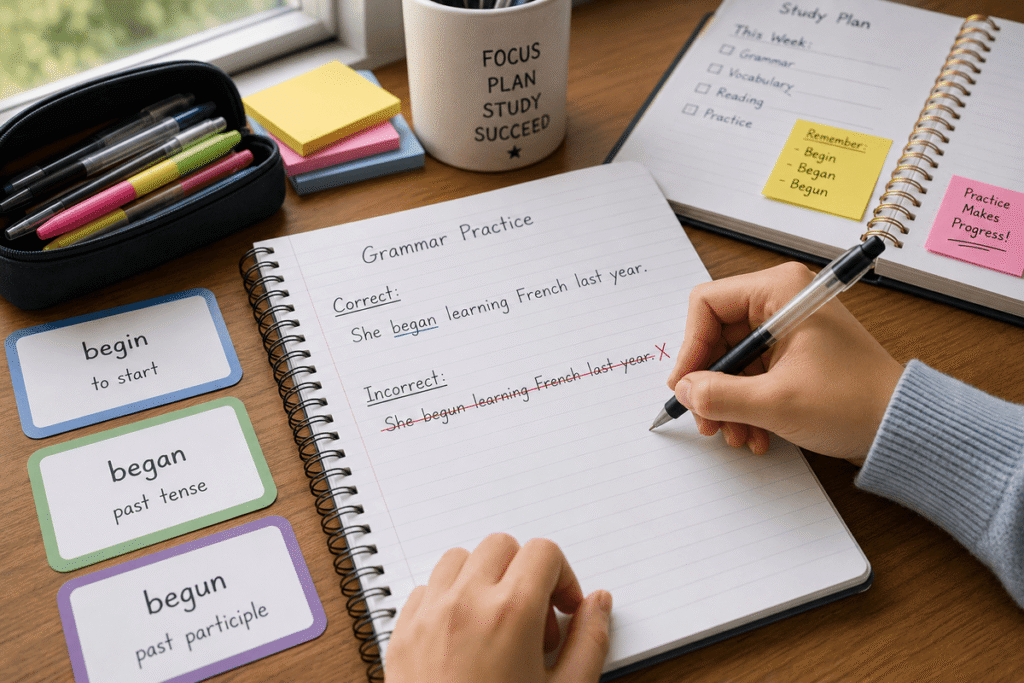
❌ She begun her homework after dinner.
The sentence is missing a helping verb, so begun cannot be used.
✔ She began her homework after dinner.
Now compare it with a correct sentence that includes a helping verb.
✔ She has begun her homework.
The helping verb changes everything. Without it, begun is incorrect.
Using Began After Has Have Or Had
People often make the opposite mistake by using began after a helping verb.
❌ They have began working on the project.
The helping verb requires the past participle.
✔ They have begun working on the project.
Another example.
❌ The meeting had began before I arrived.
✔ The meeting had begun before I arrived.
Whenever you see has, have, or had, stop for a second. The next verb should almost always be begun, not began.
Forgetting The Verb Pattern
English has many irregular verbs that follow a similar pattern.
Compare these examples.
| Base Verb | Simple Past | Past Participle |
|---|---|---|
| Begin | Began | Begun |
| Drink | Drank | Drunk |
| Sing | Sang | Sung |
| Ring | Rang | Rung |
| Swim | Swam | Swum |
Learning these verbs together makes them much easier to remember. Once you understand one pattern, the others often feel familiar.
Easy Ways To Remember The Difference
Grammar becomes much simpler when you have a memory trick.
The easiest one is this.
No helping verb means began.
Helping verb means begun.
That short rule works in most situations.
Another trick is to think of begun as part of a team. It never likes working alone. It always wants a helping verb beside it.
Has begun.
Have begun.
Had begun.
On the other hand, began is independent. It can stand on its own without any extra help.
The more examples you read, the more natural this difference becomes.
Real Life Examples
Looking at complete sentences helps you hear the difference.
Examples With Began
- The movie began exactly at seven.
- Our trip began with a long drive through the mountains.
- She began practicing the piano when she was six years old.
- The company began as a small family business.
- It began snowing before sunrise.
Each sentence describes an action that started at a specific point in the past.
Examples With Begun
- We have begun planning our vacation.
- She has begun learning Japanese.
- The construction crew had begun repairing the road before dawn.
- They have just begun discussing the proposal.
- By the time we arrived, the concert had already begun.
Notice how every sentence includes a helping verb before begun.
Began In Different Verb Tenses
The simple past is only one part of English grammar. Understanding where began fits makes it easier to avoid mistakes.
Simple Past
Use began for an action that happened and started in the past.
- The class began at nine.
- It began raining after lunch.
Past Continuous
The simple past can also appear with another ongoing action.
- It began snowing while we were driving.
- She began laughing as everyone watched.
Simple Storytelling
Writers often use began to move a story forward.
For example.
The lights went out without warning. A few seconds later, everyone heard footsteps outside. Then someone began knocking on the front door.
This sounds natural because the story describes events as they happened.
Begun In Different Verb Tenses
The past participle appears in several tenses.
Present Perfect
Use has begun or have begun for something connected to the present.
- The game has begun.
- We have begun decorating the house.
Past Perfect
Use had begun when one past action happened before another.
- The movie had begun before we found our seats.
- They had begun eating when we arrived.
Passive Voice
Sometimes begun appears in passive constructions.
- The project has been begun by the new manager.
This sentence is grammatically correct, but native speakers usually prefer an active version.
- The new manager has begun the project.
Active voice almost always sounds clearer and more natural.
Expressions That Use Begin
The verb begin appears in many everyday expressions. Learning these phrases helps you become more comfortable with all its forms.
Here are some common examples.
- Begin again.
- Begin from scratch.
- Begin with confidence.
- Begin a conversation.
- Begin a journey.
- Begin a new chapter.
- Begin work.
- Begin school.
- Begin training.
- Begin a project.
Each phrase follows the same grammar rules. The only thing that changes is the verb form.
For example.
- We began a new chapter in our lives.
- We have begun a new chapter in our lives.
The structure changes, but the meaning stays almost the same.
Why Native Speakers Still Make This Mistake
You might expect native English speakers to get this right every time. In reality, they do not.
Irregular verbs are learned through habit instead of simple rules. Since began and begun sound alike and share the same meaning, people occasionally choose the wrong form while speaking or typing quickly.
Autocorrect can make the problem even worse. It may fix spelling but cannot always recognize incorrect grammar.
That is why you will sometimes see mistakes in emails, social media posts, or even published articles. The error is common, but it is still an error.
The good news is that this is one of the easiest grammar mistakes to fix. Simply look for a helping verb. If you find one, begun is usually the correct choice. If there is no helping verb, began is probably the word you need.

FAQs
Is begun or began correct?
The answer depends on the sentence. Use began as the simple past tense without a helping verb. Use begun only after helping verbs like has, have, or had.
Can I say had began?
No. Had began is incorrect because had must be followed by the past participle.
✔ She had begun studying before dinner.
Is has began correct?
No. The correct form is has begun.
Remember that has, have, and had always take the past participle.
Why do people confuse began and begun?
Both words come from the verb begin, and both refer to actions that started in the past. The difference is grammatical, not based on meaning, so they are easy to mix up.
Is begun a real word?
Yes. Begun is the past participle of begin. It has been part of English for centuries and is completely correct when used with a helping verb.
How can I remember the difference?
A simple trick works well.
If there is has, have, or had, use begun.
If there is no helping verb, use began.
Which word should I use in formal writing?
The same grammar rules apply in every type of writing. Formal English expects began as the simple past and begun as the past participle. Following that rule makes your writing clear and professional.
Final Thoughts
The question of begun or began becomes much easier once you understand the job each word performs. Began is the simple past tense that stands on its own. Begun is the past participle that always works with a helping verb.
Instead of trying to memorize dozens of examples, focus on one simple question. Does the sentence contain has, have, or had? If the answer is yes, begun is almost certainly the right choice. If no helping verb appears, began is usually correct.
This small grammar rule appears in everyday conversations, school assignments, business emails, books, and news articles. Learning it now will improve both your writing and your confidence.
The next time you pause before typing one of these words, you will not have to guess. Look for the helping verb, choose the correct form, and keep writing with confidence.